Sukhoi Su-30MKI

We have developed plenty of RAM/RAS for MKI. The RAM panel which I posted is supposed to replace entire AI-alloy skin fairings with these composite ones. And AFAIK, these RAM panels use CNT fibremat with baked in stealth to absorb wideband RF waves from 0.1MHz to 60GHz. And we have developed even meta-materials based RAP which almost absorbs 99% RF waves in a wide spectrum.

We are developing all sorts of stuff, but only paint is going on MKI.

You are confusing programs meant for AMCA, Ghatak, and even 6th gen for MKI MLU.

The purpose of MKI MLU is to get basic upgrades in to keep the jet relevant. And the IAF is taking the least risky approach, ie, no changes to the airframe. Even the RAM coating is barely just 50-100 kg in total, so it's not much. The entire program is extremely basic.

We have developed plethora of RAM, RAP & RAS, some even metamaterials based which absorb almost 99% RF waves in a wide spectrum. Used in front of the engine intakes and compressor face, MKI's RCS is going down in order of magnitudes from what it is now. Some of the metamaterial RAP that we have developed is almost a black hole for EM waves.

RAS and MM are for AMCA.
 
Way back in early 2000s, Russians developed specific RAM coatings for inlet fans of old Su-35(Su-27M), which cut its frontal RCS by -10dB to -20dB. Our coatings are not one or two but several generations more advance('Nuff said). Rest, as I said earlier, feel free to disagree👍.

That's physically impossible.

And you read the graph wrong, it says RCS decreased from 15-20 m2 to <5 m2. Which is what has been achieved for Su-35S.

If you want the graph to go lower than that, then the scale has to be much smaller than just jumping from 0 to 10 m2. The smallest value on the graph is 1m2 and all the spikes are well above 1m2.
 
We are developing all sorts of stuff, but only paint is going on MKI.

You are confusing programs meant for AMCA, Ghatak, and even 6th gen for MKI MLU.

The purpose of MKI MLU is to get basic upgrades in to keep the jet relevant. And the IAF is taking the least risky approach, ie, no changes to the airframe. Even the RAM coating is barely just 50-100 kg in total, so it's not much. The entire program is extremely basic.


RAS and MM are for AMCA.
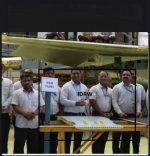
That picture which I presented wasn't of any paint but of a "RAM PANEL". That itself means that stealth of MKI has moved way beyond RAP and has now entered the realms of RAS & CNT RAM PANELS.
That's physically impossible.

And you read the graph wrong, it says RCS decreased from 15-20 m2 to <5 m2. Which is what has been achieved for Su-35S.

If you want the graph to go lower than that, then the scale has to be much smaller than just jumping from 0 to 10 m2. The smallest value on the graph is 1m2 and all the spikes are well above 1m2.
4m2 was frontal average but even within that(with full load of 12 missiles), from some aspects it was around 1-2m2. And that wasn't for Su-35S(T-10BM) but for bort 708 Su-35(T-10M), i.e., the predecessor of current Su-35S. Su-35S has RCS of 0.7m2 when clean from +-60° frontal aspect.

What we will achieve in MKI UPG. is well beyond what the Russians achieved. Even they are further trying to reduce Su-35S' RCS through Su-35SM program.
 
That picture which I presented wasn't of any paint but of a "RAM PANEL". That itself means that stealth of MKI has moved way beyond RAP and has now entered the realms of RAS & CNT RAM PANELS.

RAM panel is RAM paint. The coating is so thick that it looks like it's an attachment, but it's just a thick layer of paint, which is how it's done.

RAM tiles were used on F-117, but pretty much all aircraft just have a thick layer of coating.

4m2 was frontal average but even within that(with full load of 12 missiles), from some aspects it was around 1-2m2. And that wasn't for Su-35S(T-10BM) but for bort 708 Su-35(T-10M), i.e., the predecessor of current Su-35S. Su-35S has RCS of 0.7m2 when clean from +-60° frontal aspect.

What we will achieve in MKI UPG. is well beyond what the Russians achieved. Even they are further trying to reduce Su-35S' RCS through Su-35SM program.

Due to titanium blades that spin, it's physically impossible to get RCS below 0 dB. You need a radar blocker for the inlets, and that cannot be installed on the Su-30MKI.

If it was possible, they would have done it on Su-35 first. All it has is RAM paint, and the Russians are more advanced than India at this.
 
  • Like
Reactions: PhotonVish
RAM panel is RAM paint. The coating is so thick that it looks like it's an attachment, but it's just a thick layer of paint, which is how it's done.
Nah, bro! Radar Absorbent Paint(RAP) is a thin liquid that is sprayed on top of the composite or metallic skin. A Radar Absorbent Panel is a solid structure made of carbon-fibre reinforced epoxy(CFRP) or Carbon-Nanotubes(CNT) which is completely different from a liquid paint.

By which angle you're considering this a RAP or paint is beyond me:

1000045974.jpg

^^By which angle does it look like a Radar Absorbent Paint to you? And what do other members think here? Is it a paint or a solid RAM structure? @_Anonymous_, @Sathya, @YoungWolf, @babablacksheep, @Parthu, @Aniruddha, @marich01, et al
RAM tiles were used on F-117, but pretty much all aircraft just have a thick layer of coating.


Due to titanium blades that spin, it's physically impossible to get RCS below 0 dB. You need a radar blocker for the inlets, and that cannot be installed on the Su-30MKI.

If it was possible, they would have done it on Su-35 first. All it has is RAM paint, and the Russians are more advanced than India at this.
Even the old Russian RAP could reduce the inlet RCS by order of -10dB to -20dB. Su-35S' has got even more advance RAP in its inlet which gives it clean frontal RCS of 0.7m^2. Our solution for MKI is way more advance than what's on Su-35S. Let's leave it here and just agree to disagree👍
 
Did you watch that Vishnu Som/Baghla ADA interview?
For AMCA, they are going for composite panels pre-impregnated with RAMs, rather then coating the whole thing. That is likely backward compatible
 
Nah, bro! Radar Absorbent Paint(RAP) is a thin liquid that is sprayed on top of the composite or metallic skin. A Radar Absorbent Panel is a solid structure made of carbon-fibre reinforced epoxy(CFRP) or Carbon-Nanotubes(CNT) which is completely different from a liquid paint.

By which angle you're considering this a RAP or paint is beyond me:

View attachment 51343

^^By which angle does it look like a Radar Absorbent Paint to you? And what do other members think here? Is it a paint or a solid RAM structure? @_Anonymous_, @Sathya, @YoungWolf, @babablacksheep, @Parthu, @Aniruddha, @marich01, et al

Even the old Russian RAP could reduce the inlet RCS by order of -10dB to -20dB. Su-35S' has got even more advance RAP in its inlet which gives it clean frontal RCS of 0.7m^2. Our solution for MKI is way more advance than what's on Su-35S. Let's leave it here and just agree to disagree👍
In such cases I always defer to SUPREME Story Teller aka Google AI since Master Story Teller aka PKS is no more. This is what SUPREME Story Teller has to say 👇

Radar absorbent paint (or radar-absorbent material - RAM) varies significantly in thickness based on the target frequency band and application, but generally ranges from 1 mm to 4.5 mm for effective aircraft or marine stealth applications. While some, often experimental, coatings are designed to be ultra-thin (under 20 μm for specific high-speed applications), industrial and military-grade coatings are typically closer to 1 mm to 1.5 mm for high-performance absorption.


Radar absorbent paint (a coating) and radar absorbent material (RAM) both reduce radar cross-sections (RCS) by converting electromagnetic energy into heat, but they differ in form, application, and performance. Paint is a thin, sprayable coating for complex surfaces, while RAM is typically a solid, thicker, structural component (like tiles or sheets) designed for high-performance, broadband absorption.


I tell you SUPREME Story Teller is going to be the death of all story tellers which would be a shame in my opinion. It'd take the life out of this forum.
 
The details of any RAP/RAS treatments applied to the MKI will likely remain classified for obvious reasons. But I suspect modified airframes will be a darker shade of gray, similar to 5G jets.

Perhaps the MKI will end up looking similar to RuN Su-30SM/SM2s.

View attachment 51345
The picture which I posted was released by official channels too during RMs visit. Our research in CNT fibremat is well-known. MKI has always benefited from our desi R&D, first for Tejas program and now for AMCA program.

PS: Chinese Flankers are considered more stealthy than Russian ones(especially J-16), yet they wear a lighter grey coat versus deeper shade of grey which Russia uses in Su-30SM2. It's not because of RAP but because the picture you quoted is of Russian Naval Su-30SM/2. The VVS Su-30SM/2 uses lighter blue/grey colour:

1000046043.jpg

Source of the image: Wikipedia
 
True. Although USAF F-16CJs that have gotten 'Have Glass' RAP are noticeably darker than standard Vipers. I guess it depends on the material/composition of the RAP. I don't believe a coat of regular paint can be applied over the RAP. Guess we'll have to see.


Considering the age of the MKI airframes though, I suspect that any structural (RAS) mods will likely be kept minimal. They won't do much for high RCS zones like the vertical stabilizers, canards, etc.

In any case, I'm yet to see a radar blocker used on Ru Su-30SM/2 either (or even the Su-35 for that matter)

I'd like to see a band pass radome with a RAS treated bulkhead, and canted radar antenna stowage for the Virupaksha. A gold tinted cockpit canopy would be nice too.
 
Nah, bro! Radar Absorbent Paint(RAP) is a thin liquid that is sprayed on top of the composite or metallic skin. A Radar Absorbent Panel is a solid structure made of carbon-fibre reinforced epoxy(CFRP) or Carbon-Nanotubes(CNT) which is completely different from a liquid paint.

By which angle you're considering this a RAP or paint is beyond me:

View attachment 51343

^^By which angle does it look like a Radar Absorbent Paint to you? And what do other members think here? Is it a paint or a solid RAM structure? @_Anonymous_, @Sathya, @YoungWolf, @babablacksheep, @Parthu, @Aniruddha, @marich01, et al

Even the old Russian RAP could reduce the inlet RCS by order of -10dB to -20dB. Su-35S' has got even more advance RAP in its inlet which gives it clean frontal RCS of 0.7m^2. Our solution for MKI is way more advance than what's on Su-35S. Let's leave it here and just agree to disagree👍
That's certainly not a paint. It could be an early development of the RAM/RAS being developed for AMCA programme.

While MKI would certainly benefit from RCS reduction measures during MLU, questions arises on the overall cost-to-benefit ratio of measures applied from nose to tail across the entire fleet. A Su-27/30 design doesn't feature whatever few design choices, say a Tejas/mk2 or Eurocanards do for RCS reduction. With it's 2 massive vertical stabilisers, inlets exposing engine turbine blades, canards and canopy being RCS hotspots, such RAM/RAS treatment without addressing these hotspots will return in lower than theoretically expected results in RCS reduction.

As @Speedster1 alluded to, a coat of ITO (Indium Tin Oxide) on the canopy, radar blockers on inlet and an FSS radome in conjunction with these panels would go a long way in doing meaningful RCS reduction of this behemoth than solely relying on the showcased panels.
 
True. Although USAF F-16CJs that have gotten 'Have Glass' RAP are noticeably darker than standard Vipers. I guess it depends on the material/composition of the RAP. I don't believe a coat of regular paint can be applied over the RAP. Guess we'll have to see.


Considering the age of the MKI airframes though, I suspect that any structural (RAS) mods will likely be kept minimal. They won't do much for high RCS zones like the vertical stabilizers, canards, etc.

In any case, I'm yet to see a radar blocker used on Ru Su-30SM/2 either (or even the Su-35 for that matter)

I'd like to see a band pass radome with a RAS treated bulkhead, and canted radar antenna stowage for the Virupaksha. A gold tinted cockpit canopy would be nice too.

Just to be clear, by RAP I meant Radar Absorbent Paint. To my mind, RAS is the same as Radar Absorbent Panel since they are both integral to the airframe. Otoh, RAP is a spray-on coating.

While MKI would certainly benefit from RCS reduction measures during MLU, questions arises on the overall cost-to-benefit ratio of measures applied from nose to tail across the entire fleet. A Su-27/30 design doesn't feature whatever few design choices, say a Tejas/mk2 or Eurocanards do for RCS reduction. With it's 2 massive vertical stabilisers, inlets exposing engine turbine blades, canards and canopy being RCS hotspots, such RAM/RAS treatment without addressing these hotspots will return in lower than theoretically expected results in RCS reduction.

That's precisely why the USAF has not adopted Have Glass RAP for its F-15s, including on the latest EX model. They know the benefit won't be worth the cost.
 
Just like avionics we developed for LCA program percolated into MKI, the stealth tech like various RAP, CNT based composite panels etc., being developed for AMCA would find themselves in MKI as well. The end goal is not to make MKI VLO, 'cause it's literally impossible but to make it LO when clean or with limited air-to-air load(around 0.1m^2), while making it RO(0.5m^2 to 0.9m^2) with full air-to-air load(10 AAMs & 2 wingtip jammers).

The way our stealth tech is progressing, it isn't out of realms.
 
Just like avionics we developed for LCA program percolated into MKI, the stealth tech like various RAP, CNT based composite panels etc., being developed for AMCA would find themselves in MKI as well. The end goal is not to make MKI VLO, 'cause it's literally impossible but to make it LO when clean or with limited air-to-air load(around 0.1m^2), while making it RO(0.5m^2 to 0.9m^2) with full air-to-air load(10 AAMs & 2 wingtip jammers).

The way our stealth tech is progressing, it isn't out of realms.

Of course. And we have a history of RCS reduction work on ac like the Jag which used to be our premier strike asset back in the day.

Tbh, even a modest reduction in RCS for the MKI would be most welcome. Imo, RAP is generally cheaper and would be easier to do on our own while RAS will likely require the direct involvement of Sukhoi for QA/certification and warranty compliance.
 
Of course. And we have a history of RCS reduction work on ac like the Jag which used to be our premier strike asset back in the day.

Tbh, even a modest reduction in RCS for the MKI would be most welcome. Imo, RAP is generally cheaper and would be easier to do on our own while RAS will likely require the direct involvement of Sukhoi for QA/certification and warranty compliance.
If the cost benefit ratio favours such a replacement with Radar Absorbent Panels makes sense to go in for it even though it'd be the equivalent of development of a new FA program what with the change in CoG necessitating a change of FCL given the reduced weights of such panels & flight tests to validate these changes as well as certification.

Also makes sense given the long gestation this Super Sukhoi upgrade is taking otherwise the length of the program doesn't make much sense tbh .

Just to flog a dead horse , all this would be coming next decade when in my calculations the worst would be over & we'd have to concentrate more on internal security , border security management , counter intelligence , counter espionage , counter insurgency etc given the fast deteriorating situation in our immediate neighborhood what with Paxtan & also BD showing reduced state capacities which is expected to go down significantly in the future imperiling their very existence as a state.

Add to that the demographic imbalance in certain states which would be more pronounced then like in Al Geralam or in WB or in Assam where the CM has already gone on record to state the population of the Miyas there as of the present is already in excess of 40% ( it was 33 - 36 % in the 2011 census ) . And these were only the official figures. What's it with the illegal immigrants is something I don't even want to speculate on.

To make matters worse there's actually a former terrorist group in power in Afghanistan & while they don't pose us an immediate threat , there is & will be no meeting ground in the future once they've tackled their immediate threat which at the moment is the Paxtani Punjabi Musalman establishment & that establishment dominated state - Paxtan.

And right at that time we'd be paying thru our nose to receiving everything from Mk-2 to the Rafales to the AMCA to the proposed Su-57 to the TEDBF to the IAC-3 to the Project 75 I to the Project 76 & so on. And still no paper on our National Security Strategy or on our Internal Security .

Real fun times ahead.
 
Nah, bro! Radar Absorbent Paint(RAP) is a thin liquid that is sprayed on top of the composite or metallic skin. A Radar Absorbent Panel is a solid structure made of carbon-fibre reinforced epoxy(CFRP) or Carbon-Nanotubes(CNT) which is completely different from a liquid paint.

By which angle you're considering this a RAP or paint is beyond me:

View attachment 51343

^^By which angle does it look like a Radar Absorbent Paint to you? And what do other members think here? Is it a paint or a solid RAM structure? @_Anonymous_, @Sathya, @YoungWolf, @babablacksheep, @Parthu, @Aniruddha, @marich01, et al

Even the old Russian RAP could reduce the inlet RCS by order of -10dB to -20dB. Su-35S' has got even more advance RAP in its inlet which gives it clean frontal RCS of 0.7m^2. Our solution for MKI is way more advance than what's on Su-35S. Let's leave it here and just agree to disagree👍

That gray thing on top of the skin? That's paint. The yellow bit is the aircraft's skin.
 
That's certainly not a paint. It could be an early development of the RAM/RAS being developed for AMCA programme.

There's two ways to apply RAM. One is to paint a composite/metal sheet with it and stick it on the airframe, the other is to paint the airframe itself. MKI uses the former. So you can take the RAM panel on and off for maintenance when required. In the end, it's nothing special, just paint. It's like the difference between sticking wallpaper on a wooden wall or literally painting a concrete wall. You can also use adhesive tapes to cover gaps, typically useful on stealth jets.

Here's an example of RAM tapes.

On the F-35, the tape is baked-on.

RAS on the other hand is a complete replacement of the titanium airframe. It's an extremely complex process where you literally have to take the airframe apart, cut holes in it and replace it with RAS, and then put the aircraft through a full round of recertification, including IOC and FOC. You essentially rebuild the aircraft at that point, that's why it's not done on old aircraft. If RAS isn't made for an aircraft from the very beginning, then it will never happen.

What you see on the MKI is just the titanium skin, the yellow primer, on top of which they stick the RAM panel, and then paint over it with top coat. All the titanium that can be replaced has already been done before production. There won't be anymore changes at this point for Phase 1 MLU. If the Russians propose something new for Phase 2, we have to see, but the Russians will have to carry out the upgrade and recertification.

While MKI would certainly benefit from RCS reduction measures during MLU, questions arises on the overall cost-to-benefit ratio of measures applied from nose to tail across the entire fleet. A Su-27/30 design doesn't feature whatever few design choices, say a Tejas/mk2 or Eurocanards do for RCS reduction. With it's 2 massive vertical stabilisers, inlets exposing engine turbine blades, canards and canopy being RCS hotspots, such RAM/RAS treatment without addressing these hotspots will return in lower than theoretically expected results in RCS reduction.

The RAM on MKI is barely anything. It's designed to be absolutely minimal at just 50-100 kg. To put that in perspective, F-117 has 1T of RAM and the F-22 has almost 2T. The MKI practically does not even have 5% of the F-22's RAM.

The goal is as simple as making it competitive with the F-16 so it can use EW more effectively. There's nothing more to it.
 
  • Like
Reactions: Hydra and YoungWolf
Recently RAP developed DRL Jodhpur has been approved by GOI for MKI. Next step is to replace outer Al skin with CNT based RAM panels.

RAS would make more sense for new build ac than refurbished ones, imo. But since MKI production at HAL has ended and the conpany is back to assembling (the 12 new airframes on order for the IAF) from Russian supplied kits, anything more than a surface level coating of RAP seems unlikely atm.
 
  • Like
Reactions: Rajput Lion
RAS would make more sense for new build ac than refurbished ones, imo. Since MKI production at HAL has ended and the conpany is back to assembling (the 12 new airframes on order for the IAF) from Russian supplied kits, anything more than a surface level coating of RAP seems unlikely atm.
The Al skin is put as panels up and over Titanium spars. We're not going to touch Titanium load-sharing spars but the outer skin fairings would be replaced by CNT based composite panels. The photograph was of such a panel.

Even the RAP(that is directly sprayed on all RCS hot/spike zones) that has been developed by DRL, Jodhpur cuts the RCS substantially, shortening the detection by more than 50%(to 70%). These composite panels would reduce MKI's combat-loaded RCS, even further.

We need to cut RCS to the point where J-20's AESA can't pick MKI before MKI's Dual-Band IRST(upcoming) picks J-20 and provides a firing solution whilst working in sync with Virupaksha and other MUM-T's sensors. Rest, Astra MK2 & Gandiva will do the job.