

You are using an out of date browser. It may not display this or other websites correctly.
You should upgrade or use an alternative browser.
You should upgrade or use an alternative browser.

SAARC members warm up to PM Modi’s Covid-19 fund call
Updated: 24 Mar 2020, 12:09 AM IST
By Elizabeth Roche
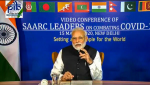
Prime Minister Narendra Modi during a video conference with South Asian Association for Regional Cooperation (SAARC) leaders on chalking out a plan to combat the COVID-19 Novel Coronavirus. (PTI)
NEW DELHI : Contributions to a fund put together by South Asian countries to combat the challenge posed by the Covid-19 pandemic to one of the most underdeveloped regions of the world seems to take taking off, with almost all nations pledging money to the pool.
The only notable holdout is Pakistan which is yet to announce any contribution to the fund first proposed by India’s Prime Minister, Narendra Modi, during a video conference meet on 15 March. Modi had then announced an initial amount of $10 million to the fund to which contributions were to be made on a voluntary basis by member countries.
The SAARC video conference meet was attended by the heads of government of all South Asian Association for Regional Cooperation countries with the exception of Pakistan, which was represented by Zafar Mirza, special adviser to Pakistan Prime Minister Imran Khan. Apart from Modi, other heads of government who joined the conference included Bhutanese Prime Minister Lotay Tshering, Bangladesh premier Sheikh Hasina, Sri Lankan President Gotabaya Rajapaksa, Maldivian President Ibrahim Mohamed Solih, Nepalese Prime Minister Oli and Afghanistan President Ashraf Ghani.
On Monday, Shivanthi Ranasinghe, Deputy Director - International Relations & Foreign Media, in Sri Lankan president Gotabaya Rajapaksa’s office told Mint that the Colombo government was earmarking $5 million for the SAARC Corona Emergency Fund.
“Just spoke to FM @DCRGunawardena of #SriLanka. Reviewed follow-up to the #SAARC-COVID Summit decisions. As good neighbours, we work closely to address the #COVID disruptions. Look forward to keeping in touch," Foreign minister S. Jaishankar tweeted on Monday.
Bangladesh has promised $1.5 million to the kitty. The announcement was made by foreign minister A.K. Abdul Momen.
Prime Minister Modi had last week taken to Twitter to thank the governments of Maldives, Nepal and Bhutan for their contributions to the SAARC fund.
“Gratitude to @PMBhutan Dr Lotay Tshering for his decision to contribute $100,000 to the COVID-19 Emergency Fund on behalf of the Bhutanese government. It is wonderful to see SAARC leaders taking initiatives that are adding strength to the collective fight against Coronavirus," Modi had said in a post on Friday.
“Deeply appreciate PM @kpsharmaoli’s announcement of contribution of NPR 10 crores (approximately $ 1 million) to the COVID-19 Emergency Fund. It reflects Oli Ji’s commitment and support to the collective fight of SAARC countries against the pandemic," Modi said in a second post on Friday.
“Deeply appreciate contribution of USD 200,000 by Government of Maldives to the COVID-19 Emergency Fund. It strengthens our resolve in this collective fight against the pandemic. @ibusolih," Modi added in another post on Saturday. Afghanistan had last week pledged $1 million to the SAARC Corona fund, according to a tweet by Afghanistan’s charge d’affaires Tahir Qadiry in New Delhi. “Pakistan was obliged to participate in the SAARC video conference meet initiated at India’s instance or it would have invited criticism," said former foreign secretary Kanwal Sibal.
Not contributing to the SAARC Corona Emergency Fund is a way of showing “resistance to India’s initiative," he said.
SAARC members warm up to PM Modi’s Covid-19 fund call
Updated: 24 Mar 2020, 12:09 AM IST
By Elizabeth Roche
- All member countries, except Pakistan, have made voluntary contributions to the Emergency Fund
- Sri Lanka earmarks $5 million for the SAARC Corona Emergency Fund.
Prime Minister Narendra Modi during a video conference with South Asian Association for Regional Cooperation (SAARC) leaders on chalking out a plan to combat the COVID-19 Novel Coronavirus. (PTI)
NEW DELHI : Contributions to a fund put together by South Asian countries to combat the challenge posed by the Covid-19 pandemic to one of the most underdeveloped regions of the world seems to take taking off, with almost all nations pledging money to the pool.
The only notable holdout is Pakistan which is yet to announce any contribution to the fund first proposed by India’s Prime Minister, Narendra Modi, during a video conference meet on 15 March. Modi had then announced an initial amount of $10 million to the fund to which contributions were to be made on a voluntary basis by member countries.
The SAARC video conference meet was attended by the heads of government of all South Asian Association for Regional Cooperation countries with the exception of Pakistan, which was represented by Zafar Mirza, special adviser to Pakistan Prime Minister Imran Khan. Apart from Modi, other heads of government who joined the conference included Bhutanese Prime Minister Lotay Tshering, Bangladesh premier Sheikh Hasina, Sri Lankan President Gotabaya Rajapaksa, Maldivian President Ibrahim Mohamed Solih, Nepalese Prime Minister Oli and Afghanistan President Ashraf Ghani.
On Monday, Shivanthi Ranasinghe, Deputy Director - International Relations & Foreign Media, in Sri Lankan president Gotabaya Rajapaksa’s office told Mint that the Colombo government was earmarking $5 million for the SAARC Corona Emergency Fund.
“Just spoke to FM @DCRGunawardena of #SriLanka. Reviewed follow-up to the #SAARC-COVID Summit decisions. As good neighbours, we work closely to address the #COVID disruptions. Look forward to keeping in touch," Foreign minister S. Jaishankar tweeted on Monday.
Bangladesh has promised $1.5 million to the kitty. The announcement was made by foreign minister A.K. Abdul Momen.
Prime Minister Modi had last week taken to Twitter to thank the governments of Maldives, Nepal and Bhutan for their contributions to the SAARC fund.
“Gratitude to @PMBhutan Dr Lotay Tshering for his decision to contribute $100,000 to the COVID-19 Emergency Fund on behalf of the Bhutanese government. It is wonderful to see SAARC leaders taking initiatives that are adding strength to the collective fight against Coronavirus," Modi had said in a post on Friday.
“Deeply appreciate PM @kpsharmaoli’s announcement of contribution of NPR 10 crores (approximately $ 1 million) to the COVID-19 Emergency Fund. It reflects Oli Ji’s commitment and support to the collective fight of SAARC countries against the pandemic," Modi said in a second post on Friday.
“Deeply appreciate contribution of USD 200,000 by Government of Maldives to the COVID-19 Emergency Fund. It strengthens our resolve in this collective fight against the pandemic. @ibusolih," Modi added in another post on Saturday. Afghanistan had last week pledged $1 million to the SAARC Corona fund, according to a tweet by Afghanistan’s charge d’affaires Tahir Qadiry in New Delhi. “Pakistan was obliged to participate in the SAARC video conference meet initiated at India’s instance or it would have invited criticism," said former foreign secretary Kanwal Sibal.
Not contributing to the SAARC Corona Emergency Fund is a way of showing “resistance to India’s initiative," he said.
SAARC members warm up to PM Modi’s Covid-19 fund call

These Mullahas are no less than the circus clowns
There is no need to worry
If out of 20 Thousand Symptomatic Patients , only 500 have tested positive
Then we will get it under control soon
People will come out until and unless home delivery is made smooth. Here BigBasket showing middle finger to state govt.
"Dear Customer, we are not operational due to restrictions imposed by local authorities on the movement of goods in spite of clear guidelines provided by central authorities to enable essential services. We are working with the authorities to be back soon."
Hoarders are good but what about common man who don't follow news, world events or any defense forum? Many of my friends are complaining probably because they feel i must have been prepared for lockdown while they were burdened with office workload.
"Dear Customer, we are not operational due to restrictions imposed by local authorities on the movement of goods in spite of clear guidelines provided by central authorities to enable essential services. We are working with the authorities to be back soon."
Hoarders are good but what about common man who don't follow news, world events or any defense forum? Many of my friends are complaining probably because they feel i must have been prepared for lockdown while they were burdened with office workload.

There's No Way 267 Million People Had Zero Cases
There's No Way 267 Million People Had Zero Cases
Daniel Moss
BloombergMarch 23, 2020, 11:00 PM GMT

There's No Way 267 Million People Had Zero Cases
(Bloomberg Opinion) -- In a matter of weeks, the world’s fourth-most populous nation went from reporting zero coronavirus cases to having the highest death toll in Southeast Asia. Now its currency is tumbling, growth forecasts are buckling, the capital is under a state of emergency, and an archipelago of 18,000 islands has effectively sealed its borders.
With a global recession in the cards, it's hard to see how Indonesia's economy moves forward. Finance Minister Sri Mulyani Indrawati may have been optimistic when she said Friday the expansion could slip to zero. The rupiah has shed about 13% this month, more than twice the decline of the South Korean won and Malaysian ringgit. More than $5 billion has fled the bond market so far in March, more than anywhere else in Asia, barring India, according to data compiled by Bloomberg. That vulnerability explains the timid quarter-point interest-rate cut from Bank Indonesia last week when many counterparts took dramatic steps: Any more could have thrown the rupiah into a faster downward spiral.
Experts and investors had been skeptical that a country of 267 million people heavily dependent on tourism could have reported so few Covid-19 cases for as long as it did. Jakarta announced the first two March 2; now, there are at least 579 cases and 49 deaths. A weak health system and bureaucratic inertia, which hold the country back in the best of times, are a major risk. Health Minister Terawan Agus, who now appears to have been sidelined, had insisted the government has been honest and reportedly attributed the disease’s absence to divine providence. He cited budget constraints for sparse testing.
That Indonesia is an accident waiting to happen was clear to me on a short trip to Bali two weeks ago. Coming from Singapore, where offices, clubs and restaurants have been checking temperatures since late January, I was shocked by the lack of thermometers. The only surgical masks available were at the duty-free store upon departure. Vulnerability to both a cascading illness and tourism crash was palpable. Tourists still dotted the island, but their presence was markedly thinner than during any of my half-dozen prior visits. Staff sat listlessly outside Balinese massage centers and batik shirts were marked down as much 50%.
But the trouble with Indonesia goes beyond a few shops struggling to offload their tourist bait. The country’s grim prognosis is grounded in its bleak history: The last time gross domestic product shrank was during the Asian financial crisis of the late 1990s. Even in the Great Recession, expansion exceeded 4%.
The idea of growth evaporating is alarming because of what has accompanied its absence. Deep contractions in 1998 and 1999 didn't just mean a rescue from the International Monetary Fund; they spelled the violent end of a three-decade political order presided over by autocrat Suharto. A generation earlier, economic collapse contributed to the overthrow of Sukarno, Indonesia's first president, a episode captured vividly in the novel and film “The Year of Living Dangerously.”
Indonesia is a different, more mature nation than it was two decades ago. Presidents are directly elected and limited to two terms, as are provincial and municipal leaders. The national legislature is hard for any president to corral. But the current government structure has mainly known prosperity. When President Joko Widodo was re-elected last year, he aimed to boost growth from the 5% average of his first term to around 7%. Now he may consider something around 2% to be a triumph.
Civilian rule doesn't mean the military disappeared to the barracks. It's still one of the few institutions that has the ability to unite a state so divided across economics, ethnicity, faith and geography. In that context, one of the most encouraging steps in Indonesia's late response to Covid-19 was placing the National Disaster Mitigation Agency, headed by a top general, Doni Monardo, in charge of coordinating the pandemic response.
The lights don't have to go out for Indonesia. Many top officials spent their early careers helping rebuild from the catastrophe of 1998. And as pronounced as the rupiah's recent slide has been, it's still small compared with the 56% drop in 1997 and the 32% tumble the following year.
Indonesia has lost a lot of time, but has come through dark days before. It will need more of Sri Mulyani's straight talk and the kind of all-in commitment a respected general can bring.
This column does not necessarily reflect the opinion of Bloomberg LP and its owners.
Daniel Moss is a Bloomberg Opinion columnist covering Asian economies. Previously he was executive editor of Bloomberg News for global economics, and has led teams in Asia, Europe and North America.
There's No Way 267 Million People Had Zero Cases
Daniel Moss
BloombergMarch 23, 2020, 11:00 PM GMT
There's No Way 267 Million People Had Zero Cases
(Bloomberg Opinion) -- In a matter of weeks, the world’s fourth-most populous nation went from reporting zero coronavirus cases to having the highest death toll in Southeast Asia. Now its currency is tumbling, growth forecasts are buckling, the capital is under a state of emergency, and an archipelago of 18,000 islands has effectively sealed its borders.
With a global recession in the cards, it's hard to see how Indonesia's economy moves forward. Finance Minister Sri Mulyani Indrawati may have been optimistic when she said Friday the expansion could slip to zero. The rupiah has shed about 13% this month, more than twice the decline of the South Korean won and Malaysian ringgit. More than $5 billion has fled the bond market so far in March, more than anywhere else in Asia, barring India, according to data compiled by Bloomberg. That vulnerability explains the timid quarter-point interest-rate cut from Bank Indonesia last week when many counterparts took dramatic steps: Any more could have thrown the rupiah into a faster downward spiral.
Experts and investors had been skeptical that a country of 267 million people heavily dependent on tourism could have reported so few Covid-19 cases for as long as it did. Jakarta announced the first two March 2; now, there are at least 579 cases and 49 deaths. A weak health system and bureaucratic inertia, which hold the country back in the best of times, are a major risk. Health Minister Terawan Agus, who now appears to have been sidelined, had insisted the government has been honest and reportedly attributed the disease’s absence to divine providence. He cited budget constraints for sparse testing.
That Indonesia is an accident waiting to happen was clear to me on a short trip to Bali two weeks ago. Coming from Singapore, where offices, clubs and restaurants have been checking temperatures since late January, I was shocked by the lack of thermometers. The only surgical masks available were at the duty-free store upon departure. Vulnerability to both a cascading illness and tourism crash was palpable. Tourists still dotted the island, but their presence was markedly thinner than during any of my half-dozen prior visits. Staff sat listlessly outside Balinese massage centers and batik shirts were marked down as much 50%.
But the trouble with Indonesia goes beyond a few shops struggling to offload their tourist bait. The country’s grim prognosis is grounded in its bleak history: The last time gross domestic product shrank was during the Asian financial crisis of the late 1990s. Even in the Great Recession, expansion exceeded 4%.
The idea of growth evaporating is alarming because of what has accompanied its absence. Deep contractions in 1998 and 1999 didn't just mean a rescue from the International Monetary Fund; they spelled the violent end of a three-decade political order presided over by autocrat Suharto. A generation earlier, economic collapse contributed to the overthrow of Sukarno, Indonesia's first president, a episode captured vividly in the novel and film “The Year of Living Dangerously.”
Indonesia is a different, more mature nation than it was two decades ago. Presidents are directly elected and limited to two terms, as are provincial and municipal leaders. The national legislature is hard for any president to corral. But the current government structure has mainly known prosperity. When President Joko Widodo was re-elected last year, he aimed to boost growth from the 5% average of his first term to around 7%. Now he may consider something around 2% to be a triumph.
Civilian rule doesn't mean the military disappeared to the barracks. It's still one of the few institutions that has the ability to unite a state so divided across economics, ethnicity, faith and geography. In that context, one of the most encouraging steps in Indonesia's late response to Covid-19 was placing the National Disaster Mitigation Agency, headed by a top general, Doni Monardo, in charge of coordinating the pandemic response.
The lights don't have to go out for Indonesia. Many top officials spent their early careers helping rebuild from the catastrophe of 1998. And as pronounced as the rupiah's recent slide has been, it's still small compared with the 56% drop in 1997 and the 32% tumble the following year.
Indonesia has lost a lot of time, but has come through dark days before. It will need more of Sri Mulyani's straight talk and the kind of all-in commitment a respected general can bring.
This column does not necessarily reflect the opinion of Bloomberg LP and its owners.
Daniel Moss is a Bloomberg Opinion columnist covering Asian economies. Previously he was executive editor of Bloomberg News for global economics, and has led teams in Asia, Europe and North America.

Group of mullah s from Thailand had stayed in mosque in my place.
They all had symptoms and admitted in IRT perundurai medical college.
When Indian government going to shut airports?
SJha had been cribbing form day 1.
Meanwhile virus won't go away.. It ll stay for long time..
We cannot lock down for ever.
Only solution is to restrict transmission levels to limit where our medical facilities can handle it.
Brace for long time stress.. And impact.
Even doctors are scarcely protected.
We cannot change bed linens / pillow cover for every patient attending the OP.
I am trying to use paper roll used in marriage dining hall for patients..
For longer length covering pillow.
That's all I could do.
Scan probe,, toilet, door s, money received.. These all cannot be sterilized for every patients.
These mullahs had function / preaching in mosque..
People tested are getting positive.
Erode district in TN become red zone.
Lock down happened just few days back..
Many People fearing govt action fled.
Don't know what to say...

Delhi has not reported any new case for last 4-5 days. The need is to block entry and exit from Delhi and isolate it from rest of the states. But we have an idiot as our CM who loves to derail Delhi every now and then on first available opportunity whether it is odd-even or covid19.

Gardermoen Airport under military lockdown by regional Home Guard district HV-02. District HV-02 is Oslo.


On the international side the Norwegian Armed Forces Medical Service has deployed to Afghanistan to help with local and international responses against Covid-19 in country. They will be assigned to the Role2 Hospital in Kabul, where Norway still has troops stationed in an advisory role.


On the international side the Norwegian Armed Forces Medical Service has deployed to Afghanistan to help with local and international responses against Covid-19 in country. They will be assigned to the Role2 Hospital in Kabul, where Norway still has troops stationed in an advisory role.


They are not clowns. They are much more contagious QURANO Viruses. Any person that comes into their contact gets converted into a mindless terrorist ZOMBIE out to kill people from all other religions which those MULLAS teach them to treat as kafir as per their Book of TERRORISM written by their POPAT....These Mullahas are no less than the circus clowns


2020 Olympics postponed due to coronavirus
2020 Olympics postponed due to coronavirus
IOC, Japan agree to postpone Olympics one year due to coronavirus concerns
The 2020 Olympics, which were scheduled to begin July 24 in Tokyo, have been postponed to a date “no later than summer 2021” due to the coronavirus pandemic.
The International Olympic Committee announced the decision Tuesday amid mounting pressure from athletes and various stakeholders.
“In the present circumstances and based on the information provided by the WHO today, the IOC President and the Prime Minister of Japan have concluded that the Games of the XXXII Olympiad in Tokyo must be rescheduled to a date beyond 2020 but not later than summer 2021, to safeguard the health of the athletes, everybody involved in the Olympic Games and the international community,” the IOC said in a statement.
2020 Olympics postponed due to coronavirus
IOC, Japan agree to postpone Olympics one year due to coronavirus concerns
The 2020 Olympics, which were scheduled to begin July 24 in Tokyo, have been postponed to a date “no later than summer 2021” due to the coronavirus pandemic.
The International Olympic Committee announced the decision Tuesday amid mounting pressure from athletes and various stakeholders.
“In the present circumstances and based on the information provided by the WHO today, the IOC President and the Prime Minister of Japan have concluded that the Games of the XXXII Olympiad in Tokyo must be rescheduled to a date beyond 2020 but not later than summer 2021, to safeguard the health of the athletes, everybody involved in the Olympic Games and the international community,” the IOC said in a statement.