

Don't get me wrong folks, but SU30MKI is present form is not ready to take on J16, may be with J11s ..
Partially but we don't know how capable Chinese AESA is. From what I've seen or read they have similar performance levels to elm 2052 but with lesser reliability so the uttam will match the Chinese AESA most likely.

Partially but we don't know how capable Chinese AESA is. From what I've seen or read they have similar performance levels to elm 2052 but with lesser reliability so the uttam will match the Chinese AESA most likely.
In terms of fratricide. Indian AD is pretty dense I don't think it's anything to be blamed on the fighter pilots. The fratricide angle is a case of incompetence rather than lack of system coherence.
The indian mki's do have an upgrade path to AESA's. Russians can gives us the fga-50 or a downgraded byelka. We ourselves have the uttam and elm 2052 which would match Russian aesa performance most likely. The problem is we need to pursue them fast.


What about TVC and HMD ? MKI is going to be upgraded with our indigenous AESA.
What about TVC and HMD ?
We will be upgrading with AESA for sure ... For an extra edge against all Chinese Su 27 derivative fighter planes, we have to wait for SFDR-based missiles since in WVR MKI will match with SU35.They are useful in WVR air combat
For BVR , you need a First Look , First Shoot Capabilities ie AESA LPI Radar
And a Strong EW suite to evade the incoming BVR AAMs
However We can say that if Su 30 Could Evade Aim 120 C 5 , then they can handle PL 15
Su 30 has been evaluated against All the Top end Fighters like F 15 , F 16 , Rafale and Eurofighter
J 16 is not superior to them
We will be upgrading with AESA for sure ... For an extra edge against all Chinese Su 27 derivative fighter planes, we have to wait for SFDR-based missiles since in WVR MKI will match with SU35.
we are not going to upgrade the engine since it's a lengthy process and costs lots of money also any indigenous equipment which is under development will be based on the power capacity of the existing equipment. 1st step of upgradation... SDR integrationWhether AESA will happen or they want to upgrade BARS is still not known
What is known is that DARE has built new HBJ and RWR
Radar upgrade also depends on
Engines , I dont think we will buy AL 41
On Twitter , from whatever discussion I have followed , I understand it will be A BARS upgrade / IBRIS Followed by UTTAM
MKI has a heavy nose due to it's heavy radar, it's also heavy due to it's metal construction, not sure how it's going to fare with a lighter airframe powered by higer thurst engines, though i belive MKI may have better AoA..What about TVC and HMD ? MKI is going to be upgraded with our indigenous AESA.
And digital RWRwe are not going to upgrade the engine since it's a lengthy process and costs lots of money also any indigenous equipment which is under development will be based on the power capacity of the existing equipment. 1st step of upgradation... SDR integration
we are not going to upgrade the engine since it's a lengthy process and costs lots of money also any indigenous equipment which is under development will be based on the power capacity of the existing equipment. 1st step of upgradation... SDR integration
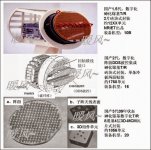
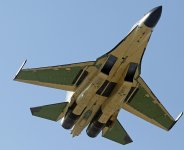
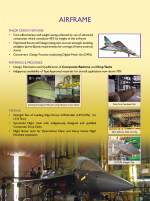
Even though this is three years old, this plane is a J-11B,Distinctive black radomeAnother thing about J16 is large use of composite unlike SU30MKI which is a metal bird.
The mki is superior in the A2G domain but the j-16 can fire pl-17 and the afk-98. So it can hit targets 500+km but the overall variety of munition access with the su-30mki is vast and IAF has yet to take full advantage of the mission computer.The J-16 is a very poor aircraft. As a platform itself, it lags significantly behind the Su-30MKI, separated by a structural chasm that cannot be bridged through upgrades.
First, consider its flight control system. China has never fully mastered the flight control laws of the Su-27 family, as Russia consistently refused to sell the source code or provide the complete set of aerodynamic data. Consequently, whether it is the J-11B, the J-15, or the J-16, these aircraft merely resemble the Su-27 structurally—they are just 'heavy platforms capable of getting airborne.' This is precisely why you will never see these Chinese variants performing advanced aerial acrobatics; their foundational flight control systems are nothing more than half-baked, unfinished products.
No matter how many fancy composite materials you slap onto the airframe, it’s completely worthless if you don’t have the flight control source code. A prime example is the J-11B, which was plagiarized from the Su-27SK. They incorporated a ton of advanced composite materials that were highly fashionable at the time and managed to significantly reduce the weight of the radar. However, because they couldn't figure out the flight control laws, they were forced to install dead-weight metal ballasts right behind the radar. This tragically added back all the weight they had just managed to shed through the use of composites, turning the aircraft into a famous, long-standing joke across the Chinese-speaking military community
Secondly, the performance of the WS-10 engine is abysmally poor, severely lacking high-altitude, high-speed capabilities. Under high angle-of-attack (AoA) maneuver conditions, it is highly prone to compressor stalls and surging.
On the other hand, while the Su-30MKI has admittedly been in service for a long time and the Indian government has not invested much effort into its modernization and upgrades—meaning it clearly lags behind the J-16 in terms of radar and weaponry—the J-16 is still far from being able to rival the Su-35, contrary to what some claim. Leaving aside the L-band radars and the R-37M missiles, the Su-35 carries 11.5 tons of internal fuel, and its 117S engines offer exceptional reliability and durability. It can even meet the operational demands of taking off and landing six times a day in the South China Sea for long-range patrols. Its combat readiness and sortie rate are at least twice that of Chinese domestic aircraft.
As for the narrative that the J-16 can defeat the Su-35, it is nothing more than a face-saving cope. Years ago, I knew many people like this who firmly believed that China's J-11B had already far surpassed the level of its Russian master. They even bet their lives that China would absolutely never purchase the Su-35S. And what happened? The General Staff in Beijing is not as foolish as they are.
There remains a massive gulf between a mere showpiece and the real deal.