

It seems like france will work more on the core section while we work on the afterburner section, we might collaborate more though. The Indo French Engine also seems modular and is said to be able to be upgraded for more power if required, if we design the fighter around this engine like most countries unlike our current way, there is no reason why it can't be used for other platforms in future.Who provided high temperature materials, parts?
Can we make bigger engines for AMCA, bigger fighter, UCAVs, etc?
You are using an out of date browser. It may not display this or other websites correctly.
You should upgrade or use an alternative browser.
You should upgrade or use an alternative browser.

It seems like france will work more on the core section while we work on the afterburner section, we might collaborate more though. The Indo French Engine also seems modular and is said to be able to be upgraded for more power if required, if we design the fighter around this engine like most countries unlike our current way, there is no reason why it can't be used for other platforms in future.
That's future tense, but did we make this afterburning Kaveri all by domestic effort?
Now it'll be tested for long time. Then we should scale it up for bigger jet/UCAV.
Since it was brahmos who built, it most likely must have been built with alloy's already in our capability. If it was something provided by the russian side, we should do a tot or make our own version for use.That's future tense, but did we make this afterburning Kaveri all by domestic effort?
Now it'll be tested for long time. Then we should scale it up for bigger jet/UCAV.


IMO, We should go with our R&D for a higher-thrust engine, However, GTRE being a government department without any ETA means we’re not really in the race. I’m not sure if anyone has the specific material details used in the current Kaveri engine since it’s still a work in progress, but according to what I found online, here are the details.Who provided high temperature materials, parts?
Can we make bigger engines for AMCA, bigger fighter, UCAVs, etc?
The manufacturing of aero-engine alloys in India has reached a high level of self-reliance, particularly through Mishra Dhatu Nigam Limited (MIDHANI), which acts as the primary source for the strategic metals that power India's jet engines.
1. Key Superalloy Grades Produced in India
MIDHANI produces several world-class nickel, cobalt, and iron-based superalloys under the brand name Superni. These are critical for the "hot section" of engines (turbines and combustion chambers).| MIDHANI Grade | International Equivalent | Typical Aero-Engine Application |
| Superni 718 | Inconel 718 | Turbine discs, casings, and high-strength fasteners. |
| Superni 80A | Nimonic 80A | High-temperature turbine blades and stator blades. |
| Superni 90 | Nimonic 90 | Turbine rotor blades and discs (high creep resistance). |
| Superni 263 | Nimonic 263 | Combustion chamber liners and exhaust ducting. |
| Superni 625 | Inconel 625 | Engine manifold systems and exhaust nozzles. |
| Superni 750 | Inconel X-750 | Aviation springs, bolts, and bellows. |
2. Major Developments (2025–2026)
India has recently moved from material development to series production for its most advanced fighter programs:- HAL AL-31FP (Su-30MKI): In early 2026, MIDHANI received certification for indigenous grades like BZL1, BZL14H, and ZS 6Y. These alloys allow India to manufacture critical components for the Sukhoi engines without relying on Russian imports.
- Kaveri and AMCA Engines: MIDHANI has completed development for 50% of the alloy systems required for the indigenous Kaveri "dry" engine and the upcoming Advanced Medium Combat Aircraft (AMCA).
- Single-Crystal Superalloys: MIDHANI has upgraded its Vacuum Induction Melting (VIM) furnaces to produce "master heats" for single-crystal blades, which are essential for 5th-generation engine performance.
3. Advanced Manufacturing Infrastructure
Manufacturing these alloys requires specialized equipment that few companies globally possess. In India, this is handled by:- MIDHANI (The Smelter): Uses a 6000T Near-Isothermal Forge Press and vacuum arc remelting to ensure the metallurgical "cleanliness" required for flight safety.
- HAL (The Fabricator): The Engine Division at Koraput uses these alloys to forge and machine blades for the Su-30MKI and Tejas (F404) engines.
- Godrej Aerospace: Specializes in the complex fabrication of these alloys into engine modules, including the assembly of the combustion chamber and exhaust units.
4. Titanium and Special Steels
Beyond nickel superalloys, India manufactures:- Titan 31 (Ti-6Al-4V): The standard aerospace titanium alloy used by HAL for compressor discs.
- MDN 15-5: A precipitation-hardening stainless steel used for structural engine parts and missile components.

IMO, We should go with our R&D for a higher-thrust engine, However, GTRE being a government department without any ETA means we’re not really in the race. I’m not sure if anyone has the specific material details used in the current Kaveri engine since it’s still a work in progress, but according to what I found online, here are the details.
The manufacturing of aero-engine alloys in India has reached a high level of self-reliance, particularly through Mishra Dhatu Nigam Limited (MIDHANI), which acts as the primary source for the strategic metals that power India's jet engines.
1. Key Superalloy Grades Produced in India
MIDHANI produces several world-class nickel, cobalt, and iron-based superalloys under the brand name Superni. These are critical for the "hot section" of engines (turbines and combustion chambers).
MIDHANI Grade International Equivalent Typical Aero-Engine Application Superni 718 Inconel 718 Turbine discs, casings, and high-strength fasteners. Superni 80A Nimonic 80A High-temperature turbine blades and stator blades. Superni 90 Nimonic 90 Turbine rotor blades and discs (high creep resistance). Superni 263 Nimonic 263 Combustion chamber liners and exhaust ducting. Superni 625 Inconel 625 Engine manifold systems and exhaust nozzles. Superni 750 Inconel X-750 Aviation springs, bolts, and bellows. 2. Major Developments (2025–2026)
India has recently moved from material development to series production for its most advanced fighter programs:
- HAL AL-31FP (Su-30MKI): In early 2026, MIDHANI received certification for indigenous grades like BZL1, BZL14H, and ZS 6Y. These alloys allow India to manufacture critical components for the Sukhoi engines without relying on Russian imports.
- Kaveri and AMCA Engines: MIDHANI has completed development for 50% of the alloy systems required for the indigenous Kaveri "dry" engine and the upcoming Advanced Medium Combat Aircraft (AMCA).
- Single-Crystal Superalloys: MIDHANI has upgraded its Vacuum Induction Melting (VIM) furnaces to produce "master heats" for single-crystal blades, which are essential for 5th-generation engine performance.
3. Advanced Manufacturing Infrastructure
Manufacturing these alloys requires specialized equipment that few companies globally possess. In India, this is handled by:
- MIDHANI (The Smelter): Uses a 6000T Near-Isothermal Forge Press and vacuum arc remelting to ensure the metallurgical "cleanliness" required for flight safety.
- HAL (The Fabricator): The Engine Division at Koraput uses these alloys to forge and machine blades for the Su-30MKI and Tejas (F404) engines.
- Godrej Aerospace: Specializes in the complex fabrication of these alloys into engine modules, including the assembly of the combustion chamber and exhaust units.
4. Titanium and Special Steels
Beyond nickel superalloys, India manufactures:
- Titan 31 (Ti-6Al-4V): The standard aerospace titanium alloy used by HAL for compressor discs.
- MDN 15-5: A precipitation-hardening stainless steel used for structural engine parts and missile components.
Awesome! Does this mean we don't need JV anymore?
Good that you mentioned full form of MiDhaNi otherwise some common & commie people might consider it like Adani.


We do need JV to speed up the process and derisk the development, say there is a 25% risk if we try to develop it on our own, it becomes 10-15% if we do it with france. Not to mention we may possibly try to develop new material for core and we need france for the proper testing, certifying and production practices.Awesome! Does this mean we don't need JV anymore?
Good that you mentioned full form of MiDhaNi otherwise some common & commie people might consider it like Adani.
The JV will likely be the quickest way to obtain the necessary thrust engine for now, providing us with much-needed independence from the US. But IMO the JV partner won't share with you the metallurgy of the critical parts that will resolve the thrust issue; they will add the prefabricated piece to complete the production of the jet engine. The JV will create the new dependency on the engine if we are trying to create the downgraded or upgraded thrust version of the engine at the component level.We do need JV to speed up the process and derisk the development, say there is a 25% risk if we try to develop it on our own, it becomes 10-15% if we do it with france. Not to mention we may possibly try to develop new material for core and we need france for the proper testing, certifying and production practices.
Wait what? What's the point of a joint venture if they wont share the critical tech we are trying to perfect? Also, most of the issues in kaveri have already been resolved as far as I'm aware, we just don't know the new weight and thrust right now, if the thrust to weight ratio is above 8, we are good. Also not sure how much of the newly developed technology have yet to be inducted into the latest kaveri. Can anyone here confirm for sure whether we adopted the blisk and used latest powdered metalurgy for the Kaveri-derivative with brahmos afterburner?But IMO the JV partner won't share with you the metallurgy of the critical parts that will resolve the thrust issue; they will add the prefabricated piece to complete the production of the jet engine.
The JV will likely be the quickest way to obtain the necessary thrust engine for now, providing us with much-needed independence from the US. But IMO the JV partner won't share with you the metallurgy of the critical parts that will resolve the thrust issue; they will add the prefabricated piece to complete the production of the jet engine. The JV will create the new dependency on the engine if we are trying to create the downgraded or upgraded thrust version of the engine at the component level.
Wait what? What's the point of a joint venture if they wont share the critical tech we are trying to perfect? Also, most of the issues in kaveri have already been resolved as far as I'm aware, we just don't know the new weight and thrust right now, if the thrust to weight ratio is above 8, we are good. Also not sure how much of the newly developed technology have yet to be inducted into the latest kaveri. Can anyone here confirm for sure whether we adopted the blisk and used latest powdered metalurgy for the Kaveri-derivative with brahmos afterburner?
> IMO we should do JV for 5gen & 6gen engines while continuing our domestic R&D towards 5gen engine & then beyond, bcoz if we compare Kaveri with say F404, then Kaveri takes in good air mass but not just specific wet thrust but dry thrust is also poor means more fuel need to be poured into AB to match a good wet value. So we can't compare it with other better engines.
When GTRE will stabilize new Kaveri & release new parameters then we can compare again to see our position.
> In my low IQ, engine TWR is a tricky thing to guess performance.
- TWR can be a guessing metric for new engine of same type.
- But 5gen engine of same dimension & material is heavier than 4gen engine. 6gen engine could be heavier than 5gen engine.
- And different nations with their R&D resulted in different materials of different weight.
- Moreover, Efficiency= 0/p / I/p but engine weight is not I/p to produce thrust.
- Theoretically the same engine with same parameters (AMF, OPR, BPR, fuel type, fuel-air mix ratio, TET, etc) can be made with lighter materials, it may increase thrust little bit indirectly when lighter turbine blades would result in lower loss of gas KE. But that's it i guess.

why you guys are wording it like kaveri was never with afterburner?That's future tense, but did we make this afterburning Kaveri all by domestic effort?
Now it'll be tested for long time. Then we should scale it up for bigger jet/UCAV.
kaveri has afterburner since inception.
it was KDE that was without it,
also afterburner is not something hightech component.
kaveri not achiveing enought afterburner thrust is purely design flaw.
lower than initial goal fan pressure, overall compressor ratio, Low bypass ratio has led to failure of kaveri engine.
it has nothing to do with metallurgy, we were always using snecma provided HOT section parts.
Nobody said Kaveri DIDN'T HAVE afterburner.why you guys are wording it like kaveri was never with afterburner?
kaveri has afterburner since inception.
it was KDE that was without it,
We're discussing who made THIS LATEST afterburner.
Althoug The AB section appears to be far less mechanical, with the fuel sprayers, flame holders, nozzle, but to non-aero people it appears quite complex looking at the science, formulas, equations behind it.also afterburner is not something hightech component.
It can be observed that Kaveri has low OPR 21/5 & BPR 0.16, compared to F404, F414, etc, BUT, if OPR is increased then it automatically increases temperature.kaveri not achiveing enought afterburner thrust is purely design flaw.
lower than initial goal fan pressure, overall compressor ratio, Low bypass ratio has led to failure of kaveri engine.
it has nothing to do with metallurgy, we were always using snecma provided HOT section parts.
And searching on Kaveri problems state reasons not just high weight, lack of testing facilities, but also including issues with compressor, core, afterburner, meaning not able to handle high temperatures & pressure, meaning metallurgy problems. Hence low OPR & low dry & wet specific thrust.
It looks lie recent R&D has improved compressor blades, combustor, AB, reduced weight,

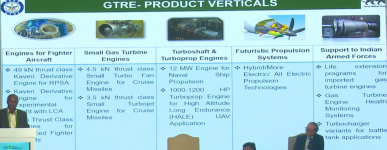
Confirmation about LCA integration as an experimental step.
- Kaveri Dry Engine : Order placed for 6 with Godrej, received 3 both and running at GTRE facility.
- GTRE Twin cell test facility will be operational in one year.
- High altitude test facility, possible location in telangana.
- STFE: Placed order for 25 engines with BATL. Received 8 engines so far.
- Kaveri-2: Discussions are ongoing.
- The unmanned UAV project Remotely Piloted Strike Aircraft (RPSA) has not yet been approved. FUFA is a technology development program to develop technologies and prove them before government sanction. ADE and GTRE working towards that.


Apparently, GTRE had already recognized a suitable sight at Nagarjunasagar in AP/Telanagana border (near Nagarjunasagar dam) nearly 15 years ago .


Is this some sort of a joke ? GTRE is going to test GTX -35VS Kaveri in its 82 KN avatar & then launch a new project Kaveri 2.0 for an 85 KN+ version . The scale of their ambition astounds me.
What next I wonder ?! Launch an 87 KN + Kaveri 3.0 project & so on till we reach 110 KN by the end of this century .
Na, GOI Is finally taking jet engine development seriously, giving GTRE more confidence, a Kaveri 2.0 with 85+ kn max thrust will be a good replacement of F404-GE-IN20 used in Tejas mk1/mk1a, as the 120-140kn thrust class engine we plan to develop with france will be slightly bigger in size(f414 size) to fit its derated version in Tejas mk1/mk1a.Is this some sort of a joke ? GTRE is going to test GTX -35VS Kaveri in its 82 KN avatar & then launch a new project Kaveri 2.0 for an 85 KN+ version . The scale of their ambition astounds me.
We're collaborating with france for this , 120-140kn class jv engine for AMCA & beyond.What next I wonder ?! Launch an 87 KN + Kaveri 3.0 project & so on till we reach 110 KN by the end of this century .
If a F-404 analogue is already being tested it makes eminent sense to go in for the development of a F-414 TF analogue.Na, GOI Is finally taking jet engine development seriously, giving GTRE more confidence, a Kaveri 2.0 with 85+ kn max thrust will be a good replacement of F404-GE-IN20 used in Tejas mk1/mk1a, as the 120-140kn thrust class engine we plan to develop with france will be slightly bigger in size(f414 size) to fit its derated version in Tejas mk1/mk1a.
Assuming the F-404 analogue being tested imparts insufficient thrust which is what the case has been since the beginning , the proposed F-414 analogue under development can be certified post which de rating the same TF can give us the F-404 analogue we're seeking.
It's easier this way than going in for incremental developments like what seems to be the plan.
I was being sarcastic in case you didn't notice.We're collaborating with france for this , 120-140kn class jv engine for AMCA & beyond.
The jv engine for amca with Safran will be same dimension as f414, basically a next gen. Analog of f414.If a F-404 analogue is already being tested it makes eminent sense to go in for the development of a F-414 TF analogue.
F414 is slightly bigger in size than f404 & you can't just downsize a engine somewhat without needing to do extensive redesign.the proposed F-414 analogue under development can be certified post which de rating the same TF can give us the F-404 analogue we're seeking.
That's why Kaveri 2.0 with 85+kn afterburner thrust target (f404 size) is in discussion instead of discussion on derating amca jv to use in Tejas mk1/mk1a in future.
Its not.It's easier this way than going in for incremental developments like what seems to be the plan.
Current Kaveri development and its targeted 82kn afterburner thrust will be somewhat underpowered compared to f404 ins20, that's Kaveri 2.0 with 85+kn targeted thrust( slightly more than f404 ins20 ) is in discussion after current Kaveri is certified.Assuming the F-404 analogue being tested imparts insufficient thrust which is what the case has been since the beginning ,