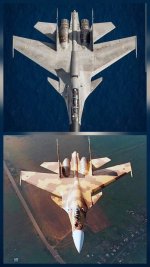
Got to brush that off again, mate! Both standard Su-27S and improved Su-27M(old Su-35 Super Flanker) had same fuselage tanks. Real difference was that Su-27M had thicker and reinforced wings/airfoil for more combat load(upto 8 tonnes) and enhanced fuel capacity:
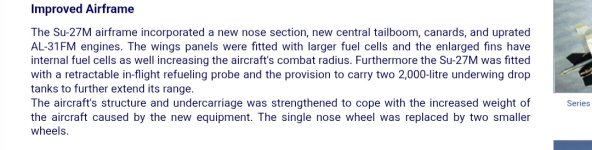
"Improved Airframe
The Su-27M airframe incorporated a new nose section, new central tailboom, canards, and uprated AL-31FM engines.
The wings panels were fitted with larger fuel cells and the enlarged fins have internal fuel cells as well increasing the aircraft's combat radius. Furthermore the Su-27M was fitted with a retractable in-flight refueling probe and the provision to carry two 2,000-litre underwing drop tanks to further extend its range.
The aircraft's structure and undercarriage was strengthened to cope with the increased weight of the aircraft caused by the new equipment. The single nose wheel was replaced by two smaller wheels."
View attachment 51497
Source:
MILAVIA Aircraft - Sukhoi Su-27M (Su-35) "Super Flanker"
You claimed airfoil became thicker, but that didn't change. As I had stated, the fuel tanks were optimized on Su-27 to carry more fuel.
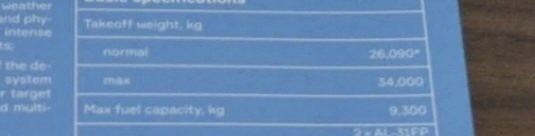
Su-27's wings have not more than 500 kg each. The upgrade added another 100 kg at best in each tank, but the full fuel increase was in the fuselage. 10250-9400 = 850 kg. So remove 200 kg from that. You can add another 270kg from fins. So the additional fuselage fuel is 380 kg.
https://www.milavia.net/aircraft/su-35_su-27m/su-35_su-27m.htm
Lolz. Su-35 used NO-11 mechanical scanned radar while Bort No. 711 aka Su-37 used the first version of NO11M PESA radar later used in MKI. So, MKI's frontal fuselage has similar width 'cause it uses literally the same radar in upgraded form. Heck, MKI uses the same twin-nosewheels layout as that of old Su-35/37 too.
Regarding tail-stinger? Just look at this picture:
What are you talking about? We were comparing Su-27 with Su-27M for fuel capacity and tail stinger, not Su-37 and MKI.
Plus N011 and N011M are both the same radars. Both are Bars, one is MS, the other is PESA. Su-27 carried the smaller N001 and was upgraded to Bars on Su-27M with the fuselage increase.
Su-30M was upgraded with twin-wheels from the original Su-27UB, along with increase in fuel capacity and MTOW.
View attachment 51498
Does MKI's tail-stinger look any smaller than Su-35/37?
The change isn't visible to the eye. It was noticed by airframe modellers. The Su-27M was modified to house the N012 radar in the stinger.

en.wikipedia.org
In addition, an N012 self-defence radar was housed in the rearward-projecting tail boom, making the aircraft the first in the world to have such a radar. - by Yefim Gordon in Su-27.
Su-30MKI carries the same unmodified stinger as the basic Su-27, along with the vertical fins.
Fact is, MKI's airframe incorporated most, if not all, of all the changes of Su-27M program like Canards, Enlarged LERX, thicker wings, strengthened fuselage with bigger tail-stinger etc., except square tipped vertical-tails. Thus MKI's fuselage + wings combined fuel-load is same as that of Su-27M/old Su-35/37, i.e., 9980kgs. Old Su-35 also had two 135kgs smaller fuel-tanks in its twin vertical tails, which increased its fuel-load to 9980 +270(135×2) = 10,250kgs. Case closed.
There is no "thicker" wing. Same stinger as Su-27. Same vertical stab as Su-27. The canards, TVC were added directly to the MKI, just like KNAAPO did with Su-35UB on the Su-30MKK. The Su-27M was used as a TD and Su-30MK got canards and TVC through a separate process led by Irkut and KNAAPO. MKI and SM have the same 9.64T of fuel as the Su-30M.
The Su-27M/Su-37's fuel tank design is different. Single seat means its original Tank 1 design wasn't changed, it was enhanced. Su-30M's Tank 1 design was changed. It has a different upper fuselage design compared to the Su-27 to house the same amount of fuel even though Tank 1 lost capacity due to the second cockpit.
Yes, because MKI's 10 tonnes fuel-load is classified and any client could pay UAC more mullah to unlock its full fuel-capacity. Otherwise, they won't unlock Su-30SM's full wing-tanks.
This argument doesn't even make any logical sense. You can't "unlock" physics. The fuel on Flankers simply flows out from wings to the fuselage tanks as fuel is consumed. It's not dammed by a beaver. Fuel flows from drop tanks to wing tanks to Tank 1 and into the main tank before entering the engine.
Su-30M has the same upgraded fuel tank design as the Su-27M. It was extended up to the wingtips.
Let me sum it up. The Su-27's 9.4T was upgraded to 10.25T on Su-27M. The airbrakes were removed to give an extra ton on Su-35S.
The Su-27UB (Su-30) added a cockpit and its fuselage and fuel tanks were modified to retain the same 9.4T of fuel. Su-30M was modified with the extra wing tanks and further fuel optimizations for CoG reasons to get to 9.64T. While MKI and SM stayed the same, the MKK was modified with fin tanks for an extra 270 kg, so 9.91T.
Su-27M was upgraded to carry Bars radar and a tail-boom radar called N012. Su-30M got its fuselage modified to carry Bars MS, but stuck with the original stinger and vertical stabs. Due to the added weight of the Bars PESA, they had to add canards on MKI to manage CoG. They originally wanted to remove canards when they discovered Su-27M could be designed without it, but the extra weight of the Bars PESA forced its addition. That's why Su-35S could eliminate canards with the lighter Irbis-E, which weighs almost the same as N001.
Su-30MKI and MKK got TVC and canards in a separate process from Su-27M/Su-37. Canards to manage a heavier radar and TVC as an upgrade to the original but upgraded AL-31F engine separate from AL-37FU. The engines are different. In fact, Su-37 was powered by pre-AL-31FP engines initially before it got its hands on the more advanced, higher performing, higher thrust (145kN) AL-37FU.