Sukhoi Su-30MKI

The Al skin is put as panels up and over Titanium spars. We're not going to touch Titanium load-sharing spars but the outer skin fairings would be replaced by CNT based composite panels. The photograph was of such a panel.

What about the canards, air brake, vertical fins, slats, etc? These metallic parts would need to be changed to carbon fibre composite at the very least, no?
 
  • Agree
Reactions: Rajput Lion
What about the canards, air brake, vertical fins, slats, etc? These metallic parts would need to be changed to carbon fibre composite at the very least, no?
Even the early MKIs used to have 6% composites by weight. All parts mentioned by you would be replaced by composites if they haven't done that already.
 
Even the early MKIs used to have 6% composites by weight. All parts mentioned by you would be replaced by composites if they haven't done that already.

These parts are currently made by pvt sector Tier 2 suppliers. Afaik, they are all metal structures. Changing them to composite material will require production retooling and increase costs.

I'm not saying it can't be done. Just that there is no open source info on it atm.
 
Most of the fuel is inside the fuselage, making the airfoil thicker doesn't mean you are adding extra space for fuel, rather you would lose space.
Got to brush that off again, mate! Both standard Su-27S and improved Su-27M(old Su-35 Super Flanker) had same fuselage tanks. Real difference was that Su-27M had thicker and reinforced wings/airfoil for more combat load(upto 8 tonnes) and enhanced fuel capacity:

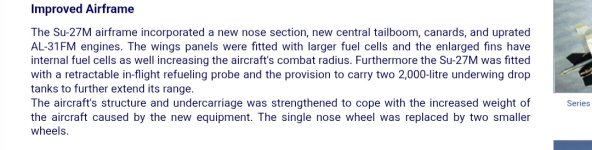
"Improved Airframe
The Su-27M airframe incorporated a new nose section, new central tailboom, canards, and uprated AL-31FM engines. The wings panels were fitted with larger fuel cells and the enlarged fins have internal fuel cells as well increasing the aircraft's combat radius. Furthermore the Su-27M was fitted with a retractable in-flight refueling probe and the provision to carry two 2,000-litre underwing drop tanks to further extend its range.
The aircraft's structure and undercarriage was strengthened to cope with the increased weight of the aircraft caused by the new equipment. The single nose wheel was replaced by two smaller wheels."

1000046760.jpg
Source: https://www.milavia.net/aircraft/su-35_su-27m/su-35_su-27m.htm

The actual difference between the Su-27 and M is the larger frontal fuselage and a longer, fatter stinger, this allowed the use of a larger radar, more fuel, and more avionics. The airfoil remained the same. Canards were added to compensate for the increased weight.
Lolz. Su-35 used NO-11 mechanical scanned radar while Bort No. 711 aka Su-37 used the first version of NO11M PESA radar later used in MKI. So, MKI's frontal fuselage has similar width 'cause it uses literally the same radar in upgraded form. Heck, MKI uses the same twin-nosewheels layout as that of old Su-35/37 too.

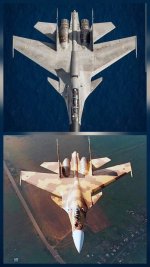
Regarding tail-stinger? Just look at this picture:

1000046758.jpg
Does MKI's tail-stinger look any smaller than Su-35/37?

Fact is, MKI's airframe incorporated most, if not all, of all the changes of Su-27M program like Canards, Enlarged LERX, thicker wings, strengthened fuselage with bigger tail-stinger etc., except square tipped vertical-tails. Thus MKI's fuselage + wings combined fuel-load is same as that of Su-27M/old Su-35/37, i.e., 9980kgs. Old Su-35 also had two 135kgs smaller fuel-tanks in its twin vertical tails, which increased its fuel-load to 9980 +270(135×2) = 10,250kgs. Case closed.
Maybe you can explain why Su-30SM was "downgraded" to 9.64T of fuel.
Yes, because MKI's 10 tonnes fuel-load is classified and any client could pay UAC more mullah to unlock its full fuel-capacity. Otherwise, they won't unlock Su-30SM's full wing-tanks.
Anyway, yeah, we are off-topic.
Not anymore buddy;)
 
  • Like
Reactions: Shan and ShiroBarks
Got to brush that off again, mate! Both standard Su-27S and improved Su-27M(old Su-35 Super Flanker) had same fuselage tanks. Real difference was that Su-27M had thicker and reinforced wings/airfoil for more combat load(upto 8 tonnes) and enhanced fuel capacity:

"Improved Airframe
The Su-27M airframe incorporated a new nose section, new central tailboom, canards, and uprated AL-31FM engines. The wings panels were fitted with larger fuel cells and the enlarged fins have internal fuel cells as well increasing the aircraft's combat radius. Furthermore the Su-27M was fitted with a retractable in-flight refueling probe and the provision to carry two 2,000-litre underwing drop tanks to further extend its range.
The aircraft's structure and undercarriage was strengthened to cope with the increased weight of the aircraft caused by the new equipment. The single nose wheel was replaced by two smaller wheels."

View attachment 51497
Source: MILAVIA Aircraft - Sukhoi Su-27M (Su-35) "Super Flanker"


Lolz. Su-35 used NO-11 mechanical scanned radar while Bort No. 711 aka Su-37 used the first version of NO11M PESA radar later used in MKI. So, MKI's frontal fuselage has similar width 'cause it uses literally the same radar in upgraded form. Heck, MKI uses the same twin-nosewheels layout as that of old Su-35/37 too.

Regarding tail-stinger? Just look at this picture:

View attachment 51498
Does MKI's tail-stinger look any smaller than Su-35/37?

Fact is, MKI's airframe incorporated most, if not all, of all the changes of Su-27M program like Canards, Enlarged LERX, thicker wings, strengthened fuselage with bigger tail-stinger etc., except square tipped vertical-tails. Thus MKI's fuselage + wings combined fuel-load is same as that of Su-27M/old Su-35/37, i.e., 9980kgs. Old Su-35 also had two 135kgs smaller fuel-tanks in its twin vertical tails, which increased its fuel-load to 9980 +270(135×2) = 10,250kgs. Case closed.

Yes, because MKI's 10 tonnes fuel-load is classified and any client could pay UAC more mullah to unlock its full fuel-capacity. Otherwise, they won't unlock Su-30SM's full wing-tanks.

Not anymore buddy;)
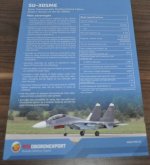
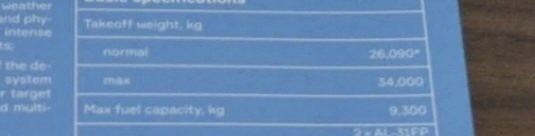
Since @randomradio, you want to take Russian claims at face value. Here is "official" brochure of Su-30SME with quoted max fuel-load of 9.3 tonnes. Now, don't tell me that you believe the Russians, and now MKI has the same 9.3 tonnes max fuel-load🤣🤣:

1000046765.jpg


1000046767.jpg
 
Got to brush that off again, mate! Both standard Su-27S and improved Su-27M(old Su-35 Super Flanker) had same fuselage tanks. Real difference was that Su-27M had thicker and reinforced wings/airfoil for more combat load(upto 8 tonnes) and enhanced fuel capacity:

"Improved Airframe
The Su-27M airframe incorporated a new nose section, new central tailboom, canards, and uprated AL-31FM engines. The wings panels were fitted with larger fuel cells and the enlarged fins have internal fuel cells as well increasing the aircraft's combat radius. Furthermore the Su-27M was fitted with a retractable in-flight refueling probe and the provision to carry two 2,000-litre underwing drop tanks to further extend its range.
The aircraft's structure and undercarriage was strengthened to cope with the increased weight of the aircraft caused by the new equipment. The single nose wheel was replaced by two smaller wheels."

View attachment 51497
Source: MILAVIA Aircraft - Sukhoi Su-27M (Su-35) "Super Flanker"

You claimed airfoil became thicker, but that didn't change. As I had stated, the fuel tanks were optimized on Su-27 to carry more fuel.

Su-27's wings have not more than 500 kg each. The upgrade added another 100 kg at best in each tank, but the full fuel increase was in the fuselage. 10250-9400 = 850 kg. So remove 200 kg from that. You can add another 270kg from fins. So the additional fuselage fuel is 380 kg.
https://www.milavia.net/aircraft/su-35_su-27m/su-35_su-27m.htm
Lolz. Su-35 used NO-11 mechanical scanned radar while Bort No. 711 aka Su-37 used the first version of NO11M PESA radar later used in MKI. So, MKI's frontal fuselage has similar width 'cause it uses literally the same radar in upgraded form. Heck, MKI uses the same twin-nosewheels layout as that of old Su-35/37 too.

Regarding tail-stinger? Just look at this picture:

What are you talking about? We were comparing Su-27 with Su-27M for fuel capacity and tail stinger, not Su-37 and MKI.

Plus N011 and N011M are both the same radars. Both are Bars, one is MS, the other is PESA. Su-27 carried the smaller N001 and was upgraded to Bars on Su-27M with the fuselage increase.

Su-30M was upgraded with twin-wheels from the original Su-27UB, along with increase in fuel capacity and MTOW.

View attachment 51498
Does MKI's tail-stinger look any smaller than Su-35/37?

The change isn't visible to the eye. It was noticed by airframe modellers. The Su-27M was modified to house the N012 radar in the stinger.

In addition, an N012 self-defence radar was housed in the rearward-projecting tail boom, making the aircraft the first in the world to have such a radar. - by Yefim Gordon in Su-27.

Su-30MKI carries the same unmodified stinger as the basic Su-27, along with the vertical fins.

Fact is, MKI's airframe incorporated most, if not all, of all the changes of Su-27M program like Canards, Enlarged LERX, thicker wings, strengthened fuselage with bigger tail-stinger etc., except square tipped vertical-tails. Thus MKI's fuselage + wings combined fuel-load is same as that of Su-27M/old Su-35/37, i.e., 9980kgs. Old Su-35 also had two 135kgs smaller fuel-tanks in its twin vertical tails, which increased its fuel-load to 9980 +270(135×2) = 10,250kgs. Case closed.

There is no "thicker" wing. Same stinger as Su-27. Same vertical stab as Su-27. The canards, TVC were added directly to the MKI, just like KNAAPO did with Su-35UB on the Su-30MKK. The Su-27M was used as a TD and Su-30MK got canards and TVC through a separate process led by Irkut and KNAAPO. MKI and SM have the same 9.64T of fuel as the Su-30M.

The Su-27M/Su-37's fuel tank design is different. Single seat means its original Tank 1 design wasn't changed, it was enhanced. Su-30M's Tank 1 design was changed. It has a different upper fuselage design compared to the Su-27 to house the same amount of fuel even though Tank 1 lost capacity due to the second cockpit.

Yes, because MKI's 10 tonnes fuel-load is classified and any client could pay UAC more mullah to unlock its full fuel-capacity. Otherwise, they won't unlock Su-30SM's full wing-tanks.

This argument doesn't even make any logical sense. You can't "unlock" physics. The fuel on Flankers simply flows out from wings to the fuselage tanks as fuel is consumed. It's not dammed by a beaver. Fuel flows from drop tanks to wing tanks to Tank 1 and into the main tank before entering the engine.

Su-30M has the same upgraded fuel tank design as the Su-27M. It was extended up to the wingtips.

Let me sum it up. The Su-27's 9.4T was upgraded to 10.25T on Su-27M. The airbrakes were removed to give an extra ton on Su-35S.
The Su-27UB (Su-30) added a cockpit and its fuselage and fuel tanks were modified to retain the same 9.4T of fuel. Su-30M was modified with the extra wing tanks and further fuel optimizations for CoG reasons to get to 9.64T. While MKI and SM stayed the same, the MKK was modified with fin tanks for an extra 270 kg, so 9.91T.

Su-27M was upgraded to carry Bars radar and a tail-boom radar called N012. Su-30M got its fuselage modified to carry Bars MS, but stuck with the original stinger and vertical stabs. Due to the added weight of the Bars PESA, they had to add canards on MKI to manage CoG. They originally wanted to remove canards when they discovered Su-27M could be designed without it, but the extra weight of the Bars PESA forced its addition. That's why Su-35S could eliminate canards with the lighter Irbis-E, which weighs almost the same as N001.

Su-30MKI and MKK got TVC and canards in a separate process from Su-27M/Su-37. Canards to manage a heavier radar and TVC as an upgrade to the original but upgraded AL-31F engine separate from AL-37FU. The engines are different. In fact, Su-37 was powered by pre-AL-31FP engines initially before it got its hands on the more advanced, higher performing, higher thrust (145kN) AL-37FU.

 
  • Like
Reactions: YoungWolf
Since @randomradio, you want to take Russian claims at face value. Here is "official" brochure of Su-30SME with quoted max fuel-load of 9.3 tonnes. Now, don't tell me that you believe the Russians, and now MKI has the same 9.3 tonnes max fuel-load🤣🤣:

View attachment 51500


View attachment 51501

This difference has to do with fuel type. Russians use fuel with a higher density compared to India, so for the same capacity of fuel in liters, the Indian fuel is heavier in kgs. Fuel mass = volume x density.

So when actual fuel mass is calculated, the density changes it. The tanks hold 9.64T of fuel for a specific density.

SM/SME have the exact same fuel layout as MKI. So the difference is in type of fuel used. We use A-1, they use TS-1.

In air show brochures, the numbers target the country in question. In some it's 0.74, in some it's 0.84. In this brochure, fuel density is considered to be 0.76. So it's targeting the fuel type of a specific hot country. Probably in ME or SEA or both.

As a result, the density of this colorless to light-yellowish fuel ranges between 0.747 and 0.84 g/cm3

Density @ 15°C, kg/m3 - 775.0 to 840.0

Indian fuel is typically no more than 0.82 at 15 deg C and 1 atm. But at higher ambient temperatures, the density falls. When density falls, volume carried decreases 'cause fuel has expanded in size, so that reduces mass. In India, in our environment, we either have high temperature or low pressure, so our real fuel density is always low.

Russian fuel density is typically 0.78-0.8 kg/L. But with their lower ambient temperature, density increases phenomenally, so mass increases. But our figures are standardized to Russian average figures of ~0.79 kg/L. So we get 9.64T. And all Russian class weights are standardized to this density.

Basically, this brochure figure supports my argument.
 
You claimed airfoil became thicker, but that didn't change. As I had stated, the fuel tanks were optimized on Su-27 to carry more fuel.
I didn't claim that Su-27M's airfoil/wings become thicker 'cause it really became thicker to carry more load, pull more Gs even with full-fuel and weapons-load and had bigger fuel cells. Where is the contradiction?
Su-27's wings have not more than 500 kg each. The upgrade added another 100 kg at best in each tank, but the full fuel increase was in the fuselage. 10250-9400 = 850 kg. So remove 200 kg from that. You can add another 270kg from fins. So the additional fuselage fuel is 380 kg.
MILAVIA Aircraft - Sukhoi Su-27M (Su-35) "Super Flanker"


What are you talking about? We were comparing Su-27 with Su-27M for fuel capacity and tail stinger, not Su-37 and MKI.
Lol. Su-37 was nothing but Su-35 BORT NO. 711 with BARS PESA and other stuff. It was also part of Su-27M program.
Plus N011 and N011M are both the same radars. Both are Bars, one is MS, the other is PESA. Su-27 carried the smaller N001 and was upgraded to Bars on Su-27M with the fuselage increase.
Yes, and that's why MKI's frontal-fuselage width is same as that of Su-27M/old Su-35/Su-37(to house 1m thick BARS radar). You actually claimed otherwise.
Su-30M was upgraded with twin-wheels from the original Su-27UB, along with increase in fuel capacity and MTOW.


The change isn't visible to the eye. It was noticed by airframe modellers. The Su-27M was modified to house the N012 radar in the stinger.

In addition, an N012 self-defence radar was housed in the rearward-projecting tail boom, making the aircraft the first in the world to have such a radar. - by Yefim Gordon in Su-27.

Su-30MKI carries the same unmodified stinger as the basic Su-27, along with the vertical fins.


There is no "thicker" wing. Same stinger as Su-27. Same vertical stab as Su-27. The canards, TVC were added directly to the MKI, just like KNAAPO did with Su-35UB on the Su-30MKK. The Su-27M was used as a TD and Su-30MK got canards and TVC through a separate process led by Irkut and KNAAPO. MKI and SM have the same 9.64T of fuel as the Su-30M.

The Su-27M/Su-37's fuel tank design is different. Single seat means its original Tank 1 design wasn't changed, it was enhanced. Su-30M's Tank 1 design was changed. It has a different upper fuselage design compared to the Su-27 to house the same amount of fuel even though Tank 1 lost capacity due to the second cockpit.


This argument doesn't even make any logical sense. You can't "unlock" physics. The fuel on Flankers simply flows out from wings to the fuselage tanks as fuel is consumed. It's not dammed by a beaver. Fuel flows from drop tanks to wing tanks to Tank 1 and into the main tank before entering the engine.

Su-30M has the same upgraded fuel tank design as the Su-27M. It was extended up to the wingtips.
And so did our MKI.
Let me sum it up. The Su-27's 9.4T was upgraded to 10.25T on Su-27M. The airbrakes were removed to give an extra ton on Su-35S.
The Su-27UB (Su-30) added a cockpit and its fuselage and fuel tanks were modified to retain the same 9.4T of fuel. Su-30M was modified with the extra wing tanks and further fuel optimizations for CoG reasons to get to 9.64T. While MKI and SM stayed the same, the MKK was modified with fin tanks for an extra 270 kg, so 9.91T.

Su-27M was upgraded to carry Bars radar and a tail-boom radar called N012. Su-30M got its fuselage modified to carry Bars MS, but stuck with the original stinger and vertical stabs. Due to the added weight of the Bars PESA, they had to add canards on MKI to manage CoG. They originally wanted to remove canards when they discovered Su-27M could be designed without it, but the extra weight of the Bars PESA forced its addition. That's why Su-35S could eliminate canards with the lighter Irbis-E, which weighs almost the same as N001.

Su-30MKI and MKK got TVC and canards in a separate process from Su-27M/Su-37. Canards to manage a heavier radar and TVC as an upgrade to the original but upgraded AL-31F engine separate from AL-37FU. The engines are different. In fact, Su-37 was powered by pre-AL-31FP engines initially before it got its hands on the more advanced, higher performing, higher thrust (145kN) AL-37FU.
Nope. Adding Canards to Su-30 wasn't a simple process, that's why we returned the early 18 Su-30Ks that we got. It requires extensive fuselage modifications including bigger LERXs and different CoG and CoP. It uses all fuselage enhancements of Su-27M program.

This difference has to do with fuel type. Russians use fuel with a higher density compared to India, so for the same capacity of fuel in liters, the Indian fuel is heavier in kgs. Fuel mass = volume x density.

So when actual fuel mass is calculated, the density changes it. The tanks hold 9.64T of fuel for a specific density.

SM/SME have the exact same fuel layout as MKI. So the difference is in type of fuel used. We use A-1, they use TS-1.

In air show brochures, the numbers target the country in question. In some it's 0.74, in some it's 0.84. In this brochure, fuel density is considered to be 0.76. So it's targeting the fuel type of a specific hot country. Probably in ME or SEA or both.

As a result, the density of this colorless to light-yellowish fuel ranges between 0.747 and 0.84 g/cm3

Density @ 15°C, kg/m3 - 775.0 to 840.0

Indian fuel is typically no more than 0.82 at 15 deg C and 1 atm. But at higher ambient temperatures, the density falls. When density falls, volume carried decreases 'cause fuel has expanded in size, so that reduces mass. In India, in our environment, we either have high temperature or low pressure, so our real fuel density is always low.

Russian fuel density is typically 0.78-0.8 kg/L. But with their lower ambient temperature, density increases phenomenally, so mass increases. But our figures are standardized to Russian average figures of ~0.79 kg/L. So we get 9.64T. And all Russian class weights are standardized to this density.

Basically, this brochure figure supports my argument.
Well, it was the Russians who claimed that Su-30M had 9.64 tonnes of fuel and now they are claimed 9.3 tonnes for Su-30SME. It has nothing to do with Indian weighing system.

Fact is, as I have quoted multiple reliable sources like Andrei Fomin and Yefim Gordon along with giving reasons why MKI has near 10tonnes of fuel-load. I don't have anything more to add to this topic.
 
I didn't claim that Su-27M's airfoil/wings become thicker 'cause it really became thicker to carry more load, pull more Gs even with full-fuel and weapons-load and had bigger fuel cells. Where is the contradiction?

This is what you said:
Su-35(T-10M) had thicker wings over standard Su-27

All they did is strengthen it for more payload. It didn't become thicker.

Lol. Su-37 was nothing but Su-35 BORT NO. 711 with BARS PESA and other stuff. It was also part of Su-27M program.

Su-27M, Su-35, and Su-37 are all the same aircraft.

M is the modernization. 35 is the new designation. 37 comes with new engine and TVC, further modifiication. It's the 11th prototype of the Su-27M/Su-35.

Yes, and that's why MKI's frontal-fuselage width is same as that of Su-27M/old Su-35/Su-37(to house 1m thick BARS radar). You actually claimed otherwise.

And so did our MKI.

MKI's modifications are all separate from Su-27M. They had nothing to do with each other. Su-27M was used as a TD to develop a new Flanker, and in a separate process Su-30 went through modifications that allowed it to carry a bigger radar, thats all.

Su-27M had far more changes that were also different in the frontal fuselage and internals compared to the Su-30M.

Nope. Adding Canards to Su-30 wasn't a simple process, that's why we returned the early 18 Su-30Ks that we got. It requires extensive fuselage modifications including bigger LERXs and different CoG and CoP. It uses all fuselage enhancements of Su-27M program.

Su-30K was an entirely different aircraft. Adding canards would have pushed it into a full development program.

Su-30MK was entirely different, and came with the ability to add canards, that's how both MKI and MKK got canards. But you couldn't do that on an airframe that did not come equipped for the modernization right from production stage.

Once again, MKI and MKK got TVC and canards in an entirely different process from Su-27M/Su-37. Both jets had different goals. Canards were added 'cause Bars PESA was heavy. On Su-27M, canards were added for more stability post modifications, but to also enhance agility. Later they figured out it was not needed. So Su-27M2 lost canards while retaining TVC, while MKI and Su-35UB were forced to use canards for stability.

If it wasn't for Bars, MKI would not have had canards.

Well, it was the Russians who claimed that Su-30M had 9.64 tonnes of fuel and now they are claimed 9.3 tonnes for Su-30SME. It has nothing to do with Indian weighing system.

At different standards. This has nothing to do with "Indian weighing system." This is standard physics used globally by all airlines.

The same aircraft has different fuel mass in India and in Russia.

Here, I found something else that explains it in more detail.

Fact is, as I have quoted multiple reliable sources like Andrei Fomin and Yefim Gordon along with giving reasons why MKI has near 10tonnes of fuel-load. I don't have anything more to add to this topic.

Fomin and Gordon are wrong. We know this for a fact. The very fact that Fomin got MKK fuel load wrong while boosting MKI's over MKK should tell you that clearly. You would have had something of substance to argue with had it been the opposite.

The SME's specs show what I said is right. If you use Russia's standard fuel density, you get MKI's figure of 9.64T.
 
I never said for old mki's. I want 500 flankers all to super sukhoi standard or atleast a partial fleet to be in super sukhi standard.
The thing with flankers is that the design is timeless and is basically a mini bomber and missile carrier and it can just be perpetually upgraded with new radars and engine and electronics. Plus it has enough capacity and range to carry any kind of munition. The flanker can be literally used for the next 100 years it's a design that is in the class of the b-52 stratofortress in terms of flexibility.
We presently have 260 flankers. We need to keep the Nashik plant going in any case. It's better we invest and expand it and create 2-3 manufacturing lines of the su-30mki and su-57. Just base it all in the al-41f1 till the Russians mature the al-51.
As much as I want rafale in the medium fighter role we need to move on su-57/60. Algeria has already procured it and r-37m creates a huge advantage when paired with su-57 low RCS. What we need is Netra and datalink kill chain combined with s-400 and s-500.
Also the Chinese will use their rocket force(with iranians giving them confidence) so we need anti-ballistic missile capability in numbers.
Naah , flankers are outdated design. Whole engine is visible

We need 5th gen , 1000 j20 + 500 j35 till 2035

We need to cpeed up amca , u can not sustain war with imported weapons(losses are part of war) , we need to produce 100 amca per year from 2035 fith indeginious engine

and develop Ourself a vertical tail less fighter jet (heavy) by our own

Waisting money or rafale or more mki or su57 is stupid

Will 200 su57 will win war(actually stopping china win a war against us) chain 1500 j20 and j35 whil they can churn over 100 of each per year ???

China is super power, acknowledge it.

Wasting 40 billion on Rafale seems pure incompetence and stupidity from iaf

They should double triple 100 down on indigenous engine and amca , 6th gen
 
  • Like
Reactions: Rajput Lion
Naah , flankers are outdated design. Whole engine is visible

We need 5th gen , 1000 j20 + 500 j35 till 2035

We need to cpeed up amca , u can not sustain war with imported weapons(losses are part of war) , we need to produce 100 amca per year from 2035 fith indeginious engine

and develop Ourself a vertical tail less fighter jet (heavy) by our own

Waisting money or rafale or more mki or su57 is stupid

Will 200 su57 will win war(actually stopping china win a war against us) chain 1500 j20 and j35 whil they can churn over 100 of each per year ???

China is super power, acknowledge it.

Wasting 40 billion on Rafale seems pure incompetence and stupidity from iaf

They should double triple 100 down on indigenous engine and amca , 6th gen
And more, if we ever fight a total war with china , china will anhilate us without industrial capacity

During a total war, whole industry works for war, over 40% of gdp is put in war

In a total war scenario, china will be producing over 200-300 5th gen in a month at least !!!!!!

People here dont know a bit of history, go and fkking read about the production rate of weapon before and during ww2

Those who support import are either fool who dont know total war time economy and have not read about ww2 weapon production or have accepted that china is our master and only way to deter china is a nuclear war when all indians(and most chinease) will die or believes that a total war with china is impossible due to Himalayas, (lol french thought same that germans can't come from ardens forest, everything is impossible till its done )


Remember, u can never ever stop your brutal defeat(let along winning war) in war against an industrial gaint without being yourself an industrial gaint !!!!!

Winning a war against china with imported weapon is more delusional that creating an utopian world where countries dont fight and only co operates
 
We need to cpeed up amca
You cannot fire Brahmos-A's, Rudram 2-3 and other future heavy munitions with the AMCA. If the flankers were an outdated design China wouldn't be still producing j-16's and j-15's. America and Israel won't be procuring f-15EX.

Those who support import are either fool who dont know total war time economy and have not read about ww2 weapon production or have accepted that china is our master and only way to deter china is a nuclear war when all indians(and most chinease) will die or believes that a total war with china is impossible due to Himalayas, (lol french thought same that germans can't come from ardens forest, everything is impossible till its done )
21st Century warfare is nowhere like WW2 warfare style. You didn't have high tech fifth gen aircrafts dependent on semiconductors and titanium in WW2. You simply can't produce 60000 fifth gen aircrafts. It simply is too time consuming and will crash economies. You are not in the era of mechanical gauged turboprop planes with no electronics.
Modern Air warfare are basically around standoff munitions and the aircrafts are essentially high speed bomb & missile trucks. That's why the flankers need to be produced. Even the f-35 couldn't create air superiority over Iran due to constant Iranian AD threat.
Winning a war against china with imported weapon is more delusional
India is not an industrial giant though. We are at U.K and Japan level economically and unlike them we ain't producing much high technology. India will be dependent on foreign tech for atleast a decade until we don't get our engine, powerplant situation fixed.
 
And what do you propose saar? Producing 1000 AMCA's when you can't even produce the Tejas MK2 or the Tejas mk1a? Dependent on American engines which you don't even have license production of?
The su-30 mki is more indian than the Tejas.

Tejas MK2, SU30MKI, Tejas MK1A are the going to be the most important jets for the next 20 yrs. Industrial output of all 3 jets should be increased in such a way that it matches the industrial output of Chinese 5th gen jets.
 
You cannot fire Brahmos-A's, Rudram 2-3 and other future heavy munitions with the AMCA. If the flankers were an outdated design China wouldn't be still producing j-16's and j-15's. America and Israel won't be procuring f-15EX.
Thats why we have tejas mk2 and ghatak(and may be bigger ghatk, and btw, if stealth is not needed(as in case of rudram 3 on su30) then amca simply can launch rudram 3 in beast mode(still far less rcs than su 30mki )

Tejas mk2, amca(with beast mode for long range and heavy weapons) and ghtak(with bigger ghatak with 2x/4x indigenous 120kn engine(dry variant obv)
21st Century warfare is nowhere like WW2 warfare style. You didn't have high tech fifth gen aircrafts dependent on semiconductors and titanium in WW2. You simply can't produce 60000 fifth gen aircrafts. It simply is too time consuming and will crash economies. You are not in the era of mechanical gauged turboprop planes with no electronics.
Same was told before ww2, ww2 tech for ww2 era was top notch , btw u have ever read what things are needed for radars and electronics?? Everything raw materials which we need for high end electronics are available in maases , our consumer electronics are far far more high end than those in fighter jet(not even joking , u seems to be uninformed)

And i again stand on my point , china will easily proudyce over 300 5th gen per month with even harming its domestic consume electronics consumption

Modern Air warfare are basically around standoff munitions and the aircrafts are essentially high speed bomb & missile trucks. That's why the flankers need to be produced. Even the f-35 couldn't create air superiority over Iran due to constant Iranian AD threat.
Because usa was not committed, a full fledge usa will destroy iran like afganistan, and yeah they did achieve air superiority, shooting ir guided sams , that too like very localised like manpads is not challanging aur superiority,

If u considEr some manpads type ir missiles as challange to aur superiority then usa did not achieved that even during the first phase of iraq war ,

ut impossible to achieve that without large scale infantry on ground
India is not an industrial giant though. We are at U.K and Japan level economically and unlike them we ain't producing much high technology. India will be dependent on foreign tech for atleast a decade until we don't get our engine, powerplant situation fixed.
But india has potential to eclipse uk japan and france together, we have lots of man power ,

If we have inhouse tech nad raw materials then In total war we can easily scale up , we wont face any issue of manpower , and our ppp gdp is more than all those 3 combined

Ppp deaks with internal economy , we can easily overshadowed all those 3 combined
 
  • Like
Reactions: Rajput Lion
You cannot fire Brahmos-A's, Rudram 2-3 and other future heavy munitions with the AMCA. If the flankers were an outdated design China wouldn't be still producing j-16's and j-15's. America and Israel won't be procuring f-15EX.


21st Century warfare is nowhere like WW2 warfare style. You didn't have high tech fifth gen aircrafts dependent on semiconductors and titanium in WW2. You simply can't produce 60000 fifth gen aircrafts. It simply is too time consuming and will crash economies. You are not in the era of mechanical gauged turboprop planes with no electronics.
Modern Air warfare are basically around standoff munitions and the aircrafts are essentially high speed bomb & missile trucks. That's why the flankers need to be produced. Even the f-35 couldn't create air superiority over Iran due to constant Iranian AD threat.

India is not an industrial giant though. We are at U.K and Japan level economically and unlike them we ain't producing much high technology. India will be dependent on foreign tech for atleast a decade until we don't get our engine, powerplant situation fixed.
You cannot fire Brahmos-A's, Rudram 2-3 and other future heavy munitions with the AMCA. If the flankers were an outdated design China wouldn't be still producing j-16's and j-15's. America and Israel won't be procuring f-15EX.


21st Century warfare is nowhere like WW2 warfare style. You didn't have high tech fifth gen aircrafts dependent on semiconductors and titanium in WW2. You simply can't produce 60000 fifth gen aircrafts. It simply is too time consuming and will crash economies. You are not in the era of mechanical gauged turboprop planes with no electronics.
Modern Air warfare are basically around standoff munitions and the aircrafts are essentially high speed bomb & missile trucks. That's why the flankers need to be produced. Even the f-35 couldn't create air superiority over Iran due to constant Iranian AD threat.

India is not an industrial giant though. We are at U.K and Japan level economically and unlike them we ain't producing much high technology. India will be dependent on foreign tech for atleast a decade until we don't get our engine, powerplant situation fixed.
Read it

Okh i did gemini, and its quite good , got co conclusion that china can prouduce 100-120 5th gen fighter jet per month is total war , far less than 300 gigure of mine but still very significant (1400 5th gen per year is not joke)

120 5th gen means We have to shot down 4 per day to stop indias defeat , do u think we can ??

We are buying more s400 which is stupid , 5 s400 is enough for now, double down on kusha is better , so is for amca

And amca will be far more effective against j20 then kusha or s400
 
And what do you propose saar? Producing 1000 AMCA's when you can't even produce the Tejas MK2 or the Tejas mk1a? Dependent on American engines which you don't even have license production of?
The su-30 mki is more indian than the Tejas.
We can not now , nor was china 20 years ago

But We need to develop industrial base and technology inmovation, it takes time but its worth it and actually needed unless u wann become slave of chinease
 
btw u have ever read what things are needed for radars and electronics?? Everything raw materials which we need for high end electronics are available in maases , our consumer electronics are far far more high end than those in fighter jet(not even joking , u seems to be uninformed)
You seem to be uninformed over the fact that even Russia was experiencing semiconductor shortages and they had to use microprocessors and microcontrollers from literal kitchen appliances to use their drones and munitions.
You seem to be uninformed about the fact that the Chinese control majority of the rare earth metal mines on the planet. And if they wanted they could really limit supply of rare earths to India essentially limiting our capabilities to produce high end avionics and radar. And if you delusionally think that "it won't be a problem saar". The Chinese have already used that tactic against the Americans to great effect to the point American trade war was limited to performative tarrif's and BS.
How exactly are you supposed to sustain a long term war when you are at the mercy of the Chinese in the raw material stage itself.