Indian Indigenous Aero Engine Developments

Hidden in ₹3.6 Lakh Crore Approvals: The 4 MW Naval Engine

12 February 2026 by alphadefense.in
1770915850865.png

The Defence Acquisition Council (DAC) has cleared ₹3.60 lakh crore worth of capital acquisition proposals to enhance the combat readiness of the Indian Armed Forces.

This massive approval covers major platforms, weapons, and systems across the Army, Navy, and Air Force. It signals one of the largest coordinated modernisation pushes in recent years.

Yet, buried inside this mega acquisition package is a modest but strategically important line:

Naval generator (04 MW Marine Gas Turbine based Electric Power Generator)

At first glance, it appears technical and minor. In reality, it could represent something far bigger — India’s entry into indigenous marine gas turbine capability.

The ₹3.6 Lakh Crore Defence Push​

The DAC approval reflects:
  • Large-scale capital modernisation
  • Focus on indigenous procurement
  • Strengthening combat readiness
  • Long-term force restructuring
Such large clearances usually include fighter aircraft, naval platforms, armoured vehicles, and advanced missile systems. These dominate headlines.

However, defence capability is not built only through large platforms. It is also built through core technologies — and propulsion is one of them.

The 4 MW Naval Gas Turbine: Why It Matters​

The proposal mentions:

04 MW Marine Gas Turbine based Electric Power Generator

This indicates:
  • A gas turbine in the 4 megawatt class
  • Designed specifically for naval application
  • Used primarily for electric power generation
India currently operates:
  • LM2500 gas turbines (US origin) on destroyers
  • Earlier Ukrainian-origin marine turbines
  • Diesel generator sets for shipboard power
But India does not operate a fully indigenous marine gas turbine in service.

That makes this approval significant.

Mapping the Power Class: LM500 Category​

Globally, a 4–5 MW marine gas turbine falls into the same power band as the GE LM500.

The LM500:
  • Produces roughly 4.4–4.5 MW
  • Is derived from an aircraft engine core
  • Has been used on vessels like Denmark’s Flyvefisken-class patrol vessels
  • Provides high power in a compact footprint
India’s 4 MW requirement sits squarely in this category.

It is important to clarify that India is not procuring the LM500. Rather, the power band is comparable. This helps us understand the intended capability bracket.

Why Start at 4 MW?​


If India intends to build an indigenous marine gas turbine ecosystem, starting at 4 MW is logical.

Lower Technical Risk​


A smaller turbine:
  • Requires less extreme thermal management
  • Has lower turbine inlet temperatures
  • Is easier to marinise

Easier Integration​


A gas turbine generator is:
  • Simpler to integrate than a propulsion turbine
  • Less mechanically stressed
  • More forgiving during early development

Ecosystem Building​


Developing a 4 MW turbine allows India to build:
  • Hot-section metallurgy expertise
  • Control systems (FADEC)
  • Marinisation processes
  • Supply chain depth
This is how propulsion ecosystems evolve globally.

Potential Applications in the Indian Navy​


A 4 MW marine gas turbine generator could support:

Next-Generation Missile Vessels​


Modern missile vessels are:
  • Sensor-heavy
  • Network-centric
  • Electrically demanding
A 4 MW turbine could provide surge power or support hybrid propulsion architectures.

Advanced Corvettes​


Future corvettes with AESA radars and electronic warfare suites will demand higher onboard power density.

Integrated Electric Propulsion (IEP) Ships​


As the Navy moves toward more electric-dominant platforms, gas turbine generators become critical components.

A Strategic Step Toward Propulsion Sovereignty​


Today, India depends on foreign suppliers for high-end marine gas turbines.

An indigenous 4 MW turbine could represent:
  • Reduced external dependency
  • Indigenous intellectual property
  • Long-term scalability toward larger turbines
  • Export potential for small combatants
Instead of jumping directly into a 25–30 MW destroyer-class turbine, India appears to be taking a calibrated and realistic approach.

The Bigger Story Behind a Small Line​

In a ₹3.6 lakh crore acquisition wave, fighter jets and major warships will attract attention.

But propulsion capability defines strategic autonomy.

The 4 MW naval gas turbine generator may look humble. Yet it could mark the beginning of India’s structured entry into the marine gas turbine domain.

If developed successfully, this program will not merely power a ship. It will power an ecosystem.

And sometimes, in defence planning, the smallest line items carry the biggest long-term implications.

Hidden in ₹3.6 Lakh Crore Approvals: The 4 MW Naval Engine - AlphaDefense.in
 
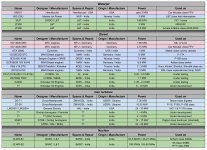
Propulsion systems used by current & upcoming Navy ships:

RED: Systems of foreign origin. Imported from abroad. No spares & services available locally.
BLUE: Systems of foreign origin. Manufactured abroad or in India. Spares & services locally available.
GREEN: Systems of Indian origin. Manufactured in India. Spares & services locally available.
Indian Navy propulsion systems development plan.jpg
The items marked in red were either procured in small quantities or were procured decades ago. Most newer ships use propulsion systems that have a good supply chain, spares & services available in the country.

Pretty sure we will figure out the diesel engines in a few years. KOEL has decades of experience in this field & the Navy is funding 70% of the R&D cost. We are also going to need to start making large sized electric motors for future IEP needs.

The 24-28 MW MGT is the most technologically challenging propulsion system. If we succeed here, then Navy's propulsion needs are sorted for decades to come.
 
Hidden in ₹3.6 Lakh Crore Approvals: The 4 MW Naval Engine

12 February 2026 by alphadefense.in
View attachment 49669

The Defence Acquisition Council (DAC) has cleared ₹3.60 lakh crore worth of capital acquisition proposals to enhance the combat readiness of the Indian Armed Forces.

This massive approval covers major platforms, weapons, and systems across the Army, Navy, and Air Force. It signals one of the largest coordinated modernisation pushes in recent years.

Yet, buried inside this mega acquisition package is a modest but strategically important line:


At first glance, it appears technical and minor. In reality, it could represent something far bigger — India’s entry into indigenous marine gas turbine capability.

The ₹3.6 Lakh Crore Defence Push​

The DAC approval reflects:
  • Large-scale capital modernisation
  • Focus on indigenous procurement
  • Strengthening combat readiness
  • Long-term force restructuring
Such large clearances usually include fighter aircraft, naval platforms, armoured vehicles, and advanced missile systems. These dominate headlines.

However, defence capability is not built only through large platforms. It is also built through core technologies — and propulsion is one of them.

The 4 MW Naval Gas Turbine: Why It Matters​

The proposal mentions:


This indicates:
  • A gas turbine in the 4 megawatt class
  • Designed specifically for naval application
  • Used primarily for electric power generation
India currently operates:
  • LM2500 gas turbines (US origin) on destroyers
  • Earlier Ukrainian-origin marine turbines
  • Diesel generator sets for shipboard power
But India does not operate a fully indigenous marine gas turbine in service.

That makes this approval significant.

Mapping the Power Class: LM500 Category​

Globally, a 4–5 MW marine gas turbine falls into the same power band as the GE LM500.

The LM500:
  • Produces roughly 4.4–4.5 MW
  • Is derived from an aircraft engine core
  • Has been used on vessels like Denmark’s Flyvefisken-class patrol vessels
  • Provides high power in a compact footprint
India’s 4 MW requirement sits squarely in this category.

It is important to clarify that India is not procuring the LM500. Rather, the power band is comparable. This helps us understand the intended capability bracket.

Why Start at 4 MW?​


If India intends to build an indigenous marine gas turbine ecosystem, starting at 4 MW is logical.

Lower Technical Risk​


A smaller turbine:
  • Requires less extreme thermal management
  • Has lower turbine inlet temperatures
  • Is easier to marinise

Easier Integration​


A gas turbine generator is:
  • Simpler to integrate than a propulsion turbine
  • Less mechanically stressed
  • More forgiving during early development

Ecosystem Building​


Developing a 4 MW turbine allows India to build:
  • Hot-section metallurgy expertise
  • Control systems (FADEC)
  • Marinisation processes
  • Supply chain depth
This is how propulsion ecosystems evolve globally.

Potential Applications in the Indian Navy​


A 4 MW marine gas turbine generator could support:

Next-Generation Missile Vessels​


Modern missile vessels are:
  • Sensor-heavy
  • Network-centric
  • Electrically demanding
A 4 MW turbine could provide surge power or support hybrid propulsion architectures.

Advanced Corvettes​


Future corvettes with AESA radars and electronic warfare suites will demand higher onboard power density.

Integrated Electric Propulsion (IEP) Ships​


As the Navy moves toward more electric-dominant platforms, gas turbine generators become critical components.

A Strategic Step Toward Propulsion Sovereignty​


Today, India depends on foreign suppliers for high-end marine gas turbines.

An indigenous 4 MW turbine could represent:
  • Reduced external dependency
  • Indigenous intellectual property
  • Long-term scalability toward larger turbines
  • Export potential for small combatants
Instead of jumping directly into a 25–30 MW destroyer-class turbine, India appears to be taking a calibrated and realistic approach.

The Bigger Story Behind a Small Line​

In a ₹3.6 lakh crore acquisition wave, fighter jets and major warships will attract attention.

But propulsion capability defines strategic autonomy.

The 4 MW naval gas turbine generator may look humble. Yet it could mark the beginning of India’s structured entry into the marine gas turbine domain.

If developed successfully, this program will not merely power a ship. It will power an ecosystem.

And sometimes, in defence planning, the smallest line items carry the biggest long-term implications.

Hidden in ₹3.6 Lakh Crore Approvals: The 4 MW Naval Engine - AlphaDefense.in
What I fail to understand is why are we starting back from square one, with the KMGT we were able to develop a 12.5MW Marine Gas Turbine (although this wasn't sustained) as far back as in 2008, which mean it could effectively power vessels under 5000 tons displacement.
Why not go full steam ahead with the 24-28MW MGT?
Obviously I do under a 4MW MGT has it's own set of applications, but we need to go full steam ahead with the MGT in the 24-28MW category, because unlike the other services here the user is actually backing the program.
 
  • Like
Reactions: ShiroBarks
Some more info below

AZAD Engineering has beaten the giants like L&T, Bharat Forge, VEM and Godrej!20 units of Engines will be manufacturedwith spares in 3 phases and toolings with 30 Engines will rebuild for the total amount of Rs 5,10,36,388.


What I fail to understand is why are we starting back from square one
Why not go full steam ahead with the 24-28MW MGT?
Obviously I do under a 4MW MGT has it's own set of applications, but we need to go full steam ahead with the MGT in the 24-28MW category, because unlike the other services here the user is actually backing the program.
We are not starting from square one. These are just different categories of engines. The 4 MW & the 24-28 MW projects will run parallelly.

with the KMGT we were able to develop a 12.5MW Marine Gas Turbine (although this wasn't sustained) as far back as in 2008, which mean it could effectively power vessels under 5000 tons displacement.
The Navy was planning to use the KMGT to power one of their Rajput class destroyers before they were decommissioned. They would replace the current 4 turbines with 4 KMGTs & use the ship for power, endurance & throttling trails. They backed out of this plan largely due to budgetary constraints.

There are still 3 of those ships in service. So technically that option is still open.


Raksha Mantri reviews projects of indigenous military gas turbine engine development during visit to DRDO’s GTRE in Bengaluru​


Lauds GTRE for bolstering national security through self-reliance

“Govt is committed to achieving self-reliance in aero engines development”

“Op Sindoor demonstrated India’s growing Aatmanirbharta in defence, Need to focus more on manufacturing world-class indigenous systems”​

Posted On: 16 FEB 2026 3:28PM by PIB Delhi

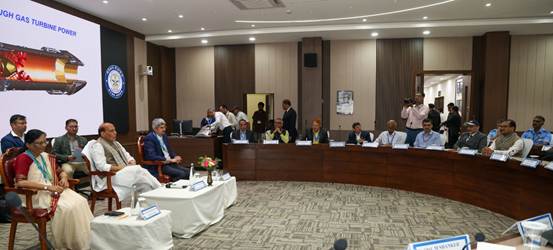
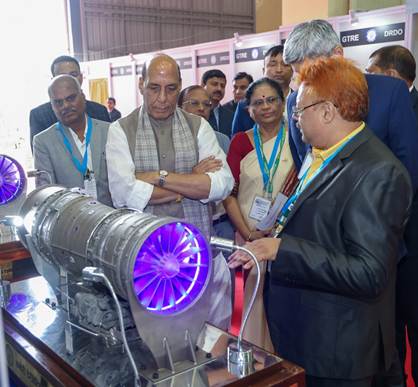
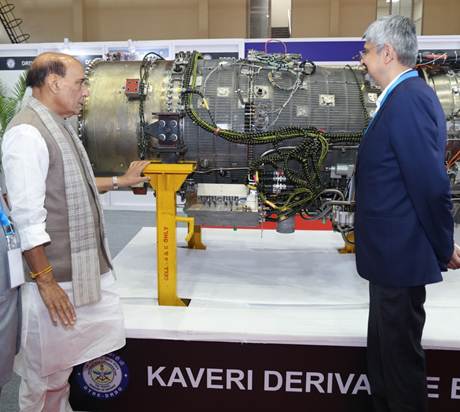
Raksha Mantri Shri Rajnath Singh, on February 16, 2026, visited DRDO’s Gas Turbine Research Establishment (GTRE) in Bengaluru, and reviewed the status of ongoing projects relating to indigenous military gas turbine engine development. He was briefed on the establishment’s projects on the anvil, interactions with the Indian Industry, academia and R&D institutes, and the support provided to the defence forces. He also visited the exhibition showcasing various indigenous engines & their parts and witnessed the full afterburner engine test of the Kaveri engine.

image001KPBR.jpg


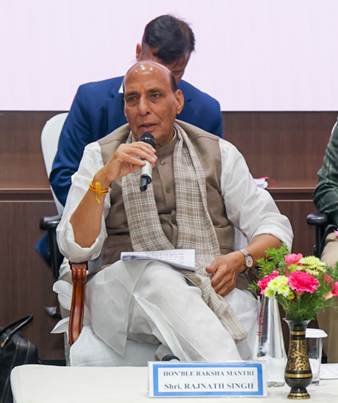
Interacting with the scientists and officials, Raksha Mantri praised GTRE for its efforts towards bolstering national security through self-reliance, describing DRDO as the foundation of India’s strategic capability. He underscored the critical importance of achieving Aatmanirbharta in aero engine technology in the present rapidly evolving geopolitical landscape, and stated that every effort is being made to prioritise the development of aero engines in India. “Supply chains are breaking and new ecosystems are developing. Nations possessing indigenous critical technologies will remain safe, secure, and sustain themselves,” he stated, reiterating Prime Minister Shri Narendra Modi-led Government’s commitment to achieving self-reliance in every field.

Acknowledging GTRE’s efforts in this critical technology domain, Shri Rajnath Singh exhorted the lab to strive and focus on next generation engines by building a nationwide robust ecosystem, while achieving self-reliance in aero engines. He added that “We are rapidly moving towards the design and development of the Advanced Medium Combat Aircraft (AMCA). We have made numerous attempts in the past to achieve expertise in the field of aero engines. Now, the time has come to complete those efforts. We cannot limit ourselves to only 5th generation engines. We must begin the development of 6th generation, advanced technologies as soon as possible. Research on them is the need of the hour. The use of Artificial Intelligence, Machine Learning and new materials is increasing. We must stay ahead of the curve.”

image002KY29.jpg


Raksha Mantri described aero engine development as an extremely complex endeavour, integrating thermodynamics, material science, fluid mechanics and advanced mechanical engineering. Noting that even developed nations often take 25-30 years to develop next-generation engines, he urged Indian scientists to compress timelines in view of the nation’s strategic needs. “We must assume that 20 years have already passed and we now have only 5-7 years left,” he said, describing it as a call to action aligned with national aspirations.

image003CZQI.jpg


Referring to Operation Sindoor, Shri Rajnath Singh emphasised that during the operation, the defence forces demonstrated India’s growing Aatmanirbharta in the defence sector. “Whether it was communication systems, surveillance equipment, or attack weapons, everything was indigenous. This boosted the morale of our soldiers and instilled pride among citizens. In view of the evolving challenges, it is imperative to focus more on indigenous methods and provide our forces with world-class systems and equipment,” he said.

Raksha Mantri praised GTRE for the joint study with the UK for aero engine development, adding that the process has been initiated with France as well for aero engines under the National Aero Engine Mission. “Both France and UK are very advanced in aero engine technology. These collaborations will not only provide us with the opportunity to learn new technologies, but also help us to understand the challenges they have faced over the past decades,” he said.

image004JLAW.jpg


Shri Rajnath Singh also highlighted the dual-use potential of such complex technologies, stating that GTRE is making high-temperature composites, which could significantly benefit civil aviation, power generation and space sectors in the future. He stated that India is one of the fastest-growing civil aviation markets in the world and technological advancements achieved today in defence aero engines could play a transformative role in civil aviation and economic growth tomorrow.

Raksha Mantri called for capitalising on the numerous opportunities India provides, making special mention of the free trade agreement between India and the European Union, which had been pending for 18 years, has now been completed. This trade agreement is an acknowledgement of India's growing economic and political power, he said. He also referred to his recent meeting with the Defence Minister of Greece, who he said, views India not as an emerging power, but as a superpower.

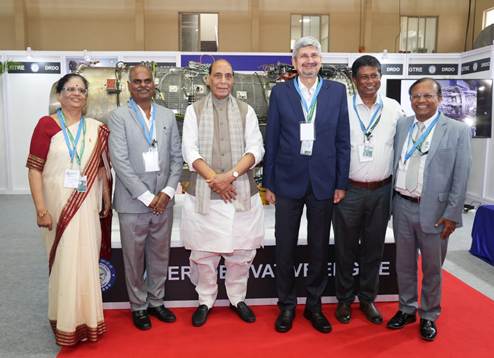
Secretary, Department of Defence R&D and Chairman DRDO Dr Samir V Kamat and senior scientists & officials of GTRE were present on the occasion.

image005SB9W.jpg


****
 
I could be wrong, but the only thing RR is known to be working on that Safran isn't (at least not publicly) is a 6th gen variable cycle engine. But then the RR variable cycle engine is meant for the Tempest/GCAP where Japan & Italy are partners. Japan's IHI & Italy's Avio are also involved with RR in the development of the GCAP's engine.

How does this development square with them? These 2 countries are "full members" of the GCAP, we are not. I can't imagine they would want to lose any workshare to us. Only way they will agree to this is if we join the GCAP, or if we have some proven tech/capability that is critical for this engine. Or maybe they desperately need funding. IDK.

Conversely, we are developing this 120-140 kN TF engine with Safran. That engine will go into the AMCA Mk2. A variant of that engine would probably go into the SCAF. Safran would eventually need to develop a variable cycle engine for the SCAF. So why not just combine 5th gen & 6th gen engines and pitch it for joint development.

5th gen engine with Safran, 6th gen with RR. Feels like we have stepped onto two boats at the same time. Let's see if we get some clarity.
 
I could be wrong, but the only thing RR is known to be working on that Safran isn't (at least not publicly) is a 6th gen variable cycle engine. But then the RR variable cycle engine is meant for the Tempest/GCAP where Japan & Italy are partners. Japan's IHI & Italy's Avio are also involved with RR in the development of the GCAP's engine.

How does this development square with them? These 2 countries are "full members" of the GCAP, we are not. I can't imagine they would want to lose any workshare to us. Only way they will agree to this is if we join the GCAP, or if we have some proven tech/capability that is critical for this engine. Or maybe they desperately need funding. IDK.

Conversely, we are developing this 120-140 kN TF engine with Safran. That engine will go into the AMCA Mk2. A variant of that engine would probably go into the SCAF. Safran would eventually need to develop a variable cycle engine for the SCAF. So why not just combine 5th gen & 6th gen engines and pitch it for joint development.

5th gen engine with Safran, 6th gen with RR. Feels like we have stepped onto two boats at the same time. Let's see if we get some clarity.
Surprised to know rr is collaborating in aero engines too, afaik of different category than amca one.


Also

Forget about all this?

Rolls-Royce is partnering with the Indian Navy to design and develop India's first even hybrid-electric warship engine, featuring advanced hybrid-electric propulsion systems and the powerful MT30 marine gas turbine
Besides the MT30, Rolls-Royce's MTU S4000 engines are already used in Indian Navy fast patrol vessels, with plans for local manufacturing.

The collaboration, highlighted during the UK Carrier Strike Group’s visit to Mumbai (featuring the HMS Prince of Wales), aims to foster local engineering, manufacturing, and supply chain growth in India.

Statement of Intent (SoI) on Electric Propulsion: Signed on November 28, 2024, in Portsmouth, this agreement focuses on the co-design, co-creation, and co-production of electric propulsion systems for future Indian naval ships, specifically next-generation Landing Platform Docks (LPDs).

Inter-Governmental Agreement (IGA): In October 2025, Prime Ministers from both nations announced the intent to finalize a formal IGA to solidify long-term cooperation on maritime electric propulsion systems.

Rolls-Royce and HAL Partnership: A critical commercial MoU exists with Hindustan Aeronautics Limited (HAL) to establish packaging, installation, marketing, and services for the MT30 marine engines in India, enabling local support and eventual indigenisation.

Triveni Engineering MoU: As of February 6, 2025, Rolls-Royce Marine North America signed an MoU with Triveni Engineering & Industries to collaborate on 4MW marine gas turbine generators for the Indian Navy, further expanding the local manufacturing ecosystem.


Many other articles too.

Source: The Economic Times Rolls-Royce sets sights on powering India's first electric warship - The Economic Times


There is lot of confusion going on wrt to aero engine programs after the talks of collaboration with RR for next gen aero engines. But as of now -

1. India & Safran JV 120-140 KN engine for AMCA MK2 is confirmed.

2. Than what's up with RR ? ...it could be - JV for 6th gen VCE engine.
- Upgradation of Kaveri core
- Naval propulsion system

3. AMCA MK2 & FCAS timelines are approx same ~2040....and FCAS project is on the verge of collapsing so most probably france will go solo on this program.
Merging both 5th gen & 6th gen ( for FCAS ) into a single JV program will be an another option to look out for.

Is there any information regarding AMCA MK2 120-140KN engine is VCE engine or not ?
It can be developed as VCE ready core that can evolve into adaptive architecture later.