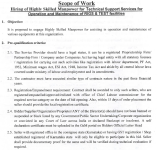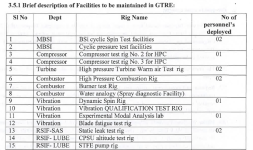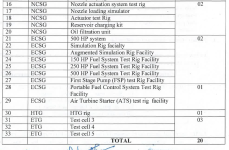
Most of the facilities built with OEM involvement are usually reserved for OEm orders only, ie only Safran orders would be catered via that line. I wonder if this is true for the new facility we see here too or not.
Indian Indigenous Aero Engine Developments
- Thread starter Ashwin
- Start date
-
- Tags
- hal htfe-25 htse-1200 manik nal
You are using an out of date browser. It may not display this or other websites correctly.
You should upgrade or use an alternative browser.
You should upgrade or use an alternative browser.


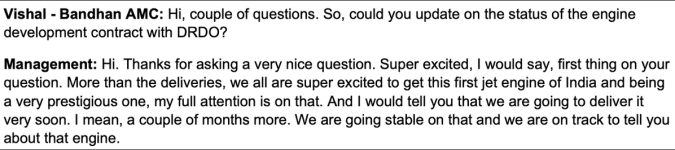
AZAD will supply the ATGG engine for the NASM-MR very soon
for reference

for reference

DIESEL ENGINE FOR RUSTOM-II UAV (Brochure DEFENCE EXPO 2020)
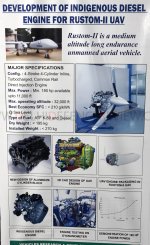
MAJOR SPECIFICATIONS :
Config. : 4-Stroke 4-Cylinder Inline, Turbocharged, Common Rail Direct Injection Engine
Max. Power : Min. 180 hp available upto 11,000 ft
Max. operating altitude : 32,000 ft
Best Economy SFC : < 210 g/kWh @ Sea Level
Type of Fuel : ATF K-50 and Diesel
Dry Weight : < 195 kg
Installed Weight : < 270 kg
DIESEL ENGINE FOR RUSTOM-II UAV (Brochure DEFENCE EXPO 2020)
Courtesy: Defence Decode


Diesel engine is developed by VRDE for RUSTOM-II UAV. Indigenously developed airworthy High power engine is producing take-off power of 180hp constant up to 11000 ft.
SALIENT FEATURES :
• Light weight cylinder block with aluminium alloy material
• Plasma iron coating on cylinder bore for wear resistance
• Deep skirt aluminium crankcase design
• Single speed gearbox with propeller pitch control
• Reduction gear box for higher thrust
• High power to weight ratio
• 2.5 kW aircraft alternator
• Indigenous full authority digital engine control (FADEC) system
• Proved target engine power at high altitude (11,000 ft and 17,500 ft)
• Engine performance, fuelling controls and starting strategy proved for higher altitudes
• Endurance testing successfully carried out for 500 hrs on accelerated mission cycle.
MAJOR SPECIFICATIONS :
Config. : 4-Stroke 4-Cylinder Inline, Turbocharged, Common Rail Direct Injection Engine
Max. Power : Min. 180 hp available upto 11,000 ft
Max. operating altitude : 32,000 ft
Best Economy SFC : < 210 g/kWh @ Sea Level
Type of Fuel : ATF K-50 and Diesel
Dry Weight : < 195 kg
Installed Weight : < 270 kg
DIESEL ENGINE FOR RUSTOM-II UAV (Brochure DEFENCE EXPO 2020)
Courtesy: Defence Decode
Diesel engine is developed by VRDE for RUSTOM-II UAV. Indigenously developed airworthy High power engine is producing take-off power of 180hp constant up to 11000 ft.
SALIENT FEATURES :
• Light weight cylinder block with aluminium alloy material
• Plasma iron coating on cylinder bore for wear resistance
• Deep skirt aluminium crankcase design
• Single speed gearbox with propeller pitch control
• Reduction gear box for higher thrust
• High power to weight ratio
• 2.5 kW aircraft alternator
• Indigenous full authority digital engine control (FADEC) system
• Proved target engine power at high altitude (11,000 ft and 17,500 ft)
• Engine performance, fuelling controls and starting strategy proved for higher altitudes
• Endurance testing successfully carried out for 500 hrs on accelerated mission cycle.
Last edited:
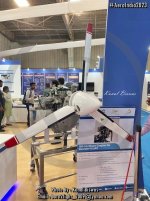
DIESEL ENGINE FOR RUSTOM-II UAV
Aero India 2023 (Courtesy: Kunal Biswas)

2178 cc Four stroke, Inline four cylinder, Common Rail Direct Injection, Turbocharged Diesel engine fitted with Constant speed Propeller.
Technology Used :
• Aluminum alloy light weight cylinder block
• Plasma Coating in cylinder bore
• Single Speed Reduction Gear box
• Indigenous Full Authority Digital Engine Control (FADEC) system having :
Single Lever Control
Automatic pitch control
Dual Channel, Redundant ECU
Engine Health Monitoring
Application : The engine developed for MALE UAVs.
Status : The prototype has been developed and performance proved at ground & high altitude at Leh (11,500 ft) and Changla (17,600 ft).
Industry Participation : M/s. Jayem Automotives Private Limited., Coimbatore.
Diesel Engine for MALE UAV (Images AERO INDIA 2023)
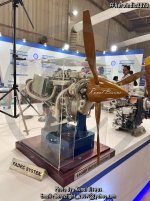
Aero India 2023 (Courtesy: Kunal Biswas)
2178 cc Four stroke, Inline four cylinder, Common Rail Direct Injection, Turbocharged Diesel engine fitted with Constant speed Propeller.
Technology Used :
• Aluminum alloy light weight cylinder block
• Plasma Coating in cylinder bore
• Single Speed Reduction Gear box
• Indigenous Full Authority Digital Engine Control (FADEC) system having :
Single Lever Control
Automatic pitch control
Dual Channel, Redundant ECU
Engine Health Monitoring
Application : The engine developed for MALE UAVs.
Status : The prototype has been developed and performance proved at ground & high altitude at Leh (11,500 ft) and Changla (17,600 ft).
Industry Participation : M/s. Jayem Automotives Private Limited., Coimbatore.
Diesel Engine for MALE UAV (Images AERO INDIA 2023)
Last edited:
Diesel Engine for MALE UAV (Images AERO INDIA 2025)
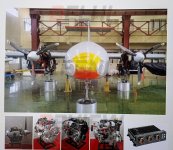
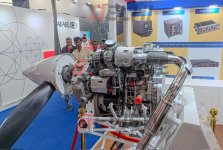
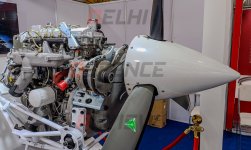
New Updates
MoD Annual Report 2024-25
Diesel Engine from Conversion of Automotive Engine for Rustom-II UAV
The high specific power airworthy diesel engine is being designed and developed for Tactical Airborne Platform for Advanced Surveillance (TAPAS) Unmanned Aerial Vehicle (UAV). Indigenously developed engine is capable of producing takeoff power of 180 hp and is expected to replace the imported engine which is currently integrated with TAPAS UAV. During 2024, 650 Hrs Beta Engine Design Validation testing was completed and Integration of Engine on R-II AF-9 Airframe & Engine Ground run through Ground Control Station (GCS) was successfully conducted
08 March 2025

Indigenous UAV Engine ground testing video report by Manish Kumar Jha of Sansad TV
Tapas UAV engine test : Push make in India story. I fully support this indigenous effort
FADEC system engine, flew 18000ft, it offers higher potential to go 32000ft. We should not kill it, rather nurture it, R&D on it.
I witnessed a great effort by this MSME.
New Updates
MoD Annual Report 2024-25
Diesel Engine from Conversion of Automotive Engine for Rustom-II UAV
The high specific power airworthy diesel engine is being designed and developed for Tactical Airborne Platform for Advanced Surveillance (TAPAS) Unmanned Aerial Vehicle (UAV). Indigenously developed engine is capable of producing takeoff power of 180 hp and is expected to replace the imported engine which is currently integrated with TAPAS UAV. During 2024, 650 Hrs Beta Engine Design Validation testing was completed and Integration of Engine on R-II AF-9 Airframe & Engine Ground run through Ground Control Station (GCS) was successfully conducted
08 March 2025
Indigenous UAV Engine ground testing video report by Manish Kumar Jha of Sansad TV
Tapas UAV engine test : Push make in India story. I fully support this indigenous effort
FADEC system engine, flew 18000ft, it offers higher potential to go 32000ft. We should not kill it, rather nurture it, R&D on it.
I witnessed a great effort by this MSME.
Last edited:


Safran steps up expansion in India for civil and military aviation and deepens commitment to “Make in India”
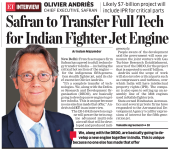
"We have agreed to... (IPR for critical parts) after getting a green light from the French government. I want to say we stand ready to both develop and make in India.”
He said " develop and produce" ! So, not just M-88 Indian version ? Will our academia get to be a part and learn stuff from non critical process?View attachment 48045
"We have agreed to... (IPR for critical parts) after getting a green light from the French government. I want to say we stand ready to both develop and make in India.”

View attachment 48045
"We have agreed to... (IPR for critical parts) after getting a green light from the French government. I want to say we stand ready to both develop and make in India.”
Those who barely fulfilled promise with turboshaft engines will give full IPR and ToT of 5th gen turbofans...
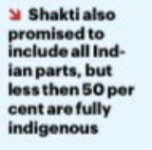
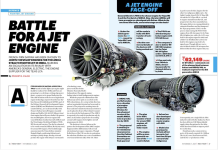
A lot of claims are made as part of the deal and pre-deal making as well. It remains to be seen if the promises will actually be fulfilled. There are certain clauses that sometimes allow the OEM to wiggle out of some parts of the contracts. If they do not wish to impart certain things to their local subsidiary, they can also resort to legal proceedings at the courts (if the contract is not watertight).He said " develop and produce" ! So, not just M-88 Indian version ? Will our academia get to be a part and learn stuff from non critical process?
It was just licence production of Ardiden 1H1 that too as a JV partner. No one ever promised IPR.Those who barely fulfilled promise with turboshaft engines will give full IPR and ToT of 5th gen turbofans...
It's about localisation, not IPR.It was just licence production of Ardiden 1H1 that too as a JV partner. No one ever promised IPR.

They pulled the same con with the Scorpene project. Result - the costs ballooned. Of course there were other reasons too.It's about localisation, not IPR.

HAL’s gas turbine engine project hit by delayed test-bed approvals, says Parliament panel
A comprehensive review by the Committee on Public Undertakings (CPU) has flagged persistent delays in Hindustan Aeronautics Limited’s (HAL) gas turbine engine development programme, with the panel cautioning that slow approvals for essential testing infrastructure continue to hinder progress.
HAL has been developing two aero-engines under its gas turbine engine programme – “a 25 kilo newton engine” for Intermediate Jet Trainer-class aircraft and a turboshaft engine for helicopters – sanctioned for Rs 441.41 crore, but with Stage II “ongoing since 2018 with no completion in sight.”
The Committee cited delays arising from the “failure to secure critical components on time, due to procurement bottlenecks and delayed approvals for test-bed construction,” as well as land clearance issues.
The Defence Ministry said material research “is being taken up by DMRL (DRDO) and MIDHANI,” with HAL placing orders of Rs 757.82 crore on MIDHANI. While acknowledging HAL’s efforts to partner with DRDO, MIDHANI and global engine makers, the Committee criticised the absence of a clear roadmap for critical testing infrastructure.
“The Ministry’s reply is interim in nature, as the core issue of developing dedicated test-bed infrastructure remains unresolved… The Committee, therefore, desires that the Ministry of Defence expedite this analysis and furnish a definitive action plan, with clear timelines and funding arrangements,” the panel said in its report. The panel emphasised that a “gap analysis… is a critical first step, but it is not the solution itself.”
The Twenty-Sixth Report of the CPU – presented to Parliament in December 2025 and chaired by Baijayant Panda – pulls up the Ministry of Defence (MoD) for failing to resolve long-pending gaps in test-bed facilities crucial for engine certification and development. The Committee comprises senior MPs from both Houses, including Tariq Anwar, Sudip Bandyopadhyay, Kanimozhi Karunanidhi, Milind Deora, John Brittas and Bhagwat Karad.
Indigenisation goals
The CPU cautioned that unless the Defence Ministry urgently operationalises the long-pending test-bed facility, the programme risks further delays, undermining the government’s Atmanirbhar Bharat plans in strategic aerospace systems. The Committee has asked the Ministry to keep it informed of progress and furnish final action-taken replies expeditiously.
Delayed approvals
The Committee reiterated concerns first raised in its Tenth Report, which underscored that the engine project had suffered time and cost overruns due to procurement hurdles and administrative delays. “One of the primary reasons for the delay is the failure to secure critical components on time, due to procurement bottlenecks and delayed approvals for test-bed construction,” it noted. It added that “land clearance approvals were delayed due to bureaucratic inefficiencies, adding more than three years to the project timeline.”
The prolonged delay has forced HAL to write off Rs 159.23 crore as costs it can no longer recover.
Indigenous challenges
Responding to the Committee, the Ministry highlighted the complexity of the project, stating, “HAL took up R&D of two engines pro-actively to become self-reliant… The critical components for such an engine are being designed and developed for the first time in the country and there has been a delay from the estimated time in redesigning them.” It further noted that engine technologies remain closely guarded internationally: “Very few countries in the world have matured gas turbine engine manufacturing technology and they do not transfer the complete technology.”
HAL has ongoing international partnerships – such as its joint venture SAFHAL with Safran Helicopter Engines – and domestic orders placed on MIDHANI for indigenous raw materials. The Ministry added that “a gap analysis of ground facilities for testing of airborne systems is being carried out.”
Not sure if the Govt or stakeholders actually take the SCOD reports as anything serious even though it is the most self criticism themed report out there. The reality of the self inflicted goal sadly.