Indian Indigenous Aero Engine Developments

HAL’s gas turbine engine project hit by delayed test-bed approvals, says Parliament panel


A comprehensive review by the Committee on Public Undertakings (CPU) has flagged persistent delays in Hindustan Aeronautics Limited’s (HAL) gas turbine engine development programme, with the panel cautioning that slow approvals for essential testing infrastructure continue to hinder progress.

HAL has been developing two aero-engines under its gas turbine engine programme – “a 25 kilo newton engine” for Intermediate Jet Trainer-class aircraft and a turboshaft engine for helicopters – sanctioned for Rs 441.41 crore, but with Stage II “ongoing since 2018 with no completion in sight.”

The Committee cited delays arising from the “failure to secure critical components on time, due to procurement bottlenecks and delayed approvals for test-bed construction,” as well as land clearance issues.

The Defence Ministry said material research “is being taken up by DMRL (DRDO) and MIDHANI,” with HAL placing orders of Rs 757.82 crore on MIDHANI. While acknowledging HAL’s efforts to partner with DRDO, MIDHANI and global engine makers, the Committee criticised the absence of a clear roadmap for critical testing infrastructure.

“The Ministry’s reply is interim in nature, as the core issue of developing dedicated test-bed infrastructure remains unresolved… The Committee, therefore, desires that the Ministry of Defence expedite this analysis and furnish a definitive action plan, with clear timelines and funding arrangements,” the panel said in its report. The panel emphasised that a “gap analysis… is a critical first step, but it is not the solution itself.”

The Twenty-Sixth Report of the CPU – presented to Parliament in December 2025 and chaired by Baijayant Panda – pulls up the Ministry of Defence (MoD) for failing to resolve long-pending gaps in test-bed facilities crucial for engine certification and development. The Committee comprises senior MPs from both Houses, including Tariq Anwar, Sudip Bandyopadhyay, Kanimozhi Karunanidhi, Milind Deora, John Brittas and Bhagwat Karad.

Indigenisation goals

The CPU cautioned that unless the Defence Ministry urgently operationalises the long-pending test-bed facility, the programme risks further delays, undermining the government’s Atmanirbhar Bharat plans in strategic aerospace systems. The Committee has asked the Ministry to keep it informed of progress and furnish final action-taken replies expeditiously.

Delayed approvals

The Committee reiterated concerns first raised in its Tenth Report, which underscored that the engine project had suffered time and cost overruns due to procurement hurdles and administrative delays. “One of the primary reasons for the delay is the failure to secure critical components on time, due to procurement bottlenecks and delayed approvals for test-bed construction,” it noted. It added that “land clearance approvals were delayed due to bureaucratic inefficiencies, adding more than three years to the project timeline.”

The prolonged delay has forced HAL to write off Rs 159.23 crore as costs it can no longer recover.

Indigenous challenges

Responding to the Committee, the Ministry highlighted the complexity of the project, stating, “HAL took up R&D of two engines pro-actively to become self-reliant… The critical components for such an engine are being designed and developed for the first time in the country and there has been a delay from the estimated time in redesigning them.” It further noted that engine technologies remain closely guarded internationally: “Very few countries in the world have matured gas turbine engine manufacturing technology and they do not transfer the complete technology.”

HAL has ongoing international partnerships – such as its joint venture SAFHAL with Safran Helicopter Engines – and domestic orders placed on MIDHANI for indigenous raw materials. The Ministry added that “a gap analysis of ground facilities for testing of airborne systems is being carried out.”
I'm absolutely stunned. I was under the impression HAL was an independent unit designated as a Maharatna by the GoI with near zero involvement of the MoD in its activities especially R&D.

Or at least that's what some members were claiming here some months ago on the AMCA thread.

Also shows the apathy to a home grown project by the IAF. It's clear that they've stuck their heads so deep up the Rafales a r s e they've neglected practically every other project solely to focus on the former to the detriment of the organisation & national security.

And we're supposed to be going up against China shortly....
 
I'm absolutely stunned. I was under the impression HAL was an independent unit designated as a Maharatna by the GoI with near zero involvement of the MoD in its activities especially R&D.

Or at least that's what some members were claiming here some months ago on the AMCA thread.

Also shows the apathy to a home grown project by the IAF. It's clear that they've stuck their heads so deep up the Rafales a r s e they've neglected practically every other project solely to focus on the former to the detriment of the organisation & national security.

And we're supposed to be going up against China shortly....

IAS officers who cannot differentiate between an howitzer and a tank are at the helm of affairs.

Add the top jockers in the Indian Armed Forces, claiming the 1st place since 2014 atleast. The IAF.

And finally a country which is 5 times poorer than China, trying to achieve a breakthrough in engine technology by further dividing it's efforts into 2, effectively making India's engine efforts 10times slower than that of China.
 
IAS officers who cannot differentiate between an howitzer and a tank are at the helm of affairs.

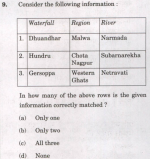
Sir, perhaps you're unaware that UPSC exams are the toughest in the universe! Perhaps you should try answering all-together useful questions like the following -- after all who knows when it might come up and wi-fi isn't working!
1765652572871.png

On a more serious note, supposedly these future bureaucrats have to answer questions related to ethics (if only to confront their own moral compass for a millisecond) -- where does that vanish? And more importantly, are these tests generating problem solvers? Or just sh*tting out those that min-max wrote memorization with no ability or desire to deal with real world problems?
 

CEO | Founder Gonagoor Technology Solutions
Well I met an guy who was in GTRE but left it later and he said they had papers about engine math from Russia which he couldn't understand. However I am skeptical about this guys claim. Indians always promise the moon and criticize but execution is 0. Kaveri actually exists in a physical form and does work in some form, believing this random twitter guy for a complete makeover is difficult, he seems to think it's only a math problem and not a metallurgy problem. In anyways Kaveri will likely power the UCAV which is coming in the 2030s.
 

His website says they have worked with GTRE, DRDO and InSpace

Quoting his other replies here

On GTRE math being wrong
We were right inside gtre, and have studied and seen all aspects of the Kaveri engine.
If the math was right the thrust will be perfect.

If they have materials then the engine must have been there as well. Accusation is a part of scientific discoveries

On test facilities
Facilities are available which must first be used. Later a dedicated one can be made as well.

On the engine
It's also that we have engines, but a total disconnect between the requirements and design translating to such problems.
Time to fix it and using the past experiences just as learnings
We saw the entire engine Bikram and examined lot more aspects. Afterburner is an issue there are a lot more issues as well. It needs a complete overhaul.

Kaveri Engine weight issue
There are material thickness issues in key sections, welding issues causing reverse sir flows, pump motor line issues which we know about.

Engine is not bulky, shaft heaviness is an issue.
A clean design helps us to forget the past and start with a new min
 
  • Like
Reactions: YoungWolf
PTI report

British aero-engine maker Rolls-Royce is exploring making India its third “home market” outside the UK, as it looks to unlock opportunities across jet engines, naval propulsion, land systems and advanced engineering, a senior executive said.

In an interview with PTI, Sashi Mukundan, Executive Vice-President of Rolls-Royce India, said the company is planning a significant investment in the country, with the development of a next-generation aero engine for India’s Advanced Medium Combat Aircraft (AMCA) programme emerging as a key priority.

Besides the UK, Rolls-Royce considers the US and Germany as its home markets, where it has a substantial presence, including manufacturing facilities.

Focus on AMCA engine development​


Mukundan said extensive discussions are underway on partnering with India to develop engines for the AMCA programme, which is expected to power the Indian Air Force’s future combat aircraft.

“If India is thinking about next-generation engines, Rolls-Royce is probably the best partner. We have the capability, the experience both in India and globally, and we have repeatedly demonstrated that we can do it,” he said.

He added that all engine design work could be undertaken in India, with technology transfer and joint ownership of new intellectual property rights.

“Once you own design IP, you have strategic control. Manufacturing then becomes the next stage, which needs to be built systematically and safely,” Mukundan said.

Investment plans and defence partnerships​


While declining to share specific numbers, Mukundan said the proposed investment would be large enough to be noticeable and would focus on developing the entire value chain across the sectors in which Rolls-Royce operates.

“If everything goes well, it would be a significant investment. What matters is the impact — the development of the ecosystem across defence, manufacturing and advanced engineering,” he said.

Rolls-Royce is also set to firm up two memorandums of understanding with Indian defence public sector undertakings — one for manufacturing engines for the Arjun main battle tank and another for engines for future-ready combat vehicles.

In October, Rolls-Royce CEO Tufan Erginbilgic had conveyed to Prime Minister Narendra Modi that India would play a critical role in the company’s future growth.

“We have developed two other home markets outside the UK — the US and Germany. We want to make India our next one,” Mukundan said.

Naval propulsion and electric systems​


Mukundan said Rolls-Royce could play a significant role in meeting India’s requirements for electric and hybrid propulsion systems for the Navy, helping enhance combat capabilities.

He explained that electric and hybrid naval propulsion systems are derived from aero engine cores and that Rolls-Royce is among the few global players with the capability to “marinise” aero engines at scale.

“If the aero-core derivative is co-designed and built in India, the overlapping supply chain can support both aero and naval marine applications,” he said, adding that building a standalone marine propulsion ecosystem would not be viable given the Navy’s limited volumes.

Mukundan highlighted Rolls-Royce’s experience in developing and certifying engines across commercial and combat aviation.

India as a long-term strategic base​


Mukundan said India’s policy clarity, scale and strong push towards building indigenous defence and industrial capabilities made it a natural strategic base for the company.

“The Indian government’s focus on building domestic capability across naval, land and air domains is very visible,” he said.

“Over the long term, India will be a major global power. For Rolls-Royce, that makes India not just an important market, but a long-term strategic home.”
 

G_1pYo9bUAk_md8


GTRE EOI out for Indian DcPP for 120kN high thrust engine.

18 engines to be delivered.

Companies aiming to become Development-cum-Production Partner (DcPP) for India’s Advanced High Thrust Class Engine (AHTCE) programme must meet strong financial benchmarks:

▪️ ₹1,500 Cr minimum consolidated annual turnover

▪️ ₹1,500 Cr minimum consolidated net worth

▪️ At least 3% consolidated revenue growth in 3 of last 5 years

▪️ Minimum credit rating of BBB+ (Stable) or equivalent

▪️ Must not be under insolvency proceedings
 
Last edited by a moderator:
Our current best blades are 3rd gen CMS4, right?

Something we can produce and use in the engines

18 engines to be delivered.

Companies aiming to become Development-cum-Production Partner (DcPP) for India’s Advanced High Thrust Class Engine (AHTCE) programme must meet strong financial benchmarks:

▪️ ₹1,500 Cr minimum consolidated annual turnover

▪️ ₹1,500 Cr minimum consolidated net worth

▪️ At least 3% consolidated revenue growth in 3 of last 5 years

▪️ Minimum credit rating of BBB+ (Stable) or equivalent

▪️ Must not be under insolvency proceedin


18 engines to be delivered.

Companies aiming to become Development-cum-Production Partner (DcPP) for India’s Advanced High Thrust Class Engine (AHTCE) programme must meet strong financial benchmarks:

▪️ ₹1,500 Cr minimum consolidated annual turnover

▪️ ₹1,500 Cr minimum consolidated net worth

▪️ At least 3% consolidated revenue growth in 3 of last 5 years

▪️ Minimum credit rating of BBB+ (Stable) or equivalent

▪️ Must not be under insolvency proceedings
I've been waiting for this for years now

This is easily the most important project of ours
 
Does anybody know what the status of high altitude facility (INDRA), and it’s specs

people are hush hush about testing facilities and even rajankunte you wont find much details