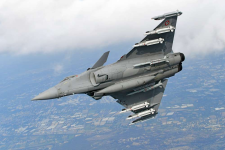
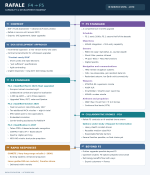
The Rafale and what you know about it.

This video is in French, so to make it easier to understand, I will summarise it. It is an interview with the General in charge of the DMAE and his deputy Colonel, who talk to us about the maintenance of the Rafale and the work it undergoes during its operational life.
 
  • Like
Reactions: Amarante
1. Starting point: availability is not a ‘bonus’, it is a prerequisite for operational existence

The Saphir exercise (February 2024) serves as a revealing example here: around Mont-de-Marsan, intense activity is sought not for ‘show’, but to test the ability to maintain a pace: the goal is to have 20 aircraft available, each capable of flying several missions per day, over five days, resulting in nearly 200 sorties. The real objective is a ‘high-intensity’ ramp-up, where the value of a weapons system is measured as much by its tactical effectiveness as by its ability to remain operational.

With this in mind, the central argument is clear: the best aircraft in the world is useless if it does not fly when needed. However, modern aircraft are becoming increasingly complex: availability is becoming a challenge, and it depends less on slogans than on a support architecture that is designed, contracted, managed and constantly adjusted.

The Rafale stands out, including through feedback from abroad (India, Greece) citing up to 90% technical availability. The question therefore becomes: what is it about the initial design and support organisation that makes these levels achievable, and what do they really mean?

2. Role of the DMAé: ‘project management’ of in-service support

The DMAé is defined, in programme vocabulary, as a project manager: it enters into the necessary contracts to enable the forces to fly, and organises the industrial ecosystem (engineers, technicians, workers) to ensure availability.

The financial order of magnitude is given at the joint level (Air and Space Force, Navy, ALAT): approximately €4 billion in payments (by 2025) for more than 45 fleets and approximately 1,200 aircraft. The scope is clarified: it covers support and maintenance (not fuel), as well as minor developments and ‘support’ innovation. The major armament standards (development/production/delivery) remain the responsibility of the DGA; the DMAé is mainly involved in the utilisation phase.

This separation of roles is essential: it structures the interface between capability trajectories, activity trajectories and industrial reality.

3. How an annual availability target is set: from policy to execution

The diagram is presented as a chain:
  • Political intention (white papers)
  • Budgets and trajectories (LPM): capability trajectories and activity trajectories
  • Annual breakdown: discussion/negotiation between the DMAé and the armed forces to translate missions, exercises, contingencies and economic conditions into activity targets and therefore availability targets.
The typical example given: a fleet of 100 Rafale aircraft and an operational requirement for 60 aircraft in service, with a target average activity (illustrative example) of 250 hours/year. Availability is not an isolated figure: it is a management variable for delivering useful flight hours, distributed according to training, ramp-up, operational preparation and projection.

The discussion is not a one-off event: it is held annually and then monitored during implementation, with adjustments made as necessary.

4. Availability: the industrial commitment covers the fleet, and maintenance work ‘pulls down’ the average

One major point, which is often misunderstood, needs to be clarified: contractual availability is calculated for the fleet as a whole (not on a per-aircraft basis) and includes downtime due to maintenance work (modernisation, repairs, corrosion, etc.). Each aircraft does have its own ‘specific’ availability, but the contract commits the manufacturer to an average value for the entire fleet.

The fleet is heterogeneous: some aircraft are older, have undergone more wear and tear, or are in ‘better shape’. Manufacturers must organise themselves: for example, a maximum simultaneous unavailability linked to a type of work (1, 2 or 3 aircraft out of 100) is set, then schedules are negotiated in line with user requirements.

The key idea is that of ongoing dialogue between the DMAé, the armed forces and industry to minimise the impact of work while maintaining activity.

5. Continuous modernisation: F4 standards and long projects, managed through optimisation

Modernisation is described as structural: F4.1, then F4.2, then F4.2 block 2+; in the longer term, discussions on F4.3 / block 3 and on tranche 5T carrying F5. For F4.1, the key point is the duration: we are talking about a project lasting several months, with an order of magnitude given as five months per aircraft (from memory, indicated as such), which necessarily implies a gradual transformation over several years.

The text emphasises two mechanisms:
  • the initial intention (mainly software standard) can be loaded over time as opportunities arise (helmet visor, canopy/tiles modifications, etc.);
  • optimisation is carried out through combined projects (retrofit + maintenance visits) to avoid sequential accumulation of downtime.
The heterogeneity of ‘sensors/equipment’ is seen as an asset but also a burden: old generation OSF vs NG OSF, PESA vs AESA, SPECTRA, DDM and TALIOS developments, navigation, interoperability. There is no such thing as a ‘monolithic Rafale’: there is a fleet with multiple configurations, whose interoperability and support must be guaranteed.

The philosophy can be summarised as follows: an aircraft that no longer evolves is often an aircraft at the end of its life. The Rafale, designed in the 1980s and entered service in the 2000s, is designed to last; therefore, it must evolve, which requires work. The cost of a renovation (even one that immobilises the aircraft) remains, according to them, much lower than a new acquisition: this is a rational approach to the life cycle.

6. Small size, high efficiency, ‘rustic’ projection: a coherent system

The fleet figures are outlined in broad terms: approximately 100+ Rafales for the Air and Space Force, 41 for the Navy, i.e. less than 150 aircraft (excluding the Mirage 2000). The argument put forward is that multi-role efficiency and the ability to withstand intensive exercises (leaving early, returning late, carrying out ‘all missions’) allow for a smaller format than some of its counterparts.

Projection is described as a marker: the ability to project three Rafales, with an A400M and an MRTT, quickly and far, with a limited footprint. This robustness is understood here in the sense of ‘easily deployable’ rather than ‘technologically simple’.

In the background, industry is explicitly recognised as a component of success (Dassault, Safran, Thales), with a relationship structured by contractual incentives: we are not in an ideal world, but in a controlled world.
 
7. Contingencies and accidents: repair, arbitration, and management of ‘potential hours’

A case of a serious incident (collision, structural damage) is used to describe the mechanics: securing, technical report, dialogue between DMAé–DGA–industry, costing and repair plan (technical expertise), technical and financial proposal, negotiation, launch of work, then return to airworthiness (authorities involved cited: technical authority, DGA, employment authority, DSAé).

Two key ideas:
  • major repairs take time (design office, workshop), but the process is structured;
  • the impact on flight hours is handled through fleet management: the fleet is a reservoir of hours. Based on a target of 250 hours/year on average, certain aircraft can be ‘pushed’ more at times (over 1–3 years) and then compensated for by reducing their activity, shifting the load to other aircraft (a logic already seen in targeted retrofits, particularly in the Navy).
The director paints a picture: not every aircraft flies exactly 250 hours per year, but over ten years, the average is maintained through potential management discipline, as the fleet must be kept going until a successor arrives.

8. Interface tools: support management centres (PCS)

PCSs are presented as a practical local interface that enables direct dialogue between the armed forces, industry and the DMAé, particularly when unexpected events occur: accidents, serious technical incidents (severity 1), airworthiness issues, quarantine decisions, risk assessments.

The PCS also serves as a mechanism for transparency on industrial constraints (e.g. supply chain tension) and operational needs (e.g. increased activity), so that everyone can anticipate and propose solutions.

9. ‘Cocooned aircraft’: past logic, different present context

The text indicates that in the mid-2010s, it may have been appropriate to put certain Rafale aircraft ‘in storage’ (potential regeneration), partly because not all aircraft were at the same level of equipment (e.g. AESA) and because the fleet structure (Mirage 2000 still numerous) offered margins.

Today, the diagnosis is clear:
  • the minimum standard is high (F3R widespread; old F2/F3.2 aircraft gone ‘from the top’);
  • the question is no longer ‘should we use this Rafale?’ but ‘we don't have enough’;
  • there is no ‘stock’ of Rafales: no dormant fleet;
  • the fleet is at full capacity: ‘every percentage point of availability is a battle’, and the margins are very small; losing a significant number of aircraft in combat would immediately become an issue.
The heterogeneous fleet (sensors and definitions) is recognised as both an asset and a liability.

10. The conceptual key: condition-based maintenance (testability + localisation + accessibility)

This is the doctrinal core of maintenance.

10.1 Principle

Condition-based maintenance aims to base maintenance on the actual condition observed, via sensors and integrated testability, rather than on a scheduled plan of periodic visits.

10.2 Requirements

The system imposes stringent requirements:
sensors and measurements everywhere (from the design stage);
software to operate these measurements (drift detection, predictive, fault detection);
above all: very high fault localisation rate, to avoid removing several pieces of equipment ‘for safety reasons’.

10.3 Operational execution

Consequences:
  • fault reporting via maintenance pages;
  • information available to the crew;
  • data collation on return from mission;
  • rapid standard exchange before the next flight.
A striking example is given: an engine can be changed in less than an hour, allowing for a very quick return to flight, whereas older aircraft require more time and space (e.g. Mirage 2000: half a day, larger team, more space).

10.4 Physical accessibility

Condition-based maintenance is reinforced by a highly advanced accessibility design: ‘hatches everywhere’, logical routing, avoiding the need to remove one piece of equipment to reach another. The absence of hatches on some ‘smooth’ aircraft is presented as a negative factor for maintainability.

10.5 Compromise with stealth

The compromise is accepted: opening hatches complicates electromagnetic stealth; therefore, the desired stealth must remain compatible with maintainability. The Rafale is positioned for ‘reasonable’ stealth (better than the Mirage 2000) so as not to sacrifice access.

10.6 Lesson in methodology

The thesis is explicit: this level of ambition cannot be ‘added’ after the fact. It must be specified from the outset, for all equipment, in a comprehensive manner, because any airworthiness failure counts for the crew.

11. MCO cost: delicate comparisons, but clear life cycle logic

The argument rejects a raw comparison between the Mirage 2000 and the Rafale at a late stage, as the cost depends on the stage of the life cycle: fewer aircraft, obsolescence, fixed costs spread over a smaller base, etc. The Mirage 2000 should be compared ‘at the heart of its life’ with the Rafale ‘at the heart of its life’.

However, two ideas remain:
  • modern aircraft are more densely equipped and integrated (analogy with Motorola vs iPhone);
  • competitiveness can be seen in the export market: price and maintainability are attractive enough that Mirage nations have switched to Rafale.
On heavy inspections, the text specifies: Rafale does not exclude ‘stripping’ operations, but these are often carried out opportunistically during capacity upgrades and ageing checks (corrosion, cracks, etc.), rather than in the form of major periodic inspections that immobilise the aircraft.

12. Logistical footprint and projection: maintenance load as a strategic variable

The maintenance load is presented as an initial, contractual requirement, followed standard after standard, including F5: do not increase the load, as this means more mechanics (a scarce resource) and reduced exportability.

Projection benefits from the ‘as-needed’ approach: there is less need to bring along a logistics train corresponding to a scheduled maintenance plan; a backup batch is carried, and the footprint is reduced. Comparative example provided: Mirage 2000 deployment with 16 trucks (cited experience), versus Pégase-type Rafale projection models (three Rafale + MRTT + A400M).

The text also mentions the prospect of sharing parts with partners (subject to agreements and airworthiness constraints) and the arrival of optimisation/predictive tools to reduce tasks and adapt maintenance to constrained environments (Africa vs mainland France).

13. High intensity: five DMAé axes (preparation, expertise, supply chain, innovation, organisation)

The ‘high intensity’ sequence is structured around five axes:
  • Preparation: increasing exercises, crisis maintenance, aircraft tours, dispersion, remote projection.
  • Technical expertise: re-acculturation to combat damage; rapid repair as close as possible; switch to degraded operation; use of degraded modes provided for in the design (redundancies, acceptable partial losses).
  • Key concept: ORM (operational risk management); accepting different levels of risk depending on the context (illustrated by the transition from 10-6 to 10-4).
  • Supply chain: balance between stocks and flows; impossibility of storing everything everywhere; need for a rear base and ramp-up of spare parts.
  • Innovation: use of maintenance and ageing data, optimisation of fleet management (choosing ‘the 30 best’ out of 100 for projection), logistical anticipation; diagnostic tools, NDT, additive manufacturing, decision support, demonstrators.
DMAé organisation: ability to contract more quickly, adapt contracts and processes without losing rigour, typical objective: to achieve in one month what would normally take nine months.

All of this is put into perspective: these approaches must be identified upstream in strategies to support future systems (Rafale F5, drone, SCAF).

14. Conclusion: the Rafale as a sustainable programme and general lesson

The director concludes by presenting the Rafale as a major post-war programme, not only because of its design and export success, but also because of user satisfaction with an aircraft that is efficient, versatile and easy to maintain in operational terms.

The lesson learned is a rule of method:

when essential support requirements are integrated upstream, the programme runs more smoothly because the user is satisfied and long-term development remains possible on a basis accepted by the armed forces.
 
Last edited:
The Rafale F5: an opportunity to create a sovereign, real-time cloud.

The war in Ukraine has revealed a profound transformation in modern warfare: operational superiority now depends as much on data infrastructure as on combat platforms themselves. The ability to connect sensors, drones, aircraft, command centers, and ground forces has become the true backbone of operations. In this context, low-orbit satellite constellations have emerged as a decisive element of resilience. Starlink has provided the most visible illustration of this.

But this development raises a fundamental strategic question for Europe: can it continue to depend on private or foreign infrastructure for its military information architecture? The most realistic answer is probably not to replicate the American model, but to gradually build a distributed architecture based on existing capabilities in Europe. The Rafale F5 could serve as a catalyst for this construction.

The planned evolution of the Rafale F5—cooperation with drones, advanced data fusion, extended electronic warfare, and increased sensors—implies a change of scale in the flow of information. Platforms will need to exchange much more data much more quickly. To support this collaborative combat model, it makes sense to rely on an orbital infrastructure capable of providing robust, distributed, and sovereign connectivity.

However, this infrastructure should not be designed as a centralized decision-making center. A truly robust military architecture must remain distributed. Each platform must retain its capacity for autonomous decision-making and action. The network is not a brain, but a backbone that carries information, synchronizes observations, and allows a coherent picture of the situation to be reconstructed.

In this context, Europe already has several essential building blocks. Military satellites such as Syracuse provide the most sensitive strategic communications. Galileo provides an independent navigation and synchronization reference. The OneWeb and IRIS² projects form the basis of a low-orbit constellation capable of transporting operational data flows. By combining these elements, it becomes possible to gradually build a distributed architecture capable of supporting air, naval, and land operations.

But a new element could profoundly transform the scope of this project: the involvement of India.

India currently occupies a unique geopolitical position. It seeks to preserve its strategic autonomy vis-à-vis the major powers while rapidly developing its industrial and technological capabilities. It already has a solid space program, growing experience in satellites, and clear ambitions in the fields of defense and artificial intelligence. It is also already linked to the OneWeb ecosystem, one of whose main shareholders is the Bharti group.

In this context, a European orbital architecture involving India would offer several major advantages.

First, it would offer much greater strategic and geographical depth. A constellation developed jointly by Europe and India would naturally cover the Euro-Mediterranean area, the Indian Ocean, and a large part of the Indo-Pacific. This geographical continuity would considerably strengthen the system's resilience and broaden its military and civilian applications.

Second, it would allow for the sharing of the industrial and financial effort required to set up a large constellation. Modern space infrastructure requires considerable investment. A Franco-Indian partnership extended to Europe would allow these costs to be shared while ensuring shared political control between strategic partners.

Such a partnership would also be clearly consistent with the growing cooperation between France and India in the field of defense. The Rafale is already a pillar of this relationship. Ongoing cooperation on fighter jet engines for the AMCA program is another. From this perspective, the development of a common orbital infrastructure would be a logical extension of this cooperation.

For the Rafale F5 and its successors, the existence of such an architecture would offer new capabilities: distributed sharing of radar observations, coordination with accompanying drones, beyond-line-of-sight communications relays, rapid updating of threat databases, and post-mission exploitation of collected data. Above all, it would ensure that these information flows remain under the control of strategic partners who share the same vision of technological autonomy.

Ultimately, this architecture could evolve into a genuine collaborative combat infrastructure linking European and Indian forces. It could serve as a basis for joint operations, multinational exercises, or maritime security missions in the Indian Ocean. It would also offer a credible alternative to infrastructures dominated by the major technological powers.

Such a development would not necessarily be incompatible with NATO. On the contrary, it could be complementary. The United States would retain its own global architecture, while Europe would have a system capable of supporting its operations autonomously when necessary. In this context, the Euro-Indian infrastructure could constitute a second technological pillar, interoperable with NATO but not dependent on it.

In a world where alliances are becoming more flexible and technological sovereignty is becoming a central issue, such a project would make strong strategic sense. It would link two large democratic areas—Europe and India—around a shared orbital infrastructure capable of supporting their economic ambitions, space programs, and defense capabilities.

From this perspective, the Rafale F5 could be more than just an evolution of a fighter jet. It could become one of the catalysts for a new strategic architecture linking Europe and India in orbital space. A distributed, resilient, and sovereign architecture, adapted to the information warfare that now characterizes the 21st century.

Satellites can be physically shared but logically separate. This is already how several modern space systems operate. Three levels can be imagined:
  • sovereign national level
  • coalition/partnership level
  • civilian or dual level
Each country then has its own cryptographic layer and its own keys. In concrete terms:
  • the satellites transport the data
  • but only users with national keys can read it.
  • This amounts to creating several superimposed networks within the same constellation.
 
We are going for 24 F5 standard Rafale. Maybe, in future we would increase its order to over 50 or 60. But unfortunately most of our Rafales would be of F4+ standard.
 
The Rafale F5: an opportunity to create a sovereign, real-time cloud.

The war in Ukraine has revealed a profound transformation in modern warfare: operational superiority now depends as much on data infrastructure as on combat platforms themselves. The ability to connect sensors, drones, aircraft, command centers, and ground forces has become the true backbone of operations. In this context, low-orbit satellite constellations have emerged as a decisive element of resilience. Starlink has provided the most visible illustration of this.

But this development raises a fundamental strategic question for Europe: can it continue to depend on private or foreign infrastructure for its military information architecture? The most realistic answer is probably not to replicate the American model, but to gradually build a distributed architecture based on existing capabilities in Europe. The Rafale F5 could serve as a catalyst for this construction.

The planned evolution of the Rafale F5—cooperation with drones, advanced data fusion, extended electronic warfare, and increased sensors—implies a change of scale in the flow of information. Platforms will need to exchange much more data much more quickly. To support this collaborative combat model, it makes sense to rely on an orbital infrastructure capable of providing robust, distributed, and sovereign connectivity.

However, this infrastructure should not be designed as a centralized decision-making center. A truly robust military architecture must remain distributed. Each platform must retain its capacity for autonomous decision-making and action. The network is not a brain, but a backbone that carries information, synchronizes observations, and allows a coherent picture of the situation to be reconstructed.

In this context, Europe already has several essential building blocks. Military satellites such as Syracuse provide the most sensitive strategic communications. Galileo provides an independent navigation and synchronization reference. The OneWeb and IRIS² projects form the basis of a low-orbit constellation capable of transporting operational data flows. By combining these elements, it becomes possible to gradually build a distributed architecture capable of supporting air, naval, and land operations.

But a new element could profoundly transform the scope of this project: the involvement of India.

India currently occupies a unique geopolitical position. It seeks to preserve its strategic autonomy vis-à-vis the major powers while rapidly developing its industrial and technological capabilities. It already has a solid space program, growing experience in satellites, and clear ambitions in the fields of defense and artificial intelligence. It is also already linked to the OneWeb ecosystem, one of whose main shareholders is the Bharti group.

In this context, a European orbital architecture involving India would offer several major advantages.

First, it would offer much greater strategic and geographical depth. A constellation developed jointly by Europe and India would naturally cover the Euro-Mediterranean area, the Indian Ocean, and a large part of the Indo-Pacific. This geographical continuity would considerably strengthen the system's resilience and broaden its military and civilian applications.

Second, it would allow for the sharing of the industrial and financial effort required to set up a large constellation. Modern space infrastructure requires considerable investment. A Franco-Indian partnership extended to Europe would allow these costs to be shared while ensuring shared political control between strategic partners.

Such a partnership would also be clearly consistent with the growing cooperation between France and India in the field of defense. The Rafale is already a pillar of this relationship. Ongoing cooperation on fighter jet engines for the AMCA program is another. From this perspective, the development of a common orbital infrastructure would be a logical extension of this cooperation.

For the Rafale F5 and its successors, the existence of such an architecture would offer new capabilities: distributed sharing of radar observations, coordination with accompanying drones, beyond-line-of-sight communications relays, rapid updating of threat databases, and post-mission exploitation of collected data. Above all, it would ensure that these information flows remain under the control of strategic partners who share the same vision of technological autonomy.

Ultimately, this architecture could evolve into a genuine collaborative combat infrastructure linking European and Indian forces. It could serve as a basis for joint operations, multinational exercises, or maritime security missions in the Indian Ocean. It would also offer a credible alternative to infrastructures dominated by the major technological powers.

Such a development would not necessarily be incompatible with NATO. On the contrary, it could be complementary. The United States would retain its own global architecture, while Europe would have a system capable of supporting its operations autonomously when necessary. In this context, the Euro-Indian infrastructure could constitute a second technological pillar, interoperable with NATO but not dependent on it.

In a world where alliances are becoming more flexible and technological sovereignty is becoming a central issue, such a project would make strong strategic sense. It would link two large democratic areas—Europe and India—around a shared orbital infrastructure capable of supporting their economic ambitions, space programs, and defense capabilities.

From this perspective, the Rafale F5 could be more than just an evolution of a fighter jet. It could become one of the catalysts for a new strategic architecture linking Europe and India in orbital space. A distributed, resilient, and sovereign architecture, adapted to the information warfare that now characterizes the 21st century.

Satellites can be physically shared but logically separate. This is already how several modern space systems operate. Three levels can be imagined:
  • sovereign national level
  • coalition/partnership level
  • civilian or dual level
Each country then has its own cryptographic layer and its own keys. In concrete terms:
  • the satellites transport the data
  • but only users with national keys can read it.
  • This amounts to creating several superimposed networks within the same constellation.

"shared political control"

"common orbital infrastructure"

I snorted as soon as I read these lines.

Absolute zero chance of this happening. Joint development is possible, but whatever we create will be entirely distinct from a pan-Indo-European "shared" system.

Strategic autonomy by definition is not shared. India's main goal is neutrality. Which means someday this network will be used to attack a friend of India, like some poor African country, and similarly India will attack a friend of Europe, like China. In both cases either side will object and defeat the purpose of the "shared" network leaving both sides vulnerable. This network will also be taken over the whims and fancies of member states in the EU where a 40 yo childless Karen PM of a country with a population smaller than my neighborhood gets to have a say over the defense needs of a fifth of humanity on the other side of the planet. No, thank you.

And I'm sure this will be a "democratic process," where Europe gets 27 votes and India gets one.

Plus, it's obvious Europe knows it cannot afford to build such a network. So what next? India foots the bill for this, and then gets told how Europe cannot release all source codes 'cause crown jewels or something? And what if India develops the network, will Europe hand over the sources codes to their platforms for integration? Should we hand over our source codes then?

There is a reason why even the US doesn't share its communication systems protocols with Europe and only gets the option to use them.

The whole thing is entirely unfeasible.

Joint development is definitely feasible and is already happening with France to a certain degree on SBS P3; 21 satellites with France and 31 satellites via Indian private companies. From a previous agreement, the initial plan for JV for 8-10 satellites included joint operations for maritime surveillance. But SBS P3 is for the exclusive use of the Indian military, with France potentially gaining contractual access via sharing intelligence, even real-time access, rather than having operational control over the satellites. And this is for France alone.
 
We are going for 24 F5 standard Rafale. Maybe, in future we would increase its order to over 50 or 60. But unfortunately most of our Rafales would be of F4+ standard.
IMO (not that it changes anything), the 114-jet order should be an even split between F4 and F5, 57 jets each. I say so bcoz by the time the Indian production line comes online and starts churning out jets, France will have certified and cleared F5 for serial production (~2032). So by that year, we could wrap up F4 production and start building F5. Ofc, just my €0.02. Theres still a while before the parties sign the dotted line, the numbers split could change either way.
 
  • Agree
Reactions: Rajput Lion
IMO (not that it changes anything), the 114-jet order should be an even split between F4 and F5, 57 jets each. I say so bcoz by the time the Indian production line comes online and starts churning out jets, France will have certified and cleared F5 for serial production (~2032). So by that year, we could wrap up F4 production and start building F5. Ofc, just my €0.02. Theres still a while before the parties sign the dotted line, the numbers split could change either way.

It will be difficult to streamline production with a small number of F4s, the minimum necessary will be 90. F5 uses a new engine and different internal estate and avionics, so we will have to continue the production line with more numbers later on for F5 too. Plus exports. After spending so much, we are unlikely to stop at 200.
 
Some news of Rafale F4 and F5 :


"Interview with Armament Engineer General Sébastien, Head of the Rafale Program at the DGA

Mer et Marine:
Launched in 2018, the Rafale F4 standard was developed using an incremental approach, with the F4.1, F4.2, and F4.3 sub-standards. What are the advantages of this method?

IGA Sébastien: This approach primarily helps reduce the time between successive system versions. By shortening delivery cycles, we can adapt much more rapidly to operational requirements. When development spans several years, there is a risk of only partially addressing the evolving needs of the armed forces throughout that period. The objective is therefore to deliver new capabilities on a regular basis. For the Rafale, we are now operating at a rhythm of approximately one new version or sub-version every two years, each bringing new functional services.

This approach also offers another advantage: it allows us to incorporate changes during development that were not originally planned. Major capabilities continue to be developed in accordance with the initial specifications, but we can quickly introduce new functionalities as operational requirements evolve. In particular, contract amendments can be used to integrate capabilities that were not necessarily foreseen when development began. This allows us to address emerging needs with relatively short notice, without having to wait several years for the delivery of an entirely new standard.

Where does the deployment of these different sub-standards stand within the French armed forces today?

The F4.1 standard was qualified by the DGA in March 2023. Qualification corresponds to the verification and validation of the entire system before delivery to the armed forces, which then carry out trials and operational introduction. Today, the entire French Rafale fleet has been upgraded to this standard.

The F4.2 standard, meanwhile, was qualified in October 2025. It is currently undergoing an evaluation phase conducted notably by the Air and Space Force’s Military Air Expertise Center (CEAM) and the French Navy’s Aeronautical Test and Acceptance Center (CEPA), with support from DGA facilities. The objective is to assess the new functionalities from an operational standpoint, particularly to validate concepts of employment. Deployment has already begun, with several Rafales converted to F4.2, and the rollout will continue progressively across the fleet through the end of 2026 and the beginning of the following year.

Finally, the F4.3 standard constitutes the last increment of the F4 standard, with qualification expected during 2027. Industrial development is due to be completed by the end of this year, before qualification, operational testing, and deployment activities begin.

Do the F4.1, F4.2, and F4.3 designations also apply to Rafale export customers?

No. These designations are specific to France. Export standards are derived from the French standards, but they have their own names and configurations tailored to the requirements of each customer. Nevertheless, there is a common software baseline and numerous shared technical building blocks across the various Rafale versions.

Rafale F4: New Sensors and Enhanced Connectivity

What are the main capabilities introduced by F4.1?


F4.1 introduces several major developments, beginning with the Scorpion helmet-mounted display. This device, positioned in front of the pilot’s eye, notably facilitates target designation.

The standard also marks an important first step toward collaborative air combat, one of the key pillars of F4. We introduced new data-sharing capabilities between Rafales, notably enabling passive threat localization through the fusion of information collected by multiple aircraft. The principle is to use the passive sensors carried by different fighters to collect information about a threat. By correlating this information through connectivity means, the aircraft can determine the threat’s position. We therefore combine onboard sensor detection capabilities with platform collaboration to achieve localization.

F4.1 also integrates the 1,000-kg AASM modular air-to-ground weapon, with INS/GPS and laser-guidance capabilities. This significantly increases the Rafale’s strike power. An aircraft can carry up to three 1,000-kg AASMs, representing a particularly heavy loadout.

We also improved several aircraft sensors, notably the Talios laser designation pod and the Front Sector Optronics (FSO) system. One of the key developments is the introduction of a new IRST-type infrared channel (Infrared Search and Track), enabling the detection of aerial targets at very long ranges through their thermal signature.

Additional improvements were introduced in radar modes, particularly for tracking ground targets, as well as in the Spectra self-protection system. Finally, the aircraft’s connectivity has been enhanced overall.

And what about F4.2?

One of the most visible enhancements of the F4.2 standard is the integration of two additional MICA missiles under the Rafale’s wings, on station number 3, which had previously been unused. This increases the number of available air-to-air weapons and therefore the aircraft’s engagement capacity in air combat, as well as its self-defense capability during long-range strike missions.

Another major development is the introduction of a supplementary navigation and attack system connected to the aircraft systems. This system takes the form of an Electronic Flight Bag (EFB), essentially a tablet device that can be placed, for example, on the pilot’s knee, similar to those found in some civilian aircraft. Its distinctive feature is that it is directly connected to the Rafale’s navigation and attack systems.

The objective is to provide an open system capable of integrating new applications connected to the aircraft systems through very short development cycles. We particularly want to give the armed forces the ability to develop and integrate their own applications, addressing specific operational requirements while maintaining security.

The EFB provides an appropriate development environment allowing users to introduce applications on their own initiative without modifying the core of the Rafale combat system. The tablet can interface with communication systems and retrieve mission-system data. Applications can then exploit this information and present it to aircrews in forms tailored to their needs.

The F4 standard also opens two new hardpoints for MICA and MICA-NG air-to-air missiles. Each Rafale can therefore carry up to eight air-to-air missiles while retaining three heavy hardpoints for external fuel tanks or air-to-ground weapons.

F4.2 also introduces embedded simulation and, for naval Rafales, carrier landing assistance. How do these capabilities work?

The principle of embedded simulation is relatively simple. Today, when training a pilot in flight for certain combat scenarios, another aircraft is generally required to represent the threat, whether another fighter or a light aircraft acting as an aggressor.

With embedded simulation, we can directly stimulate the Rafale’s sensors using synthetic tracks. These may correspond to pre-programmed scenarios or tracks generated from a ground center and transmitted to the aircraft in real time via a data link.

This effectively brings into the Rafale capabilities that were previously available only in ground simulators. It enables realistic airborne training using the aircraft’s actual combat system without requiring all scenario participants to be physically present. This capability applies equally to Air and Space Force Rafale C and B aircraft and Navy Rafale M aircraft.

The other major development, specific to the Rafale M, is carrier landing assistance. Its objective is to reduce pilot workload during recovery aboard the aircraft carrier.

The system assists the pilot from integration into the landing pattern through the final approach. It provides highly accurate guidance that enables the aircraft to arrive above the flight deck in optimal conditions. The pilot receives indications that can be followed throughout the approach, allowing the system to support precise carrier landings.

Sea trials, notably aboard the aircraft carrier Charles de Gaulle, have already been conducted to validate the system’s integration before operational deployment.

F4.3 Will Be the Final Increment of the F4 Standard. What Major Enhancements Will It Bring?

One of the main developments concerns the Talios targeting pod, with the introduction of a mode known as ATDR (Automatic Target Detection and Recognition). This is an automatic target detection and recognition capability.

The principle is to allow the pod to automatically scan a geographic area and identify objects that may be of operational interest. To achieve this, we use artificial intelligence techniques, including a neural network embedded within the pod, capable of analyzing imagery and highlighting objects of interest.

The system automatically scans an area, detects various objects, classifies them, and provides a preliminary identification. The pilot can then move between the different detections proposed by the system. When an object is selected, the pod displays a more detailed image, allowing the pilot to visually analyze it and determine whether it corresponds to the target sought as part of the mission.

This enables the pilot to move rapidly from one object to another without having to manually search through all the elements present in a target area. Artificial intelligence is used for the detection and pre-selection of potentially relevant objects, while the aircrew retains responsibility for assessing their actual operational value.

The other major aspect of F4.3 concerns connectivity. This standard is intended to provide the Rafale with its full sovereign networking capability, notably through the integration of the CONTACT radio.

This radio system performs traditional voice communication functions but also enables the exchange of digital data over an aeronautical network based on the IP protocol, similar to the one used on the Internet. This creates a communication architecture capable of distributing data among multiple platforms.

In addition, F4.3 introduces BLOS (Beyond Line Of Sight) satellite communications, another key component of this aeronautical network. This capability enables information exchange beyond the radio horizon, particularly with command-and-control centers located at great distances.

We are also introducing a significant upgrade to the Spectra self-protection system, including new digital jamming capabilities that will notably improve the system's responsiveness to emerging threats.

Finally, F4.3 will enable the integration of the MICA NG missile.

The MICA NG represents a major evolution in the Rafale's air-to-air weaponry, featuring new seekers in both its electromagnetic-guided (EM) and infrared-guided (IR) versions.

The other major advancement concerns propulsion, with the introduction of a dual-pulse rocket motor. This will significantly improve both engagement range and missile lethality.

As a result, both the EM and IR variants will benefit from upgraded seekers and enhanced propulsion. Integration work is already well advanced, as demonstrated by firing trials conducted from a Rafale flying at supersonic speed.

​


Accelerated Development to Meet Operational Requirements

The Chief of Staff of the French Air and Space Force recently mentioned the introduction of a new very-long-range air-to-air missile, called COMETE, which could enter service around 2030 on the Rafale F4. How can such a weapon be developed and integrated so quickly?


This topic is not yet sufficiently mature for us to discuss in detail. The Chief of Staff has indeed announced the program, but I cannot provide much additional information at this stage.

However, when the objective is to develop a new capability rapidly, one solution is to build upon technologies and solutions that already work, rather than trying to introduce major innovations simultaneously across every subsystem of a weapon.

For example, with the MICA NG, we sought to achieve major technological advances in several areas of the missile, which naturally requires lengthy development timelines.

If the goal is to move much faster, a different approach can be adopted by retaining proven solutions and concentrating development efforts only on the modifications necessary to meet the new operational requirement.

To give a simple example: if the objective is to increase the range of a missile, one possible approach is to focus primarily on improving its propulsion system, rather than redesigning all of its other subsystems.

That does not mean integration becomes simple. Increasing a missile's range often requires a larger propulsion system, which affects its mass and aerodynamic characteristics. This in turn requires new integration work on the aircraft.

However, by building on an existing solution and adapting it as needed, development can proceed much faster than if the entire missile had to be redesigned from scratch.

From the DGA's perspective, this also requires a different way of working.

This is exactly the philosophy behind the concept of a "combat DGA" promoted by our General Delegate for Armament. We are seeking innovative working methods capable of breaking away from some traditional practices in order to respond more rapidly to military requirements.

This requires strong involvement from all participating industries, ensuring coordinated development of both the missile and its aircraft integration. We must be able to make the right technical trade-offs quickly, with very short decision-making cycles.

The same applies to contracting processes, which we seek to make as agile as possible to avoid delays and allow industry to begin work rapidly.

Rafale F5: A True Mid-Life Upgrade

Let us turn to the Rafale F5. How significant is this evolution compared with previous standards, and what timeline do you foresee for its development?


Our objective is to deliver this capability during the next decade. However, it is important to understand that the Rafale F5 represents a genuine mid-life upgrade of the aircraft. It is not merely a marginal improvement to its sensors or weapon systems.

While we are building on an existing and proven platform, we will thoroughly modernize its sensors, propulsion system, and mission systems to address the challenges of the coming decades, as the Rafale is expected to remain in service with the French armed forces until around 2070. The goal is to provide the aircraft with a new generation of sensors capable of countering future threats while preserving sufficient growth potential for further enhancements.

This will involve a profound transformation of the aircraft's computing and electronic architecture, including a broader integration of artificial intelligence, whose applications we have already begun testing in flight. We aim to provide more adaptive responses to emerging threats that aircrews may encounter. This is an extremely ambitious project that differs significantly from previous standards. We are no longer simply improving existing equipment incrementally; we are conducting a deep modernization of the entire combat system.

As with the F4 standard, do you plan to divide this new version into several increments?

At this stage, we are indeed considering two increments. The idea is first to introduce the new hardware architecture along with the initial major systems and sensors based on that architecture. Subsequently, we will integrate a new generation of sensors and processing systems, fully exploiting the possibilities enabled by the new architecture.

This is currently the overall approach we envision: an initial F5.1 increment, expected in the early 2030s, followed by F5.2 in the second half of the decade.

One of the major developments will be the RBE2 XG radar. This will be an entirely new radar that will not reuse the current radar's antenna. We will introduce a new AESA antenna using Gallium Nitride (GaN) transmit/receive modules, replacing the current Gallium Arsenide (GaAs) technology. The advantage of GaN lies in its ability to tolerate higher temperatures and operate at greater power levels.

This will allow us to field a significantly more powerful radar, with a substantial increase in effective detection range. The evolution goes beyond the antenna itself. We are also planning new processing capabilities and operating modes, particularly to address the threat posed by aircraft with extremely low radar signatures.

We will also introduce AI-powered functions into these new processing systems, particularly within radar imaging modes. The concept is similar to the ATDR mode used in the Talios targeting pod. We want to automatically analyze radar-generated imagery to identify objects or facilities of interest. This capability could be used, for example, to locate enemy air defense sites. Radar imagery processing will highlight sought-after objects in much the same way Talios does with its electro-optical sensors.

We will also evolve the radar's operating modes. Today, in certain situations, transitions must be made between different functions, notably between air-to-air and air-to-ground modes. The new radar will include interleaving capabilities, allowing multiple modes to operate simultaneously. We will therefore be able to combine different functions without interrupting one to use another. This will greatly enhance the radar's effectiveness during complex missions, where crews may need to search for and track multiple categories of threats at the same time.

The Rafale F5 must be able to conduct first-entry missions against increasingly capable integrated air defense systems. What developments will be necessary to meet this challenge?

There are two major objectives shaping the F5 standard.

The first is to support the airborne nuclear deterrent component, notably through integration of the future ASN4G missile.

The second concerns the capability to conduct first-entry operations, meaning penetration of airspace protected by integrated air defense systems. Today, surface-to-air defense networks are organized in multilayered architectures combining short-, medium-, and long-range detection and engagement systems. To penetrate such defenses, several Rafale capabilities must evolve.

The first area is navigation. We require an exceptionally resilient navigation system, capable of maintaining very high accuracy in contested electromagnetic environments. We are planning to introduce a new generation of inertial navigation systems based on Hemispherical Resonator Gyroscope (HRG) technology, providing highly accurate positioning. This will enhance navigation resilience when satellite systems are disrupted or jammed.

The second area is communications. Once precise navigation is ensured, platforms must also be able to exchange information even in heavily jammed environments. This is one of the objectives of the new IVDL (Inter Vehicle Data Link), which will be integrated into the F5 standard.

IVDL is a low-probability-of-intercept and highly jam-resistant data link. Conventional radio systems can be relatively easy to detect, especially when transmitting omnidirectionally. By contrast, IVDL aims to provide communications that are extremely difficult to detect, intercept, or jam. This capability is particularly important for penetration missions where multiple platforms must exchange information while maintaining stealth.

Is IVDL a specifically French system? Is it intended to replace Link 16?

It is a sovereign French data link, but it is not intended to replace Link 16.

Link 16 remains the interoperability standard used with allied forces. IVDL meets a different requirement, focusing on communication discretion and resilience. Although sovereign, it could potentially be partially opened to selected partners for information-sharing during joint operations.

We also plan to strengthen satellite communication capabilities through a redundant architecture and enhanced connectivity with the growing number of low-Earth-orbit telecommunications constellations expected in the coming years.

Beyond navigation and communication upgrades, will the Rafale F5 also receive new weapons?

Absolutely.

Once we can navigate precisely and communicate resiliently, we must also be able to detect and engage enemy defense systems deep within hostile territory. This requires both improved sensors and the integration of new weapons tailored to these missions.

Among these will be the future STRATUS-RS missile, developed under the future anti-ship and cruise missile program conducted jointly with the United Kingdom and Italy. This supersonic missile is intended to strike heavily defended targets deep within enemy territory. It will be suitable against naval targets, air-defense sites, and high-value airborne targets such as AWACS aircraft and aerial refueling tankers.

We are also working on several weapons under the Future Air-to-Surface Weapons (AASF) program. One example is the AASM XLR, which will provide significantly greater range than current variants. The AASF program may also include the SmartGlider and SmartCruiser families, lighter weapons capable of operating in swarms and addressing complementary mission requirements.

The objective is to field strike capabilities adapted to different target categories, particularly for long-range suppression of enemy air defenses.

Naturally, integration of the ASN4G nuclear missile remains another fundamental objective of the F5 standard.

Will the aircraft's own performance also improve? At the 2025 Paris Air Show, you mentioned a new M88 engine version and conformal fuel tanks. What other major upgrades are planned?

We are indeed working on an upgraded M88 engine, with thrust increasing from approximately 7.5 to 9 tons under the T-Rex program. This increase will significantly improve Rafale performance in heavy configurations carrying substantial external loads.

We also plan to integrate Conformal Fuel Tanks (CFTs) mounted along the aircraft's fuselage. These tanks will increase fuel capacity while generating less drag than conventional underwing fuel tanks. The objective is to substantially improve both range and combat radius.

Another major development concerns the Spectra self-protection system, which will transition to a digital architecture. Detection and jamming capabilities will be modernized to address future threats. In this field, there is a constant competition between offensive and defensive technologies. Detection systems and missiles continue to improve, and self-protection systems must evolve to remain effective.

We are therefore making substantial investments in this next-generation Spectra system, including fully digital signal-processing chains and advanced digital jamming capabilities.

Significant advances are also planned in electro-optics, beginning with a new pod known as TR (Targeting and Reconnaissance). This system will replace the current Talios pod and combine targeting and reconnaissance functions in a package of similar size, replacing both Talios and the much larger Reco NG pod.

The second major electro-optical enhancement will be a new forward-sector infrared sensor called Silent Killer. This passive infrared sensor will offer greatly improved long-range detection performance, particularly against stealth aircraft.

While stealth aircraft significantly reduce their radar signatures through shaping and materials, it is far more difficult to completely conceal their thermal signatures, which originate from engines and aerodynamic heating. A sufficiently capable infrared sensor can detect such targets through their heat emissions without relying solely on radar.

The future Silent Killer system will therefore provide enhanced passive detection of stealth aircraft at significantly greater ranges. These capabilities will also improve detection of certain drone categories, complementing new radar modes optimized for low-speed targets.

Beyond Rafale

The Rafale F5 is also expected to operate alongside combat drones. Initially, France considered a relatively large stealth drone derived from the nEUROn demonstrator. However, recent DGA information requests regarding collaborative combat systems appear to open the door to more compact drones, similar to American Collaborative Combat Aircraft (CCA). What is the current thinking?

The concept is indeed that Rafale F5 will operate with connected drones capable of participating in collaborative combat, generally referred to as PCA (Autonomous Collaborative Platforms).

Our priority is to identify the solutions that best meet military operational requirements. This is precisely the purpose of the information request issued to industry. We want to evaluate a broad range of options and determine which architectures are most effective for the missions envisioned.

All options remain under consideration. These range from relatively large combat drones, where attrition must remain limited, to smaller expendable systems similar to Remote Carriers, as well as medium-sized collaborative platforms that are less expensive than large combat drones but still reusable.

Several complementary drone families may ultimately be developed to support different missions and progressively expand operational capabilities.

However, we remain in the assessment phase, and no final decisions have been made.

What remains constant is the operational concept: a group or swarm of AI-enabled connected drones coordinated by a conductor, namely the Rafale F5.


The cancellation of the European program that was supposed to lead to the SCAF and NGF creates uncertainty regarding the future of French and European combat aviation beyond 2040. Can Rafale continue evolving beyond F5?

We must distinguish between NGWS (Next Generation Weapon System), which referred to the cooperative development of a next-generation combat system, and France's requirement for a future air combat system, known as SCAF (Future Air Combat System).

Changes in the cooperative framework do not eliminate that requirement.

As mentioned earlier, the Rafale still has many decades ahead of it. The operational environment evolves continuously, and we know new threats will emerge. Consequently, the aircraft's capabilities will need to keep evolving to meet future challenges.

The Rafale platform will therefore continue to evolve long after the F5 standard.


Are you already working on technologies that could be integrated into future standards beyond F5?

Yes, absolutely.

This is a major part of our activity, particularly through upstream research programs designed to mature technologies for future systems. Technological breakthroughs cannot be improvised overnight. They often require preparation years before integration into operational systems.

For example, when we launched the F4 standard in 2018, we simultaneously initiated research studies that laid the groundwork for the Spectra upgrades now planned for F5.

This illustrates the way the DGA operates. We must simultaneously manage short development cycles to quickly deliver new capabilities while preparing technological breakthroughs that may only reach maturity one or two decades later.

These early-stage programs allow technologies to mature to a level where industrial development and operational integration become feasible.

It is also a crucial aspect of DGA's role in supporting the French defense industry. If we want to maintain world-class armed forces and a world-class defense industrial base tomorrow, we must invest today in the technologies we will need.

Final question: the Rafale enjoys strong export success, often with configurations tailored to each customer. Can these export-driven developments also benefit French Rafales?

Yes, certainly.

Export developments are primarily built upon capabilities and upgrades originally developed for the French armed forces, but benefits can also flow in the opposite direction.

When equipment or functionalities are developed at the request of export customers, we may evaluate whether they are also beneficial for our own forces. This has already been the case with certain support and maintenance enhancements, where developments initially funded for export customers have later been leveraged by France.

Although national programs remain the primary driver of the Rafale's evolution, some export-specific adaptations can indeed directly benefit the French armed forces."

 
The interview with the DGA, which clarifies certain points, particularly regarding the UAE: (French Video transcription translated in ENGLISH)

As for the Rafale, Emmanuel Macron has indeed revived talks with the United Arab Emirates to develop the Rafale F-5 and for them to potentially participate in its development – talks that had initially stalled over funding issues. What has changed now?

Well, that’s what has changed. I was with the President of the Republic when we were in Abu Dhabi.
What has changed is the approach to working with the Emirates, and it’s interesting – it took just a couple of seconds – because this is probably a new way of running programmes in the future: rather than simply involving the Emirates and inviting them to participate in the Rafale F-5 as a whole.

In fact, we’re taking a different approach by saying, ‘No, the Rafale F-5 is, first and foremost, a new aircraft; we’re going to change everything except – I’d say – the shape of the aircraft, but we’re going to change the radar, we’re going to change the engine, we’re going to change all the systems; in fact, in a way, it’s going to be a new aircraft, even if the shape doesn’t change.

And so we say: ‘But you can contribute to such-and-such components – such pods, such fuel tanks, such radars, the engine, and so on.’
There are certain components where you can contribute to specific parts, and we’ll be able to reuse those components on other platforms. Typically, the UAE are also developing drones with Edge; they might want to reuse the engine, the Safran propeller, the Thales pod, and so on.

And this is probably the future of cooperation in the defence sector; indeed, this holds true regardless of the platform, even if there are differences, because, as for the future, the future of air combat isn’t a single fighter aircraft; it’s a fighter aircraft surrounded by a host of other assets – drones, large and small, stealthy, fast – as soon as they’re prepared, and so on.

The same applies to ships; if you listen to Admiral Cluzel, he’ll explain it in much the same way, the same applies on land, and so we can cooperate on components – whether they’re parts or sensors – that can be reused; what matters in the end is that we’re interoperable, hence our strategy on open architectures and architectures where it’s actually not that complicated to take a particular sensor and fit it onto another platform, enabling overall interoperability.

And so that’s what we’ve done with the Emiratis, who have agreed that commercial negotiations are still to take place with the manufacturers, but in any case, at government level, it’s a done deal.

Have you signed an agreement?

Yes, that’s right; we’ve signed a government agreement with them covering a number of items, though all of this still needs to be turned into a contract, so there are discussions taking place – naturally – between Emirati and French manufacturers.

And does that mean the Emirates will be funding part of the F-5?

– They’ll be funding items that will be part of the F-5.
That’s what I’m telling you: we’re no longer thinking in terms of the F-5 itself; they’re going to fund components that will go into the F-5, that are part of the F-5, including the engine.

And we know the amount of this funding.

Well, I can’t give you a figure because it will depend on the negotiations taking place, but we have funding parameters – it’s a significant amount.

And the question of technology transfer inevitably arises: how do we handle this – and how far are we prepared to go?

That’s an excellent question because it lies at the heart of our strategy. As I said earlier, this is already the instrument of sovereignty.
Sovereignty doesn’t mean ‘made in France’; sovereignty means I’m in control of what I do – in other words, sovereignty means that the State, the French citizen represented by the President of the Republic, Commander-in-Chief of the Armed Forces, when he needs the armed forces and presses the button, nuclear buttons, of course – one can imagine – but any button to dispatch, for instance, when there’s a natural disaster, Akatsure aircraft to go and deliver supplies, and so on; it’s the same button – well, not literally the same button, but the same idea – and well, it works, and its defence apparatus will function; and for that, our job is really to ensure that we are in full control of what we’re doing and that the choices we make are, of course, part of the discussions we have.

The Rafale carries nuclear weapons, so you can’t imagine for a split second that we’d put ourselves in a situation where we’d jeopardise our deterrent – that that’s out of the question. However, as we have complete technical mastery of the system – including at the DGA, where, as you’ll recall, there are 10,600 staff, 8,000 of whom are in the Engineering and Expertise Directorate – these are people who are perfectly capable of telling you, OK, but with regard to a particular item, this we can share, that we don’t share, and so on.

And so that’s it – that’s the whole collaborative effort – so obviously, obviously, all the Arco-Comé members reserve our sovereignty over it, that is to say our ability to ultimately decide when we need it, that it works, and that we aren’t two-thirds dependent on others to make it work, and so on.

But that doesn’t mean – as you can well imagine – especially when it comes to our armaments and our bolts; not the bolts themselves – we don’t really care about the bolts, actually; we’ll always know how to make bolts in France, so we’ll sort that out. So, there’s all that. I’ll take an example – obviously a bit of an exaggeration – but this is the work we’re constantly carrying out. And so, of course, there’s no contract that we we’ll sign or any partnership we’ll enter into that would jeopardise what we call our sovereignty – that is to say, our ability, ultimately, to control our own destiny – and to ensure that when we need our weaponry, it works.

It’s a Rafale that will be powered by a new-generation engine, the T-Rex, which is currently being developed by Safran, who have already started work on it. Have you reached an agreement with Safran on the funding to develop this engine, which is expected to deliver excellent thrust?

We hope to finalise all the development contracts – or rather, all the contracts, particularly the funding agreements for the Rafale 5 – by the end of the year, so we have virtually finalised the discussions with Safran.

Let’s talk about Europlasma; this is a sensitive issue for the Ministry of the Armed Forces. The company is in administration – the company is in administration – so will the State rescue the Tarbes forges?

So the answer is probably yes. What happened was that we sought to develop the Forges de Tarbes; Forges de Tables is a thriving industry that we need for the 155mm shells. What we discovered this summer was a management approach that took us by surprise – decisions taken by the shareholders, decisions by the Forges de Tarbes shareholders that took us by surprise, and we’re questioning whether they’re in the company’s best interests. That’s why we filed a ‘Article 40’ request with the public prosecutor to have this analysed. The company has been placed in administration, and so at the moment we’re working with the administrator to identify potential buyers; we currently have four potential buyers with whom we are in discussions, so I have no concerns; in any case, this is also being handled with great care.

So I’m not worried about finding a buyer for Les Forges de Tarbes; discussions are ongoing and we’re monitoring the situation very closely, but I’m not concerned about the administration proceedings. There’s an administrator in place and now it’s a matter of finding a buyer; as I said, we have four potential buyers, including some French ones, so I have no real concerns.

Right, and are there any French parties involved?

There are French parties; we’ll see which one we choose; we’ll choose what’s in our best interests – it’s the same line of reasoning: we’ll assess the situation and choose what’s in the best interests of our sovereignty, that is to say, our ability to ensure that certain businesses can grow and that we secure what France needs. So, we’ll then see, depending on the potential buyers, what guarantees they offer us, and so on.
We’ll be particularly vigilant in light of the experience we’ve just been through.

You might say, however, that the State may perhaps have been a little too lax on this matter because Roplasma has had – shall we say – a somewhat dubious reputation, at least in terms of its financing and operating methods; we’ve had some warnings over the last few months, particularly since last April.

I wouldn’t put it that way. Firstly, we looked for a buyer after you; at the time we didn’t have fifty, so we were very pleased to find a buyer, and things went rather well at the start.
So the situation has deteriorated quite recently; things were going rather well before – production was up to standard, and we weren’t having any difficulties – but now the situation has deteriorated sharply and rapidly due to management decisions which we certainly question, but well, that will be for the courts to decide.

Anyway, I’m not worried about the future of Tarbes forges. And on the other hand, is the Fonderie de Bretagne finished?

I can’t say for sure, but I get the impression that, unfortunately, the Fonderies de Bretagne would have accounted for at most ten per cent of our business if we’d seen the projects through to completion – that is to say, we were interested in them for a number of applications, notably for Thales, but they would have represented only ten per cent of the Fonderies de Bretagne’s business. So firstly, one: it wasn’t critical in the sense that we needed it straight away; on the other hand, we did have opportunities, but unfortunately that only accounted for ten per cent of our business.

So it wasn’t the defence sector; it was essentially the automotive sector that the foundries in Brittany were involved in, and unfortunately we only accounted for a small part of that – we did everything we could to ensure that this particular ten per cent remained unaffected.
Unfortunately, the company’s ups and downs mean that… well, that’s how it is.

And amongst the four potential buyers currently interested in the Ottarbe forges, could Ienak be interested in the Bretagne foundry?

So, France Munition: first of all, one might say that ammunition is still the absolute priority for us, particularly in next year’s budget.
And this year, to give you an idea, our main missile supplier is Mbédia.
This year, as I speak, we’ve spent four times as much on orders with Mbédia as we did last year.
So we’re significantly ramping up our ammunition orders.
As for France Munition, the process is continuing; in particular, we’re in the initial dialogue phase with financial stakeholders to see who’s interested and how this might work… so the project is still ongoing and we’re in discussions, consulting the various financial stakeholders who might be interested.

Speaking of which, you had acquired Mbédia. What difference will the new CEO at the helm of Mbédia make, with Jean-Brice Dumont due to take up the post, I believe, on 1 November?

Well, I’m not one to personalise these discussions, so Mbédia is a crucial company for France.
Firstly, because it is our main supplier of missiles; secondly, it supplies the air component of our deterrent force, so it is an absolutely critical company.
So we’ll be engaging in dialogue; we’re already having very important discussions with Jean-Brice Dumont.
The key issue for us regarding Mbédia, firstly, is that this company continues to grow and remains in good health for the reasons I’ve explained; and secondly, the issue is, of course, the industrial ramp-up; the focus today is on increasing volumes and speeding up lead times; these two issues, which are actually slightly different but very closely linked, are the main areas on which we are working with Mbédia.
But, for example, we’ve launched an air-to-air missile project – which, to put it plainly, we’d call ‘Gapfiller’ – and we want an air-to-air missile with an extended range.
We’re going to develop a new, extended-range Meteor; that’s going to take us a very long time, so we’ve started work with Mbédia, and it’s going well. I think we’ll be launching this project by the end of the year; we’re currently finalising the design, establishing that we need a missile with a much longer range.
We’ve set ourselves a practical objective: we’re asking, ‘What can we actually do to have a missile by 2030, by reusing existing technology?’ So not by rejecting a very, very conventional approach, but by taking everything that’s already on the market, everything around us, and we’re trying to say, ‘Right, let’s make a longer-range missile’, and our objective has just two constraints: extended range, and that it can be carried under the aircraft – it won’t blow the pilot’s face off when he presses the button, there you go, that’s it; broadly speaking, our two objectives are, in fact, that it can be carried and used, and secondly, that it has an extended range. Well, we’ve been discussing it – we’ve had a chat with Mbédia and it’s worked out – and I think we’ll end up with something we can launch, which will mean we’ll have this missile very quickly. We’re in 2030 – you can imagine, 2030 is just around the corner for building a missile, so it’s quite a challenge – we’ve never done this before, developed a new missile. It won’t be a completely new one, mind you, but to produce something with an extended range like that in such a short timeframe… I hope we’ll manage it; I think we will, but we’ve never done it before.

We’re almost at the end of the round; I’ve got a quick question, Joseph-Michel – we’ll have another one too. You’re talking about critical companies; there’s one in particular that’s been in the spotlight for the past five years.There’s been a lot of back-and-forth in recent months surrounding its listing on the stock exchange – discussions that may be taking place amongst the Germans regarding the capital structure. How do you view this issue with KNDS?

In any case, today it’s a Franco-German company; we have a governance agreement that was discussed this summer when the family decided they wanted to sell their shares – they still want to sell them, incidentally – but the market has turned because of the Rheimettal bubble, which has, as it were, the Rheimettal share price, which to some extent freezes the value of companies in the sector – particularly in the terrestrial sector – and it has plummeted sharply; so, naturally, valuations have fallen, meaning the market was less buoyant, at least until recently, and the families were less interested, but we’ve had lengthy discussions, so we now have a governance agreement in place with the Germans, we can see what the Germans are doing there, but in any case, as far as we’re concerned, the matter is now settled as to how it will work, on a Franco-German basis, since the German government is set to take over a significant stake in Candest, we’re still sticking to half French and half German; we’re simply moving from family ownership to government control, and Kaischamp may be involved via an IPU – we’ll see what happens in the coming weeks – but I’d say the mechanics of Franco-German governance, our, our, our mantra in the negotiations, is that we want a single company; we want a company that grows, so we want, we want it to work; this Franco-German company – that’s it, and that’s what I think we’ve achieved – that is to say, to say, ‘OK, we’re in the process of building a Franco-German land-based company’.

Do you feel that the CEOs – and yourself, for that matter – are under threat from a Russian operation, as might be the case for Saab’s CEO Michael Johnson or the CEO of Red Metal, whom you mentioned to Armin Paperguer? Do you feel that there are threats hanging over the leading French defence industry executives?

Listen, in any case, the hybrid threat against French interests – particularly in the defence sector – if such threats actually exist, is a reality; that’s why I can’t give you any concrete examples of incidents involving major French defence industry executives. And we have to carry on living – or at least try to live without dwelling on it – because otherwise we won’t make any progress. But the fact is, the threat is real, which is why we’re carrying out extensive work with defence companies, prefectures, the Ministry of the Interior and the security forces, etc., and the ADSD – a whole range of efforts to identify risks and strengthen security. Obviously, I’m not going to give you any details, but you’ll easily understand why.
In any case, we’re carrying out work to identify the risks and determine what precautionary measures of all kinds we can take to increase our vigilance and our resilience in the face of threats which, in fact, do exist. Well then, on a social note, thank you very much, Patrick Payaud.
 
PRÉPARATION ET EMPLOI DES FORCES :

FORCE PREPARATION AND EMPLOYMENT:

b. Ongoing capability development projects to rapidly restore SEAD capability

i. Long-range SEAD/DEAD capabilities


As the SEAD mission is a priority for achieving air superiority and the capability to carry out subsequent strikes, the AAE has expressed to the EMA and the DGA the need to acquire a SEAD capability without delay, through a supersonic cruise missile capable of targeting the most modern enemy weapon systems from a safe distance whilst offering high ‘survivability’. Development of this missile was initially scheduled for 2025, as part of the Franco-British FMAN/FMC programme, for which MBDA is the prime contractor.

The programme was officially renamed STRATUS in September 2025. STRATUS comprises two complementary missiles (a manoeuvrable supersonic missile, the STRATUS RS (formerly RJ10 ([22])), and a stealthy subsonic missile, the STRATUS LO), capable of fulfilling four missions that will be crucial for French forces in the future: the capability to neutralise enemy air defences (SEAD/DEAD), anti-ship strikes, strikes deep behind enemy lines, and the destruction of high-value aircraft (HVAA).

According to information provided by MBDA to your rapporteur, the STRATUS RS represents a genuine technological leap forward due to its active seeker, which enables it to detect and neutralise the target autonomously in all weather conditions without the need for the target to transmit a signal. Until now, Western armed forces’ anti-radiation systems have been equipped with a passive seeker, which meant that the weapon system could only locate and destroy a radar or air defence system if the latter was transmitting a signal. STRATUS RS is therefore not an anti-radiation missile but a missile designed for SEAD/DEAD missions in addition to its other roles. Furthermore, STRATUS RS is said to possess the speed, manoeuvrability, range and accuracy required to penetrate enemy defences. Finally, the STRATUS RS would have a warhead large enough to destroy a significant portion of the battery, not just the radar.

This capability could be operational on the Rafale F5 in the early 2030s to carry out SEAD and anti-ship missions with complete operational autonomy. Without SEAD capability, there is a major risk that France would be relegated to the second echelon during a coalition operation, as nations with SEAD capabilities would initially carry out a ‘breach-opening’ mission in the enemy’s airspace before allowing non-SEAD nations to enter at a later stage.

The AAE considers this programme to be fundamental to the SEAD mission, as it represents the key capability for destroying the most advanced and threatening enemy surface-to-air defence systems. It will restore the AAE’s ability to be the first to engage the enemy autonomously within a conventional framework. Your rapporteur strongly urges that development of the missile be launched as soon as possible in order to keep pace with the Rafale’s F5.1 standard (2033). According to the budgetary documents, production of the future cruise missile is due to commence in 2026, with a budgeted expenditure of 470 million euros.

ii. Short- and medium-range SEAD/DEAD capabilities

Furthermore, the AASF (Future Air-to-Ground Weapons) major programme brings together several weapons designed to meet the requirements of the SEAD mission. As stated in the Defence Mission’s annual performance plan (P146), ‘In addition to ensuring the long-term sustainability and improvement of the AASM’s capabilities, the AASF programme addresses the need for a capability to neutralise short- and medium-range surface-to-air threats, an essential prerequisite for the Rafale’s ability to be the first to engage. The maturation phase should enable the selection of the option best suited to meeting the operational requirement prior to the operation’s launch (…). The specific objective will be defined upon the operation’s launch.”

The AASF family comprises:

- the AASM NG (New-Generation Modular Air-to-Ground Weapon) produced by SAFRAN and THALES LAS.

It involves:
  • Improving the AASM’s range by modifying the propulsion system;
  • Developing a guidance system known as ‘EMIR’ (electromagnetic and infrared) enabling the weapon to navigate precisely in a GPS-jammed environment, and to recognise and locate targets in order to guide the weapon;
  • A version carrying electronic warfare payloads (instead of the conventional warhead) is also under consideration in order to increase the survivability of these weapons.
- smaller weapons, known as ‘saturation’ weapons, from MBDA’s ‘Smart’ family: ‘Smart Glider’ (gliding bombs) and ‘Smart Cruiser’ (propelled).

According to information provided to your rapporteur by MBDA, the ‘SmartCruisers’ are capable of flying in swarms according to predefined strategies deemed effective against modern short- or medium-range defence systems (150 km). Connected to one another and to the aircraft, they are able to reconfigure themselves, collaboratively and under the gunner’s control, to optimise their survivability and their strike plan against the targeted system. Artificial intelligence algorithms enhance their ability to identify targets, thereby providing much greater flexibility in their deployment. Their self-protection is therefore based on the quantity of munitions fired but can also be reinforced by carrying an electromagnetic warfare payload that would act as a self-protection jammer.

MBDA will also offer the ‘SmartGlider’, a gliding version of the ‘SmartCruiser’, which will provide forces with more cost-effective weapons when swarm tactics or extended range are not required. A version of the SmartGlider equipped with electronic warfare payloads will enable better localisation of enemy threats, thereby increasing the swarm’s survivability through jamming.

According to the information provided to your rapporteur regarding the AASM NG timetable, the propulsion kit is expected to be operational in 2031, whilst the EMIR seeker is expected to be operational by 2033 on the Rafale’s F5.1 standard. As regards the timetable for the ‘SMART CRUISER’, this weapon system could also be incorporated into the Rafale’s F5.1 standard (2033).

The Defence Mission’s Programme Implementation Plan (P146) states that ‘funding is earmarked for AASF in 2026 to commence production’ (€600 million). The AASF programme, along with the first orders for kits, is therefore expected to be launched in 2026, a development which your rapporteur welcomes. He calls for strict adherence to the 2026 launch schedule for the AASF programme.

The AASF development timetable will depend heavily on the ambitions and priorities associated with the F5 programme, as well as on opportunities for cooperation. Your rapporteur reiterates the urgent need to finalise the scope of the Rafale’s F5 standard in its most ambitious version in the near future, so that the F5.1 standard can effectively be equipped with future air-to-ground weapons. The timetable for the AASF programme, which will be drawn up upon its launch depending on the concept or concepts selected, currently provides for full integration into the Rafale’s F5 standard. However, depending on the modularity of the selected concepts, it cannot be ruled out that the Rafale at the F4 standard might also be equipped with certain components available more quickly – an option which your rapporteur recommends and strongly advocates.

Finally, with a view to regaining the capability to suppress enemy air defences (SEAD), it seems essential that the Air and Space Force’s fighter aircraft be equipped with a high-power electronic jamming pod-type solution in order to maintain the ability to be the first to enter increasingly contested environments.
******
Ultimately, SEAD capability is an essential but not exclusive component of the credibility of integrated air defence. An integrated air defence system will be supported in its defensive role by a credible offensive capability, ensuring the enemy that if it strikes the shield too hard, the sword may also pierce its own lines of defence.
 
the high-power electronic jamming pod-type solution that’s being recommended is a proposal from the rapporteur and by no means a request from the armed forces, who don’t want it!
 
If you want one, we’ll give you one, but we don’t need one – we do smarter things than that
A few posts above, You put up a good article about the Rafale EW and the coming SEAD
The article included the new Falcon SIGINT, which I think is a game changer for France

Then you go and say something stupid, EA isn't notable on any platform yet, Denying the need doesn't make it better
 
Last edited: