Sukhoi Su-30MKI

MKI was always capable of acting as mini-AWACS, but it has nothing to do with radar. The MKIs carried Russian patrol links from the beginning. It could communicate with 3 other MKIs, which may have been further enhanced to cover more aircraft. Now BNET takes over some of that function. That connectivity made it a mini-AWACS.

No. The idea was that MKI would detect air targets at long ranges via its Bars radar and vector other fighters onto them, doubling up as a mini-awacs/radar picket. With its massive 650kg antenna, the Bars was the most powerful mmr in the IAF back then. I'm talking about the early 2000s.

Though you are partially correct. The MKI came with the Russian TKS-2 IFDL which allowed it to communicate with upto 4 other Flankers. I believe those have now been replaced with the ODL/BNET/Vayulink TDLS.
 
Last edited:
Another 54-72 Su30 MKI isn't doing any harm.
I mean with 260 Su30 in service, the IAF is already top heavy, but on the flipside it's the only chain for which an assembly line has been reopened and which is less susceptible to supply chain shocks (period).
114 Rafales is going to significant restrict CAPEX allocation for procurement of Tejas Mk2 for a few years and we are still seeing supply chain issues with the Tejas Mk1A.
So in order to have a continuous stream of aircraft being inducted, a few additional Su30 MKI isn't doing any harm IMO

The MKIs are at an oversupply, the IAF is thinking of getting rid of some early on, not further expanding the fleet.

The budget will be big enough for both Rafale and LCA Mk2 in parallel, which is the goal too.
 
  • Like
Reactions: Aniruddha
AESA DcPP thing was posted here, it's same old su30 with some improvements, best guess. Nothing official. 40 months, AESA is still far away View attachment 50550

IMO: Should order more Su30s, nothing offers as much range as them, not Rafale either. + BrahMos + Can integrate pretty much anything
During our last year's skirmish, MKI was our biggest game-changer. It just took 9 BrahMos-A, that too of the oldest lot, to bring Pakistan to its knees and beg for cease-fire. Just think what it would do once we get BrahMos-A ER(800kms version) ready;). So more MKIs, despite us procuring Su-57s, additional Rafales, FCAS/GCAP JV, AMCAs, LCA MK2 etc., actually make plenty of sense. Since none of the above can carry BrahMos-A or are as versatile as the MKI.
We have requirements, 42 squadrons is an old number
With two-front war scenario always looming and with the expansion of PLAAF's might, that indeed is an outdated figure. Now the talk is about having official requirements of 50 squadrons, which shall further be increased to 60 squdrons or 1200 jets. So finding space for additional MKI is not a problem.
 
Brahmos integration was different, all HAL did was add a new hardpoint.

Sukhoi has threatened to revoke certification if changes are made to the airframe, that's why no internal MAWS. That's why only secondary and non-critical structures could be changed into composites.

If we are to change critical metal parts to composites and add RAS, we will have to involve Sukhoi for recertification.

Not only will Sukhoi have to do it, we will also have to take it through a complete cycle of design, engineering, flight testing, IOC, FOC etc, the entire development cycle. That's essentially a whole new aircraft, like the J-16. And will cost a lot and more than half a decade before we can MLU it. No one's doing all that.

The only thing announced to date was the addition of RAM coating that will increase weight by 50-100 kg. That's it.
Russians have assured their full-support in MKI UPG. programme. So whatever we want in it, won't be a problem.
 
  • Like
Reactions: Shan and Aniruddha
AESA DcPP thing was posted here, it's same old su30 with some improvements, best guess. Nothing official. 40 months, AESA is still far away View attachment 50550

IMO: Should order more Su30s, nothing offers as much range as them, not Rafale either. + BrahMos + Can integrate pretty much anything

We have requirements, 42 squadrons is an old number

In their current avatar, and in our current operational environment, Rafale's range is twice that of the MKI's. Both jets provide 2 hours on-station time at 1000 km and 500 km resply. It's 'cause of drop tanks. MKI will match the Rafale post MLU.

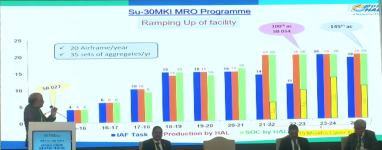
The 12 jets are standard MKIs, attrition replacement.
 
No. The idea was that MKI would detect air targets at long ranges via its Bars radar and vector other fighters onto them, doubling up as a mini-awacs/radar picket. With its massive 650kg antenna, the Bars was the most powerful mmr in the IAF back then. I'm talking about the early 2000s.

Though you are partially correct. The MKI came with the Russian TKS-2 IFDL which allowed it to communicate with upto 4 other Flankers. I believe those have now been replaced with the ODL/BNET/Vayulink TDLS.

To speak to jets outside the MKI fleet required a new data link, that came with ODL in 2009-10 and now BNET. So the MKI could act as mini-AWACS to MKIs from the beginning, and then using the ODL to whatever could connect with the rest in the 2010s, Mig-29 and Mig-21. It has nothing to do with the radar itself.

TKS-2 is still in use for intra-MKI use. It connects across an entire squadron group.
 
Russians have assured their full-support in MKI UPG. programme. So whatever we want in it, won't be a problem.

They have specifically rejected airframe modifications and IAF is playing ball.

The MLU goal is to make the jet as Indian as possible without changing the airframe. So the unique metal alloys and core systems remain Russian. That's also why they haven't allowed us to use our own alloys in the engine either, they will continue to be supplied by the Russians. It's part of their intent to protect their IP so we cannot export their tech.

Now you understand a bit about why IAF is no longer chasing after Russian tech.
 
  • Like
Reactions: YoungWolf
They have specifically rejected airframe modifications and IAF is playing ball.
MKI UPG. will have new FBW to account for CoG change due to lighter nose avionics. Plus, we aren't changing any inner spars, rather just changing the Al skin with Composite one.
The MLU goal is to make the jet as Indian as possible without changing the airframe. So the unique metal alloys and core systems remain Russian. That's also why they haven't allowed us to use our own alloys in the engine either, they will continue to be supplied by the Russians. It's part of their intent to protect their IP so we cannot export their tech.
We are already using our alloys in AL-31FP and that share will continue to grow further.
Now you understand a bit about why IAF is no longer chasing after Russian tech.
Wait for some time, the chase is still on;)
 
MKI UPG. will have new FBW to account for CoG change due to lighter nose avionics. Plus, we aren't changing any inner spars, rather just changing the Al skin with Composite one.

Replacing critical structures with another alloy or composites requires recertification in all flight regimes and in all weapons configurations.

What you are talking about is only done through a modernization program, like what LCA is going through, not MLU.

We are already using our alloys in AL-31FP and that share will continue to grow further.

Not critical ones. It's only at 60%+, the core alloys will remain Russian. Replacing those with Indian alloys was denied. I'm referring to the nickel superalloys to machine SCBs for the turbines, they have to be imported. We could only replace the compressor blades using our own titanium alloys.

As per our entire MKI contract, all raw materials for production have to be bought from Russia. Their goal is to remain a direct supplier for the MKI for the next 40 years even though we are willing to pay them off.

F414 otoh will come with 80% design ToT and we will be allowed to replace the remaining 20% with Indian tech during overhaul.

That's just one of the reasons why the chase for Russian tech is over.
 
To speak to jets outside the MKI fleet required a new data link, that came with ODL in 2009-10 and now BNET. So the MKI could act as mini-AWACS to MKIs from the beginning, and then using the ODL to whatever could connect with the rest in the 2010s, Mig-29 and Mig-21. It has nothing to do with the radar itself.

The whole rationale for IFDL was to allow one ac in a formation to use its radar to scan for targets and share data while the others maintained radio silence. Afaik, the Russians pioneered this concept.

Without the use of radar, the whole idea is moot.

In any case, TKS-2 is older gen tech and likely doesn't meet modern standards wrt jamming resistance, data transfer rates, et all.

The IAFs NCW plans since the mid 2000s have called for standardized comms protocols across fighter, transport and helo fleets.

It is unlikely that MKIs use two different sets of datalink today, esp since the IAF adopted BNET as its standard SDR, replacing the old HAL INCOM series radios.
 
The whole rationale for IFDL was to allow one ac in a formation to use its radar to scan for targets and share data while the others maintained radio silence. Afaik, the Russians pioneered this concept.

Without the use of radar, the whole idea is moot.

In any case, TKS-2 is older gen tech and likely doesn't meet modern standards wrt jamming resistance, data transfer rates, et all.

The IAFs NCW plans since the mid 2000s have called for standardized comms protocols across fighter, transport and helo fleets.

It is unlikely that MKIs use two different sets of datalink today, esp since the IAF adopted BNET as its standard SDR, replacing the old HAL INCOM series radios.

The point of mini-AWACS is about how data is shared, not what type of data, whether it's radar, comm, IRST, or RWR/ESM. What makes the MKI a mini-AWACS is the TKS-2.

Anyway, TKS-2 is a standard that can be upgraded. Plus the core sensors are still from the same era as the TKS-2. MKI MLU will require a new patrol link.

It difficult to maintain a specific standard across the fleet for patrol links. The F-22 uses IFDL, F-35 and B-2 use MADL, F-47 will come with its own standard too. What you are talking about is the standard force-wide data link, not the patrol link.

Maybe B-21 and F-47 will use the same link, similarly we could see MKI MLU, LCA Mk2, and AMCA carrying the same link. Rafale has its own new link and I doubt Mk1A has any.

For different patrol links to communicate with each other, you need a gateway translator, like the one between the F-22's IFDL and MADL. It's not seamless, but at least you aren't gonna be clueless about what the other is doing.

Aircraft without a patrol link will have to use its standard data link.
 
  • Like
Reactions: Rajput Lion
Replacing critical structures with another alloy or composites requires recertification in all flight regimes and in all weapons configurations.

What you are talking about is only done through a modernization program, like what LCA is going through, not MLU.


Not critical ones. It's only at 60%+, the core alloys will remain Russian. Replacing those with Indian alloys was denied. I'm referring to the nickel superalloys to machine SCBs for the turbines, they have to be imported. We could only replace the compressor blades using our own titanium alloys.

As per our entire MKI contract, all raw materials for production have to be bought from Russia. Their goal is to remain a direct supplier for the MKI for the next 40 years even though we are willing to pay them off.

F414 otoh will come with 80% design ToT and we will be allowed to replace the remaining 20% with Indian tech during overhaul.

That's just one of the reasons why the chase for Russian tech is over.
Despite Russian objection, we have already indigenised certain critical and core alloys of AL-31FP like BZL1, BZL14H & ZS 6Y. @ShiroBarks may confirm this!
 
The point of mini-AWACS is about how data is shared, not what type of data, whether it's radar, comm, IRST, or RWR/ESM.

It's very simple. IRST, RWR are passive sensors and can be freely used by all ac within a formation. Not so with radar, comms as they can give away your position. It's all about EMCON.

In any case, MKI was literally supposed to be a stand-in AWACS for the IAF in the early 2000s. Its 1st Phalcon didn't even arrive until 2009.

Anyway, TKS-2 is a standard that can be upgraded. Plus the core sensors are still from the same era as the TKS-2. MKI MLU will require a new patrol link

The USAF got around this problem by deploying the BACN gateway translator. Iirc, the IAF uses satellite overlays to connect different types of ac aka Vayulink. Though its role seems to be more oriented toward blue force tracking than building situational awareness.
 
  • Like
Reactions: Rajput Lion
It's very simple. IRST, RWR are passive sensors and can be freely used by all ac within a formation. Not so with radar, comms as they can give away your position. It's all about EMCON.

In any case, MKI was literally supposed to be a stand-in AWACS for the IAF in the early 2000s. Its 1st Phalcon didn't even arrive until 2009.

RWR can distribute work across a network. IRST's FoV is limited, so you need multiple sensors looking at multiple targets and sending the data over to each other. These are all mini-AWACS functions directly related to the patrol link.

I'll repeat it again, the mini-AWACS role has absolutely nothing to do with radar. It's all about the distribution network.

The USAF got around this problem by deploying the BACN gateway translator. Iirc, the IAF uses satellite overlays to connect different types of ac aka Vayulink. Though its role seems to be more oriented toward blue force tracking than building situational awareness.

Yeah. Vayulink is for blue force tracking. A patrol link is entirely different.
 
RWR can distribute work across a network.

Now that's a first. I've heard of passive geolocation capability via multiple rwr antenna. But networking rwr with other ac, that's unheard of.

IRST's FoV is limited, so you need multiple sensors looking at multiple targets and sending the data over to each other

Not nose mounted IRST per se. But podded IRST like the LM Legion pod do have geolocation capability apparently.

I'll repeat it again, the mini-AWACS role has absolutely nothing to do with radar

Without radar, you don't have an AWACS and no mini-awacs either.

If you're talking about sensor fusion, both awacs and combat ac can correlate multiple target tracks but it usually happens onboard/at the unit level.

Mini-awacs absolutely is an active emitter passing on target data to his wingman.
 
  • Like
Reactions: Rajput Lion
Got to brush up that again mate🤣🤣. ZS 6Y is a super-alloy which is far away from steel or titanium and is vital for modern aero-engines.

I'm not referring to the ones you mentioned. I'm referring to what was allowed in the AL-31FP's production by the Russians. Only titanium and steel alloys were allowed. Indigenization percentage only went up by a few percentage points after all, 54 to 63.

Midhani's superalloys you mentioned have been certified for use on AL-31FP, but the Russians have prevented its use. For now, HAL is pushing for their use in overhauled AL-31FPs.

As per the contract, we have to buy raw materials from Russia for production, but spares can be procured from local industry. So there is a chance these superalloys can be used during overhaul, but Russia may not agree for what's not yet in the contract, the main hot parts.

Think about it, the provisional clearance for these superalloys came only a few days ago whereas AL-31FPs have already started deliveries using Russian materials.
 
Now that's a first. I've heard of passive geolocation capability via multiple rwr antenna. But networking rwr with other ac, that's unheard of.

Since MKIs were not introduced with multi-sensor fusion, pilots would offload work to each other for different targets with different priorities. EA too requires manual oversight.

One pilot handled air targets, another ground targets, a third prioritized targets for weapons release, a fourth commanded the group. That's your mini-AWACS.

This is what AWACS do too, with their multiple consoles.

Without radar, you don't have an AWACS and no mini-awacs either.

If you're talking about sensor fusion, both awacs and combat ac can correlate multiple target tracks but it usually happens onboard/at the unit level.

Mini-awacs absolutely is an active emitter passing on target data to his wingman.

Radar is just one of the functions of an AWACS.

But what makes AWACS an AWACS is battlespace management. And it can do that even with its radar turned off.

What you are talking about is a sensor-shooter loop, which is not AWACS. Any fighter with a basic data link can do that. One fighter tracks a target, sends fire control to another. That's not a control system.