Pinaka Multi Barrel Rocket Launching System

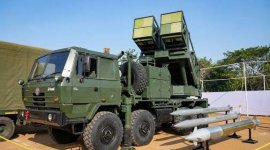
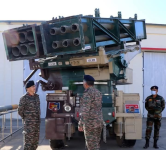
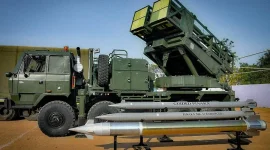
If you look carefully at the following image, the rocket pod from which the 120km LRGR was fired is physically larger than the rocket pod meant to launch the unguided 214mm Pinaka rockets.
So technically, a single Pinaka launcher should be capable of dishing out 8 LRGRs to a distance of 120km.
View attachment 48682
Correct. The launcher can take a combination of 214mm and larger dia tubes as well

1767063785804.jpeg
 
Last edited:

G9WBZojaoAAOaUc
 
Just a reminder how much of a game changer the 120km Pinakas are.
Analysis for India's western front, approx distance for all the places hit during Op. Sindoor:

Place
Approx
distance (km)
Sampled Point
Bahawalpur
110 km
Khajuwala
Muridke
60 km
Amritsar
Muzaffarabad
60 km
Uri
Kotli
67 km
Uri
Rawalakot
36 km
Uri
Chakswari
50 km
Rajouri
Bhimber
23 km
Naushera
Neelum Valley
58 km
Uri
Jhelum
53 km
Naushera
Chakwal
111 km
LoC near Naushera
Nur Khan Air Base (Chaklala / Rawalpindi)
100 km
Uri
Rahim Yar Khan Air Base
100 km
Longewala
Rafiqui Air Base (Shorkot)
140 km
LoC near Sri-Ganganagar
Murid Air Base (PAF Murid)
119 km
LoC near Naushera
Sargodha Air Base (PAF Mushaf)
176 km
LoC near Ranjan/Amritsar
Sukkur (Sukkur Airport / base)
120 km
Border near Longewala
Sialkot Air Base / Sialkot city
38 km
Jammu
Pasrur
70 km
Amritsar
Chunian
60 km
Firozpur
Skardu Air Base
100 km
Kargil
Bholari Air Base
130 km
Border near Lakhpat
Jacobabad Air Base
185 km
Longewala

Only 2 locations safe, 2 just beyond the verge, and 2 at max distance.
1. They will remain vulnerable to enemy electronic warfare, and GMLRS in particular have been jammed easily in Ukraine and in India as well (Fatah-1s).
2. Doesn't mean much if the number of rounds acquired are subpar, as they will be easier to shoot down than a typical guided missile.
3. It will primarily be used to hit equipment, not military infrastructure. Targets include, enemy artillery, air defences, troop concentration, radars etc.

To hit and cripple infrastructure IA would need large magazine depth, which is unlikely to happen as only ₹2500 cr worth procurement is planned, and would usually take a decade (or more) to be delivered in total (as is the case with the DPICM procurement). A few hundred isn't going to make a cut for that.

Which is why the pakistani F-1 strikes were a dud. Easy to shoot down, easy to jam, and not easy to replenish (for them). Result? Them resorting to fire unguided A100 MLRS on India, especially Srinagar (as evident by debris recovered from Dal Lake). So we will have to procure such systems in large numbers to maintain relevance.
If you look carefully at the following image, the rocket pod from which the 120km LRGR was fired is physically larger than the rocket pod meant to launch the unguided 214mm Pinaka rockets.
So technically, a single Pinaka launcher should be capable of dishing out 8 LRGRs to a distance of 120km.
View attachment 48682
The pod used for 80km guided Pinaka and the LRGR is the same, only tube dimensions are different. 8 rounds per launcher. Even unguided ones have similar loadout.
1767066451094.png
 
  • Like
Reactions: jmaxwell_ and spice
1. They will remain vulnerable to enemy electronic warfare, and GMLRS in particular have been jammed easily in Ukraine and in India as well (Fatah-1s).
2. Doesn't mean much if the number of rounds acquired are subpar, as they will be easier to shoot down than a typical guided missile.
3. It will primarily be used to hit equipment, not military infrastructure. Targets include, enemy artillery, air defences, troop concentration, radars etc.

To hit and cripple infrastructure IA would need large magazine depth, which is unlikely to happen as only ₹2500 cr worth procurement is planned, and would usually take a decade (or more) to be delivered in total (as is the case with the DPICM procurement). A few hundred isn't going to make a cut for that.

Which is why the pakistani F-1 strikes were a dud. Easy to shoot down, easy to jam, and not easy to replenish (for them). Result? Them resorting to fire unguided A100 MLRS on India, especially Srinagar (as evident by debris recovered from Dal Lake). So we will have to procure such systems in large numbers to maintain relevance.

The pod used for 80km guided Pinaka and the LRGR is the same, only tube dimensions are different. 8 rounds per launcher. Even unguided ones have similar loadout.
View attachment 48685

They will be good when backed by numbers. Current production rate is pathetic for the needs. And I am just taking about rockets. Not the whole system. Need more than 1000 rockets per day for round the clock suppression along IB in initial days of a war.

Otherwise SRBM and other Surface to Surface missiles along with UAV swarms and munitions will be prioritised for targetting.
 
They will be good when backed by numbers. Current production rate is pathetic for the needs. And I am just taking about rockets. Not the whole system. Need more than 1000 rockets per day for round the clock suppression along IB in initial days of a war.
The issue with this strategy is that when you have developed an inventory of say 1 million/10 lakh rockets you also have developed the cons of the idea too, that is proper maintenance, storage and sudden explosion prevention.

Solid rocket motors are extremely prone to developing static current which in turn can ignite it easily unless proper mechanism is deployed. It also develops cracks and disjoint parts in the propellant layer which can result in sudden burst explosion when being launched from the launcher itself.

For a guided rocket, you also need to initialise the rocket guidance module before launch with signal via an antenna in the MLS vehicle, or use a satcom which the western rocket do and were jammed/spoofed by denying the sat signal. This is why we use self containing guidance method, no full reliance on sat signal due to dense ew environment. So the guided pinaka also has many electronic module & signal acquiring parts where the shelf life is very poor, even the smallest faulty part means the rocket fail QT before service release.

So what happens to this 10 lakh rocket inventory that you have built up and boast about? you will find 20% 30% even 45% of the total are completely rejected when it comes to use, therefore your money is wasted. This is before any battle inflicted attrition. So you have spent millions of money over the years and are now finding complete scrap heap building & a shortage that you intended to avoid.
So, 2 are carried in a single pod and 4 LRGR per launcher.

Hmm based on this, I can assume 300km LRGR will be carried as 1 per pod and 2 per launcher.
That is a test setup, that too for the maiden test. We should be glad its from the MLS, the makeshift one probably was done at ARDE range or Pokhran range possibly. Actual provision we will wait and see, likely 4 per pod. Not too high difference tbh.
 
The issue with this strategy is that when you have developed an inventory of say 1 million/10 lakh rockets you also have developed the cons of the idea too, that is proper maintenance, storage and sudden explosion prevention.

Solid rocket motors are extremely prone to developing static current which in turn can ignite it easily unless proper mechanism is deployed. It also develops cracks and disjoint parts in the propellant layer which can result in sudden burst explosion when being launched from the launcher itself.

For a guided rocket, you also need to initialise the rocket guidance module before launch with signal via an antenna in the MLS vehicle, or use a satcom which the western rocket do and were jammed/spoofed by denying the sat signal. This is why we use self containing guidance method, no full reliance on sat signal due to dense ew environment. So the guided pinaka also has many electronic module & signal acquiring parts where the shelf life is very poor, even the smallest faulty part means the rocket fail QT before service release.

So what happens to this 10 lakh rocket inventory that you have built up and boast about? you will find 20% 30% even 45% of the total are completely rejected when it comes to use, therefore your money is wasted. This is before any battle inflicted attrition. So you have spent millions of money over the years and are now finding complete scrap heap building & a shortage that you intended to avoid.

That is a test setup, that too for the maiden test. We should be glad its from the MLS, the makeshift one probably was done at ARDE range or Pokhran range possibly. Actual provision we will wait and see, likely 4 per pod. Not too high difference tbh.

My thought on this:

Given the current environment and stakes, within/without the case of 2/3 front war.. India will definitely look to cripple pak army within 3-4 weeks. Max 2 months. To not be bogged down, when China is the bigger threat ( even if no active battle is going on northern border, forces and industry will be kept ready for it).

For that, what we need wouldn't be just inventory of 10 lakh.. but the production capacity in surge. Since, the goal will be quick-shock-destory/cripple the PA's ability to be meaningful threat.. rockets will be prioritised in place of tube artillery, given the lethality and range. Ofcourse, Loitering munitions, SRBMs, Cruise missiles, some naval and air resources will be deployed in tandem too.

Now, I searched and got PIB doc that puts expected capacity of production at 5000/year. That's capacity. In surge time, let's say they can at most 2x/3x it. Since, other demands will need to be met too which shares the production/supply line with Rockets. What's the expected inventory of pinaka today ? 10k-20k? Including the older versions, unguided ones, with newer stock being comparably lower.
How much of that inventory can be dedicated to western border? 3 days, 4dyas, 1-2 week Max if the army uses it selectively and rations it ( their current role) What after that?

That's where I was hinting to.. the production rate. It's so low that even the surge time wouldn't fill the current operational need of IA. 5000/year = 13/day. Even if we take some ideal scenario and 5x production for pinaka without compromise.. it's 65/day.
That is nowhere enough to stockpile enough rockets and replacing expended ones during war. To mitigate it, supply chain needs attention With dedicated person working on widening the pool per system. The "reforms of overall industry" will take time and should run parallel to it.

As for issues/comes you mentioned.. that's an excuse that war won't care for. Same issues can persist for stockpile of 10k or 100k.

Our threat profile have changed. But defense industry isn't keeping up. Limited vendors across the Tier-1,2,3 supply chain for any unavoidable expendables, with limited investment in the scaling of production facilities as needed. Tube Artillery won't give you the asymmetrical domination IA will need to freeze western front quickly. And this is about the products that have been in production for a while with established PSUs responsible.

The sheer numbers required in UAVs is dependent on upcoming drone industry. ( We don't have an industry yet, we have startups and BTPs ). Keeping above things in mind, even the current production rate is pathetic. No need to go back to 2000 to comment on current stockpile.

 
  • Like
Reactions: jmaxwell_
For that, what we need wouldn't be just inventory of 10 lakh.. but the production capacity in surge. Since, the goal will be quick-shock-destory/cripple the PA's ability to be meaningful threat
You can go with as much planning , early planning etc but warfare is such dynamic you will eventually have to come to terms with it. Since its a live of die situation for you, the same equation also apply to your enemy as well & its reaction is also based on exploiting the weak points in your strategy. That is why improvization in battlefield is much valued. Every military action is wargamed multiple times covering multiple situation and stages beforehand , but what is to happen in real time , no one can accurately predict each time. I think this was stated by our DGMO as well, same echo is also present in military strategy books

This shock and awe model works only against ragtag militia/very low end adversary with headstrong force & no backup. A single battle can be won that way, not the war.
 
1. They will remain vulnerable to enemy electronic warfare, and GMLRS in particular have been jammed easily in Ukraine and in India as well (Fatah-1s).
2. Doesn't mean much if the number of rounds acquired are subpar, as they will be easier to shoot down than a typical guided missile.
3. It will primarily be used to hit equipment, not military infrastructure. Targets include, enemy artillery, air defences, troop concentration, radars etc.

To hit and cripple infrastructure IA would need large magazine depth, which is unlikely to happen as only ₹2500 cr worth procurement is planned

EW is a cat and mouse game that will continue to evolve, I'm certain the GNC on the LRGR will not just be GNS based. Nevertheless once enemy EW has been degraded, nothing else can bring precise mass on to the enemy at cost and quantity like this can.

Your concern on magazine depth is most valid. Even if India can produce LRGRs at the same cost as the original guided pinaka (doubtful), INR 2500 Cr. will procure ~3200 rockets. Not enough. Especially when India is willing to spend $30M for just 200 SPICE kits.


The issue with this strategy is that when you have developed an inventory of say 1 million/10 lakh rockets you also have developed the cons of the idea too, that is proper maintenance, storage and sudden explosion prevention.

I'm sure the IA has experience and capability to sort out the storage/maintenance issues. The original GPRS had a shelf life of 15yrs with known probability of failure and I'm sure the IA will expect the same standards from LRGR:
Screenshot_20251230_085840_OneNote.png

Pinaka is a battlefield weapon, unlikely it would be escalated to that level unless a Kargil like situation arise imo.

Perhaps not at max range but at < 3m CEP, it would be a mistake to treat this as just a battlefield weapon.
Paired with precision tube artillery of the desi Excalibur variety, what a lethal 1-2 punch this is going to be.

As @Subgradewalker pointed out, India needs to build out this inventory no matter what. In the current environment with the rise of authoritarian govts all over the world on a steady march towards WW3, it's inadvisable for India to only field a force with a fighting capacity of 3 weeks. There is nothing else that will come close in cost for vectoring precise mass on the enemy. With MIL, EEL and all the private sector companies like Solar, there is a path here to bring out the full lethality of this option if GoI has the will.

And further there is now no good reason to risk IAF pilots for Balakot type strikes. Besides, can India really afford to spend over $0.5B each time it has to take out 200-300 from a madrassa when there are 250M pre-radicalized just waiting for the next the next t@rror shack to be put up?
 
You can go with as much planning , early planning etc but warfare is such dynamic you will eventually have to come to terms with it. Since its a live of die situation for you, the same equation also apply to your enemy as well & its reaction is also based on exploiting the weak points in your strategy. That is why improvization in battlefield is much valued. Every military action is wargamed multiple times covering multiple situation and stages beforehand , but what is to happen in real time , no one can accurately predict each time. I think this was stated by our DGMO as well, same echo is also present in military strategy books

This shock and awe model works only against ragtag militia/very low end adversary with headstrong force & no backup. A single battle can be won that way, not the war.

We are not talking about mission to mission planning here. We are talking about Warfare of attrition and industrial capacity to sustain it. The 2 front scenario is not a new thing in our national security discourse. It's been there since 1990s, even before among the top brass. Perhaps they downplayed China before but we can't afford to do it anymore. It's our principal threat.

Your idea of dynamism is valid for as war evolves. But even that dynamism and armed forces' ability to take decisions and manoeuvre depends on the foundation built during "peace" times. And industrial production capacity is the very backbone. The availability of a weapon system and its replenishment rate can change whole decision matrix for a commander.

As for quick crippling of PA, that's been the forefront of strategy of IA since the idea of cold start was envisioned. It's only gonna evolve as northern border gets beefed up. Your core strategy can't be left without a foundation to back it up. Which is exactly the situation we find ourself in.

Leave Kusha R&D. If even Akash and other indegineous systems had streamlined chains for production at larger scale ( bring down cost/unit), post-op sindoor process would've played out differently. But the truth is that even basic things like Rockets aren't backed by industrial capacity, let alone major systems.

Look at Russia-Ukraine war only.. it's becoming a race of industry now. Then look at China.. the sheer manufacturing capacity.. to fight China, you gotta have scale to near-match them. Even USA finds itself on backfoot for the same reason. Not everything is simply about REE. Even if China exports all its inventory of REE, US wouldn't be able to compete with Chinese industry.


This is what I am talking about. Not decisions. But capacity. The 4 week scenario is an example I gave you based on already known strategic planning of forces and evolution from 2016-2019-2025.
 
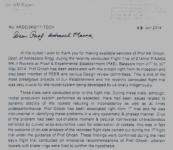
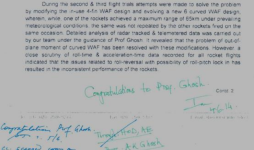
Thought this was posted before in a different forum long time ago, from the old days testing of the pinaka rockets. Doc attached below.

1767431703353.png
1767431726893.png
 

Attachments

Last edited:
  • Like
Reactions: jmaxwell_
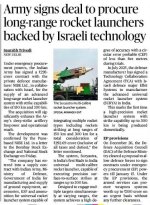
Pinaka Range Extension is taking time

So meanwhile Indian Army wants ONE Regiment of Israeli PULS

A single regiment in IA's context would mean 18 launchers (six per battery), CP, Replenishment vehicles.
As per the Sept 2020, cost of a single Pinaka regiment is 430 crores, now factoring into account inflation, this would be somewhere closer to 600 crores.
I doubt 292 crores can afford even half a regiment, that too of a foreign system which is going to be significantly more expensive.
This is likely being bought to benchmark future Pinaka rockets with greater calibres.
 
  • Like
Reactions: jmaxwell_
Army has good stock of 122mm ammo rockets, so initial procurement can be for the extra and that other long range rocket, its equipment & ground handling systems.
More important, if I were the user, I would like to know the user interface , command control console, software features & guidance provided for such long range. Mere pushing the launch button is not everything. Mission planning via the software console is very important, its feature can be recommended for DRDO made LRGR too.
If I have not used a product of a certain spec & learned the utility and unique features in it, how can I recommend to make the user defined changes both in this products future version and my own product under development ?
 
A single regiment in IA's context would mean 18 launchers (six per battery), CP, Replenishment vehicles.
As per the Sept 2020, cost of a single Pinaka regiment is 430 crores, now factoring into account inflation, this would be somewhere closer to 600 crores.
I doubt 292 crores can afford even half a regiment, that too of a foreign system which is going to be significantly more expensive.
This is likely being bought to benchmark future Pinaka rockets with greater calibres.

This is under Emergency Purchase powers , no tender , no trials needed

Even if it is Half a Regiment, the Order can be repeated because NIBE is an Indian company

We don't have anything beyond 90 KM ,.right Now

120 KM rocket, which was tested the other day , will take at least a few months to enter mass production

And here the press release says that IA wants 150 and 300 KM rockets

We are Basically matching Pakistanis who have this Fatah 1 and 2 , which is obviously a Chinese made rocket