My dear sir, Sirsa is like 250 km away from DelhiYeas, not all. But Fateh isn't an ordinary threat, they travell all the way near to Delhi.
 . It's closer to IB than it is to Delhi. Lumber 1 rocket Fateh is as good as a flying lumber of wood.
My dear sir, Sirsa is like 250 km away from DelhiYeas, not all. But Fateh isn't an ordinary threat, they travell all the way near to Delhi.
. It's closer to IB than it is to Delhi. Lumber 1 rocket Fateh is as good as a flying lumber of wood.
Not days it will be years. The guy who shot Osama Bin Laden revealed himself now in 2025, 14 years after that operation.@vstol Jockey
@randomradio
If Any Member who knows about
My Question Below ; Please Answer
I was just Thinking that After How many DAYS are the Fighter Pilots allowed to Tell their Families that they were part of the Strike Packages from 6th May to 10 th May
Is there some Rule for or against such disclosures

Parthu sir how capable is our Uttam GaN AESA radar for Tejas Mk2 compared to Rafale RBE and KJL7 on J10C?? I've heard GaN Uttam entered into lsp recently.
Normal ppl have been watching too many "Top Gun" type movies and shows where they think dogfighting = entire war. Of course air power is essentially but to base entire analysis on one aspect of the entire conflict is silly.Article by Tom Cooper (link below):

India-Pakistan, Additional Details, Part 2 & Q&A
www.cemaat.media
Q: I saw the interview with Times TV. Not a single mention of the Rafale downing. Why not? Is this major incident not important in the context of the war. Or was it edited out by Indians terrible media channels?
I’ve explained this in regards of the ‘public narrative’ at the start of this feature. Let me add an even more important aspect.
I find it is impossible to emphasise strongly enough – especially for those still insistent on ‘but Pakistan shot down 5, 15, 50 Indian jets: Pakistan won’ – that in the case of this war, no matter how short and intensive or not, one must keep in mind: one nuclear power (named India) disabled the nuclear deterrent of another nuclear power (named Pakistan). If you like, name them San Marino and Brunei, or switch names, if it’s going to make you feel better. But, this is a matter of fact.
Tejas Mk2 can confront even J16??? WawI think @Gautam and @marich01 are the best people to ask regarding status of GaN Uttam.
What I can say is that physically, the Uttam on Tejas Mk2 will be a bigger array than RBE2 (simply because Tejas Mk2's nose will be bigger than Rafale's), and will have a larger number of TRMs to work with. But all else being equal, it won't have as much electric power to work with (single engine vs dual engine).
The rest will depend on how many functionalities we manage to implement, like GMTI, SAR, NCTR etc. If the work we're doing on current version of Uttam is any indication, these functionalities will be extensive.
But the most critical capability in my opinion is that we will have 100% design & IP control. Need not pay anyone or ask anyone's permission to implement whatever weapons or systems we want with it, and it will work seamlessly with our UEWS.
Combine this with Netra Mk-1A/Mk-2, and Tejas Mk2 will be one hell of a potent platform that can give any J-10C or J-16 a run for its money.
 . But of course we need far more extensive AWACS support than we have currently. More importantly we NEED to link Astra Mk2 with Netra AWACS. Somehow this must be done imo.
 indianexpress.com
I do not think it was the x-band radar on fighter that was limiting factor here. That radar in Rafale was totally fine.I think @Gautam and @marich01 are the best people to ask regarding status of GaN Uttam.
What I can say is that physically, the Uttam on Tejas Mk2 will be a bigger array than RBE2 (simply because Tejas Mk2's nose will be bigger than Rafale's), and will have a larger number of TRMs to work with. But all else being equal, it won't have as much electric power to work with (single engine vs dual engine).
The rest will depend on how many functionalities we manage to implement, like GMTI, SAR, NCTR etc. If the work we're doing on current version of Uttam is any indication, these functionalities will be extensive.
But the most critical capability in my opinion is that we will have 100% design & IP control. Need not pay anyone or ask anyone's permission to implement whatever weapons or systems we want with it, and it will work seamlessly with our UEWS.
Combine this with Netra Mk-1A/Mk-2, and Tejas Mk2 will be one hell of a potent platform that can give any J-10C or J-16 a run for its money.

As per the few patents/drawings of Uttam MK2, it's still using GaAs TRMs. That news that you read in I D R W is likely false. Though the later prototypes/final production models may be GaN, as we all anticipated and wanted.Parthu sir how capable is our Uttam GaN AESA radar for Tejas Mk2 compared to Rafale RBE and KJL7 on J10C?? I've heard GaN Uttam entered into lsp recently.


For special missions like Balakot strikes, family gets to know after the operation is over. But for Op Sindoor, the families would have known in advance as the entire base was activated.@vstol Jockey
@randomradio
If Any Member who knows about
My Question Below ; Please Answer
I was just Thinking that After How many DAYS are the Fighter Pilots allowed to Tell their Families that they were part of the Strike Packages from 6th May to 10 th May
Is there some Rule for or against such disclosures

We've added stuff that nobody else has - and which requires deep integration with Spectra. Like the new rear jammer.
Adding GaN doesn't magically make your radar more powerful
If AMCA fails, then it isn't stop-gap anymore.
That doesn't explain why F-47 needs a 2,000-km unrefueled combat radius.
The PLARF is an extremely important part of the Chinese OrBat. They have the industrial base & scale which can make missiles considerably cheaper to use & replenish than anyone can imagine.
Been over this before as well in the Taiwan thread.
Meteor is not your average BVRAAM.
The current crop of Ramjet-powered extreme long range AAMs wouldn't be a thing if making use of inputs from offboard assets wasn't an option.
You cannot take the tactics of a VLO platform & apply it to Rafale. The F-35 & F-22 can rely on cooperative tactics cuz they were meant to penetrate enemy airspace 100s of kilometers without being detected. That's why they also need stealthy datalinks like MADL.
There's a reason the Rafale only uses Link-16 (or in our case, whichever we use) which is omnidirectional transmission. It cannot do cooperative tactics inside enemy airspace and expect not to be seen. Not to mention, it's not a VLO jet to begin with.
That's why France wants to continue buying AEWs.
France Nears Deal for Swedish Saab GlobalEye for AWACS Replacement
France Nears Deal for Swedish Saab GlobalEye for AWACS Replacementarmyrecognition.com
Maybe you should educate them that as they plan on moving to a Rafale-only fighter fleet within a decade, they no longer need an AEW for long-range tracks.
The only way to see a certain target at a certain range is to have a certain number of TRMs outputting a beam of a certain power.
What really matters when it comes to being advanced is how much power each TRM is capable of outputting.
So I don't see how they're supposed to be more advanced. They're just doing things much later, taking advantage of newer techs. But then in the next step, the Americans steal a lead again (by going 6G about a decade before France does).
It's a frame of reference thing. Do you want to buy a Core i9 made on a 7nm process node today or a Core i5 made on a 5nm node a few years from now? The 5nm 10-core i5 is technically more advanced, but the 7nm 24-core i9 is still more capable.
It's not like the French (or the Chinese) will obtain new technologies (GaN-on-Diamond or anything else) while the rest of the world stays the same.
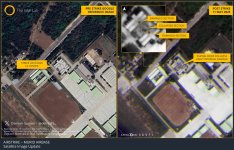 Thats some unreal level of precision. Impressive!!!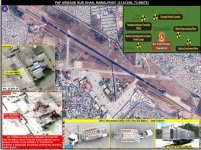
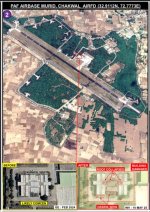
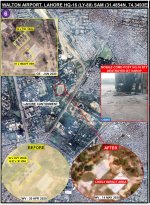
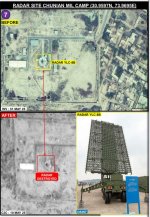
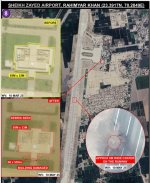
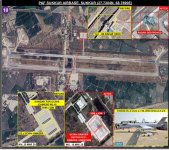

This is getting traction..
How some evidence comes out
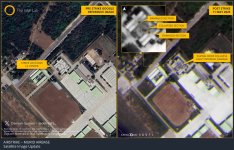
The HT is wrong with one assessment tho C130 is completely fine, even the IAF has said there was only one target They have striked in noor khan Air base, and sat image's also proves no C 130 has damage, Also HT repeatedly reported false News in russia Ukraine war, so it's hard to take them a reliable sourceWaiting for the evidence to come out. Everything hinges on it now. If a reptable defence weekly were to back it, it will give India a definite edge in PR.
Pakistan spokesperson also have said we striked Afghanistan, we launched six ballastic missiles into our territory, he did live briefing in the middle of the night lmao, not every squadron of su30mki can fire brahmos only a few of them can, 1 sortie one brahmos, land brahmos have bigger nose cone, not a single of them has been found while we have certainly seen the ALCM brahmos nose cone,Present the evidence, otherwise everything is nonsense, said a spokesperson for the Pakistani Air Force. India launched 100 BrahMos missiles, while the Indian authorities did not provide the specific number.

A vet on their forum claimed "minor splinter" damage to one C-130.The HT is wrong with one assessment tho C130 is completely fine, even the IAF has said there was only one target They have striked in noor khan Air base, and sat image's also proves no C 130 has damage, Also HT repeatedly reported false News in russia Ukraine war, so it's hard to take them a reliable source
That's part of the SPECTRA suite, it's not a new system designed specifically for India.
Trust me, you have zero clue about this.
You literally just said a bucket contains less water than a mug. I can't do anything with this level of ignorance in a subject.
Depends on whether they plan on keeping AMCA going like LCA or cancel it entirely.
If you understood how radars worked, you wouldn't bring it up.
At least we don't have any offboard assets that can cue the Meteor better than the Rafale. For example, Netra cannot tell if a target at 300 km is at 9 km alttiude or 1 km. So it vectors the Rafale to the threat. Then the Rafale uses its radar to resolve the target into a 1x1 km box, the closer it moves towards the target the smaller the box becomes.
To resolve targets for BVRAAMs, we need digital GaN of Erieye-ER or Netra Mk1A/2. When people talk about using AWACS to cue missiles, this is the entry level tech they are talking about.But even with GaN, they will still not be able to do a better job than the Rafale, but at least they can put a missile in the viscinity of the target for the seeker to pick up. The missile pk will be low, but it's something.
So, no, even with upcoming radars the Rafale's radar will be better.
Where on earth did that come from?
Cooperative tactics have nothing to do with VLO, pretty much the opposite in fact. It's about the radar that's emitting. For stealth, they need to use receive-only modes.
What I'm talking about is a bunch of jets providing far more information than AWACS by getting their radars cooperating with each other in non-stealth mode while operating very close to the enemy because they are fighter jets, which means the enemy knows they are being watched just like they can tell there's AWACS present. In that respect, 4 Virupakshas will provide far more data than 1 Netra. So what VLO?
France can't afford a global AMTI constellation. They have to work with whatever the US lets them use. So they have no choice but to rely on AWACS for independent operations that can quickly go island hopping across the world to all their overseas territories. India too, it's not like India will get an AMTI constellation faster than the US or China either.

Not even close. Virupaksha will probably have less power in each TRM compared to APG-77 due to Bars limitations, and will still significantly surpass it. There's a lot more at play here.
You can divide PESA into three generations. But you can divide AESA into 8 or 9 generations. APG-81 is at the lower end and the APG-85 is at the higher end. At the minimum, the APG-85 needs to at least be as good as what's coming with RBE2-XG.
To deal with current gen targets, APG-81 is more than enough, but to deal with MUM-T, RBE2-XG is at the entry level of what's necessary.
And the expectation is the J-20 is already there.
The Americans are introducing the APG-85 early in order to keep up with the Chinese.
And you think the IAF is gonna be retarded enough to choose systems that won't work against the Chinese?
I don't mind choosing between a 5nm and a 7nm, but what you are proposing is choosing between a 64nm and a 2nm. That's how much of a gap there is between 81 and 85.