
Kashmir : An Illusive Solution
- Thread starter Manmohan_MMY
- Start date
You are using an out of date browser. It may not display this or other websites correctly.
You should upgrade or use an alternative browser.
You should upgrade or use an alternative browser.


Jammu police arrested 6 Rohingyas.
They used to bring Drungs to Jammu from other states through Trains to sell it in Jammu. When quizzed, they revealed they could come out of the railway station with drugs with ease & railway security staff.
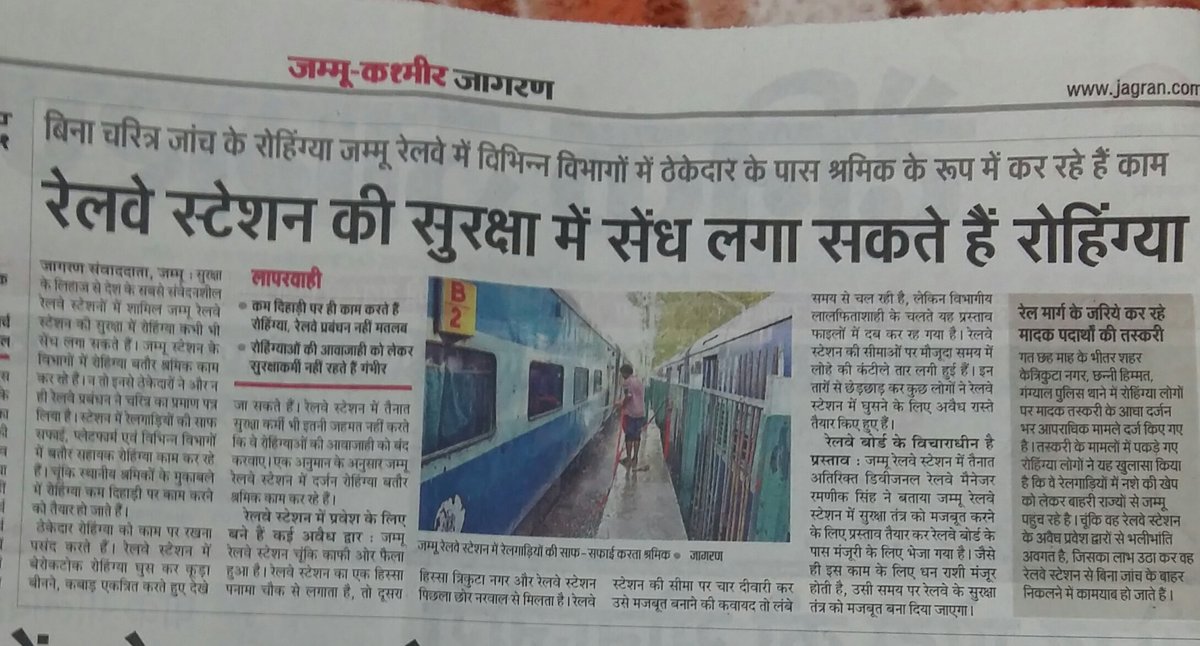
They want to create Punjab like situation in Jammu

Rare good article by CNN on Islamic Terrorism and ISIS in J&K
Why violence in Kashmir is a tempting prospect for ISIS
ISIS first declared its intention to move into Kashmir in 2016, describing it as part of its Khorasan province. But only in the past few months have there been the first signs of activity there.
In February, ISIS claimed the killing of a police officer in Kashmir's capital, Srinagar, through a Telegram channel called 'Kashmir Villayah.' State police chief Shesh Paul Vaid said the attack was a "cause of worry," telling Indian network NDTV that though there didn't seem to be a substantial presence of ISIS in the region, the attack could have been driven by ISIS ideology.
It was the second ISIS claim in Kashmir in three months. In November, the Qaraar media outlet claiming to represent the "mujahideen of the Islamic Caliphate in the gateway of India" posted a photograph of a militant who was killed in an attack in Srinagar that left a policeman dead. At his funeral, the militant's body was wrapped in an ISIS flag.
Officials in New Delhi have flatly denied that ISIS exists in Kashmir; Vaid also asserted it had no "substantial" presence in the region. But there is concern that ISIS' ideology may attract militant Kashmiri youth. Amira Jadoon of the Combating Terrorism Center at West Point says that "unlike their predecessors of the 1990s, this generation is educated and highly active on social media, a powerful recruitment tool for the Islamic State."
Militant cells in Kashmir benefit from widespread support among young Kashmiri men. On several occasions in recent months, hundreds of them have pelted security forces with stones in an effort to shield militants. The situation has been exacerbated by the lack of any political progress on Kashmir's future.
Two Pakistan-based groups - Lashkar-e-Taiba and Jaish-e-Mohammed -- have long been the main jihadi networks in Kashmir, and they are viscerally opposed to ISIS. No surprise, perhaps, that the pro-ISIS media outlet al-Qaraar has urged Muslims to abandon these groups and wage "pure jihad" under its banner, while describing Pakistan as an "enemy of Islam."
ISIS may find it difficult to challenge the Pakistan-based groups because -- in the eyes of the US and other western governments -- they enjoy the support of Pakistani military intelligence.
US Director of National Intelligence Daniel Coatstold Congress in March that "militant groups supported by Islamabad will continue to take advantage of their safe haven in Pakistan to plan and conduct attacks in India and Afghanistan."
Additionally, Kashmiri militancy has been focused on liberating the region from Indian rule; it hasn't had much time for global jihad.
Jadoon says the possibility that ISIS can "inspire a sufficiently large number of young Kashmiris to stimulate an entire new wave of jihad in Jammu and Kashmir seems unlikely, at least in the short term." But the region is potentially attractive to ISIS, with a large community of radicalized youth, mountainous territory, and a long-established insurgency that could potentially be co-opted.
Why violence in Kashmir is a tempting prospect for ISIS
ISIS first declared its intention to move into Kashmir in 2016, describing it as part of its Khorasan province. But only in the past few months have there been the first signs of activity there.
In February, ISIS claimed the killing of a police officer in Kashmir's capital, Srinagar, through a Telegram channel called 'Kashmir Villayah.' State police chief Shesh Paul Vaid said the attack was a "cause of worry," telling Indian network NDTV that though there didn't seem to be a substantial presence of ISIS in the region, the attack could have been driven by ISIS ideology.
It was the second ISIS claim in Kashmir in three months. In November, the Qaraar media outlet claiming to represent the "mujahideen of the Islamic Caliphate in the gateway of India" posted a photograph of a militant who was killed in an attack in Srinagar that left a policeman dead. At his funeral, the militant's body was wrapped in an ISIS flag.
Officials in New Delhi have flatly denied that ISIS exists in Kashmir; Vaid also asserted it had no "substantial" presence in the region. But there is concern that ISIS' ideology may attract militant Kashmiri youth. Amira Jadoon of the Combating Terrorism Center at West Point says that "unlike their predecessors of the 1990s, this generation is educated and highly active on social media, a powerful recruitment tool for the Islamic State."
Militant cells in Kashmir benefit from widespread support among young Kashmiri men. On several occasions in recent months, hundreds of them have pelted security forces with stones in an effort to shield militants. The situation has been exacerbated by the lack of any political progress on Kashmir's future.
Two Pakistan-based groups - Lashkar-e-Taiba and Jaish-e-Mohammed -- have long been the main jihadi networks in Kashmir, and they are viscerally opposed to ISIS. No surprise, perhaps, that the pro-ISIS media outlet al-Qaraar has urged Muslims to abandon these groups and wage "pure jihad" under its banner, while describing Pakistan as an "enemy of Islam."
ISIS may find it difficult to challenge the Pakistan-based groups because -- in the eyes of the US and other western governments -- they enjoy the support of Pakistani military intelligence.
US Director of National Intelligence Daniel Coatstold Congress in March that "militant groups supported by Islamabad will continue to take advantage of their safe haven in Pakistan to plan and conduct attacks in India and Afghanistan."
Additionally, Kashmiri militancy has been focused on liberating the region from Indian rule; it hasn't had much time for global jihad.
Jadoon says the possibility that ISIS can "inspire a sufficiently large number of young Kashmiris to stimulate an entire new wave of jihad in Jammu and Kashmir seems unlikely, at least in the short term." But the region is potentially attractive to ISIS, with a large community of radicalized youth, mountainous territory, and a long-established insurgency that could potentially be co-opted.

This entire nonsense of special needs to be thrown out. People who do not agree, should be allowed to proceed to Pakistan.
The reason why Abdullah is scared now, is the passage of land reforms if passed in Leh and Jammu will result in upward movement of property prices. Also, the inflow of funds and human resources into these areas will result in demographic change. Another 15 years and the resultant demographic move will result in the death of the PDP and NC.
A matter of 15 years. And this time, if the terrorists strike, like they struck the Pandits in the 1980s, implement the Punjab plan. Hunt them down and kill them. RUTHLESSLY.


