Indian Air Force : Updates & Discussions

  • Thread starter Thread starter Tarun
  • Start date Start date
Every system has a problem and challenges.
Chinese anti ship hgv are "operational" and "in service".

As for plasma blocking signals not really, vlf and vhf frequencies are regularly used to overcome plasma, rockets communicate with ground stations using that, for decades

Working of a seeker can be a problem( though solutions to this also exist), but communication is not, not for decades now.

They are already operational.
Even then the efficacy of HGVs against defended moving targets like aircraft carriers has not been proven yet and can only be assumed, certainly not proven as we have seen anti tank drones. It will take a major conflict to see if the HGVs perform as expected.
Can anyone tell me about the Tajikistan air base story.
I only know GoI and IAF was intrested in an airbase in Tajikistan but Russians were opposing this deal.


(Interestingly, there are now 4 aircraft shelter and another one under construction)
Operated by RAW and used to support Northern Alliance iirc. Had an entire hospital which treated Northern alliance soldiers.
 
Hey all! I'm a long time lurker.
Let's be honest, there is a lot of information thrown around in this forum. I'm creating this thread to understand what is going on in the Air Force, like:
What is it's strategy? What are their goals right now? How has it changed from the past?
What steps are they taking to achieve it?
How is the future technology and procurements coming along?
Please add more if you feel so. I'm looking to have a general, all-round discussion.

I'll tell you what I'm trying to achieve with this thread; I can't keep up with all the tidbits of information in say, the MMRCA thread and I just can't figure out what's happening, and whether it's connected to other factors. That's why I'm creating this thread. This is just one example. I'm sure there are many more things happening, and I think many would appreciate a general understanding of what's going on without going too technical or deep into one thing.

I could not find an existing or active thread for this discussion, hence I am creating one. Apologies if such a thread already exists.
 
Hey all! I'm a long time lurker.
Let's be honest, there is a lot of information thrown around in this forum. I'm creating this thread to understand what is going on in the Air Force, like:
What is it's strategy? What are their goals right now? How has it changed from the past?
What steps are they taking to achieve it?
How is the future technology and procurements coming along?
Please add more if you feel so. I'm looking to have a general, all-round discussion.

I'll tell you what I'm trying to achieve with this thread; I can't keep up with all the tidbits of information in say, the MMRCA thread and I just can't figure out what's happening, and whether it's connected to other factors. That's why I'm creating this thread. This is just one example. I'm sure there are many more things happening, and I think many would appreciate a general understanding of what's going on without going too technical or deep into one thing.

I could not find an existing or active thread for this discussion, hence I am creating one. Apologies if such a thread already exists.
These are very vague questions. Goal of the airforce is to defend this nation's interests. That answers your question as clearly as your question. It shows that you have not done enough reading on the topic you are asking about. I recommend that you take some time to understand what you are curious about before returning.
 
Unescorted missions, very less fighter squadron strength, very few support aircrafts, no BVR edge, technologically old aircrafts but still completing the given mission.

The only reason our Air Force gets the job done is because of the sheer *censored*ing will of our pilots.
 
Unescorted missions, very less fighter squadron strength, very few support aircrafts, no BVR edge, technologically old aircrafts but still completing the given mission.

The only reason our Air Force gets the job done is because of the sheer *censored*ing will of our pilots.
When you make your entire fleet suffer in the hopes of acquiring a silver bullet at prices equivalent to that of gold and that silver bullet does not have what it takes to be the game changer that you hoped for, this is bound to happen.
 
In my short lifetime so far, from completely unwilling to use airforce/air strike for fear of being seen as an escalation move during the Kargil days to now using IAF as the main strike force is a little bit of progress in my view. So one armed forces service that for decades was seen as air support service mainly and not really as force multiplier effect it could bring, this entire value centric approach was completely disregarded. From that perceived mentality you can not expect IAF as a service would be top notch asset wise comparable to many Western air forces or Rus/chinese in another way.


Core point being
1. As a nation we are not war centric unlike the westerners, russians or some other radical group controlled countries. We try to avoid conflicts.
2. Even when a conflict is necessary or pushed into our way, decision makers try to contain the escalation as much as possible. This is natural.
3. Since as a nation we are averse to wars, we also do not actively look to improve our conventional warfighting strength.
4. Because we are surrounded by neighbors where at least once or more military leadership has seized power, our political decision makers are always wary of own country military, this will play in their mind till we exist as a country.
5. Since the above factor is seen as vital by the various political coalition within the country (irrespective of various ideology of different local or national political parties) , our Armed force projection will remain at a minimum credible deterrence stage, which if you translate in Western ideology the word would be insufficient.
6. This entire aspect is not changing anytime soon. If you live long enough you will probably see LCA jets also being used way past their service life in future & facing related issues.
7. Historically we have faced a lot of extinction level event thru invasion and invading forces but we as a country have never went into that route. Culturally the Indian influence have spread across many parts of the world be it in Asian countries or African or elsewhere (nomads in Eurasia) but that was never thru invasion or forced. This proves our mindset will never be along the invasive way of force projection. When this is ingrained in the basic human characteristics, it also get reflected in how we prepare our deterrence thru conventional force projection. To me at least both aspect seem like well matched and balanced.
So in summery, despite having 3rd or 4th largest volume centric Military power, its core assets will be very rusty with very little regard to timely improvement needed. Therefore IAF will continue to be well below its power, will get asset introduction well past the time needed and in a reactive mode basis rather than proactive.
 
In my short lifetime so far, from completely unwilling to use airforce/air strike for fear of being seen as an escalation move during the Kargil days to now using IAF as the main strike force is a little bit of progress in my view. So one armed forces service that for decades was seen as air support service mainly and not really as force multiplier effect it could bring, this entire value centric approach was completely disregarded. From that perceived mentality you can not expect IAF as a service would be top notch asset wise comparable to many Western air forces or Rus/chinese in another way.


Core point being
1. As a nation we are not war centric unlike the westerners, russians or some other radical group controlled countries. We try to avoid conflicts.
2. Even when a conflict is necessary or pushed into our way, decision makers try to contain the escalation as much as possible. This is natural.
3. Since as a nation we are averse to wars, we also do not actively look to improve our conventional warfighting strength.
4. Because we are surrounded by neighbors where at least once or more military leadership has seized power, our political decision makers are always wary of own country military, this will play in their mind till we exist as a country.
5. Since the above factor is seen as vital by the various political coalition within the country (irrespective of various ideology of different local or national political parties) , our Armed force projection will remain at a minimum credible deterrence stage, which if you translate in Western ideology the word would be insufficient.
6. This entire aspect is not changing anytime soon. If you live long enough you will probably see LCA jets also being used way past their service life in future & facing related issues.
7. Historically we have faced a lot of extinction level event thru invasion and invading forces but we as a country have never went into that route. Culturally the Indian influence have spread across many parts of the world be it in Asian countries or African or elsewhere (nomads in Eurasia) but that was never thru invasion or forced. This proves our mindset will never be along the invasive way of force projection. When this is ingrained in the basic human characteristics, it also get reflected in how we prepare our deterrence thru conventional force projection. To me at least both aspect seem like well matched and balanced.
So in summery, despite having 3rd or 4th largest volume centric Military power, its core assets will be very rusty with very little regard to timely improvement needed. Therefore IAF will continue to be well below its power, will get asset introduction well past the time needed and in a reactive mode basis rather than proactive.
1761660704083.gif

A few days back someone called my post emotionally cynic or something, now this is what an emotional post looks like, complete with pseudo-history.

from completely unwilling to use airforce/air strike for fear of being seen as an escalation move during the Kargil days
we were soviet lackeys until 1991 which meant bad relations with western world. 1991 economic crisis meant we needed to trade with them. Nukes were tested in 1998. Sanctions again. We needed them if we wanted to get out of economic misery.
That restraint was a very smart move to establish trust with the capitalist countries. When indians boast about $700 Billion forex reserves while looking at Pakistan, remember, it was steps like these(restraint during kargil) that helped us reach here.

now using IAF as the main strike force is a little bit of progress in my view. So one armed forces service that for decades was seen as air support service mainly and not really as force multiplier effect it could bring, this entire value centric approach was completely disregarded. From that perceived mentality you can not expect IAF as a service would be top notch asset wise comparable to many Western air forces or Rus/chinese in another way.
Talking about war-fighting over land, Air Force as the main instrument of war has now triumphed over army.

In WW2, Hitler's Airforce was never as capable as UK's but Hitler's Army was superior to its peers - innovation in design & tactics. The result was evident. The lesson here is that airbombing was so inaccurate that it didnt matter if you had good or bad air-force, it just needed to be competent enough as it was your army that decided your fate.
Now, 70+ years later, Air-strikes have become so accurate & economical that its the Air Force that decides your fate in war not your army, case-in-point Russia-Ukraine war. Russia has clear superiority in manpower & armor, doesn't amount to much as their expensive tanks get blown to pieces by $500 drones. Neither side has clear superiority in the air, so its a stalemate. Airpower is determining the course of war here.

Also, including Russia in the comparison with China & western powers is funny now. Russia cant even produce Su-57 without subsystems from european companies. They are becoming technological laggards as time goes on & they wont be able to catch up in air-power. Do you know they are considering buying J-35 as their naval fighters now?? Tables have turned.

1. As a nation we are not war centric unlike the westerners, russians or some other radical group controlled countries. We try to avoid conflicts.
2. Even when a conflict is necessary or pushed into our way, decision makers try to contain the escalation as much as possible. This is natural.
You are mixing a lot of things here. There is nothing inherent about india's culture that prevents india from going to war. Democracies generally avoid warfare as its wasteful. People take democracy for granted in this country & dont realise how good we have had it compared to other post colonial countries. Improving standard of living is more important than warfare. We are the fastest growing large economy. The day our growth dampens down & someone else takes our place, then people will realise how important that is.

Since as a nation we are averse to wars, we also do not actively look to improve our conventional warfighting strength.
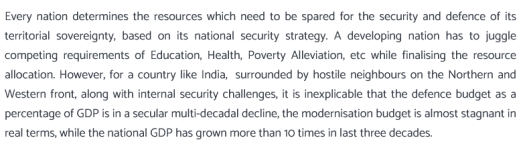
We are averse to wars as thats the rational thing to do for a poor & under-industrialised country like ours. If you want india's MIC to progress like china's, that would require investment and R&D like china. Its a function of money not culture. Our meager resources are better spent to build-up our economy & industrialisation rather than MIC. MIC can be built up later once we are richer.

Also, our conventional warfighting strength has improved. I dont understand why you think otherwise. We are not spending as much as we can cause we have other priorities. Also, nuclear weapons give us breathing space. It allows us to spend on the much needed infra like roads, rail, ports, etc.

Because we are surrounded by neighbors where at least once or more military leadership has seized power, our political decision makers are always wary of own country military, this will play in their mind till we exist as a country.
5. Since the above factor is seen as vital by the various political coalition within the country (irrespective of various ideology of different local or national political parties) , our Armed force projection will remain at a minimum credible deterrence stage, which if you translate in Western ideology the word would be insufficient.
That was true like 15-20 years ago, not today. Everyone now realises that generals are not good rulers. Our people are more educated & wont tolerate military rule as we have living examples in our neighborhood - Pakistan & Myanmar - both Junta ruled, both riddled with ethnic wars, poor, miserable. The theaterisation of our military is a good example of faith in military's intentions.

This entire aspect is not changing anytime soon. If you live long enough you will probably see LCA jets also being used way past their service life in future & facing related issues.
well, in the short life i have had, i have seen arjun take decades for only 150 to be service. Meanwhile, Zorawar was prototyped & ordered in just 2 years. So, in the end it was all a function of money, R&D, maturity of industry.

Historically we have faced a lot of extinction level event thru invasion and invading forces but we as a country have never went into that route. Culturally the Indian influence have spread across many parts of the world be it in Asian countries or African or elsewhere (nomads in Eurasia) but that was never thru invasion or forced. This proves our mindset will never be along the invasive way of force projection. When this is ingrained in the basic human characteristics, it also get reflected in how we prepare our deterrence thru conventional force projection. To me at least both aspect seem like well matched and balanced.
This is just 🤦‍♂️.India's influence into SEA was a result of both conflict & trade. It wasn't as peaceful as you think. Similarly, Islam arrived in the subcontinent through trade & peaceful means. Conflict arrived later on after 10th century. This line you wrote - "This proves our mindset will never be along the invasive way of force projection. When this is ingrained in the basic human characteristics, it also get reflected in how we prepare our deterrence thru conventional force projection." is pure nonsense, case in point 1971.

So in summery, despite having 3rd or 4th largest volume centric Military power, its core assets will be very rusty with very little regard to timely improvement needed. Therefore IAF will continue to be well below its power, will get asset introduction well past the time needed and in a reactive mode basis rather than proactive.
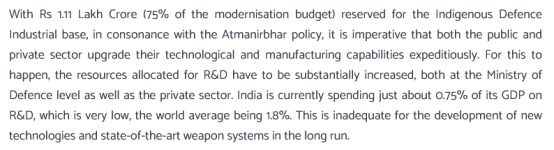
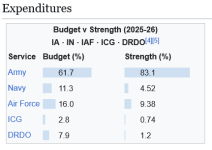
That military power comes just from the size of our population & imported machinery. If we start spending a lot of money on R&D, that can change, but that shouldnt be our priority. What we can do, is to reorient our spending keeping the future in mind. Reduce the spending on army & increase the spending on air force, as air force is now the determining factor. Days of army openly charging into enemy territory are over. Cheap drones will chew everything up.


1761683334332.png

1761683312745.png
1761683402776.png
1761683418932.png

1761683467329.png
 
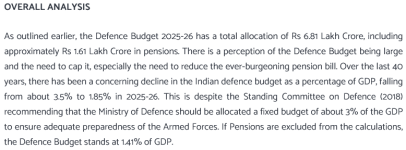
So, in summary, India is a weak military power beacuse:
1. India is a poor country, so become rich first then dream about being a military power.
2. India spends little on MIC R&D.
3. India is under-industrialised, so just increasing the R&D budget wont immediately help as you need a productive industrial base. Otherwise every sub-syestem will be imported.

India is fine right now. We need to re-orient our military spending from army to air-force. Our gradual industrialisation & economic growth is more important than being seen as a great military power. There is an economic crisis in our neighborhood every year - Sri Lanka, Maldives, Bangladesh, Nepal, Pakistan, Myanmar - was their military of any use when their own citizens turned on their rulers??? Maybe in case of Pakistan but not others...
 
View attachment 47366

A few days back someone called my post emotionally cynic or something, now this is what an emotional post looks like, complete with pseudo-history.


we were soviet lackeys until 1991 which meant bad relations with western world. 1991 economic crisis meant we needed to trade with them. Nukes were tested in 1998. Sanctions again. We needed them if we wanted to get out of economic misery.
That restraint was a very smart move to establish trust with the capitalist countries. When indians boast about $700 Billion forex reserves while looking at Pakistan, remember, it was steps like these(restraint during kargil) that helped us reach here.


Talking about war-fighting over land, Air Force as the main instrument of war has now triumphed over army.

In WW2, Hitler's Airforce was never as capable as UK's but Hitler's Army was superior to its peers - innovation in design & tactics. The result was evident. The lesson here is that airbombing was so inaccurate that it didnt matter if you had good or bad air-force, it just needed to be competent enough as it was your army that decided your fate.
Now, 70+ years later, Air-strikes have become so accurate & economical that its the Air Force that decides your fate in war not your army, case-in-point Russia-Ukraine war. Russia has clear superiority in manpower & armor, doesn't amount to much as their expensive tanks get blown to pieces by $500 drones. Neither side has clear superiority in the air, so its a stalemate. Airpower is determining the course of war here.

Also, including Russia in the comparison with China & western powers is funny now. Russia cant even produce Su-57 without subsystems from european companies. They are becoming technological laggards as time goes on & they wont be able to catch up in air-power. Do you know they are considering buying J-35 as their naval fighters now?? Tables have turned.


You are mixing a lot of things here. There is nothing inherent about india's culture that prevents india from going to war. Democracies generally avoid warfare as its wasteful. People take democracy for granted in this country & dont realise how good we have had it compared to other post colonial countries. Improving standard of living is more important than warfare. We are the fastest growing large economy. The day our growth dampens down & someone else takes our place, then people will realise how important that is.


We are averse to wars as thats the rational thing to do for a poor & under-industrialised country like ours. If you want india's MIC to progress like china's, that would require investment and R&D like china. Its a function of money not culture. Our meager resources are better spent to build-up our economy & industrialisation rather than MIC. MIC can be built up later once we are richer.

Also, our conventional warfighting strength has improved. I dont understand why you think otherwise. We are not spending as much as we can cause we have other priorities. Also, nuclear weapons give us breathing space. It allows us to spend on the much needed infra like roads, rail, ports, etc.


That was true like 15-20 years ago, not today. Everyone now realises that generals are not good rulers. Our people are more educated & wont tolerate military rule as we have living examples in our neighborhood - Pakistan & Myanmar - both Junta ruled, both riddled with ethnic wars, poor, miserable. The theaterisation of our military is a good example of faith in military's intentions.


well, in the short life i have had, i have seen arjun take decades for only 150 to be service. Meanwhile, Zorawar was prototyped & ordered in just 2 years. So, in the end it was all a function of money, R&D, maturity of industry.


This is just 🤦‍♂️.India's influence into SEA was a result of both conflict & trade. It wasn't as peaceful as you think. Similarly, Islam arrived in the subcontinent through trade & peaceful means. Conflict arrived later on after 10th century. This line you wrote - "This proves our mindset will never be along the invasive way of force projection. When this is ingrained in the basic human characteristics, it also get reflected in how we prepare our deterrence thru conventional force projection." is pure nonsense, case in point 1971.


That military power comes just from the size of our population & imported machinery. If we start spending a lot of money on R&D, that can change, but that shouldnt be our priority. What we can do, is to reorient our spending keeping the future in mind. Reduce the spending on army & increase the spending on air force, as air force is now the determining factor. Days of army openly charging into enemy territory are over. Cheap drones will chew everything up.


View attachment 47388

View attachment 47387
View attachment 47389
View attachment 47390

View attachment 47391

Muhammed bin Qasim and Arabs invaded in 700s lol. Muh peaceful before 10th century saar. Read a history book.

So, in summary, India is a weak military power beacuse:
1. India is a poor country, so become rich first then dream about being a military power.
2. India spends little on MIC R&D.
3. India is under-industrialised, so just increasing the R&D budget wont immediately help as you need a productive industrial base. Otherwise every sub-syestem will be imported.

India is fine right now. We need to re-orient our military spending from army to air-force. Our gradual industrialisation & economic growth is more important than being seen as a great military power. There is an economic crisis in our neighborhood every year - Sri Lanka, Maldives, Bangladesh, Nepal, Pakistan, Myanmar - was their military of any use when their own citizens turned on their rulers??? Maybe in case of Pakistan but not others...
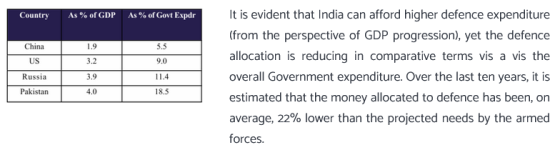
Those tiny irrelevant countries dont have the worlds second superpower as their rival bud. India needs to spend more on its military. We're not saying Soviet Union 20% of GDP levels obviously but it should be 2.5% and we should reform the domestic industry, remove reservations from DRDO HAL ISRO. And all of this apart from NOT doing clown tier moves such as that Mirage 2000 upgrade program.

See Arihant class, the way it was developed with massive investment, private sector involvement, secrecy and patience. The aerospace sector now needs its Arihant moment. We need to make our own capabilities starting from now. If we can spend $40 billion every year on free food, then what problem we should have to spend $15-20 billion on AMCA and say another $3-4 billion on Tejas Mk2? Arihant class itself required more than $10 billion to achieve.

And btw to think India can enter a crisis like those tiny little countries have is foolish thinking. India is too vast and strong to enter such a situation. We are poor wtr per capita but we aren't some frickin Guetemala or Kangladesh lol.