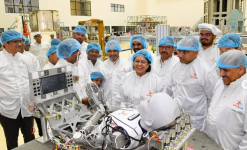
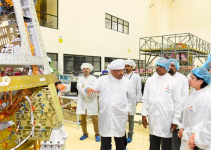
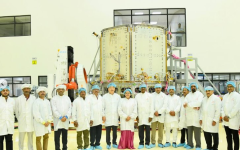
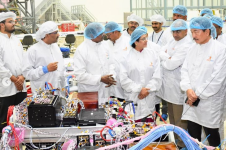
Gaganyaan Mission : ISRO to send Indian into space by 2022


Successful accomplishment of Drogue Parachute Deployment Tests for Gaganyaan

December 20, 2025

ISRO has successfully completed a series of qualification tests for Drogue Parachutes for the development of deceleration system of Gaganyaan Crew Module at the Rail Track Rocket Sled (RTRS) facility of the Terminal Ballistics Research Laboratory (TBRL), Chandigarh, during December 18-19, 2025.

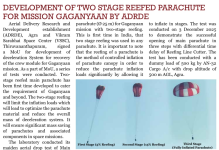
The deceleration system of Gaganyaan Crew Module comprises of a total of 10 parachutes of 4 types. The descent sequence begins with two apex cover separation parachutes that remove the protective cover of the parachute compartment, followed by two drogue parachutes that stabilize and decelerate the module. Upon release of the drogues, three pilot parachutes are deployed to extract three main parachutes, which further slowdown the Crew Module to ensure a safe touchdown.

A crucial component of this system is the deployment of drogue parachutes, which play a pivotal role in stabilizing the Crew Module and also reducing its velocity to a safe level during re-entry.

The objective of this specific test series was to rigorously evaluate the performance and reliability of the drogue parachutes under extreme conditions. Both the RTRS tests on drogue parachutes were successfully conducted on December 18 & 19, 2025 achieving all the test objectives and confirming their robustness even under the situation of significant variation in flight conditions.

The successful completion of these tests marks another significant step toward qualifying the parachute system for human spaceflight, with active support and participation from the Vikram Sarabhai Space Centre (VSSC), ISRO, Aerial Delivery Research and Development Establishment (ADRDE), DRDO and Terminal Ballistic Research Laboratory (TBRL), DRDO.

View attachment RTRS_201225vid.webm

Successful accomplishment of Drogue Parachute Deployment Tests for Gaganyaan
 
  • Like
Reactions: Kiduva21

PARLIAMENT QUESTION: ACHIEVEMENTS OF GAGANYAAN MISSION
The major accomplishments under the Gaganyaan programme in the past year include the following:

· IADT-01 successfully demonstrated the objective of end-to-end performance validation of the critical parachute-based deceleration system of the Crew Module for Gaganyaan mission in nominal mission scenarios.

· For TV-D2 mission, electrical and mechanical integration activities of Crew Module completed. Environmental tests completed.

· Standalone checks of integrated Crew Module and Service Module completed for G1. Integrated software simulations being carried out.

· Service Module Propulsion System hot test for 350s to validate the integrated performance for off-nominal mission profile.

· Parachute systems: As part of the Rail Track Rocket Sled test, clustered deployment of drogue parachutes under extreme conditions of dynamic pressures carried out.

· Integrated Main Parachute Airdrop Test conducted to demonstrate the delay in disreefing between the two main parachutes.

· Ground Qualification Tests of Crew Escape System motors, Orbital Module Adaptor, Service Module structure, Service Module Fairing, separation systems and pyros carried out.

1st Test vehicle mission and 1st Integrated Airdrop tests were successful and met all the test objectives. Based on the technical observations, certain improvements such as crew module uprighting systems, additional checks during parachute assembly, have been incorporated.

The cumulative expenditure as on January 2026 is ~ ₹6018 Crores.

Risk mitigation in the actual flight is carried out by conducting extensive ground tests simulating various failure scenario. For instance, in the recent integrated Main Parachute Airdrop Test, one drogue and one main parachute failure case was simulated and system performance was verified successfully. In October 2024, the scope of Gaganyaan programme was revised from three missions (G1, G2, H1) to eight missions. It includes three uncrewed missions G1, G2, G3 followed by two crewed missions (H1 & H2) followed by docking mission to any space station (G4), launch of BAS-01 and docking mission to BAS-01 (G5).

This information was given by the Minister of State for Personnel, Public Grievances & Pensions and Prime Minister’s Office Dr. Jitendra Singh in a written reply in the Rajya Sabha today.
 

Total Pool Of 40​

In all, the committee has proposed an astronaut cadre strength of up to 40, arguing that long-term uncertainties and evolving global opportunities warrant a larger margin in planning. The readiness of the second batch has been targeted in 72 months, with the third batch by 96 months.

While the selection process and creation of an astronaut cadre is on expected lines given India's plans for a sustained human presence in space, the space agency is lagging in related infrastructure and technology development.

Isro currently only operates a temporary astronaut training centre and is yet to begin the process to set up a full-fledged facility. In terms of technology, even for the first uncrewed mission, Isro is lagging in several aspects, the most crucial being ECLSS (environment control and life support systems) without which no astronaut can venture into space.

P.S. See the image in the article for more details.
 
Last edited:
  • Like
Reactions: BoredBear

July 04, 2026

ISRO is developing a solid motor based Sub-Orbital Launch Vehicle for Experiments (SOLVE) as a test platform to carry out Integrated Parachute Tests for validation of deceleration system of Gaganyaan Crew Module under various test conditions. During these test missions, the Crew Module will be carried to an altitude of 10 - 17 km and separated from the vehicle. A series of 10 parachutes will be deployed to reduce the velocity of the Crew Module before splashdown in the sea.

The solid stage of SOLVE is derived from the PSLV Strap-on Motor with few modifications to meet the Gaganyaan test requirements including development of slow burn rate propellant and straight nozzle with secondary injection thrust vector control.

The first ground test of the SOLVE solid motor was carried out successfully at the Static Test Facility, Satish Dhawan Space Centre, Sriharikota. The test was successfully conducted on 03-07-2026 at 10:00hrs and the motor performance parameters are as expected. The development of SOLVE vehicle provides flexibility in conducting Gaganyaan Test Missions simulating various conditions in the actual mission.​
 
  • Like
Reactions: Gautam
Successful accomplishment of Major Qualification Tests Crew Module systems of Gaganyaan Mission

July 12, 2026

Recently ISRO has successfully accomplished three major qualification tests for Crew Module (CM) systems of Gaganyaan mission viz. Float inflation test for Crew Module Up-righting System (CMUS), umbilical separation testing of Crew module Service module Connect & Disconnect System (CSCDS) and Crew Module Structure qualification test for Apex Cover separation loads.

1. Float Inflation Test of Crew Module Up-righting System (CMUS):

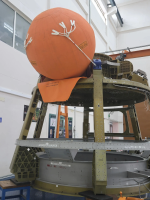
Ensuring up-right position for Crew Module after splashdown in the sea is one of the important crew safety requirements. A stored cold gas based up-righting system has been developed to meeting these requirements.

A system level qualification test setup consisting of all the elements of CMUS was realized and successfully conducted inflation tests for the primary inflation module where in stored gas in the high-pressure gas bottle was made to inflate the floatation by operating the control valves. The tests demonstrated the inflation module meeting the functional and performance requirements for deployment of the primary flotation. The test also demonstrated the inflation time requirements over the complete operating range of gas bottle pressures.

1783874824746.png

2. Umbilical separation testing of Crew Module Service Module Connect Disconnect System (CSCDS):

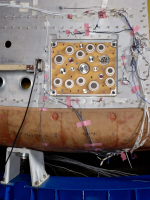
The Crew Module Service Module - Connect Disconnect System (CS-CDS) is one of the major systems that serves as an electrical / hydro-pneumatic umbilical link between Crew Module (CM) and Service Module (SM). All the electrical communication between CM and SM as well as the fluid communication for Environment Control & Life Support System (ECLSS) takes place through CS-CDS. This system consists of two parts, Crew module - Service module Umbilical (CSU-1 & CSU-2) one each at CM and SM side. After separation of SM from CM at CSU-1, CSU-2 on CM side is separated before re-entry of CM.

Separation test of CSU-2 from simulated Crew Module was carried out. The test demonstrated the clean separation of CSU-2 as well as structural stability of the Crew Module panel and their interfaces. The test validated the functionalities of integrated CSU-2 system and demonstrated the required design margins.

1783874880704.png

3. Crew Module Structural qualification test for Apex Cover Separation loads:

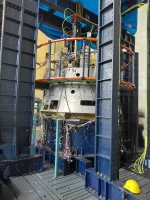
Apex cover of Crew Module protects the parachutes and associated subsystems during the mission. Before deployment parachutes in sequence to decelerate the Crew Module, the apex cover is separated at a predetermined altitude operating pyrotechnically actuated thrusters.

To validate the structural integrity of the Crew Module during apex cover separation event, an instrumented test rig along with simulated crew module and associated systems were realized and approximately 1.75 times of estimated reaction loads were applied to simulated crew module at identified locations. All the measured strain and deformations during the tests confirmed the design margins and also validated the structural integrity of crew module for the apex cover separation event in the flight.

3_crew_module.jpg.webp

Successful accomplishment of Major Qualification Tests Crew Module systems of Gaganyaan Mission
 
Australian tracking terminal commissioned for India’s historic human spaceflight program

9 July 2026
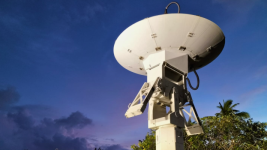
1783875099428.png

Australia is playing a vital role in India’s push to send astronauts into space.

Coordinated by the Australian Space Agency, the key space tracking infrastructure is now operational in the Cocos (Keeling) Islands to support India’s historic Gaganyaan Human Spaceflight Program.

The commissioning was announced today as part of the joint statement between Prime Minister Albanese and Prime Minister Modi at the Third Australia–India Annual Summit in Melbourne.

"The Prime Ministers highlighted the importance of strengthening space cooperation, including industry-to-industry partnerships.

"The Leaders welcomed Australia’s continued support for India’s Gaganyaan Human Space Flight Program, including commissioning of a temporary space tracking terminal on Cocos (Keeling) Islands, and expressed hope to further deepen collaboration between the Indian Space Research Organization (ISRO) and the Australian Space Agency."

~Joint statement between Prime Minister Albanese and Prime Minister Modi

Located in the Indian Ocean, the newly commissioned terminal will provide mission-critical tracking support for four planned missions led by ISRO.

The first uncrewed test flight is expected to launch soon from India’s Satish Dhawan Space Centre.
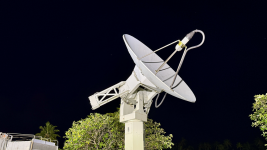
1783875292572.png

Aussie expertise backing India’s space ambitions

Australia’s contribution, led by the Australian Space Agency, highlights the strength of the Australia–India partnership, particularly in science, innovation and advanced technology.

The Agency worked with other government agencies and Australian defence and space company Nova Systems to establish temporary telemetry terminals in the Cocos (Keeling) Islands to track the four Gaganyaan missions.

In a media release issued today, the Assistant Minister for Science, Technology and the Digital Economy, Dr Andrew Charlton, highlighted how the collaboration reflects the importance of Australia’s relationship with India and the opportunities created by growing cooperation in the space sector.

“India is one of Australia’s most important economic partners, with its ambitious national space program and rapidly growing commercial space sector a key driver strengthening our relationship.

“This collaboration highlights Australia’s role as a trusted partner in space and reaffirms our commitment to advancing science, innovation and international cooperation across the global space sector.”

~ Assistant Minister for Science, Technology and the Digital Economy, Dr Andrew Charlton

The commissioning demonstrates Australia’s unique geographic advantages and growing capability as a trusted partner in space mission support across the Indo-Pacific.

Head of the Australian Space Agency Enrico Palermo said Australia’s support for Gaganyaan underscores the depth of bilateral cooperation and the important role Australia can play in human spaceflight missions.

"Our unmatched geographic advantages make Australia a desirable partner for space launches and returns – with our wide-open ranges, coastlines and access to targeted orbits – but also for critical space tracking capability, thanks to our distinctive and clear view of the sky.”

~ Head of the Australian Space Agency Enrico Palermo
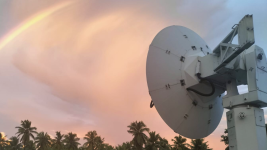
1783875259992.png

Advancing space exploration


Gaganyaan – Sanskrit for “Sky Craft” – will send three astronauts into low Earth orbit for a three-day mission before returning them safely to Earth.

The upcoming mission will make India only the fourth nation to send astronauts into space through its own national program.

Australia and India are also exploring potential cooperation on search and rescue operations for controlled landings in waters off Western Australia, expanding the partnership beyond launch tracking to broader mission support.

“This is a proud moment for the region, underscoring the strategic importance of the Cocos (Keeling) Islands to Australia and the world.”

~ Minister for Regional Development, Local Government and Territories of Australia, Kristy McBain

Australia’s support for the Gaganyaan mission reflects the growing scale and ambition of the Australia–India relationship, and the role both countries are playing in advancing regional and global space capability.

https://www.space.gov.au/news-and-m...for-historic-indian-human-spaceflight-program

 
  • Like
Reactions: Asterion Moloc
Title of the thread, its circa 2026 and boys are still on earth.

Gaganyaan Mission : ISRO to send Indian into space by 2022​