Gaganyaan Mission : ISRO to send Indian into space by 2022

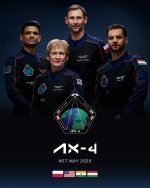
ISRO-ESA collaboration in microgravity research in upcoming Axiom-4 Mission

January 31, 2025

Recently, ISRO and European Space Agency (ESA) have entered into an agreement to cooperate on activities related to Astronaut Training, Mission Implementation and Research Experiments. This agreement provides an opportunity for undertaking joint microgravity experiments. In this regard, following microgravity research experiments by Indian Principal Investigators (PIs) have been jointly shortlisted by ISRO & ESA for implementation on International Space Station (ISS) during Axiom-4 mission:

Sl. No.
Microgravity Experiment
Institution (s)
1​
Comparative growth and proteomics responses of cyanobacteria on urea and nitrate in microgravity​
International Centre for Genetic Engineering & Biotechnology (ICGEB)
Dept. of Biotechnology​
2​
Impact of Microgravity on Growth and Yield Parameters in Food Crop Seeds​
Indian Institute of Space Science and Technology, Dept. of Space & College of Agriculture, Vellayani, Kerala Agricultural University​

Currently, these shortlisted microgravity experiments are under various phases of evaluation in view of safety driven operational philosophy of human spaceflight missions. Further, ISRO& ESA will be jointly carrying outhuman research and other scientific/ technology demonstration experiments.

In addition to these, cooperation in microgravity research with other space agencies during Axiom-4 mission is also being actively pursued.

The field of microgravity research with potential applications in human health research, physical sciences, material sciences, novel pharmaceutical development and biotechnology offers significant opportunities to national scientific community. Indian Human Space Program, Gaganyaan aims to encourage and support Indian scientific community in microgravity research activities through flight opportunities in ISRO’s missions as well as joint international efforts.

ISRO-ESA collaboration in microgravity research in upcoming Axiom-4 Mission
 
Successful accomplishment of joint ISRO-ESA Radio Frequency Compatibility Tests (RFCT) for Gaganyaan Missions

February 11, 2025

Indian Space Research Organization (ISRO) has successfully completed validation of network operations of Gaganyaan Orbital Module communications systems with the European Space Agency (ESA) Ground Station by conducting a series of Radio Frequency Compatibility Tests (RFCT). These tests are essential towards ensuring readiness of the entire communications architecture and validation of compatibility of ISRO’s systems with external ground stations before undertaking Gaganyaan missions. This requires integrated operation of the Gaganyaan onboard Telemetry, Tracking & Command (TTC), Data Handling, Audio/Video Systems with the external Ground Station.

With the successful accomplishment of these RFCT jointly with ESA, end-to-end compatibility between ISRO’s Gaganyaan Orbital Module communications systems and ESA’s Ground station network has been demonstrated.

Ensuring seamless communication between Mission Control Centre and Gaganyaan Orbital Module is vital for the mission success. This is essential for successful accomplishment of mission operations in human space missions such as communication with onboard Crew, monitoring of various onboard systems of the Orbital Module as well as commanding operations by a team of ground-based Flight Controllers. In order to provide maximal communication coverage during the Gaganyaan missions, ISRO will be utilizing is own capabilities as well as external ground station support from other agencies across the world.

This cooperative activity was enabled through a Technical Implementing Plan (TIP) for providing Ground Tracking Support for Gaganyaan Missions signed by both ISRO and ESA in December,2024.

Successful accomplishment of joint ISRO-ESA Radio Frequency Compatibility Tests (RFCT) for Gaganyaan Missions
 
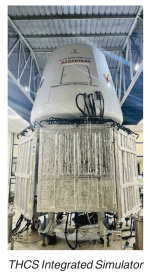
Ground test of the Gaganyaan's Temperature & Humidity Control System (THCS) was successful:
Screenshot (1100).png

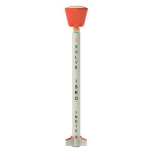
Sub-Orbital Launch Vehicle for Experiments (SOLVE) based on PSLV's PSOM-XL booster. It will be used to simulate parachute deployment during various descent phases of Gaganyaan Crew Module:
1739814007082.png
 
  • Like
Reactions: South block

Some nice updates on Gaganyaan:
  • Human Rated Launch Vehicle (HLVM3): Development and ground testing completed.
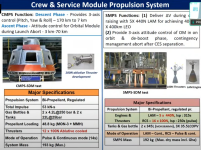
  • Orbital Module: Propulsion systems for Crew Module and Service Module developed and tested. ECLSS engineering model realized.
  • Infrastructure established: Orbital Module Preparation Facility, Gaganyaan Control Centre, Gaganyaan Control facility, Crew training facility, Second Launch pad modifications.
  • Precursor Missions: A Test Vehicle developed for validating CES and flight tested in TV-D1. Activities progressing for TV-D2 and IADT-01.
  • Flight Operations and Communication Network: Ground network configuration finalized. IDRSS-1 feeder stations and terrestrial links established.
  • First Uncrewed Mission (G1): C32-G stage and CES motors realised. HS200 Motors and CES Fore end up to Crew Module Jettisoning Motor stacked. Crew Module and Service module structure realised. Crew Module Phase-1 checks completed.

  • The second test vehicle mission (TV-D2) - Q3 of 2025.
  • The first unmanned orbital flight under the Gaganyaan mission - Q4 of 2025.
  • The second and third unmanned orbital flights (G2 and G3) - 2026.
 

IADT test to be done tomorrow, according to WION, the crewed Gaganyaan mission will only take place in the 2030s
 
ISRO accomplishes first Integrated Air Drop Test for Gaganyaan Missions successfully

August 24, 2025

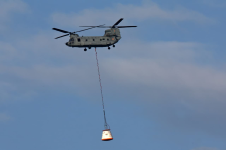
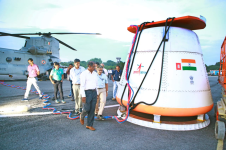
On August 24,2025, ISRO accomplished first Integrated Air Drop Test (IADT-01) for Gaganyaan program at Satish Dhawan Space Centre (SDSC), Sriharikota. This test successfully demonstrated the objective of end to end performance validation of the critical parachute-based deceleration system of the Crew Module for Gaganyaan mission in one of the typical mission scenarios. This test is part of system level qualification of parachute-based deceleration system, in which a simulated CM, encompassing the deceleration system is dropped using a helicopter.

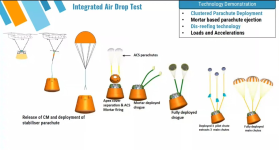
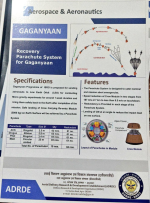
In Gaganyaan missions, parachute-based Deceleration system is employed during terminal phase of Crew Module (CM) descent to reduce the touchdown velocity of Crew Module to an acceptable limit for safe landing on sea. The parachute system and its layout, for IADT, was same as that of Gaganyaan missions. It comprised of four types of parachutes viz. Apex Cover Separation (ACS) (Ø 2.5 m - 2 nos), Drogue (Ø5.8 m - 2nos), Pilot (Ø3.4 m - 3 nos.) and Main parachutes (Ø 25 m - 3nos.).

In IADT-01, the simulated Crew module (~4.8 t) with Parachute system was released from an altitude of about 3 km using Indian Air Force's Chinook Heavy lift helicopter. The deceleration system initiation began with firing of ACS Mortar which deploys the Ø2.5 m ACS parachutes, which is followed by the separation of Apex cover. The deployed ACS parachutes then decelerated the Apex cover and prevented it from re-contacting the descending simulated CM during the test. The Ø5.8 m Drogue parachutes were then deployed using Drogue Mortar, which provided first stage deceleration to the simulated crew module. After first stage deceleration, the Drogue parachutes were released using pyro-based parachute releasers. This was followed by firing of three Pilot Mortars, which ejected and deployed the Ø3.4 m Pilot parachutes., which then independently extracted and deployed the three Main parachutes of Ø25 m diameter.

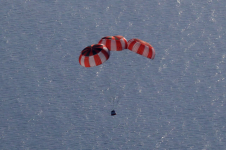
Further, main parachutes reduced the terminal velocity of the simulated Crew Module to about 8m/s. After touchdown, the Main parachutes were released using parachute releasers. These parachutes totaling ten in number deployed in a precise sequence to gradually decrease the velocity of the Crew Module for safe touchdown.

The test simulated a possible abort scenario on the launch pad. Upon release of CM, the onboard avionics commanded for deceleration system initiation and there after parachutes deployed in predefined sequence. During this test, onboard avionics systems were also used to measure various parameters, which were telemetered to ground as well as stored onboard using Solid State Data Recorder (SSDR). Post splashdown, the simulated Crew Module was successfully recovered and ferried back on INS Anvesha to Chennai port.

Extensive modeling of CM as well as helicopter was carried out to address the dynamics of underslung body. Besides this, extensive trials with a dummy crew module hardware and IAF’s Chinook Helicopter were carried out to validate the mission profile and related standard operating procedures. Following successful accomplishment of multiple trial sorties and clearance by Test Authorisation Board (TAB), IADT-01 was carried out with the actual test article. Apart from ISRO centres, other governmental agencies including DRDO, Indian Air Force, Indian Navy and Indian Coast Guard also contributed in the successful accomplishment of this major test. Similar tests at different deployment conditions are planned in forthcoming days.

ISRO accomplishes first Integrated Air Drop Test for Gaganyaan Missions successfully
 
  • Like
Reactions: babablacksheep