Brexit and Future of UK : Discussions

Hum,actually it was agreed that Britain would have to pay the Brexit bill before even an hypothetical trade deal is finalized. However it happens that your PM and the others who represent you tend to have different words depending on the place they are. Makes you think who's really trying to save face.

They are lying to you making you think Britain will only pay its bill if it gets a fair trade deal.

dude, negotiations are actually heavily dependent on perceptions of negotiators. That's where Britain aces. You will find during negos that British diplomats etc. are always seen walking with long, strident gait and stentorian voice unlike gnome like characters like Juncker and philosophers like Macron. On the table no one can beat the brits and their inherent superior handling of things will give them the advantage.
 
German MEP reveals Juncker FINALLY understands Brexit’s danger to EU after crunch meeting

EXCLUSIVE: Jean-Claude Juncker finally understands Brexit has “severe repercussions” for the European Union, German MEP Hans-Olaf Henkel has revealed after a crunch meeting with the European Commission President.
By JOE BARNES
PUBLISHED: 07:16, Tue, Jan 16, 2018 | UPDATED: 07:27, Tue, Jan 16, 2018


1K

German MEP: Juncker understands Brexit's 'danger to EU'
Pause
Mute
0:11
/
1:09
Loaded: 0%Progress: 0%

Fullscreen
Facebook
Twitter
Share
UP NEXT:Expert sheds light on BRUTAL North Korean regime
Mr Henkel met with Mr Juncker in Strasbourg, attempting to encourage the Commission boss to offer Britain a fresh deal in order to protect Europe from Brexit.

The German went to the Commission President with a list of concerns, which he believes many European Union bosses are ignoring to the detriment of the bloc.

Ahead of their discussion, Mr Henkel warned “the significant negative impact of Brexit on the remaining 27 countries justifies the EU offering Britain a deal which avoids a tragedy of historical dimensions.”

However, to date the EU has been reluctant to offer anything to Britain, urging Theresa May's negotiators to make the first move.

Brexit news EU UK Juncker HenkelGETTY•EXPRESS

Brexit news: Hans-Olaf Henkel reveals contents of crunch meeting with Jean-Claude Juncker
I think Jean-Claude Juncker is starting to realise that Brexit has severe repercussions for Europe

Hans-Olaf Henkel

Speaking to Express.co.uk, immediately after his meeting with Mr Juncker, Mr Henkel said: “We agreed on certain things and agreed to disagree on others.

“We both deeply regret Brexit. I think that he is having an understanding Brexit has also significant disadvantages for the European Union.

“I could explain to him some examples, like in the automotive industry for Germany. On the other hand, he gave me some examples of problems and complications which I did not know.

“I think he is starting to realise that Brexit has severe repercussions for Europe.”

Sir Heywood warns of 'huge challenges' with no deal Brexit
Play Video
Mr Henkel also revealed that the Mr Juncker sees Britain’s European Union divorce as a “personal defeat”, but refuses to admit the European Commission has its own share of blame for Brexit.

“I mentioned the centralisation tendencies of Brussels, which were against the grain of the British people,” the German added.

“I also mentioned my opinion that David Cameron did not get the degree of autonomy to control immigration as he should have.

“He said that David Cameron got, more or less, everything he wanted, so here we disagreed.”

Madness of King Juncker: EU boss' craziest moments
Wed, July 26, 2017
Jean-Claude Juncker greets colleagues with kisses and slaps


PLAY SLIDESHOW
European Commission President Jean-Claude Juncker greets EU Commission Chief spokesperson Margaritis Schinas REUTERS1 of 16
European Commission President Jean-Claude Juncker greets EU Commission Chief spokesperson Margaritis Schinas
Jean-Claude Juncker jokes and gives Margaritis Schinas a slap before the weekly college meeting of the European Commission
European Commission President Jean-Claude Juncker greets Switzerland President-elect Simonetta Sommaruga at the European Commission headquarters in Brussels
Donald Tusk and Jean-Claude Juncker during the EPP Summit in Saint Julians, Malta
Jean-Claude Juncker at the start of the weekly college meeting of the European Commission in Brussels
Jean-Claude Juncker, President of the European Commission, kisss Michel Barnier
EU Commission President Jean-Claude Juncker (L) and Portuguese Member of European Parliament Maria Joao Rodrigues of the Socialist Party (Partido Socialista) (R) attend the forum 'Which way forward for a better European Future?' at BOZAR in Brussels
The German MEP, a Vice Chairman for European Conservatives and Reformists Group, urged Mr Juncker to offer Britain the “best deal possible”, adding: “Of course, his official line was the remaining 27 countries of the European Union have one line and he thinks he will follow that line.

“In other words, he waits for Britain to make the first move. At this stage, he did not promise me he would come up with a new deal for Britain.”

Mr Juncker’s anti-Brexit attitude should be a concern for the remaining EU member states because the “long-term repercussions for the EU” have yet to be understood, warned Mr Henkel.

The German concluded: “The typical continental attitude that a bad deal for Britain doesn’t really concern us much, I think that is a gross miscalculation.”
 
Ahead of their discussion, Mr Henkel warned “the significant negative impact of Brexit on the remaining 27 countries justifies the EU offering Britain a deal which avoids a tragedy of historical dimensions.”
Well, Mr Henkel, can you outline what this significant negative impact is? Give concrete examples.
 
  • Like
Reactions: Vergennes
Well, Mr Henkel, can you outline what this significant negative impact is? Give concrete examples.
Should be obvious. Automotive industry for example. Adding WTO tariffs on top of fallen £ effect will reduce car exports to UK. Fashion industries would also be badly affected. The impact would be massive and there is no pay-off to counter it for them.
 
Germany has no Government, its a temporarily rulership. Difficult case, cause SPD base council rejects a GROKO. ( CDU and SPD).
On the other side EU begs UK to cancel Brexit. We could see a possible lead in the EU of UK , Italy , Spain and eastern contries if Brexit is cancelled. Eastern Countries are rid of of German dominance.
 
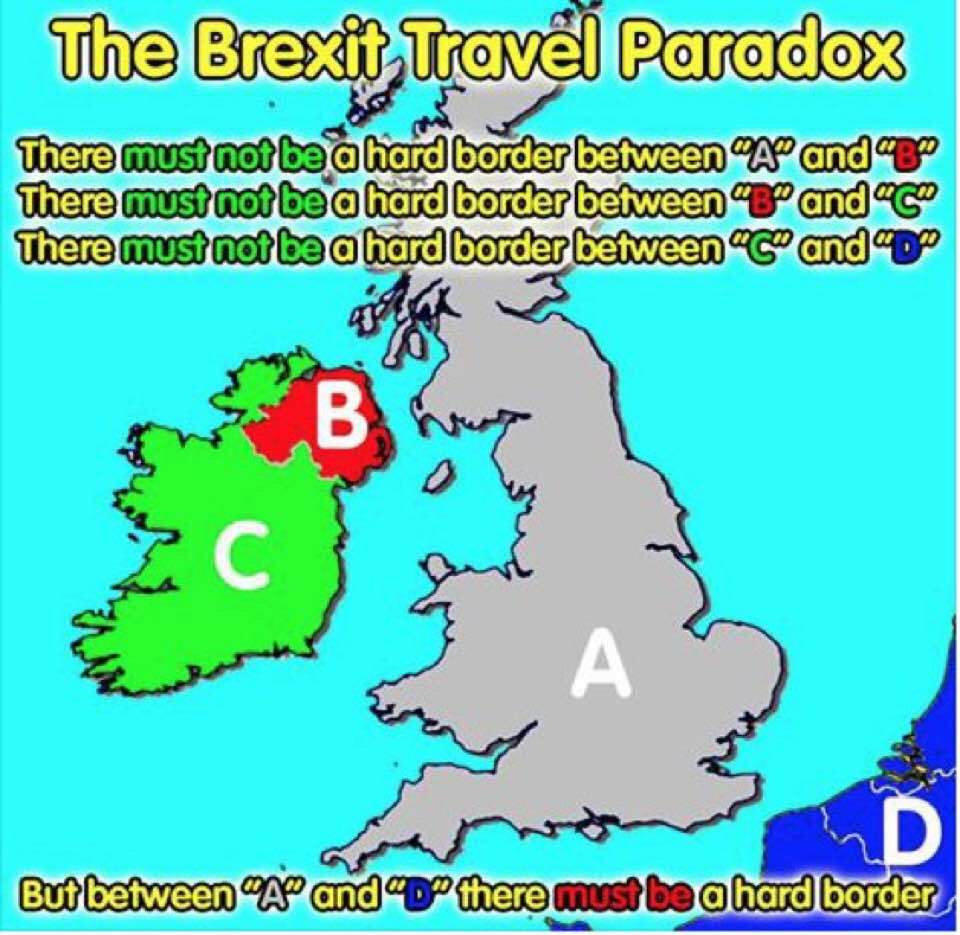
Europe will not lose the British market. Just go through Ireland. You can thank the DUP for that, by the way, they want no hard border between Ireland and Great Britain.

Z8VmB8x.jpg
 
  • Like
Reactions: Atalay
The European Parliament is to call for Britain to have 'privileged' single market access after Brexit

The European Parliament is to call for Britain to have 'privileged' single market access after Brexit

The European Parliament is preparing a "detailed," 60-paragraph resolution which will call for more flexibility in future relationship talks with Britain. The Parliament wants the EU to negotiate an 'association agreement' which could give Britain "privileged" single market access and membership of EU agencies. The resolution marks a break from the position of the EU's chief Brexit negotiator. The Parliament's plans were revealed to British MPs during meetings in Brussels this week. LONDON — The European Parliament is putting together a 60-paragraph document outlining its desire for an "association agreement" with post-Brexit Britain, in a break from the position of the chief EU negotiator
 
while Britain lives in one fantasy to another, France sees an unexplained jump of 90% in FDI post Brexit. WOnder what that is about....
 
UK could IMMOBILISE important EU military equipment after Brexit following Brussels THREAT

UK could IMMOBILISE important EU military equipment after Brexit following Brussels THREAT
A MAJOR EU security satellite could be crippled by the UK if the trade bloc attempts to block Britain from using the military device after Brexit, it has been reported.
By DAN FALVEY

PUBLISHED: 00:05, Tue, Mar 27, 2018 | UPDATED: 11:28, Tue, Mar 27, 2018


fb.png


tw.png


g-plus.png


m.png


sh.png

760

c.png


Galileo aims to produce world's 'most accurate' sat nav system
Play
Mute

0:45

/

1:30

Loaded: 0%

Progress: 0%


FullscreenFacebookTwitterShare
Ministers are planning to render useless the GPS system, known as Galileo, after Brussels bureaucrats said the UK would not be allowed to use the encrypted navigation data.

A total of 15 per cent of the £2.3billion project was paid for by the UK and senior politicians are now considering shutting down the project if they are not allowed to make use of their investment.

A Whitehall source said: “Galileo relies on a huge amount of British know how, as well as our territories all over the world.

“Trying to cut us out of it would backfire badly on the EU Commission.”
 
  • Like
Reactions: Aravind
Much ado about nothing. There are several Galileo partners that are not part of the EU, nor even of the ESA. (There are several countries in the ESA that are not in the EU. Countries like Norway, Switzerland, or even Canada. The ESA also has cooperation agreements with Ukraine and Turkey. There's really no obstacle to the UK remaining in the ESA after Brexit.) Israel and Morocco have joined the Galileo program, and even China did (between 2003 and 2006, then they left to focus instead on their own Beidou program).

There are two monitoring stations in the UK (Swanwick and Glasgow), but then again, there are also Galileo monitoring stations in a lot of other non-EU places, notably Canada, Chile, Egypt, Iceland, Israel, Mauritania, Morocco, Norway, South Africa, Switzerland, Tunisia, and Turkey.

So it's just a bunch of posturing. If the UK wants to stay in that program, there's no reason they can't.
 
In Eastern Europe, the E.U. faces a rebellion more threatening than Brexit

In Eastern Europe, the E.U. faces a rebellion more threatening than Brexit
325246973_0-5432.jpg

An honor guard stands in formation outside the Hungarian parliament in Budapest. (Akos Stiller/Bloomberg)

By Griff Witte and Michael Birnbaum April 5 at 5:00 AM Email the author

BUDAPEST — It was a continentwide party to mark the end of history.

On a spring night in 2004, a chorus sang in a Warsaw square. Beethoven’s “Ode to Joy” — the anthem of the European Union — echoed across once-bloody frontiers. Midnight fireworks sparkled along the Mediterranean. The next morning, organizers set a white-tablecloth breakfast on Budapest’s Chain Bridge for revelers still celebrating the dawn of a new era for Europe.

“The divisions of the Cold War are gone — once and for all,” declared then-European Commission President Romano Prodi as he welcomed 10 new members to the E.U., eight from the former communist East.

And yet, 14 years later, new divisions are emerging — many of them following old lines. The triumph of liberal democracy is being attacked from within by E.U. members that openly deride the club’s values, principles and rules. The bloc, meanwhile, has been incapable of fighting back, its weakness a side effect of the optimism with which it grew.

Ground Zero for the rebellion is here in Hungary, where Prime Minister Viktor Orban is running for reelection Sunday with boasts of his illiberalism, swipes at the hostile E.U. “empire” and promises to further tighten his grip on a country dancing ever-closer to the edge of autocracy.

hungaryeu009.jpg
Fireworks over Budapest celebrate the enlargement of the European Union on May 1, 2004. (ATTILA KISBENEDEK/AFP/Getty Images)

Orban’s defiance presents the E.U. with a far different threat than the one it faced in 2016, when Britain voted to exit and speculation swirled over who might go next. It may be more serious than that — a challenge that endangers the character of the union.

“Orban doesn’t want to leave the E.U.,” a senior German official said. “He really wants to change the E.U.”

By some measures, he’s succeeding. Far from being a pariah, Orban has found imitators in Poland and admirers in the Czech Republic, Austria and even at top political levels in Germany.

Orban’s European opponents, meanwhile, have proved unable to curb his behavior. Rather than punish Hungary for its intransigence, Brussels continues to supply the government with billions of euros in E.U. subsidies — money that Orban’s domestic critics say is vital to his survival because it boosts the economy and puts cash in the pockets of favored cronies.

“Orban is waging his freedom fight against the E.U. with huge amounts of E.U. money,” said Peter Kreko, executive director of the Budapest-based policy research firm Political Capital. “Lenin said ‘Capitalists will sell the rope to us with which we’ll hang them.’ Well, the E.U. is not selling. It’s giving it to Orban for free.”

The E.U. never gave itself adequate tools for dealing with a wayward leader such as Orban because it never imagined needing them, even as the alliance spread far beyond its original Western European core to countries with scant experience of democratic governance.

At the start of the millennium, the bloc had just 15 members — none of them east of the old Iron Curtain. But after the fall of communism, Eastern European countries that had been in the orbit of the Soviet Union looked to the E.U. and NATO as institutions that could bind them to the West and keep them out of Moscow’s grasp. Prosperous western neighbors spotted an opportunity to spread their influence across the continent.

Everyone assumed that, with time, differences would recede as the new members grew to adopt the values, rules and institutions of the old ones.

“We wanted to believe it. History would go on and we would be on the right side of it,” said the German official, who spoke on the condition of anonymity because he was not authorized to speak for the record. “We never imagined that history could go the other way.”

For Hungarians, too, there were expectations that, in retrospect, look naively optimistic.

“It was a fantastic constellation. We wanted it. The West wanted it. It was back wind in every respect,” said Peter Balazs, a former Hungarian diplomat who was deeply engaged in the E.U. accession process. “And the follow-up was in the fairy tales: They live happily ever after.”

Balazs, who would go on to become the country’s foreign minister, said Hungary spent a decade proving to the E.U. that it was worthy of membership, working assiduously to meet the club’s strict rules for entry.

But once Hungary had joined, the union’s best leverage to keep the country on a free and democratic path evaporated. Meanwhile, no one had seriously planned for what would happen after Hungary and others joined the bloc — a failure that Balazs attributed to parallel illusions.

“A Hungarian illusion that the E.U. would do it, that somebody else would solve our problems,” he said. “And for Europe, the illusion that they would be like us.”

The result was fertile ground for Orban. Since coming to power in 2010, he has simultaneously used the bloc as rhetorical foil and cash spigot — all without fear of meaningful consequences.

“I have, in fact, more respect for the decency of Euroskeptics who at least say, ‘Well, I don’t like the European Union, and I don’t like the values, and I’ll go out,’” Guy Verhofstadt, who was prime minister of Belgium when Hungary joined the E.U., told Orban last year when the Hungarian leader came to speak at the European Parliament. “You want to continue the money of European funds, the money of the European Union, but not the European values.”

Verhofstadt, who is now the leader of a centrist bloc of the European Parliament, has condemned fellow E.U. leaders for refusing to hit Hungary with sanctions.

Orban openly brags of his aim to build “an illiberal state based on national foundations” and cites Russia and China as exemplary models.

He has consolidated his party’s influence over formerly independent arms of the Hungarian state and society, including prosecutors’ offices, government auditors and the media. If he wins reelection, as is widely expected, the 54-year-old Orban has promised to press ahead with legislation that would allow the banning of aid groups that work on behalf of refugees or other immigrants.

On the campaign trail, he delights crowds by lashing out at Brussels, part of a trinity of enemies that also includes Muslim refugees and the Hungarian American investor George Soros.

As recently as 2011, Hungary scored the highest rating possible from Freedom House, an international nongovernmental organization, but it is now the least free of all E.U. members. The corruption monitor Transparency International ranks it the second most corrupt country in the bloc, just behind Bulgaria.

Yet Hungary is also among the greatest net beneficiaries of E.U. funds, receiving 4.5 billion euros (or $5.5 billion) in 2016 — equivalent to 4 percent of the country’s economic output — while contributing less than 1 billion euros, or $1.23 billion.

The money has helped to buoy the Hungarian economy, which has been growing at a healthy clip. It has also found its way into the pockets of friends, allies and family members of the prime minister.

“It’s E.U. taxpayers that feed the system and allow Orban to grow strong,” said Sandor Lederer, chief executive of the Budapest-based anti-corruption watchdog K-Monitor. “He’s decided it’s not enough for you to be the political leader. You also have to be the leader of the thieves, and this is the only way you can really exercise power.”

The mayor of Orban’s home village, a gas-fitter by trade, has become one of Hungary’s richest men during his schoolmate’s run leading the nation. Much of his wealth has been fueled by government contracts.

Companies owned or operated by Orban’s son-in-law have also fared well in the competition for government work, winning lucrative E.U.-funded contracts to upgrade street lighting in towns and cities across the nation. In January, the E.U.’s anti-fraud monitor found “serious irregularities” and “conflicts of interest” in the awarding of those contracts, which totaled more than 40 million euros, or nearly $50 million.

But Brussels-based investigators are virtually powerless to do anything about it. Authority to pursue the matter resides in Hungary, with prosecutors who are widely perceived to do the bidding of the ruling party.

That is typical of the E.U.’s dilemma in how to address Hungary’s piece-by-piece moves against the rule of law and democratic norms.

Until recently, the bloc did not even have measures to address rule-of-law violations that fell short of triggering the bloc’s nuclear option — E.U. sanctions that would suspend a country’s voting rights.

In 2013, as a direct reaction to Orban’s moves, the E.U. enacted new rules that gave policymakers in Brussels the power to flag developments in member countries that set off rule-of-law concerns and force a dialogue with national leaders. But the new powers were not retroactive, and Hungary had already enshrined many of its legal changes. The rules also lacked teeth. Although E.U. officials searched for ways to open investigations, they found Orban was an excellent tactician, walking right up to their lines without crossing them.

“We can’t just go in there flippantly,” said a senior E.U. official who is involved in monitoring violations of European treaties and who spoke on the condition of anonymity to describe backroom discussions.

Meanwhile, the nuclear option — known as Article 7 — has effectively been neutralized. The problem was underlined after the European Commission triggered the article for the first time in December against Poland. But the like-minded governments in Poland and Hungary have vowed to protect one another should either be targeted.

Other countries, too, may have Hungary’s back. Away from the campaign trail, Orban can often be seen joking around with fellow leaders at E.U. summits in Brussels. If they were to move against Orban, it would cost them comity and allies at an already fractious time.

It could also cost them politically at home. Orban’s relentless attacks on refugees and immigrants have been a winning message in Hungary. Others, including Austrian Chancellor Sebastian Kurz and German Interior Minister Horst Seehofer, have taken notice and adopted similarly hard-line messages, while publicly welcoming the Hungarian prime minister as an honored guest.

 
Hungary leader Viktor Orban sweeps to re-election win with super majority

Hungary leader Viktor Orban sweeps to re-election win with super majority
Fox NewsApril 8, 2018

27101b85ce4a73cf6300d55c974bd70e


Hungary leader Viktor Orban sweeps to re-election win with super majority

More
BUDAPEST, Hungary – Hungarian Prime Minister Viktor Orban easily won a third consecutive term Sunday and his Fidesz party was poised to regain its super majority in parliament, according to preliminary results from the country's election. With 84.7 percent of the votes counted, Fidesz and its small ally, the Christian Democrat party, had secured 133 of the 199 seats in the legislature, the minimum needed for a two-thirds majority. The right-wing nationalist Jobbik party placed second with 26 seats, while a Socialist-led, left-wing coalition ran third with 20.
 
Brussels begins big battle on post-Brexit budget

Brussels begins big battle on post-Brexit budget
Cédric SIMON,AFP Sun, 29 Apr 05:04 BST

119c9a7245fe84c2ddf8cdb602c84ac1cdf8e97e.jpg
EU Budget Commissioner Guenther Oettinger, who will present the plans in Brussels on Wednesday, says that tough steps are needed to fill a 12 to 14 billion euro hole left by Brexit
The EU will this week unveil its first formal plans for a larger, one-trillion-euro-plus long-term budget after Britain's departure, which threaten to further deepen divisions in the bloc.

From slashed farm funds that will anger French farmers, to development cash tied to respect for democracy, and demands for greater national contributions, the 2021-2027 budget promises to be an explosive mixture.

EU Budget Commissioner Guenther Oettinger, who will present the plans in Brussels on Wednesday, says that tough steps are needed to fill a 12 to 14 billion euro hole left by Brexit.

A race against time will follow, especially as the European Commission, the EU's executive arm, wants the budget agreed before the next European Parliament elections in May 2019, two months after Britain leaves.

EU states say it is "impossible" given the rifts between east, west, north and south, with countries anxious not to put their hands in their pockets at a time when populism on the march.

"They have to take responsibility for the ambitions that they have expressed" for the EU after Brexit, an official in Jean-Claude Juncker's commission said on condition of anonymity.

- 'There will have to be cuts' -

The loss of Britain deprives the EU of one of its biggest net contributor nations at a time when the bloc is trying to finance new areas such as defence and tackling migration.

Countries including Austria and the Netherlands are already gearing up to fight any demand for increased national contributions, although France and Germany have said they are ready to pay more.

The sums at stake in the budget debate are huge, even if on the face of it they only represent a tiny fraction of the overall wealth of the European Union -- the current 2014-2020 budget represented just 1 percent of the bloc's GDP.

Oettinger has called for countries to increase their contributions to "between 1.1 percent and 1.2 percent" of their national budgets for the next "multi-annual financial framework".

But along with the new resources "there will have to be cuts," the German commissioner has warned.

Sources said they would be "modest" amounting to less than 10 percent.

Most will target the two areas that together account for nearly three quarters of all EU spending.

The EU's infamous Common Agricultural Policy is first in the crosshairs, accounting for 37 percent of the bloc's spending. That will be difficult to swallow for France, whose farmers are the biggest beneficiaries of CAP funds.

Paris has said it is ready to defend "substantial reform" but the "indispensable security of aid for farmers cannot be affected", a diplomatic source said.

- 'Political pressure' -

Also targeted will be so-called cohesion funds that are used to fund development in poorer European countries. They represent a further 35 percent of the EU's budget.

Most of that money currently goes to eastern former Soviet bloc countries which are still catching up economically.

But southern nations such as Spain and Italy have started demanding that some is redirected to tackle mass youth unemployment in their countries.

The eastern countries are also alarmed by the commission's plans to link the funds to respect for the rule of law.

Poland and Hungary, both criticised by Brussels over democratic issues, have battened down the hatches and say they are being criticised for failing to take in refugees.

"We will not accept arbitrary mechanisms which will make the funds an instrument of political pressure, Poland's deputy European affairs minister Konrad Szymanski said.

Some of the money saved will be directed to guarding the EU's frontiers in the wake of the migration crisis, with the Commission planning to more than quintuple the size of the Frontex border agency to nearly 6,000, a European source said.
 
UK is a small Island full of lazy weed smoking people. Immigrants were brought in because indigenous population was unable to work and still is. Biggest majority of Immigrants in UK is from EU. Likewise there are million Brits living in Spain alone. How the government will balance out all that is beyond me.
Brexit was a political mistake. The laZY whites blame everything that goes wrong in their lives , on immigrants while being incapable of doing anything right for themselves. Those type of whites voted yes for Brexit and most of them are illiterate drunks.
 
  • Like
Reactions: Guynextdoor
UK is a small Island full of lazy weed smoking people. Immigrants were brought in because indigenous population was unable to work and still is. Biggest majority of Immigrants in UK is from EU. Likewise there are million Brits living in Spain alone. How the government will balance out all that is beyond me.
Brexit was a political mistake. The laZY whites blame everything that goes wrong in their lives , on immigrants while being incapable of doing anything right for themselves. Those type of whites voted yes for Brexit and most of them are illiterate drunks.
@BMD