

Agni & Prithvi Ballistic Missiles : News & Discussions
- Thread starter Sathya
- Start date
You are using an out of date browser. It may not display this or other websites correctly.
You should upgrade or use an alternative browser.
You should upgrade or use an alternative browser.

Intermediate Range Ballistic Missile ‘Agni-3’ successfully test-fired
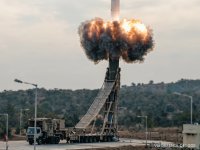
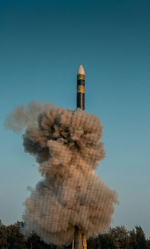
Intermediate Range Ballistic Missile ‘Agni-3’ was successfully test-fired from the Integrated Test Range, Chandipur, Odisha on February 06, 2026. The launch validated all operational and technical parameters. It was carried out under the aegis of the Strategic Forces Command.Agni 3 flight tested

 timesofindia.indiatimes.com
Do production A3s have an exposed interstage truss (like A1, A2) or is it faired over as in A5 etc? Anybody know?
India test-fires Agni-III: Strategic Forces Command launches intermediate-range ballistic missile - The Times of India
News News: NEW DELHI: India on Friday successfully test-fired the intermediate-range ballistic missile Agni-3 from the Integrated Test Range in Chandipur, Odisha.
timesofindia.indiatimes.com
Do production A3s have an exposed interstage truss (like A1, A2) or is it faired over as in A5 etc? Anybody know?

Thats a massive booster.
I am assuming it's due to much higher initial velocity requirements for Meteor style solid fuel ram jet

Its a ground based test so it needs a larger booster to reach optimum velocity for ramjet ignition, something not needed in fighter jets flying at near-supersonic speeds already.Thats a massive booster.
I am assuming it's due to much higher initial velocity requirements for Meteor style solid fuel ram jet

Yes, they did fire Agni 3. It remains to be seen if it was under Strategic nuclear control force or it was under a developmental agency. If the second, then in high probability they might be testing some new equipment which may get introduced in upcoming missiles.Dod they test fire an Agni 3 ?
I thought the missile had been retired
And yes we are going to see quite a few all total new platforms in within an year or two.
A3 is in production and deployed by SFC. It is probably being cannisterized like A5 since they are both of the same diameter.Yes, they did fire Agni 3. It remains to be seen if it was under Strategic nuclear control force or it was under a developmental agency. If the second, then in high probability they might be testing some new equipment which may get introduced in upcoming missiles.
And yes we are going to see quite a few all total new platforms in within an year or two.
Agni 3 was a test platform for Agni 5.Yes, they did fire Agni 3. It remains to be seen if it was under Strategic nuclear control force or it was under a developmental agency. If the second, then in high probability they might be testing some new equipment which may get introduced in upcoming missiles.
And yes we are going to see quite a few all total new platforms in within an year or two.
Don't think it was ever meant for a full deployment.
Agni 5bis the same first and second stages, with a third stage tucked up in the top cone .
Just a guess
Confirmed, it was tested under SFC from the production lot.A3 is in production and deployed by SFC. It is probably being cannisterized like A5 since they are both of the same diameter.
Agni3 is under production, not a tech demonstrator.Agni 3 was a test platform for Agni 5.
Don't think it was ever meant for a full deployment.
Agni 5bis the same first and second stages, with a third stage tucked up in the top cone .
Just a guess
India generally speaking tests few innovations in regular deployed missiles however that happens under the development agencies, if government chooses to report as such.

As the Great Nicobar Project is in the news again, it's time to appraise ourselves of the strategic significance of the Andaman & Nicobar Islands once again. There's a reason the Agni-1 Prime (A-1P) with its softly-spoken Anti-Ship capability (that highly maneuverable Fins + DACS RV isn't for nothing, you know) is perhaps the most tactically significant ballistic missile developed by DRDO this decade, despite it being primarily intended for strategic roles i.e. nuclear delivery.
(And then there's the BM-04 in development, which uses an A-1P boost stage but with a new finned, conical HGV sitting on top, but let's talk about the conventional MaRV-based A-1P for now.)
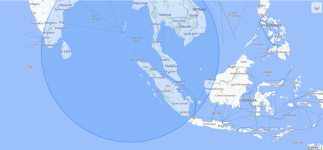
The first map below shows a 2,000-km radius with the Great Nicobar Island at its centre. As is evident, the A-1P (or BM-04) can hold any Carrier Battle Group attempting to traverse the Malacca Strait under threat. Even the Sunda Strait isn't out of reach.
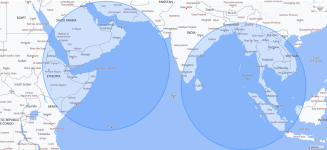
The second map also shows the same radius but with Socotra Island at its centre. In the not too distant future, the Turkish Navy may obtain the capabilities necessary for power projection into the IOR i.e. Carriers, together with their existing LHDs. A battery of A-1Ps stationed at Socotra can perform targeted attacks against specific ships/battle groups as they attempt to traverse either the Straits of Hormuz or the Bab-el-Mandeb Strait, effectively locking down both approaches into the wider IOR.
The ground-based element of a long-range kill chain is rapidly coming into being. While space-based ISR capabilities that are necessary to complete this chain exist, they are very much in need of expansion as China holds several matured ASAT cards in its deck (direct ascent, co-orbital etc.). Our own ASAT capabilities (direct ascent KKV demonstrated in 2019) may not provide sufficient deterrence beyond a point.
Bottomline is, the Space Based Surveillance (SBS) Phase III program needs to be implemented at a rapid pace in order to give ourselves enough chances to execute targets of opportunity effectively - without having to rely on third-party ISR inputs.
In the distant future, as I've previously theorized, the four Arihant-class SSBNs can possibly be converted into SSGNs carrying the LRAShM boost-glide HGV (or Scramjet-based weapons) and deliver a similar capability as the A-1P/BM-04 but from a submerged, survivable platform that could literally be anywhere in the IOR.But that can only happen after we begin commissioning the next generation "S-5" class SSBNs into the all-important deterrence role, sometime next decade. Till then, the A-1P (with either the regular MaRV or a HGV-based warhead) will be an extremely important tactical A2/AD system for the upcoming Maritime Theatre Command.
Last edited:




Lower body too
Could be AI enhanced ? AI usually add things to places which it can't enhance properly.Lower body too

India to develop lighter intercontinental missile capable of beating THAAD, S-500 air defence systems: Report
India is developing its next generation of intercontinental missiles, which is reportedly a significant step up from the Agni-5 in terms of range and effect. The project is reportedly being kept top secret, as its objective is to ensure it can evade the world's best missile defence systems, such as Russia's S-500, America's THAAD, and China's HQ-19.
The project aims to develop a missile that is not only powerful but also lighter than the Agni-5—the nuclear-capable, intermediate-range ballistic missile (IRBM) developed by the Defence Research and Development Organisation (DRDO). The platform is expected to carry 10 to 12 warheads and have a range exceeding 10,000 kilometres. The Agni-5's range is said to be between 5,000 and 5,500 km.
The use of Manoeuvrable Re-entry Vehicles (MaRVs), advanced decoys to deceive radars, and radar-absorbing coatings will be key to beating the S-500, THAAD, and similar systems. A Manoeuvrable Re-entry Vehicle (MaRV) is a type of ballistic missile payload designed to change its flight path after re-entering the Earth's atmosphere. A MaRV's capability to change its trajectory makes it possible to evade enemy missile defence systems.
Earlier reports indicated that the design of the new missile was completed in 2025, Mathrubhumi said in a report. The technology of the K-5 and K-6 Submarine-Launched Ballistic Missiles (SLBMs), launched from under the sea, is being used for the development of the new missile, the daily claimed. As K-5 missiles are designed to be stored in submarine launch tubes, making use of the same technology will help the new, undisclosed weapon operate faster and more efficiently.
It is expected to carry warheads weighing up to three tonnes. To reduce its own weight, "advanced composite materials" will be used in place of steel parts, the Mathrubhumi report said. This will help reduce the missile's weight by more than 20 per cent, as using these components in the missile's engine casings and other parts will increase fuel efficiency and range.
India is developing its next generation of intercontinental missiles, which is reportedly a significant step up from the Agni-5 in terms of range and effect. The project is reportedly being kept top secret, as its objective is to ensure it can evade the world's best missile defence systems, such as Russia's S-500, America's THAAD, and China's HQ-19.
The project aims to develop a missile that is not only powerful but also lighter than the Agni-5—the nuclear-capable, intermediate-range ballistic missile (IRBM) developed by the Defence Research and Development Organisation (DRDO). The platform is expected to carry 10 to 12 warheads and have a range exceeding 10,000 kilometres. The Agni-5's range is said to be between 5,000 and 5,500 km.
The use of Manoeuvrable Re-entry Vehicles (MaRVs), advanced decoys to deceive radars, and radar-absorbing coatings will be key to beating the S-500, THAAD, and similar systems. A Manoeuvrable Re-entry Vehicle (MaRV) is a type of ballistic missile payload designed to change its flight path after re-entering the Earth's atmosphere. A MaRV's capability to change its trajectory makes it possible to evade enemy missile defence systems.
Earlier reports indicated that the design of the new missile was completed in 2025, Mathrubhumi said in a report. The technology of the K-5 and K-6 Submarine-Launched Ballistic Missiles (SLBMs), launched from under the sea, is being used for the development of the new missile, the daily claimed. As K-5 missiles are designed to be stored in submarine launch tubes, making use of the same technology will help the new, undisclosed weapon operate faster and more efficiently.
It is expected to carry warheads weighing up to three tonnes. To reduce its own weight, "advanced composite materials" will be used in place of steel parts, the Mathrubhumi report said. This will help reduce the missile's weight by more than 20 per cent, as using these components in the missile's engine casings and other parts will increase fuel efficiency and range.
so agnii 6India to develop lighter intercontinental missile capable of beating THAAD, S-500 air defence systems: Report
India is developing its next generation of intercontinental missiles, which is reportedly a significant step up from the Agni-5 in terms of range and effect. The project is reportedly being kept top secret, as its objective is to ensure it can evade the world's best missile defence systems, such as Russia's S-500, America's THAAD, and China's HQ-19.
The project aims to develop a missile that is not only powerful but also lighter than the Agni-5—the nuclear-capable, intermediate-range ballistic missile (IRBM) developed by the Defence Research and Development Organisation (DRDO). The platform is expected to carry 10 to 12 warheads and have a range exceeding 10,000 kilometres. The Agni-5's range is said to be between 5,000 and 5,500 km.
The use of Manoeuvrable Re-entry Vehicles (MaRVs), advanced decoys to deceive radars, and radar-absorbing coatings will be key to beating the S-500, THAAD, and similar systems. A Manoeuvrable Re-entry Vehicle (MaRV) is a type of ballistic missile payload designed to change its flight path after re-entering the Earth's atmosphere. A MaRV's capability to change its trajectory makes it possible to evade enemy missile defence systems.
Earlier reports indicated that the design of the new missile was completed in 2025, Mathrubhumi said in a report. The technology of the K-5 and K-6 Submarine-Launched Ballistic Missiles (SLBMs), launched from under the sea, is being used for the development of the new missile, the daily claimed. As K-5 missiles are designed to be stored in submarine launch tubes, making use of the same technology will help the new, undisclosed weapon operate faster and more efficiently.
It is expected to carry warheads weighing up to three tonnes. To reduce its own weight, "advanced composite materials" will be used in place of steel parts, the Mathrubhumi report said. This will help reduce the missile's weight by more than 20 per cent, as using these components in the missile's engine casings and other parts will increase fuel efficiency and range.

The long awaited Surya ICBM is here. IIRC, the goal is to eventually standardize naval and land based N delivery vectors. So this kinda makes sense.