
Jammu & Kashmir live updates: GOI remove all provisions of Article 370
- Thread starter Ashwin
- Start date
You are using an out of date browser. It may not display this or other websites correctly.
You should upgrade or use an alternative browser.
You should upgrade or use an alternative browser.
I was being sarcastic. They are also reporting every single fire and even speculating those that are not fired... full on panic mode loaded on paskistan's hard drive...They are aligning units to their eastern border. That’s India. How’s that a tone down?
If we are smart, then we should. At tactical level it makes sense to have ppl who protest under our control. It will deny the pak backed elements to dictate the situation in the valley. But only issue is ensure that things dont spin out of control. Remember 1971 plane hijacking, which was useful for India.Should government fund protests?


Not suspended. His account for geo-blocked in India.Lal top account got suspended. Lal topi got azadi


Bosnia, Croatia, etc. were part of Yugoslavia. Yugoslavia was a founding member of the Non-Aligned Movement, and therefore was never part of the Warsaw Pact.Not necessary. Check what happened with old Warsaw pact countries which got divided into bosnia, croatia etc.
on Article 370 removal & making JK a UT ->
1. It is completely legal.
2. Anyone complaining it is not "moral" or it was bulldozed by BJP are conveniently forgetting the horrendous genocide committed and how 370 enabled it. When faced with evil, everything is fair.
3. JK can be made into UT, don't need to ask Kashmiri people or any people for that matter, We are NOT union of states, We are UNION OF INDIA where States are forced for administrative purpose. The INDIAN UNION can dissolve states, create new ones, change existing ones at any time it chooses through act of parliament.
4. That we are a representative democracy should not be lost on anyone & because of that fact, act of Parliament is will of majority of people. If some one do not like it, contest elections, win seats and change laws. AS IT STANDS TODAY, BY ACT OF PARLIAMENT, BJP HAS FULFILLED THE WILL OF INDIAN PEOPLE.
5. Anyone crying how it was done and why it was done and how some sections are not consulted, are sore losers who are braying devoid of facts. What do you think Indian Union has been doing for past 70 years? They were consulting constantly and this act in parliament is not an Isolation act but a culmination of things of past 70 years.
On SC ->
IF anyone thinks Modi has not consulted SC on this, they are living in lala land. None of the major parties have approached SC & for a reason.
This is done and dusted and SC would not dare interfere.
On Conversions ->
Let's wait and watch.
Religious freedom is sacrosanct but let us not pretend that conversions in India happen because anything but inducements.
These conversion factories target the poor, vulnerable sections for a reason AND this will definitely be targeted by BJP govt.
1. It is completely legal.
2. Anyone complaining it is not "moral" or it was bulldozed by BJP are conveniently forgetting the horrendous genocide committed and how 370 enabled it. When faced with evil, everything is fair.
3. JK can be made into UT, don't need to ask Kashmiri people or any people for that matter, We are NOT union of states, We are UNION OF INDIA where States are forced for administrative purpose. The INDIAN UNION can dissolve states, create new ones, change existing ones at any time it chooses through act of parliament.
4. That we are a representative democracy should not be lost on anyone & because of that fact, act of Parliament is will of majority of people. If some one do not like it, contest elections, win seats and change laws. AS IT STANDS TODAY, BY ACT OF PARLIAMENT, BJP HAS FULFILLED THE WILL OF INDIAN PEOPLE.
5. Anyone crying how it was done and why it was done and how some sections are not consulted, are sore losers who are braying devoid of facts. What do you think Indian Union has been doing for past 70 years? They were consulting constantly and this act in parliament is not an Isolation act but a culmination of things of past 70 years.
On SC ->
IF anyone thinks Modi has not consulted SC on this, they are living in lala land. None of the major parties have approached SC & for a reason.
This is done and dusted and SC would not dare interfere.
On Conversions ->
Let's wait and watch.
Religious freedom is sacrosanct but let us not pretend that conversions in India happen because anything but inducements.
These conversion factories target the poor, vulnerable sections for a reason AND this will definitely be targeted by BJP govt.
on Article 370 removal & making JK a UT ->
1. It is completely legal.
2. Anyone complaining it is not "moral" or it was bulldozed by BJP are conveniently forgetting the horrendous genocide committed and how 370 enabled it. When faced with evil, everything is fair.
3. JK can be made into UT, don't need to ask Kashmiri people or any people for that matter, We are NOT union of states, We are UNION OF INDIA where States are forced for administrative purpose. The INDIAN UNION can dissolve states, create new ones, change existing ones at any time it chooses through act of parliament.
4. That we are a representative democracy should not be lost on anyone & because of that fact, act of Parliament is will of majority of people. If some one do not like it, contest elections, win seats and change laws. AS IT STANDS TODAY, BY ACT OF PARLIAMENT, BJP HAS FULFILLED THE WILL OF INDIAN PEOPLE.
5. Anyone crying how it was done and why it was done and how some sections are not consulted, are sore losers who are braying devoid of facts. What do you think Indian Union has been doing for past 70 years? They were consulting constantly and this act in parliament is not an Isolation act but a culmination of things of past 70 years.
On SC ->
IF anyone thinks Modi has not consulted SC on this, they are living in lala land. None of the major parties have approached SC & for a reason.
This is done and dusted and SC would not dare interfere.
On Conversions ->
Let's wait and watch.
Religious freedom is sacrosanct but let us not pretend that conversions in India happen because anything but inducements.
These conversion factories target the poor, vulnerable sections for a reason AND this will definitely be targeted by BJP govt.
SC can not intervene since this is a parliamentary enacted change.
The legal challenge if mounted will be to examine the constitutional validity of the change. There is no dare for the SC here. We would do well to not question our own establishments
SC can not intervene since this is a parliamentary enacted change.
The legal challenge if mounted will be to examine the constitutional validity of the change. There is no dare for the SC here. We would do well to not question our own establishments
Agreed, Establishments should not be questioned.
But SC does not subject itself to any kind of scrutiny of Audit. In fact SC is the only establishment in our nation whose inner workings are never ever made public or open for inspection.
This does not happen anywhere in the world & when faced with such an organization, it is imperative that we question people leading it (if not the organization) to keep them on their toes and honest.
For example - SC in space of a month said FOE is sacrosanct and asked govt to release prisoners who were caught with materials that showed plans to kill PM. Just few weeks later these clowns had the audacity to ask a girl from WB to say sorry as pre-condition for bail for a Facebook post.
I used to be of the view that certain institutions should be not questioned BUT then I realized questioning people working and exposing them does not necessarily mean questioning the institution.

Good Morning Kashmir - Open The Magazine
For those interested in whether it would withstand judicial scrutiny

×

COVER STORY
Good Morning Kashmir
Correction and redemption in the sudden death of Article 370
 PR Ramesh + Ullekh NP + Siddharth Singh| 09 Aug, 2019
(Photo Illustration: Saurabh Singh)
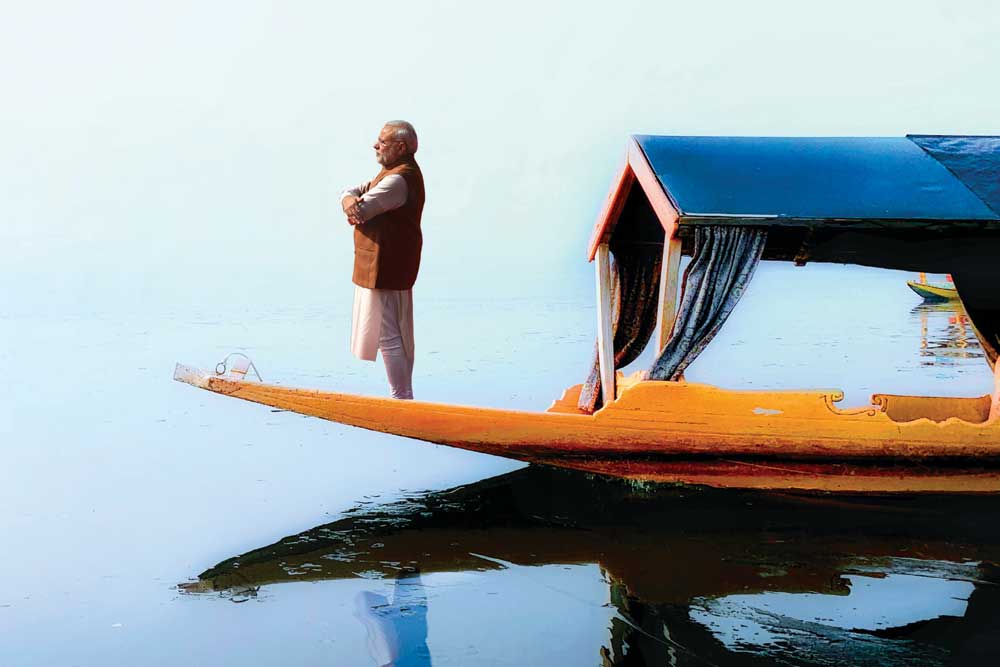
JUST PAST 11 am on August 5th, when Union Home Minister Amit Shah announced the scrapping of special status for Jammu and Kashmir and the reorganisation of the restive region, he was making history, scripting a new chapter in the integration of India left incomplete by the leaders of modern India. The rich Himalayan region, also the world’s most militarised zone, is now being split into two Union Territories, one with legislature and the other without. Shah has put an abrupt end to decades of kid-glove treatment meted out by the Centre to the Muslim-majority state that became part of India in 1947 through an instrument of accession and enjoyed a near-autonomy from Indian laws, including several fundamental rights, the right to information, and a raft of others.
The moment when Shah dropped the bombshell in the Rajya Sabha was historic, but the pursuit has been long. As early as the late-1940s, Hindu nationalists had fought tooth and nail the decision of the first Prime Minister, Jawaharlal Nehru, to offer provisions that treated Jammu and Kashmir as a state more equal than the others. They even risked their lives for the cause. Syama Prasad Mookerjee, founder-president of the Bharatiya Jana Sangh, the BJP’s predecessor, had quit as minister from the Nehru Cabinet following the 1950 Delhi Pact with Pakistan and had later launched a ferocious campaign against Article 370 which, he argued, was a threat to national unity. In 1953, demanding the repeal of the legislation, he famously travelled to Jammu and Kashmir along with his young protégé Atal Bihari Vajpayee, who was destined to become the BJP’s first prime minister. At Pathankot, the Bengali academic and leader instructed Vajpayee to return to Delhi while he proceeded to Jammu and Kashmir where he died under house arrest in June the same year under what his colleagues claim were mysterious circumstances. Since then, abrogation of Article 370 had been a rallying cry for the Hindu nationalists.
IN THE RUN-UP to the General Election earlier this year, Prime Minister Narendra Modi, at a rally on April 1st, hit out against the dynasts of Kashmir, referring to their parties as “shops” and their activities as “deception” to bamboozle New Delhi. His message was unambiguous. He lashed out at what he called the unholy nexus between the Congress and these self-appointed custodians of Kashmir whose days, he warned, were numbered. Article 370 has figured in all BJP poll manifestoes since 1984, and the likes of Vajpayee and others had continually raised the issue in both Houses of Parliament over the last seven decades. The August 5th Bills on Kashmir tabled by Shah in the Upper House, which included presidential orders—cleared later by both Houses of Parliament with emphatic margins and even with unexpected support from several opposition parties—effectively upended the Nehruvian political legacy that had endured for long. Forceful arguments in Parliament by the likes of Vajpayee and Sushma Swaraj—who sadly passed away just a day after the Government’s move—and popular mobilisations by several others, including the young Modi who was part of the Ekta Yatra of 1991-1992 that culminated in the unfurling of the Indian Tricolour at Lal Chowk, Srinagar, on January 26, 1992, as well as many similar bids to attract public opinion to abrogate Article 370 may have appeared feeble individually, but not as collective action. And then, August 5th happened.
Both the Prime Minister and the Home minister were convinced of the need to deploy more troops in Jammu and Kashmir to ensure no untoward incident took place following the tabling of the Bills. Yet, since utmost secrecy had to be maintained to ensure that the Bills sailed through Parliament, most people close to the duo had only vague ideas about the real plan, with the probable exception of Solicitor General Tushar Mehta. People who had to spring to action to beef up security in the region at a time when the Amarnath Yatra had started included National Security Adviser Ajit Doval, Principal Secretary to the Prime Minister Nripendra Misra, Home Secretary Rajiv Gauba, Jammu and Kashmir Governor Satya Pal Malik and state Chief Secretary BVR Subrahmanyam. Heads of security agencies were also directed to step up security, especially in the notorious trouble spots in the Valley.
On August 4th, on the pretext of an intelligence tip, state governments of Uttar Pradesh, Bihar, West Bengal, Kerala, Madhya Pradesh, Assam, Andhra Pradesh, Telangana and so on were asked to bolster security arrangements in communally sensitive areas. On the morning of August 5th, around 8.30 am, Shah summoned Law Minister Ravi Shankar Prasad and briefed him about the comprehensive plan in the Rajya Sabha for that day. Later, at the Cabinet meeting, details of what was in store for the day were divulged and instructions were given shortly afterwards to select people to parley with those who had been in touch with political parties, including the BJD, BSP, AIADMK, TRS, YSR Congress Party and others to back the Government in its crucial Kashmir bid. These parties were approached through various people to drum up support for the Bills without specifying the details.
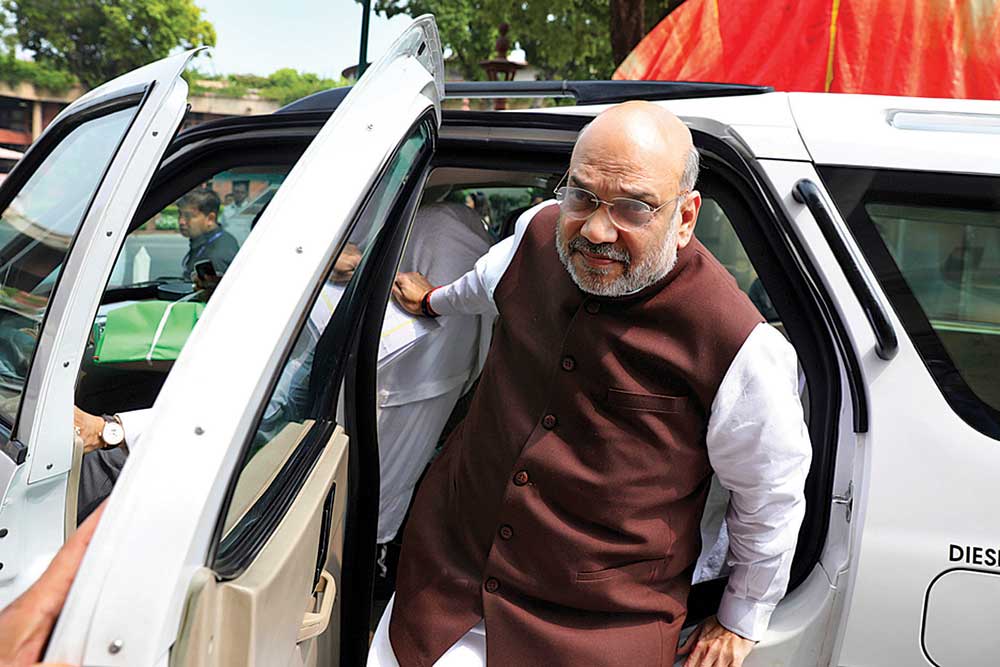 Amit Shah arrives at Parliament, New Delhi, August 5 (Photo: AP)
A few of them dithered, and therefore the Rajya Sabha session was tense for the floor managers assigned by Shah. Some of the parties agreed to throw their weight behind the Government only much later, just ahead of the vote in the Upper House. Barring parties such as the Congress, Trinamool, parties of the Left and the Nitish Kumar-led Janata Dal(U), all others had some idea that the Government was contemplating a big push over Kashmir in the House, especially over Article 35A. Shah called up Nitish Kumar just before he reached Parliament. The Bihar Chief Minister mildly opposed the decision (and later asked his members to stage a walkout in the Rajya Sabha). Over the next few days though, his intransigence turned into apparent surrender and the JD(U) spokesperson said that all was well that ended well.
Meanwhile, External Affairs Minister S Jaishankar was asked to brief the P5 (five permanent members of the UN Security Council) countries and a few others after the Bill was presented in the Rajya Sabha. Notably, at the Cabinet meeting, Prime Minister Modi cautioned the attendees against any show of triumphalism, reaffirming that his Government was not pandering to any section to pull in votes but mapping a determined route towards integrating the country. Reminded Shah: “Don’t forget that Article 370 denied the refugees who came from Pakistan to Jammu and Kashmir the right to citizenship. They never got a chance to participate in the electoral process of the nation. When refugees who came to J&K could not even become councillors, refugees who went to other parts got every right due to them. Two of them went on to become the prime ministers of this country. Democracy could never flourish in the state because of Article 370. Under President’s rule, local bodies have been formed and the Centre has already sent Rs 3,500 crore for these bodies.”
THE GROUNDWORK
The Kashmir decision had equal doses of symbolism and substance. The President’s order stated that, ‘…the President, on the recommendation of Parliament, is pleased to declare that, as from the 6th August, 2019, all clauses of the said Article 370 shall cease to be operative…’ Again, if the language was simple, its import was momentous.
Behind the bold decision, one that eluded generations of politicians in India, lay careful legal and legislative preparations. Article 370 is probably one of the most complex parts of the Indian Constitution. In its wording, interpretation, impact and end, the article has defied unpacking for long. Its removal from the Constitution began on Monday when Home Minister Amit Shah introduced two Bills and moved a resolution to be adopted by the House. The resolution moved by Shah stated that, ‘this House recommends that the President issue a public proclamation under Article 370(3) that all sections of the article cease to operate from the date specified by him’. These were almost the same words used by the President a day later when he issued the proclamation.
Accompanying this package, Shah also moved the Jammu and Kashmir Reorganisation Bill 2019, which was later, on Tuesday, passed by the Lok Sabha as well. Crucially, Constitutional Order 272 added a sub-clause to Article 367 of the Constitution (as it applies to Jammu and Kashmir) that states, ‘in proviso to clause (3) of Article 370 of this Constitution, the expression ‘Constituent Assembly of the State referred to in clause (2)’ shall read ‘Legislative Assembly of the State.’’ This is a crucial addition that was essential for the repeal of Article 370. The original Article 370 had a proviso that made it essential for the Constituent Assembly of the state to recommend the abrogation of Article 370 before the President could issue a proclamation of the kind that he did on August 6th. The entire package of Bills, resolutions and Presidential proclamations was necessary to ensure that the abrogation of Article 370 and the bifurcation of Jammu and Kashmir pass judicial scrutiny, something that will happen as those from the opposition mount a judicial challenge on political grounds.
 A sheep herder in Srinagar, August 8 (Photo: Reuters)
BAGGAGE OF HISTORY
Since the day Maharaja Hari Singh, the then ruler of Jammu and Kashmir, signed an instrument of accession that merged his state with India, the terms of that marriage have been contentious. Originally, India had the right to frame laws and intervene in just three matters: defence, foreign affairs, communications and some ancillary matters. The instrument was signed barely a month after India gained Independence. The country’s Constituent Assembly had begun functioning in December 1946. At that time, the final shape of the country was unknown and the British plan to partition India lay six months ahead, in June 1947.
Two years later, four representatives from Kashmir joined the Constituent Assembly. Sheikh Abdullah, Mirza Mohammad Afzal Beg, Maulana Syeed Mohammad Masoodi and Moti Ram Bagda were instrumental in securing a ‘special provision’ for their state in India’s Constitution. That provision, Article 370, re-asserted the limitations imposed by the instrument of accession signed in 1947. Since 1950, this provision has been behind the tug of war between Kashmir’s politicians and the Government of India, irrespective of the party or the person who has held the reins of power in New Delhi.
Since its inception, Article 370 was placed in Part XXI of the Constitution that deals with ‘temporary, transitional and special provisions’. The Article itself made it clear that the President could by public notification declare that the Article has ceased to exist, something that President Ram Nath Kovind did on Tuesday. The placement and the wording of the Article make it clear that it was indeed meant to be a temporary provision until the political settlement between the state and the Centre was firmed up. It is worth noting that a similar instrument of accession was signed by the rulers of hundreds of states in the period between 1947 and 1949 when their territories merged with India. Within a decade, the Constitution applied fully as did the laws made by Parliament in these areas. Kashmir remained an exception.
This was totally due to Article 370, which expressly limited the powers of Parliament to make laws for Jammu and Kashmir. Over time, ways were found to implement Indian laws and the Constitution to the state. The process began in 1950 itself when the first Constitution (Application to Jammu and Kashmir) Order was issued on January 26th, 1950. Since then, this device has been resorted to dozens of times. This set in motion a conflicted dynamic. Every time such an order was passed, politicians in the Valley would claim that the state’s “autonomy” guaranteed by Article 370 was being “eroded”. For the Union Government, the compulsion was different: a part of the Union could not forever be treated on an entirely different footing from the rest of the country.
Over time, this led to a number of myths being created. One was that Kashmir was ‘distinct’ or even ‘separate’ and that ‘India’ was out to undo its special status. The reality is otherwise. Any Indian law explicitly states that it is not applicable to the state of Jammu and Kashmir, unless special provisions are made to extend it there.
In doing all this, the Constitutional Order was hurt. For one, Article 370 is the only article in the Constitution where the President is bestowed with extraordinary legislative power, something unimaginable in any other modern constitution based on the separation of powers between the executive, the legislature and the judiciary. Ordinarily, laws made for the country are debated threadbare in Parliament before they are enacted. Something similar happens in the case of laws passed by state Assemblies for the states. Under Article 370, Parliament had no such role: the President could, and did, simply extend a law to Kashmir with the flick of his pen. This also damaged the idea of separation of powers that freedom fighters had championed during the British colonial era.
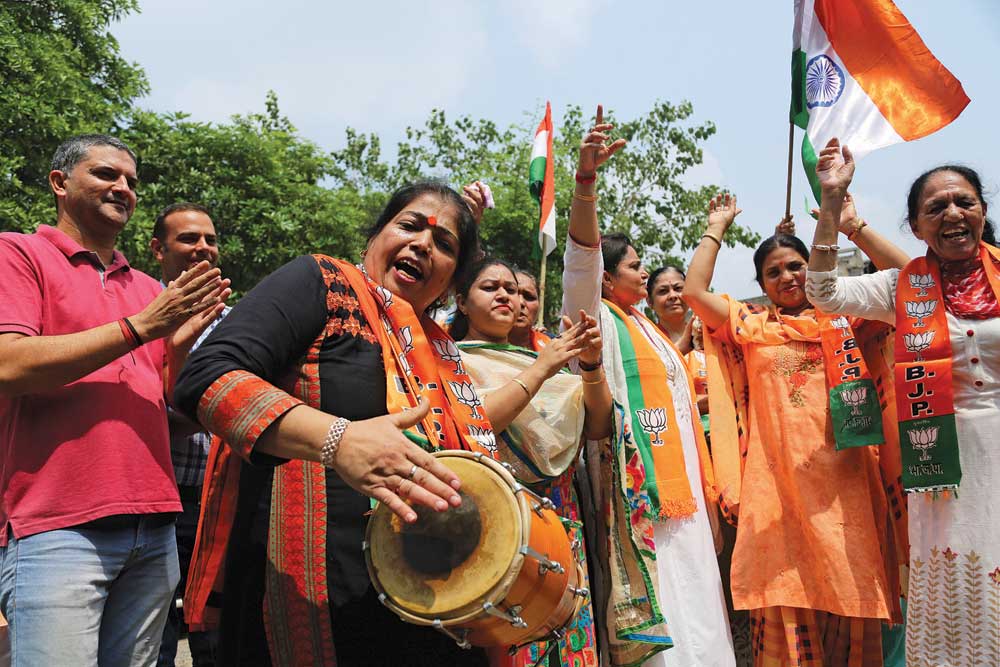 BJP supporters celebrate the repealing of Article 370, in Jammu, August 5, 2019 (Photo: AP)
At another level, a different myth was bred by others. This was that Article 370 could not be repealed by using the President’s power to do so. This was based on a reading of Clause 3 of the Article, which stated that the President could not issue such a notification before securing the recommendation of the Constituent Assembly of Jammu and Kashmir. This assembly framed a separate constitution for the state and existed between 1952 and 1957. Clearly such a recommendation could not be secured in 2019, more than 60 years after that body had ceased to exist. But as the proceedings in Parliament from Monday onward showed, this line of reasoning was just a myth. The complicated legislative proceedings in Parliament were necessitated by that single line in Article 370.
The trouble with such myths is that they lead to sterile political ends. Consider the theory that Article 370 was a permanent feature of the Indian Constitution. Any modern constitution, let alone the Indian one, is based on an understanding that no part of the founding document is immune from changes desired by succeeding generations of citizens and their representatives in a legislature. To do so would be to turn a constitution into a theological text, beyond the reach of humans. History shows this to be untrue. In India, the 42nd Amendment to the Constitution literally re-wrote entire swathes of the document crafted in 1949. This was undone by the 44th Amendment with some important exceptions. Similarly, since its inception in 1950, the Indian Constitution has been amended 103 times making it amply clear that it is a living document.
The state forged by war and treaty simply did not get enough time for its constituent units to blend together organically. Geographic barriers did the rest. Long after Maharaja Hari Singh left the stage, people from different parts—Jammu, Ladakh and Kashmir proper—continued to jostle for privileges and rights with each other. In the din around the alleged loss of autonomy of the state, another debate—this time on regional autonomy within the state—was lost. The people of Jammu and Ladakh have for long wanted some ‘space’ from Kashmir. The speech of Jamyang Tsering Namgyal, the Member of Parliament from Ladakh on Tuesday, August 6th, only made manifest what was latent for a very long time. So, when Home Minister Amit Shah introduced the Jammu and Kashmir Reorganisation Bill in the Rajya Sabha on Monday, his statement of reasons for the Bill that “The Ladakh Division of the State of Jammu and Kashmir has a large area but is sparsely populated with a very difficult terrain. There has been a long pending demand of people of Ladakh, to give it the status of a Union Territory to enable them to realise their aspirations,’ was pretty much on the mark. Military historian and former cold warrior Edward Luttwak argues that historically Ladakh is much different from the rest of Kashmir, backing the new Government move.
With the end of Article 370, the structural features that bred a psychology of separatism will also go away. That may take time but it will happen.
For those interested in whether it would withstand judicial scrutiny
×
COVER STORY
Good Morning Kashmir
Correction and redemption in the sudden death of Article 370
PR Ramesh + Ullekh NP + Siddharth Singh| 09 Aug, 2019


(Photo Illustration: Saurabh Singh)
JUST PAST 11 am on August 5th, when Union Home Minister Amit Shah announced the scrapping of special status for Jammu and Kashmir and the reorganisation of the restive region, he was making history, scripting a new chapter in the integration of India left incomplete by the leaders of modern India. The rich Himalayan region, also the world’s most militarised zone, is now being split into two Union Territories, one with legislature and the other without. Shah has put an abrupt end to decades of kid-glove treatment meted out by the Centre to the Muslim-majority state that became part of India in 1947 through an instrument of accession and enjoyed a near-autonomy from Indian laws, including several fundamental rights, the right to information, and a raft of others.
The moment when Shah dropped the bombshell in the Rajya Sabha was historic, but the pursuit has been long. As early as the late-1940s, Hindu nationalists had fought tooth and nail the decision of the first Prime Minister, Jawaharlal Nehru, to offer provisions that treated Jammu and Kashmir as a state more equal than the others. They even risked their lives for the cause. Syama Prasad Mookerjee, founder-president of the Bharatiya Jana Sangh, the BJP’s predecessor, had quit as minister from the Nehru Cabinet following the 1950 Delhi Pact with Pakistan and had later launched a ferocious campaign against Article 370 which, he argued, was a threat to national unity. In 1953, demanding the repeal of the legislation, he famously travelled to Jammu and Kashmir along with his young protégé Atal Bihari Vajpayee, who was destined to become the BJP’s first prime minister. At Pathankot, the Bengali academic and leader instructed Vajpayee to return to Delhi while he proceeded to Jammu and Kashmir where he died under house arrest in June the same year under what his colleagues claim were mysterious circumstances. Since then, abrogation of Article 370 had been a rallying cry for the Hindu nationalists.
IN THE RUN-UP to the General Election earlier this year, Prime Minister Narendra Modi, at a rally on April 1st, hit out against the dynasts of Kashmir, referring to their parties as “shops” and their activities as “deception” to bamboozle New Delhi. His message was unambiguous. He lashed out at what he called the unholy nexus between the Congress and these self-appointed custodians of Kashmir whose days, he warned, were numbered. Article 370 has figured in all BJP poll manifestoes since 1984, and the likes of Vajpayee and others had continually raised the issue in both Houses of Parliament over the last seven decades. The August 5th Bills on Kashmir tabled by Shah in the Upper House, which included presidential orders—cleared later by both Houses of Parliament with emphatic margins and even with unexpected support from several opposition parties—effectively upended the Nehruvian political legacy that had endured for long. Forceful arguments in Parliament by the likes of Vajpayee and Sushma Swaraj—who sadly passed away just a day after the Government’s move—and popular mobilisations by several others, including the young Modi who was part of the Ekta Yatra of 1991-1992 that culminated in the unfurling of the Indian Tricolour at Lal Chowk, Srinagar, on January 26, 1992, as well as many similar bids to attract public opinion to abrogate Article 370 may have appeared feeble individually, but not as collective action. And then, August 5th happened.
Any modern constitution, let alone the Indian one, is based
on an understanding that no part of the founding document
is immune from changes desired by succeeding generations of
citizens and their representatives in a legislature. To do so would be to turn a constitution into a theological text, beyond the reach of humans. History shows this to be untrue
The preparations for the August 5th Rajya Sabha move on Kashmir were planned to a T.on an understanding that no part of the founding document
is immune from changes desired by succeeding generations of
citizens and their representatives in a legislature. To do so would be to turn a constitution into a theological text, beyond the reach of humans. History shows this to be untrue
Both the Prime Minister and the Home minister were convinced of the need to deploy more troops in Jammu and Kashmir to ensure no untoward incident took place following the tabling of the Bills. Yet, since utmost secrecy had to be maintained to ensure that the Bills sailed through Parliament, most people close to the duo had only vague ideas about the real plan, with the probable exception of Solicitor General Tushar Mehta. People who had to spring to action to beef up security in the region at a time when the Amarnath Yatra had started included National Security Adviser Ajit Doval, Principal Secretary to the Prime Minister Nripendra Misra, Home Secretary Rajiv Gauba, Jammu and Kashmir Governor Satya Pal Malik and state Chief Secretary BVR Subrahmanyam. Heads of security agencies were also directed to step up security, especially in the notorious trouble spots in the Valley.
On August 4th, on the pretext of an intelligence tip, state governments of Uttar Pradesh, Bihar, West Bengal, Kerala, Madhya Pradesh, Assam, Andhra Pradesh, Telangana and so on were asked to bolster security arrangements in communally sensitive areas. On the morning of August 5th, around 8.30 am, Shah summoned Law Minister Ravi Shankar Prasad and briefed him about the comprehensive plan in the Rajya Sabha for that day. Later, at the Cabinet meeting, details of what was in store for the day were divulged and instructions were given shortly afterwards to select people to parley with those who had been in touch with political parties, including the BJD, BSP, AIADMK, TRS, YSR Congress Party and others to back the Government in its crucial Kashmir bid. These parties were approached through various people to drum up support for the Bills without specifying the details.
A few of them dithered, and therefore the Rajya Sabha session was tense for the floor managers assigned by Shah. Some of the parties agreed to throw their weight behind the Government only much later, just ahead of the vote in the Upper House. Barring parties such as the Congress, Trinamool, parties of the Left and the Nitish Kumar-led Janata Dal(U), all others had some idea that the Government was contemplating a big push over Kashmir in the House, especially over Article 35A. Shah called up Nitish Kumar just before he reached Parliament. The Bihar Chief Minister mildly opposed the decision (and later asked his members to stage a walkout in the Rajya Sabha). Over the next few days though, his intransigence turned into apparent surrender and the JD(U) spokesperson said that all was well that ended well.
Meanwhile, External Affairs Minister S Jaishankar was asked to brief the P5 (five permanent members of the UN Security Council) countries and a few others after the Bill was presented in the Rajya Sabha. Notably, at the Cabinet meeting, Prime Minister Modi cautioned the attendees against any show of triumphalism, reaffirming that his Government was not pandering to any section to pull in votes but mapping a determined route towards integrating the country. Reminded Shah: “Don’t forget that Article 370 denied the refugees who came from Pakistan to Jammu and Kashmir the right to citizenship. They never got a chance to participate in the electoral process of the nation. When refugees who came to J&K could not even become councillors, refugees who went to other parts got every right due to them. Two of them went on to become the prime ministers of this country. Democracy could never flourish in the state because of Article 370. Under President’s rule, local bodies have been formed and the Centre has already sent Rs 3,500 crore for these bodies.”
THE GROUNDWORK
The Kashmir decision had equal doses of symbolism and substance. The President’s order stated that, ‘…the President, on the recommendation of Parliament, is pleased to declare that, as from the 6th August, 2019, all clauses of the said Article 370 shall cease to be operative…’ Again, if the language was simple, its import was momentous.
Behind the bold decision, one that eluded generations of politicians in India, lay careful legal and legislative preparations. Article 370 is probably one of the most complex parts of the Indian Constitution. In its wording, interpretation, impact and end, the article has defied unpacking for long. Its removal from the Constitution began on Monday when Home Minister Amit Shah introduced two Bills and moved a resolution to be adopted by the House. The resolution moved by Shah stated that, ‘this House recommends that the President issue a public proclamation under Article 370(3) that all sections of the article cease to operate from the date specified by him’. These were almost the same words used by the President a day later when he issued the proclamation.
“I must make it clear that this Government will not talk to those who take inspiration from or are being handled by Pakistan. We will not talk to Hurriyat. We will have dialogue with the people of the Valley and we are ready to remove their apprehensions, if any,” says Amit Shah, home minister
While the proceedings were on in the Upper House, the President issued a separate notification under Article 370—The Constitution (Application to Jammu and Kashmir) Order, 2019 or Constitutional Order 272—that superseded the Constitutional Order that extended the Constitution of India to Jammu and Kashmir issued in 1954. This was a major order that included Article 35A, a provision that allowed the Jammu and Kashmir legislature to define persons who could be permanent residents of the state and confer rights and privileges on them. With that, Article 35A ceased to exist even as Parliament deliberated the resolution asking the President to abrogate Article 370.Accompanying this package, Shah also moved the Jammu and Kashmir Reorganisation Bill 2019, which was later, on Tuesday, passed by the Lok Sabha as well. Crucially, Constitutional Order 272 added a sub-clause to Article 367 of the Constitution (as it applies to Jammu and Kashmir) that states, ‘in proviso to clause (3) of Article 370 of this Constitution, the expression ‘Constituent Assembly of the State referred to in clause (2)’ shall read ‘Legislative Assembly of the State.’’ This is a crucial addition that was essential for the repeal of Article 370. The original Article 370 had a proviso that made it essential for the Constituent Assembly of the state to recommend the abrogation of Article 370 before the President could issue a proclamation of the kind that he did on August 6th. The entire package of Bills, resolutions and Presidential proclamations was necessary to ensure that the abrogation of Article 370 and the bifurcation of Jammu and Kashmir pass judicial scrutiny, something that will happen as those from the opposition mount a judicial challenge on political grounds.
BAGGAGE OF HISTORY
Since the day Maharaja Hari Singh, the then ruler of Jammu and Kashmir, signed an instrument of accession that merged his state with India, the terms of that marriage have been contentious. Originally, India had the right to frame laws and intervene in just three matters: defence, foreign affairs, communications and some ancillary matters. The instrument was signed barely a month after India gained Independence. The country’s Constituent Assembly had begun functioning in December 1946. At that time, the final shape of the country was unknown and the British plan to partition India lay six months ahead, in June 1947.
Two years later, four representatives from Kashmir joined the Constituent Assembly. Sheikh Abdullah, Mirza Mohammad Afzal Beg, Maulana Syeed Mohammad Masoodi and Moti Ram Bagda were instrumental in securing a ‘special provision’ for their state in India’s Constitution. That provision, Article 370, re-asserted the limitations imposed by the instrument of accession signed in 1947. Since 1950, this provision has been behind the tug of war between Kashmir’s politicians and the Government of India, irrespective of the party or the person who has held the reins of power in New Delhi.
Since its inception, Article 370 was placed in Part XXI of the Constitution that deals with ‘temporary, transitional and special provisions’. The Article itself made it clear that the President could by public notification declare that the Article has ceased to exist, something that President Ram Nath Kovind did on Tuesday. The placement and the wording of the Article make it clear that it was indeed meant to be a temporary provision until the political settlement between the state and the Centre was firmed up. It is worth noting that a similar instrument of accession was signed by the rulers of hundreds of states in the period between 1947 and 1949 when their territories merged with India. Within a decade, the Constitution applied fully as did the laws made by Parliament in these areas. Kashmir remained an exception.
This was totally due to Article 370, which expressly limited the powers of Parliament to make laws for Jammu and Kashmir. Over time, ways were found to implement Indian laws and the Constitution to the state. The process began in 1950 itself when the first Constitution (Application to Jammu and Kashmir) Order was issued on January 26th, 1950. Since then, this device has been resorted to dozens of times. This set in motion a conflicted dynamic. Every time such an order was passed, politicians in the Valley would claim that the state’s “autonomy” guaranteed by Article 370 was being “eroded”. For the Union Government, the compulsion was different: a part of the Union could not forever be treated on an entirely different footing from the rest of the country.
The ruckus over the bifurcation of the state follows an old mythology. The claim that conversion of J&K into a Union Territory is unprecedented is true in a strictly legal sense. But there is nothing more to it. Parliament was well within its right to do so for there is no constitutional limitation
MYTHS GALOREOver time, this led to a number of myths being created. One was that Kashmir was ‘distinct’ or even ‘separate’ and that ‘India’ was out to undo its special status. The reality is otherwise. Any Indian law explicitly states that it is not applicable to the state of Jammu and Kashmir, unless special provisions are made to extend it there.
In doing all this, the Constitutional Order was hurt. For one, Article 370 is the only article in the Constitution where the President is bestowed with extraordinary legislative power, something unimaginable in any other modern constitution based on the separation of powers between the executive, the legislature and the judiciary. Ordinarily, laws made for the country are debated threadbare in Parliament before they are enacted. Something similar happens in the case of laws passed by state Assemblies for the states. Under Article 370, Parliament had no such role: the President could, and did, simply extend a law to Kashmir with the flick of his pen. This also damaged the idea of separation of powers that freedom fighters had championed during the British colonial era.
At another level, a different myth was bred by others. This was that Article 370 could not be repealed by using the President’s power to do so. This was based on a reading of Clause 3 of the Article, which stated that the President could not issue such a notification before securing the recommendation of the Constituent Assembly of Jammu and Kashmir. This assembly framed a separate constitution for the state and existed between 1952 and 1957. Clearly such a recommendation could not be secured in 2019, more than 60 years after that body had ceased to exist. But as the proceedings in Parliament from Monday onward showed, this line of reasoning was just a myth. The complicated legislative proceedings in Parliament were necessitated by that single line in Article 370.
The trouble with such myths is that they lead to sterile political ends. Consider the theory that Article 370 was a permanent feature of the Indian Constitution. Any modern constitution, let alone the Indian one, is based on an understanding that no part of the founding document is immune from changes desired by succeeding generations of citizens and their representatives in a legislature. To do so would be to turn a constitution into a theological text, beyond the reach of humans. History shows this to be untrue. In India, the 42nd Amendment to the Constitution literally re-wrote entire swathes of the document crafted in 1949. This was undone by the 44th Amendment with some important exceptions. Similarly, since its inception in 1950, the Indian Constitution has been amended 103 times making it amply clear that it is a living document.
The truth is that unlike many other states, J&K historically did not enjoy geographic and political unity among its constituents. Its foundation by the Treaty of Amritsar in 1846 only added a part of what was later to be called Jammu and Kashmir state. The diverse regions were home to different ethnic groups
Interestingly, the ruckus over the bifurcation of the state follows a similar mythology. The claim that conversion of Jammu and Kashmir into a Union Territory (UT) is unprecedented is true in a strictly legal sense. But there is nothing more to it. Parliament was well within its right to do so for there is no constitutional limitation that holds the legislature’s hand in this respect. Historically, too, the unity of Jammu and Kashmir is a myth. The truth is that unlike many other Indian states, Jammu and Kashmir historically did not enjoy geographic and political unity among its constituent units. The foundation of the state by the Treaty of Amritsar in 1846 only added a part of what was later to be called Jammu and Kashmir State. Ladakh, Gilgit, Baltistan, Chitral, Hunza and Poonch were all added at different times to the state. These diverse regions were home to different ethnic groups and cultural settings.The state forged by war and treaty simply did not get enough time for its constituent units to blend together organically. Geographic barriers did the rest. Long after Maharaja Hari Singh left the stage, people from different parts—Jammu, Ladakh and Kashmir proper—continued to jostle for privileges and rights with each other. In the din around the alleged loss of autonomy of the state, another debate—this time on regional autonomy within the state—was lost. The people of Jammu and Ladakh have for long wanted some ‘space’ from Kashmir. The speech of Jamyang Tsering Namgyal, the Member of Parliament from Ladakh on Tuesday, August 6th, only made manifest what was latent for a very long time. So, when Home Minister Amit Shah introduced the Jammu and Kashmir Reorganisation Bill in the Rajya Sabha on Monday, his statement of reasons for the Bill that “The Ladakh Division of the State of Jammu and Kashmir has a large area but is sparsely populated with a very difficult terrain. There has been a long pending demand of people of Ladakh, to give it the status of a Union Territory to enable them to realise their aspirations,’ was pretty much on the mark. Military historian and former cold warrior Edward Luttwak argues that historically Ladakh is much different from the rest of Kashmir, backing the new Government move.
With the end of Article 370, the structural features that bred a psychology of separatism will also go away. That may take time but it will happen.

TRAGEDY OF ERRORS
Nehru may have talked about the “erosion” of Article 370 following the humiliating 1962 war which saw his nationalistic traits dominate over his liberal credentials. But then he passed away shortly after, in 1964, and his successors did nothing to mainstream Kashmir to India, as it was done in the past by making the Election Commission’s powers applicable in the state. For Indira Gandhi, the early struggle after Nehru’s death was to establish herself as a leader to reckon with, in the face of stiff opposition from within and from former colleagues of her father. This prompted her to tie up with communists and others. As a result, she wasn’t able to make much headway on Kashmir. Conversely, as in the past elections of 1957 and 1962, the 1967 elections also saw massive rigging by the Congress-led Centre to anoint a collaborator-dynast in power in the state. The trend continued. Decades of electoral malpractice resulted in public loss of faith in the Central Government which continued to rule through proxy, benefiting dynasties that enriched themselves in this long association.
When militancy surfaced in the late 1980s and the 1990s, it coincided with the fall of the Soviet Union, a development that left Islamist jihadis free to be deployed in Kashmir to create mayhem and go on a recruiting spree to wreak havoc in India. The handling of the situation was sloppy and a place that prided itself as a centre of Sufi thought exhibited signs of Wahhabism taking deep roots with anti-India protests increasingly acquiring a religious halo. Things got so bad that Kashmiri Pandits were asked to flee—and the announcement came from loudspeakers inside mosques—leaving behind their women and property if they were not willing to convert to Islam. The Pandit migration of the early 1990s is a shameful chapter in the history of Kashmir, which at its peak in the past was an intellectual hub.
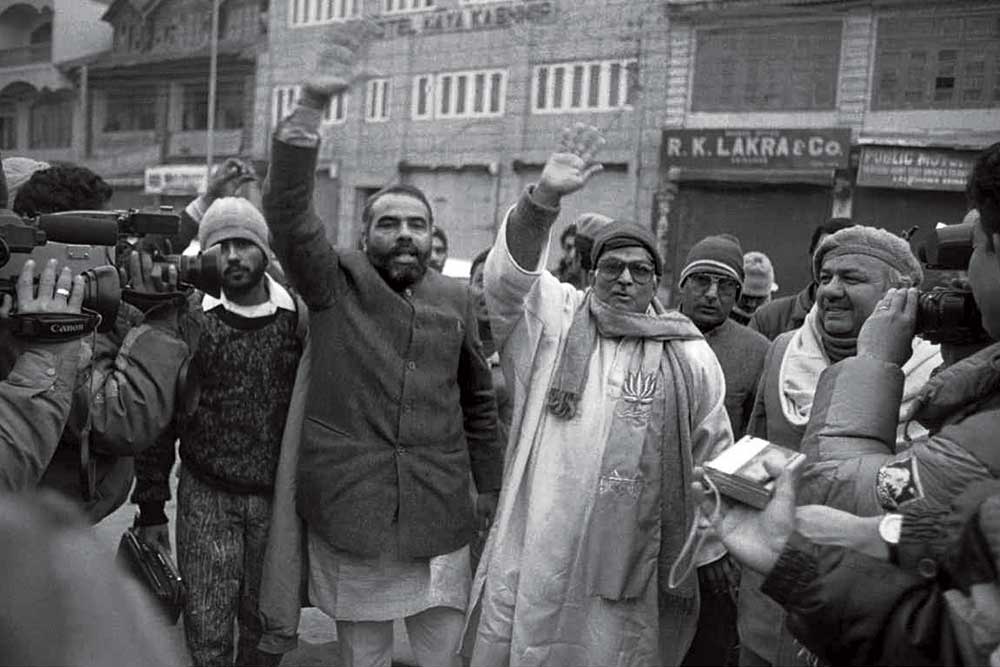 Narendra Modi with Murli Manohar Joshi during the Ekta Yatra, Srinagar, January 26, 1992 (Photo: Express Archives)
Says Dr Devika Rangachari, award-winning author and academic: “Kalhana’s Rajatarangini talks of Kashmir being a centre of multiple faiths, such as Shaivism (in particular, the worship of Ardhanarishvara), Buddhism and Naga worship, among others. One can also consult the Nilamatapurana (undated but definitely written before the 8th century CE), a text on the early traditions of Kashmir that details the major sacred sites and the rituals to be followed for the prosperity of the people. The text indicates the existence of several tribes in the region that followed their own indigenous traditions.” She adds that early Kashmir was a centre of eclecticism. “Both royal and non-royal people could aspire to rule, and have a say in the political, social, economic and religious context. So, it was not as if only the upper castes had power and influence. Also, women of all classes were hugely prominent throughout Kashmir’s ancient and early medieval past.” For those who are interested, Dr Rangachari recommends, “Apart from the texts mentioned, there are other interesting ones, such as Kshemendra’s Samayamatrika, Somadeva’s Kathasaritasagara and several others that were written in Kashmir and that display an awareness of and curiosity towards lands and people beyond their region.”
Kalhana also mentions scholars from Gauda (modern Bengal) coming to Kashmir to study. “There is an awareness of literary and religious traditions emanating from the Gangetic heartland, and connections with the south and other regions. Islamisation of Kashmir took place in the 13th and later 15th centuries. It fell to the Mughals, the Afghan Durranis and later the Sikhs whose iconic emperor was Ranjit Singh. In the mid-1800s, the rajas of Jammu became its rulers under the tutelage of the British until 1947,” she says.
The former princely state of Kashmir now falls in three countries: India (Indian Kashmir), Pakistan (Pakistan-Occupied Kashmir, Gilgit and Baltistan) and China (Aksai Chin). Kashmir is a tinderbox between India and Pakistan, which have fought multiple wars over it. Pakistani writer Mohammed Hanif notes that Pakistani children were taught in school that Kashmir was their ‘shah rug’ (jugular vein), confirming why the region will remain a flashpoint between the two South Asian nuclear neighbours. The dispute over Kashmir started when raiders affiliated to Pakistan launched attacks in the Valley in late 1947 under, as VP Menon says in his stellar work, Integration of the Indian States, ‘a mysterious officer called ‘General Tariq’ who was later identified as none other than Major-General Akbar Khan of the Pakistani Army.’
The Muslim veto in politics was one factor that hobbled any progress in tweaking Article 370. Times have changed now. And New Delhi’s sense of urgency in pushing the Kashmir Bills through perhaps hinged not just on internal security matters and the need to ensure greater national integration as portrayed. It also has got to do with, military experts aver, the proposed American pullout from Afghanistan ahead of next year’s US elections.
Policymakers and military officers alike are anxious of a likely repeat of history—of jihadists heading to Kashmir from Afghanistan in the event of a US troop withdrawal similar to what happened following the breakup of the Soviet Union. If it happens, a corrupt local administration will most likely be as ineffective as it was in Kashmir in the early 1990s in fighting terrorism from across the border and the chaos within, especially with non-state actors and Islamists proliferating across the globe with their own strange interpretation of the Quran.
The contention among military scholars in India is that, with the Centre ruling Jammu and Kashmir directly and financing its development and normalisation, it is going to be easier to tackle terror. The Union Government has already said that with investments expected to flow into Kashmir now that many trade-related and similar restrictions are being lifted, the locals will also gain vastly from new investments. This means the economic concerns of individuals can override other concerns, including ideological ones that are often an outcome of indoctrination by outfits that flourish with the connivance of local authorities.
The Centre has said that its new set of legal measures will forever change Kashmir and kick-start a process of correction of the mistakes of the past committed by the likes of Nehru who trusted Sheikh Abdullah and other leaders of the Valley too extravagantly and foisted his borrowed ideas of national integration on protesting Congress stalwarts, including Sardar Vallabhbhai Patel. Brigadier (Retd) BN Sharma writes of this incident in his book titled India Betrayed: The Role of Nehru: ‘Nehru, who was abroad at the time, rang up Patel and requested him to get the Article 370 approved (within the Congress). It speaks volumes of Patel’s loyalty to a colleague that despite his own and others misgivings, he managed to convince the members of Constituent Assembly and Congress Party Executive.’
While historians are divided on the claim that Patel and Nehru were not on the same page on Kashmir, several others contend that Patel remained loyal to Nehru even when it meant he had to embarrass himself over issues he and the Prime Minister never saw eye-to-eye. Incidentally, it was Nehru who wanted to engage with Sheikh Abdullah despite his own suspicions of the man’s intent and sway over his people. Patel had insisted on only securing Junagadh and Hyderabad over Kashmir. As regards the drafting of Article 370, Nehru authorised N Gopalaswami Ayyangar, who had great difficulty in dealing with Abdullah who kept changing his mind about crucial phrases in the legislation.
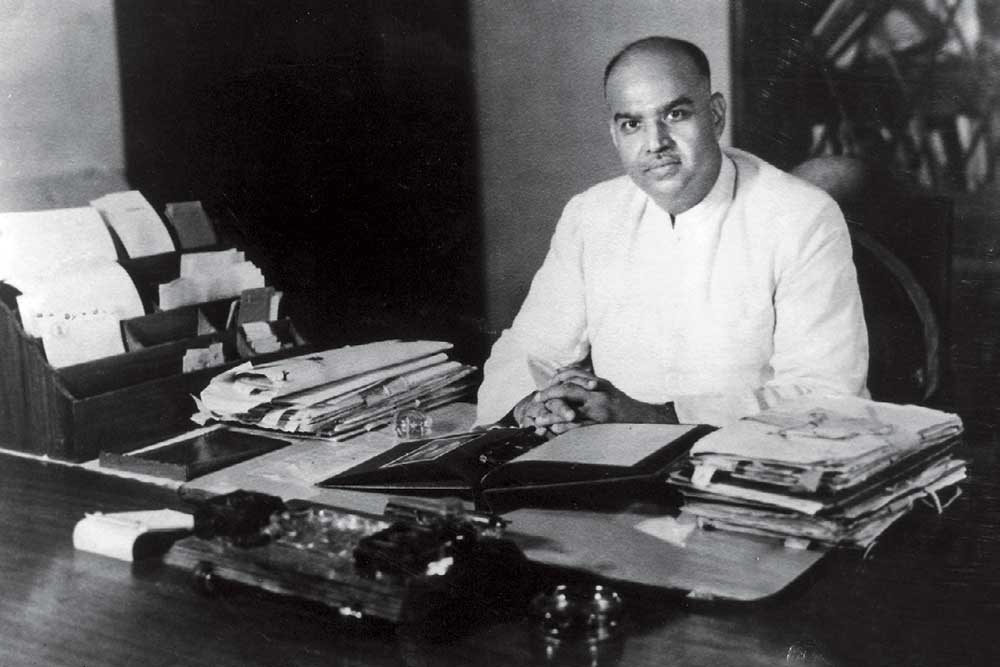 Syama Prasad Mookerjee
Nevertheless, many Army officers and scholars of the Indian Constitution feel that here is now an opportunity to tread a clearer path that discourages young people from being attracted by the ‘frivolous’ azadislogan.
COURSE CORRECTION
What die-hard detractors of the Government—a dwindling community in this particular case, with even the likes of AAP leader Arvind Kejriwal appreciating the Government’s move—fail to comprehend is perhaps the realisation both inside Kashmir and outside, especially in the rest of India, about the Kashmir question. Which explains why even Congress leader and son of Maharaja Hari Singh, Karan Singh, has finally praised the Modi Government for bifurcating the state and abrogating Article 370. Various other young leaders, too, have lent their support to the ruling dispensation. They include young Congress leaders like Jyotiraditya Scindia and Milind Deora, among others. Besides, with the Congress showing signs of unravelling and the people of Kashmir—as several military officers and officials repeatedly aver—finding the slogan of azadi unrealistic, the once-formidable stakeholders who have dominated Kashmir are finding it difficult to stay afloat. First among them are the dynasties of the Abdullahs (Farooq and Omar) and the Muftis (Mehbooba). Next, the Hurriyat and its leaders of every hue, the so-called real claimants to power in the Valley, find themselves irrelevant and discredited amid charges of nepotism, opportunism and corruption.
Amit Shah, meanwhile, told Open: “Article 370 and 35A helped the politicians of the Valley to indulge in corruption and largescale loot of resources meant for the citizen. A probe has been initiated into the functioning of the Jammu and Kashmir Bank. Auditing was carried out. An administrator has taken charge and suddenly we see many pale faces in the Valley. Why? This bank was a cash-dispensing machine for politicians and those connected with them. The protests of politicians of the Valley are aimed at saving their skin and not to protect the interests of the citizens. They used Article 370 for not operationalising the anti-corruption law in the state.” He emphasises that those who incite the youth of the state and push them onto the path of violence keep their own children from harm’s way. “Their children study and settle down in the UK and the US. They don’t want the children of the Valley to be empowered through education,” says Shah.
Naysayers are crying ‘fascism’, drawing parallels with the ‘Enabling Act’ and the Anschluss. But the Government of the day, masterful as it appears in forging ahead with legislation and handling administration, has put its foot down and wants to act on its own terms. “People first” is our policy, it contends. Shah told Open: “And I must make it clear that this Government will not talk to those who take inspiration from or are being handled by Pakistan. We will not talk to Hurriyat. We will have dialogue with the people of the Valley and we are ready to remove their apprehensions, if any.”
At the moment, despite its vow of cautious optimism, the Government’s enthusiasm on Kashmir is contagious and the scope for new possibilities in the region is abundant
Nehru may have talked about the “erosion” of Article 370 following the humiliating 1962 war which saw his nationalistic traits dominate over his liberal credentials. But then he passed away shortly after, in 1964, and his successors did nothing to mainstream Kashmir to India, as it was done in the past by making the Election Commission’s powers applicable in the state. For Indira Gandhi, the early struggle after Nehru’s death was to establish herself as a leader to reckon with, in the face of stiff opposition from within and from former colleagues of her father. This prompted her to tie up with communists and others. As a result, she wasn’t able to make much headway on Kashmir. Conversely, as in the past elections of 1957 and 1962, the 1967 elections also saw massive rigging by the Congress-led Centre to anoint a collaborator-dynast in power in the state. The trend continued. Decades of electoral malpractice resulted in public loss of faith in the Central Government which continued to rule through proxy, benefiting dynasties that enriched themselves in this long association.
When militancy surfaced in the late 1980s and the 1990s, it coincided with the fall of the Soviet Union, a development that left Islamist jihadis free to be deployed in Kashmir to create mayhem and go on a recruiting spree to wreak havoc in India. The handling of the situation was sloppy and a place that prided itself as a centre of Sufi thought exhibited signs of Wahhabism taking deep roots with anti-India protests increasingly acquiring a religious halo. Things got so bad that Kashmiri Pandits were asked to flee—and the announcement came from loudspeakers inside mosques—leaving behind their women and property if they were not willing to convert to Islam. The Pandit migration of the early 1990s is a shameful chapter in the history of Kashmir, which at its peak in the past was an intellectual hub.
Says Dr Devika Rangachari, award-winning author and academic: “Kalhana’s Rajatarangini talks of Kashmir being a centre of multiple faiths, such as Shaivism (in particular, the worship of Ardhanarishvara), Buddhism and Naga worship, among others. One can also consult the Nilamatapurana (undated but definitely written before the 8th century CE), a text on the early traditions of Kashmir that details the major sacred sites and the rituals to be followed for the prosperity of the people. The text indicates the existence of several tribes in the region that followed their own indigenous traditions.” She adds that early Kashmir was a centre of eclecticism. “Both royal and non-royal people could aspire to rule, and have a say in the political, social, economic and religious context. So, it was not as if only the upper castes had power and influence. Also, women of all classes were hugely prominent throughout Kashmir’s ancient and early medieval past.” For those who are interested, Dr Rangachari recommends, “Apart from the texts mentioned, there are other interesting ones, such as Kshemendra’s Samayamatrika, Somadeva’s Kathasaritasagara and several others that were written in Kashmir and that display an awareness of and curiosity towards lands and people beyond their region.”
Kalhana also mentions scholars from Gauda (modern Bengal) coming to Kashmir to study. “There is an awareness of literary and religious traditions emanating from the Gangetic heartland, and connections with the south and other regions. Islamisation of Kashmir took place in the 13th and later 15th centuries. It fell to the Mughals, the Afghan Durranis and later the Sikhs whose iconic emperor was Ranjit Singh. In the mid-1800s, the rajas of Jammu became its rulers under the tutelage of the British until 1947,” she says.
The former princely state of Kashmir now falls in three countries: India (Indian Kashmir), Pakistan (Pakistan-Occupied Kashmir, Gilgit and Baltistan) and China (Aksai Chin). Kashmir is a tinderbox between India and Pakistan, which have fought multiple wars over it. Pakistani writer Mohammed Hanif notes that Pakistani children were taught in school that Kashmir was their ‘shah rug’ (jugular vein), confirming why the region will remain a flashpoint between the two South Asian nuclear neighbours. The dispute over Kashmir started when raiders affiliated to Pakistan launched attacks in the Valley in late 1947 under, as VP Menon says in his stellar work, Integration of the Indian States, ‘a mysterious officer called ‘General Tariq’ who was later identified as none other than Major-General Akbar Khan of the Pakistani Army.’
The young Modi was part of the Ekta Yatra of 1991-1992 that culminated in the unfurling of the Indian Tricolour at Lal Chowk, Srinagar, on January 26, 1992. Many similar bids to attract public opinion to abrogate Article 370 appeared feeble individually, but not as collective action. And then, August 5, 2019 happened
NEW COMPULSIONSThe Muslim veto in politics was one factor that hobbled any progress in tweaking Article 370. Times have changed now. And New Delhi’s sense of urgency in pushing the Kashmir Bills through perhaps hinged not just on internal security matters and the need to ensure greater national integration as portrayed. It also has got to do with, military experts aver, the proposed American pullout from Afghanistan ahead of next year’s US elections.
Policymakers and military officers alike are anxious of a likely repeat of history—of jihadists heading to Kashmir from Afghanistan in the event of a US troop withdrawal similar to what happened following the breakup of the Soviet Union. If it happens, a corrupt local administration will most likely be as ineffective as it was in Kashmir in the early 1990s in fighting terrorism from across the border and the chaos within, especially with non-state actors and Islamists proliferating across the globe with their own strange interpretation of the Quran.
The contention among military scholars in India is that, with the Centre ruling Jammu and Kashmir directly and financing its development and normalisation, it is going to be easier to tackle terror. The Union Government has already said that with investments expected to flow into Kashmir now that many trade-related and similar restrictions are being lifted, the locals will also gain vastly from new investments. This means the economic concerns of individuals can override other concerns, including ideological ones that are often an outcome of indoctrination by outfits that flourish with the connivance of local authorities.
The Centre has said that its new set of legal measures will forever change Kashmir and kick-start a process of correction of the mistakes of the past committed by the likes of Nehru who trusted Sheikh Abdullah and other leaders of the Valley too extravagantly and foisted his borrowed ideas of national integration on protesting Congress stalwarts, including Sardar Vallabhbhai Patel. Brigadier (Retd) BN Sharma writes of this incident in his book titled India Betrayed: The Role of Nehru: ‘Nehru, who was abroad at the time, rang up Patel and requested him to get the Article 370 approved (within the Congress). It speaks volumes of Patel’s loyalty to a colleague that despite his own and others misgivings, he managed to convince the members of Constituent Assembly and Congress Party Executive.’
While historians are divided on the claim that Patel and Nehru were not on the same page on Kashmir, several others contend that Patel remained loyal to Nehru even when it meant he had to embarrass himself over issues he and the Prime Minister never saw eye-to-eye. Incidentally, it was Nehru who wanted to engage with Sheikh Abdullah despite his own suspicions of the man’s intent and sway over his people. Patel had insisted on only securing Junagadh and Hyderabad over Kashmir. As regards the drafting of Article 370, Nehru authorised N Gopalaswami Ayyangar, who had great difficulty in dealing with Abdullah who kept changing his mind about crucial phrases in the legislation.
Nevertheless, many Army officers and scholars of the Indian Constitution feel that here is now an opportunity to tread a clearer path that discourages young people from being attracted by the ‘frivolous’ azadislogan.
COURSE CORRECTION
What die-hard detractors of the Government—a dwindling community in this particular case, with even the likes of AAP leader Arvind Kejriwal appreciating the Government’s move—fail to comprehend is perhaps the realisation both inside Kashmir and outside, especially in the rest of India, about the Kashmir question. Which explains why even Congress leader and son of Maharaja Hari Singh, Karan Singh, has finally praised the Modi Government for bifurcating the state and abrogating Article 370. Various other young leaders, too, have lent their support to the ruling dispensation. They include young Congress leaders like Jyotiraditya Scindia and Milind Deora, among others. Besides, with the Congress showing signs of unravelling and the people of Kashmir—as several military officers and officials repeatedly aver—finding the slogan of azadi unrealistic, the once-formidable stakeholders who have dominated Kashmir are finding it difficult to stay afloat. First among them are the dynasties of the Abdullahs (Farooq and Omar) and the Muftis (Mehbooba). Next, the Hurriyat and its leaders of every hue, the so-called real claimants to power in the Valley, find themselves irrelevant and discredited amid charges of nepotism, opportunism and corruption.
Amit Shah, meanwhile, told Open: “Article 370 and 35A helped the politicians of the Valley to indulge in corruption and largescale loot of resources meant for the citizen. A probe has been initiated into the functioning of the Jammu and Kashmir Bank. Auditing was carried out. An administrator has taken charge and suddenly we see many pale faces in the Valley. Why? This bank was a cash-dispensing machine for politicians and those connected with them. The protests of politicians of the Valley are aimed at saving their skin and not to protect the interests of the citizens. They used Article 370 for not operationalising the anti-corruption law in the state.” He emphasises that those who incite the youth of the state and push them onto the path of violence keep their own children from harm’s way. “Their children study and settle down in the UK and the US. They don’t want the children of the Valley to be empowered through education,” says Shah.
As early as the late-1940s, Hindu nationalists had fought tooth and nail Nehru’s decision to offer provisions that treated Jammu and Kashmir as a state more equal than the others. Syama Prasad Mookerjee, founder-president of the Jana Sangh, had quit as minister from the Nehru Cabinet following the 1950 Delhi Pact with Pakistan
The rules of engagement have changed in Kashmir, thanks to a variety of reasons. The Centre does not care about holding talks with the separatists, after having tried it unsuccessfully as Vajpayee himself had done as Prime Minister. The killing of militant Burhan Wani in 2016 in the Valley also triggered a major churning internally, with home-grown insurgents getting influenced by al-Qaeda and the Islamic State, then taking up arms and questioning the credibility of existing politicos and separatists about their modus operandi. The televising of stark anti-India slogans has produced a counter-narrative within the country that is not helping the insurgent cause: the growing repugnance of the Indian public towards the rabid content directed against the country and its leaders is shaping opinion and resulting in largescale polarisation. Aided by the counter-campaign from the ruling coalition, the acceptability of new trends has risen rapidly. Hesitation in expressing one’s Indian-ness is a thing of the past. The proof of this is the rejection of such arguments at the hustings—and the electoral landslide for the Modi Government which was re-elected in 2019 on a wave generated by Modi’s personal charisma and nationalism exemplified by zero-tolerance for any act or remark that hurts the idea of a strong, integrated India that brooks no external aggression or separatism. People are aware of the intentions of separatists like SA Geelani of the Hurriyat who had said, “Yahan kya chalega? Nizam-e-Mustafa (what will rule in Kashmir? The rule of Allah).” Simply put, the guilt over being proud of the Indian national identity has been buried.Naysayers are crying ‘fascism’, drawing parallels with the ‘Enabling Act’ and the Anschluss. But the Government of the day, masterful as it appears in forging ahead with legislation and handling administration, has put its foot down and wants to act on its own terms. “People first” is our policy, it contends. Shah told Open: “And I must make it clear that this Government will not talk to those who take inspiration from or are being handled by Pakistan. We will not talk to Hurriyat. We will have dialogue with the people of the Valley and we are ready to remove their apprehensions, if any.”
At the moment, despite its vow of cautious optimism, the Government’s enthusiasm on Kashmir is contagious and the scope for new possibilities in the region is abundant



Pak deploying fighter jets to Skardu near Ladakh, India watching closely
Pak deploying fighter jets to Skardu near Ladakh, India watching closely
I thought they had already deployed 6 months back

Just tell me one thing
How many casualties of Soldiers can
Indian people accept while Conquering POK
One Abhinandan brought the Feb Conflict to an immediate end
Why do you want Modi to become unpopular
Let us proceed in a Careful manner
India will not initiate a war with Pakistan. But if we fight a war that's imposed on us, that's a different story.
He will contest and might hand over the baton by 2026 when he turns 75.
Honestly that sounds ridiculous, you can't just hand over the seat of PM in the middle of a term to anyone like its a relay race. But, I am no expert on this, so who knows what might happen!!
75 years is the age limit for contesting elections, not the retirement age.
Modi will be below 75 during his third term, so he can stay in power for the entire duration of the third term. You can expect him to retire when he turns 78.
Quite possible. I just mentioned a hypothetical scenario. I would like him to stay as log as he is fit.75 years is the age limit for contesting elections, not the retirement age.
Modi will be below 75 during his third term, so he can stay in power for the entire duration of the third term. You can expect him to retire when he turns 78.

sir , this time pakistan and bharat haters will have it for sure no matter they are indian muslims too . pirzada type illiterate mullas will vanish in thin air who believe in gazwa e hind and kashmir is the land of converted hindu descendants but rishi kashyap . the stage is set , person has been appointed , job will be done for sure . jai hind .Openly telling to kill hindus but if repeat of 1990 occurs , we shouldn't hold back this time. Remember we Hindus have only one country has our own , we need to fight for it till the last man.