More than their whole airforce it is their satellite system which has become a threat.
Not really. It's just a handful of EO sats, about half a dozen. Only one of which is a radar sat, so poor revisit rate. What they can do is provide early warning regarding any massed troop movements or relocation of air assets to forward bases in anticipation of strikes. Which is something China was already providing them, to an even greater degree. Albeit with their own sats, they can slowly gain more control of their own ISR and deconflict with China's own needs.
Regarding Pak's own sats though, those numbers are too few to be of actual tactical relevance i.e. persistent GMTI, real-time tracking or force-wide SATCOM uplinking.
There's a reason why our SBS Phase-III program consists of 50+ satellites. Even that number has to be supplemented later on if we want true, persistent space-based ISR in multiple spectrums.
The bigger challenge for Pakistan though is going to be longevity. You can't just put up satellites and then forget about them. Most LEO sats have to be consistently replaced every ~5 or so years. So the bigger the constellation you build, the more you need to spend on sustaining it in the long term.
India will become first country in the world to neutralize an adversary recon satellite overtly.
Quite possibly.
It's a good thing we have multiple options for doing that, including some that need not even be overt, and without causing a debris field in LEO that could possibly effect other satellites (including our own). So things like XSV-1 direct-ascent ASAT would be last resort. Read part of reply to
@FalconSlayers below.
Yes but in an absence of terminal seekers this thing can't survive in a SATNAV-jamming environment the Fatah-1s couldn't.
Depends on how it's configured. If it's fitted out similarly to Iranian OWA drones (go to fixed inertial coordinates, following a set path stored in onboard memory, then detonate once reached), it won't be affected by GPS/Radio jamming all that much. It's ability to compare its actual position relative to where it's supposed to be could be hindered, but over relatively short distances like the Indo-Pak front, it's unlikely to matter much. Not enough time or distance for errors to accumulate.
It's gonna require hard-kill more often than not. As will the MGLDs & similar LMs that we would be launching at them.
For that we'll need ISRO's RLV spaceplane in service asap that can potentially de-orbit enemy satellites. The newer gen military satellites are being designed to be capable of manoeuvring in-orbit as well as getting re-fuelled. Thanks to re-usable rocket tech.
Don't even need the RLV for that. That's for more sophisticated missions like potential snatch-and-grab to bring payloads back for study or installing tapping equipment.
Back in 2025 on a PSLV POEM stage, we flew & validated multiple small robotic arms that can be mounted on relatively small cube sats. While the algorithms for close Rendezvous & Proximity Operations (RPOs) are already proven through SPADEX.
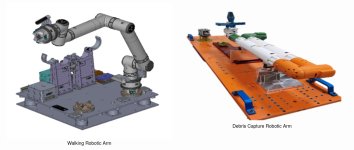
 View attachment Demonstrating tethered debris capture in space using visual servoing, motion prediction, and a...mp4
Latch on, fire a thruster and boom, hostile sat de-orbited. These co-orbital ASAT capabilities are quite cheap & simple once you've cracked the software stack for RPOs.
Given the total lack of SSA on Pakistan's part, they won't even know what happened until & unless somebody else tells them.