Pakistan AirForce : Updates & Discussions

How effective an EW payload is going to be, even in a swarm given the powerplants are microturbojets.

Hi, sorry for late reply.

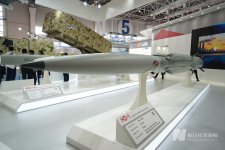
While jamming/spoofing-focused decoy applications exist (like MALD-J), I'd reckon the primary aim of systems like Arrow-1 is going to be saturation of enemy air defences.

If it can successfully pretend to be a more sophisticated threat (like Babur, Raad, Fatah-series etc) flying a lo-lo profile, it could force our IADS to deplete more capable interceptors like QRSAM or SPYDER on a threat that otherwise would be left to cheap AAA, like the YIHA-3s during Op. Sindoor, which were mostly swatted out of the sky by guns while our SAMs were only going up to shoot down things like Fatah-1/2 or CM-400AKG.

Overcoming these decoys will require better target-discrimination capabilities (not just in terms of hardware like AESA FCRs, but also in terms of building & updating threat-libraries with their distinct signatures. AI & Cognitive EW work wonders here).

Then on top of that of course it's a numbers game. Who runs out of attack vectors first, who runs out of interceptors first.
 
Pakistan has no design and development expertise for any manned aircraft, let alone an advance KF21 type aircraft.

This is either just talk show like project azm or a design & developed by chinease, same as JF-17, which is also economically less viable, specially when J-35 already exist.

At this point, PFX is a paper design and J-20 is probably overkill for a small AF like PAF. J-35 would fit their requirement for a twin engine mwf quite nicely.

They haven't operated a TE jet since the A-5 Fantan of Chinese origin back in the 70s-80s, iirc.

Shishir Gupta may be talking out of his *censored* here (wrt PAF getting J20) is all I'm saying.
 
  • Agree
Reactions: Photon Vish
The first line sounds cope tbh .
The vid is from NASTAP , as the initial design and models were first seen there .There is no Chinese or Turkish design .
Wdym by "screwdriver" , Its literally an original IP .
It really doesn't matter what copy it is or isn't.
The entire western arsenal is a copy of each other. The whole UK fleet of Nuclear strategic submarines carry Trident a US missile.
List goes on.

As long as its available, it flies to the target and goes bang , that's what matters.

BTW what happened to indian Rustom Drone project?
1800 caror INR gone in the gutter . The so called indigenous drone .
 
Hi, sorry for late reply.

While jamming/spoofing-focused decoy applications exist (like MALD-J), I'd reckon the primary aim of systems like Arrow-1 is going to be saturation of enemy air defences.

If it can successfully pretend to be a more sophisticated threat (like Babur, Raad, Fatah-series etc) flying a lo-lo profile, it could force our IADS to deplete more capable interceptors like QRSAM or SPYDER on a threat that otherwise would be left to cheap AAA, like the YIHA-3s during Op. Sindoor, which were mostly swatted out of the sky by guns while our SAMs were only going up to shoot down things like Fatah-1/2 or CM-400AKG.

Overcoming these decoys will require better target-discrimination capabilities (not just in terms of hardware like AESA FCRs, but also in terms of building & updating threat-libraries with their distinct signatures. AI & Cognitive EW work wonders here).

Then on top of that of course it's a numbers game. Who runs out of attack vectors first, who runs out of interceptors first.
Yes but in an absence of terminal seekers this thing can't survive in a SATNAV-jamming environment the Fatah-1s couldn't.
More than their whole airforce it is their satellite system which has become a threat. India will become first country in the world to neutralize an adversary recon satellite overtly.
For that we'll need ISRO's RLV spaceplane in service asap that can potentially de-orbit enemy satellites. The newer gen military satellites are being designed to be capable of manoeuvring in-orbit as well as getting re-fuelled. Thanks to re-usable rocket tech.
 
More than their whole airforce it is their satellite system which has become a threat.

Not really. It's just a handful of EO sats, about half a dozen. Only one of which is a radar sat, so poor revisit rate. What they can do is provide early warning regarding any massed troop movements or relocation of air assets to forward bases in anticipation of strikes. Which is something China was already providing them, to an even greater degree. Albeit with their own sats, they can slowly gain more control of their own ISR and deconflict with China's own needs.

Regarding Pak's own sats though, those numbers are too few to be of actual tactical relevance i.e. persistent GMTI, real-time tracking or force-wide SATCOM uplinking.

There's a reason why our SBS Phase-III program consists of 50+ satellites. Even that number has to be supplemented later on if we want true, persistent space-based ISR in multiple spectrums.

The bigger challenge for Pakistan though is going to be longevity. You can't just put up satellites and then forget about them. Most LEO sats have to be consistently replaced every ~5 or so years. So the bigger the constellation you build, the more you need to spend on sustaining it in the long term.

India will become first country in the world to neutralize an adversary recon satellite overtly.

Quite possibly.

It's a good thing we have multiple options for doing that, including some that need not even be overt, and without causing a debris field in LEO that could possibly effect other satellites (including our own). So things like XSV-1 direct-ascent ASAT would be last resort. Read part of reply to @FalconSlayers below.

Yes but in an absence of terminal seekers this thing can't survive in a SATNAV-jamming environment the Fatah-1s couldn't.

Depends on how it's configured. If it's fitted out similarly to Iranian OWA drones (go to fixed inertial coordinates, following a set path stored in onboard memory, then detonate once reached), it won't be affected by GPS/Radio jamming all that much. It's ability to compare its actual position relative to where it's supposed to be could be hindered, but over relatively short distances like the Indo-Pak front, it's unlikely to matter much. Not enough time or distance for errors to accumulate.

It's gonna require hard-kill more often than not. As will the MGLDs & similar LMs that we would be launching at them.

For that we'll need ISRO's RLV spaceplane in service asap that can potentially de-orbit enemy satellites. The newer gen military satellites are being designed to be capable of manoeuvring in-orbit as well as getting re-fuelled. Thanks to re-usable rocket tech.

Don't even need the RLV for that. That's for more sophisticated missions like potential snatch-and-grab to bring payloads back for study or installing tapping equipment.

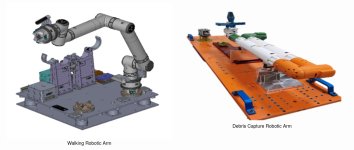
Back in 2025 on a PSLV POEM stage, we flew & validated multiple small robotic arms that can be mounted on relatively small cube sats. While the algorithms for close Rendezvous & Proximity Operations (RPOs) are already proven through SPADEX.

GfZYf4kasAAmw0i.jpeg

Relocatable-Robotic-Manipulator-Technology-Demonstrator-RRM-TD.jpg

View attachment Demonstrating tethered debris capture in space using visual servoing, motion prediction, and a...mp4

Latch on, fire a thruster and boom, hostile sat de-orbited. These co-orbital ASAT capabilities are quite cheap & simple once you've cracked the software stack for RPOs.

Given the total lack of SSA on Pakistan's part, they won't even know what happened until & unless somebody else tells them.

 
Not really. It's just a handful of EO sats, about half a dozen. Only one of which is a radar sat, so poor revisit rate. What they can do is provide early warning regarding any massed troop movements or relocation of air assets to forward bases in anticipation of strikes. Which is something China was already providing them, to an even greater degree. Albeit with their own sats, they can slowly gain more control of their own ISR and deconflict with China's own needs.

There is word coined Space Silk Road. The established capability is mere a starting point and not the end, China will expand their presence but not overburden it. It is mere a face of Chinese expanding multi spectrum space capabilities and dual use ground infrastructure for long range recon in the global south. The deployment of Chinese ground stations around Indian sub continent is a big strategic challenge.

Regarding Pak's own sats though, those numbers are too few to be of actual tactical relevance i.e. persistent GMTI, real-time tracking or force-wide SATCOM uplinking.

It gives more secure comm channels for proxy war in Kashmir and North East and ToT or transfer of defence equipment from China under the table in the name of civilian space deal.

There's a reason why our SBS Phase-III program consists of 50+ satellites. Even that number has to be supplemented later on if we want true, persistent space-based ISR in multiple spectrums.

Correct.
 
There is word coined Space Silk Road. The established capability is mere a starting point and not the end, China will expand their presence but not overburden it. It is mere a face of Chinese expanding multi spectrum space capabilities and dual use ground infrastructure for long range recon in the global south. The deployment of Chinese ground stations around Indian sub continent is a big strategic challenge.


It gives more secure comm channels for proxy war in Kashmir and North East and ToT or transfer of defence equipment from China under the table in the name of civilian space deal.


Correct.

Pak is reportedly planning an 'indigenous' navsat system which will likely follow the same template as the eo sat constellation- chinese designed/built, pak operated.

Wrt, mil space capabilities, Pak is currently at the same stage we were at back in 2001 when we launched TES-1 as a testbed for 1m res imager followed by a Israeli Tecsar radar sat.
 
  • Like
Reactions: screambowl
Pak is reportedly planning an 'indigenous' navsat system which will likely follow the same template as the eo sat constellation- chinese designed/built, pak operated.

Wrt, mil space capabilities, Pak is currently at the same stage we were at back in 2001 when we launched TES-1 as a testbed for 1m res imager followed by a Israeli Tecsar radar sat.

For terrain mapping and imagery and surveillance of mass mobilization it works well as mentioned by Parthu. If you have 3-4 of such then collective will give you real time data in every 23 minutes.
 
Visible decline is evident on ISRO since 2014. They achieved mainly irrelevant public stunt missions only.
Defence is definitely a let down from ISRO. But will improve and infact demand more payloads after our private players in just next 2 years.

But those "irrelevant public stunt" are as much if not more important than the Defence side of space for a Nation.

You need young people to be in science(STEM), space is the best motivator for this.

And for science, nothing is irrelevant.

We don't need to think like security state like pakistan for whome any thing which does not improve security is waste of money.

A country is secured by militry but developed by science (STEM) and industries. Militry can not develope a country.

Even spending 10s of billions of USD on civilian space is less.
 
  • Like
Reactions: Jarvis
There is word coined Space Silk Road. The established capability is mere a starting point and not the end, China will expand their presence but not overburden it. It is mere a face of Chinese expanding multi spectrum space capabilities and dual use ground infrastructure for long range recon in the global south. The deployment of Chinese ground stations around Indian sub continent is a big strategic challenge.

Ultimately, we have to develop our own leverage over the Chinese by enacting similar policies in their neighbourhood. We're already working on it.


"...India has offered to explore the establishment of observation stations at multiple locations in the Philippines, which would enable Manila to access imagery from Indian satellites covering surrounding maritime areas. India has a similar set up with some other Asean countries in the region. This could strengthen the Philippines' maritime domain awareness, particularly as it deals with growing security challenges in the South China Sea..."

Visible decline is evident on ISRO since 2014. They achieved mainly irrelevant public stunt missions only.

Bro, control your cortisol please.

Getting preoccupied in developing our sustained human access to Low Earth Orbit (Gaganyaan/BAS) is not a public stunt. It's this capability that could end up defining the basis for what our stake on the Moon & beyond will be in the decades to come, once resource-extraction becomes an established economy.

Yes, there have been a few failures in natsec launches but ISRO is getting back on track. We've had two back-to-back successes with GISAT-1A (capable of detecting ballistic missile launch plumes) and NVS-03 (NaVIC is back, baby), both put up by GSLV.

In the meantime, the size & shape of our space industry is changing in a huge way. Our private players are no joke. A small Indian company like Pixxel launched 6 hyperspectral sats just last year, part of their planned 24-sat constellation. Pakistan now has 1, that too made by China based on a Chinese bus.


"...The Pakistani satellite was mainly built by the Innovation Academy for Microsatellites, a Shanghai-based subsidiary of the Chinese Academy of Sciences..."

The US National Reconnaissance Office (NRO) has signed up to buy hyperspectral imagery from Indian companies and you're over here hyperventilating about ISRO decline, LMAO :ROFLMAO:

 
Ultimately, we have to develop our own leverage over the Chinese by enacting similar policies in their neighbourhood. We're already working on it.

https://www.firstpost.com/world/india-philippines-relationship-brahmos-akash-pinaka-deals-space-cooperation-visiting-forces-agreement-14060882.html
"...India has offered to explore the establishment of observation stations at multiple locations in the Philippines, which would enable Manila to access imagery from Indian satellites covering surrounding maritime areas. India has a similar set up with some other Asean countries in the region. This could strengthen the Philippines' maritime domain awareness, particularly as it deals with growing security challenges in the South China Sea..."

Right, but I was specifically talking about their new upgradation with Satellite uplink which you previously mentioned in the post on troop mobilization surveillance. This points to the fact the satellites are becoming a major threat even at tactical level. Of course there will be counter measures deployed but then it will only become more challenging post Op Sindoor.

My doubt will be if they have integrated it with any of the sats operated by SUPARCO.

(DEFENCE SECURITY ASIA) — Pakistan’s reported activation of the indigenous AM-350S long-range radar and Machaan tactical air defense radar marks a significant shift in South Asia’s electromagnetic battlespace, where survivability increasingly depends on sensor dominance rather than platform numbers alone.

The integration of both systems with a China-backed satellite data link transforms these radars from isolated surveillance assets into nodes of a network-centric kill chain, compressing reaction timelines from minutes to seconds and strengthening Pakistan’s ability to fight through electronic warfare disruption.

 
For terrain mapping and imagery and surveillance of mass mobilization it works well as mentioned by Parthu. If you have 3-4 of such then collective will give you real time data in every 23 minutes.

We now have real time space situational awareness capability via Digantara's SCOT payload which went up just months before Op Sindoor started. It's no coincidence that IAF S400 batteries during were able to relocate in the nick of time before inbound Pakistani missiles arrived on target.
 
  • Like
Reactions: Aniruddha
We now have real time space situational awareness capability via Digantara's SCOT payload which went up just months before Op Sindoor started. It's no coincidence that IAF S400 batteries during were able to relocate in the nick of time before inbound Pakistani missiles arrived on target.

Indian defence upgradations have been more China centric now, 15 more launches to go, hopefully the pre planned timeline is satisfied.. And additional players will join in couple of years.
 
Right, but I was specifically talking about their new upgradation with Satellite uplink which you previously mentioned in the post on troop mobilization surveillance. This points to the fact the satellites are becoming a major threat even at tactical level. Of course there will be counter measures deployed but then it will only become more challenging post Op Sindoor.

My doubt will be if they have integrated it with any of the sats operated by SUPARCO.


For persistent, force-wide SATCOM connectivity you need geostationary sats. LEO would give very intermittent connectivity which is not effective, so none of their recent additions are of much use there. Pak does have 1 or 2 Chinese-made GEO communication sats, which I'm pretty sure are already being used to support military SATCOM functions, for platforms that actually support that capability (like ships).

Newer air defence additions with SATCOM capability would also have to uplink to those same sats. Unless of course, China is allowing them to link with actual PRC-owned sats. Which wouldn't surprise me, in light of limited bandwidth on Pak-operated ones.