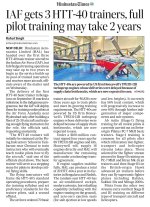
Trainer Aircraft of IAF - PC-7, HTT-40, HJT-36, BAE Hawk


Aircraft maker Hindustan Aeronautics Limited (HAL) may have delivered the first batch of HTT-40 basic trainers to the Indian Air Force (IAF), out of 70 on order, but a steady supply of engines by US firm Honeywell remains critical to keeping the ₹6,838-crore programme on schedule, officials aware of the matter said.

The aerospace major hopes Honeywell will resolve supply-chain bottlenecks and stabilise TPE331-12B engine deliveries from next year, the officials said.

The IAF ordered 70 basic trainers three years ago to train its rookie pilots. Under the contract, HAL was to deliver 12 trainers to the IAF in fiscal 2025-26 but failed to deliver any aircraft due to an engine shortage. Honeywell, which faced supply chain bottlenecks, began delivering the turboprop engines for the indigenous basic trainer aircraft to HAL a few months ago and assured the firm of timely supplies.

“There is an engine-related issue as Honeywell has tier-1 and tier-2 supply chain issues. The firm has promised us six engines by December. It is looking for alternative sources (to overcome supply chain bottlenecks),” HAL chairman and managing director Ravi K said in an interview.

“The supplies are expected to stabilise from next year. Aircraft production is not an issue; it’s on track,” he told HT.​
Just a query! This is the same engine as on the Do228? .... so .... how are they getting engines for that ?
 

Honeywell Delivers First TPE331-12B Engines to HAL for HTT-40​


Honeywell Aerospace Technologies delivered the first three TPE331-12B turboprop engines to Hindustan Aeronautics Limited (HAL) in Bengaluru, India, on June 11, 2026, advancing the Indian Air Force’s HTT-40 basic trainer program after previous supply chain delays.

The handover marks a critical milestone for a $100 million engine contract signed in July 2022. The HTT-40 aircraft is designed to replace the Indian Air Force’s aging Kiran trainer fleet and address pilot training squadron shortages under the Indian government’s ‘Aatmanirbhar Bharat’ (Self-Reliant India) initiative.

Phased delivery and domestic assembly​

According to a Honeywell press release, the company will supply a total of 16 engines directly to HAL. Following this initial batch, HAL will assume responsibility for the local assembly of the remaining powerplants, with more than 80 engines planned to support the HTT-40 program over the coming years.

Thandava Edara, Vice President of Engineering and Head of Aerospace Engineering for India at Honeywell Technology Solutions, stated that the collaboration underscores a shared commitment to strengthening local manufacturing, assembly, and long-term support capabilities in India.

The TPE331-12B features a single-shaft design that provides the immediate throttle response required for military pilot training. The broader TPE engine family encompasses 18 models and 106 configurations, accumulating over 122 million flight hours across more than 13,000 global deliveries.

Supply chain recovery and production targets​

The June 11, 2026, delivery arrives after persistent supply chain bottlenecks impacted the program’s timeline. Reporting by Defence News India indicates that Honeywell missed an initial September 2025 deadline for the first engine delivery, pushing the timeline into mid-2026.

As a result of the delay, HAL revised its HTT-40 delivery targets in December 2025. The manufacturer reduced its projected output for the 2025-2026 financial year from 12 aircraft down to three units. India’s Ministry of Defence had previously signed a contract with HAL in March 2023 for the procurement of 70 HTT-40 aircraft.

With the first engines now on site, HAL Chairman and Managing Director Ravi K expressed optimism regarding the production schedule. In the Honeywell release, he noted that the deliveries mark a significant milestone for the program and stated confidence that future engine shipments will continue on schedule.

AirPro News analysis​

The arrival of the first TPE331-12B engines in Bengaluru provides HAL with the necessary hardware to meet its revised 2025-2026 financial year target of three HTT-40 aircraft. While the initial supply chain delays highlight the vulnerability of domestic aerospace programs to global component shortages, the structured transition toward local engine assembly mitigates long-term risk. We view the successful transfer of assembly capabilities to HAL as the true test of this partnership. If Honeywell can maintain the delivery schedule for the remaining 13 direct-supply engines, HAL will be well-positioned to stabilize the HTT-40 production line and begin fulfilling the Indian Air Force’s critical training requirements.
 
Honeywell Aerospace expects to complete deliveries of 16 engines ordered for Hindustan Aeronautics Ltd’s (HAL) HTT-40 basic trainer aircraft ahead of schedule.

Speaking at a media briefing in New Delhi, Matt Milas, President, Defense and Space, Honeywell Aerospace, said four engines have been delivered for the programme, with another four scheduled for delivery by the end of 2026, taking the total to eight.

 
571273383_849855907725012_1141865992493984942_n.jpg


Thiojoe Am I A Joke To You GIF
 
  • Haha
Reactions: Gautam and Parthu
They could have used the prototypes to start training the instructors. Could have fast tracked the process by 6 months.
That's what they did?

HAL made TSR001 and TSR002, did the flight testing, implemented the required aero changes, and completed certification. Then they were re-registered as XH0702 and XH0703 before being handed over to IAF for evaluation and initial training.

Also they won't be leaving these airframes idle for 2 years, any further QFI and maintenance training will be done too.
 
Last edited:

EXCLUSIVE: KAI invited to bid for India's $6 billion 150-jet trainer program​


Korea Aerospace Industries (KAI) confirmed it has been invited to India’s planned procurement of around 150 advanced jet trainers to replace its aging British-designed aircraft before official invitation to be issued December in 2027.

“We have received the RFI (Request for Information) and are currently reviewing it internally,” a KAI official said on condition of anonymity.

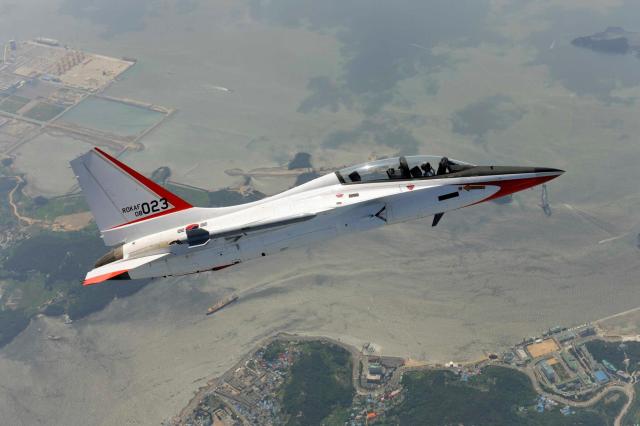
A retired senior Indian Air Force officer pointed to KAI’s T-50 Golden Eagle as one of the strongest candidates along with Italy's Leonardo M-346 advanced jet trainer.

KAI’s T-50, a supersonic advanced jet trainer, would be a potential contender if the company proceeds. Based on recent export prices for the T-50, an estimated unit price of around $40 million would put the value of a 150-aircraft order at roughly $6 billion. The final value would depend on the buyer’s requirements and package terms.

The Indian Air Force has extended the RFI response deadline twice — from Oct. 5 to Nov. 16 and then to Dec. 14 — giving prospective participants an additional 70 days. It has not disclosed the reasons for the extensions.

The 20-page document published by India’s Ministry of Defence calls for a more advanced training system than the existing Hawk fleet, with requirements extending beyond aircraft performance.

Technology transfer and local maintenance capabilities feature prominently.

Manufacturers are asked to detail their supply chains in India and their ability to provide long-term maintenance, repair and overhaul (MRO) services.

The retired Indian Air Force officer, who separately tipped AJP that the T-50 was among the top candidates, also raised the possibility of cooperation between KAI and Indian defense company MKU.

Founded in 1985, MKU makes body armor, military helmets and optical equipment and has recently expanded into military aircraft maintenance. In April, it secured a long-term MRO contract covering work on the Indian Air Force’s Soviet-designed Antonov An-32 transport aircraft.

A cooperation proposal shared by the former officer outlined a possible division of responsibilities between KAI and MKU.

“MKU could support India operations including trained manpower,” the proposal stated. “MKU can do MRO in India with supervision of KAI.”

It also suggested that MKU could offer “pre-bid suggestions on RFI response options” and help establish a local facility.

Asked whether the companies had already made contact, the retired officer replied: “They have been independently in touch."

Potential foreign competitors include Italy’s Leonardo M-346 advanced jet trainer. Leonardo has previously expressed interest in India’s training modernization plans and said it was exploring opportunities for local industrial cooperation.

Lt. Col. Athul Sreedharan, a defense public relations officer based in Tezpur, told AJP in response to questions about the program: “I reached out to the concerned department, as per them they do not have any information to give out.”​
 
  • Haha
Reactions: Ashwin

EXCLUSIVE: KAI invited to bid for India's $6 billion 150-jet trainer program​


Korea Aerospace Industries (KAI) confirmed it has been invited to India’s planned procurement of around 150 advanced jet trainers to replace its aging British-designed aircraft before official invitation to be issued December in 2027.

“We have received the RFI (Request for Information) and are currently reviewing it internally,” a KAI official said on condition of anonymity.

A retired senior Indian Air Force officer pointed to KAI’s T-50 Golden Eagle as one of the strongest candidates along with Italy's Leonardo M-346 advanced jet trainer.

KAI’s T-50, a supersonic advanced jet trainer, would be a potential contender if the company proceeds. Based on recent export prices for the T-50, an estimated unit price of around $40 million would put the value of a 150-aircraft order at roughly $6 billion. The final value would depend on the buyer’s requirements and package terms.

The Indian Air Force has extended the RFI response deadline twice — from Oct. 5 to Nov. 16 and then to Dec. 14 — giving prospective participants an additional 70 days. It has not disclosed the reasons for the extensions.

The 20-page document published by India’s Ministry of Defence calls for a more advanced training system than the existing Hawk fleet, with requirements extending beyond aircraft performance.

Technology transfer and local maintenance capabilities feature prominently.

Manufacturers are asked to detail their supply chains in India and their ability to provide long-term maintenance, repair and overhaul (MRO) services.

The retired Indian Air Force officer, who separately tipped AJP that the T-50 was among the top candidates, also raised the possibility of cooperation between KAI and Indian defense company MKU.

Founded in 1985, MKU makes body armor, military helmets and optical equipment and has recently expanded into military aircraft maintenance. In April, it secured a long-term MRO contract covering work on the Indian Air Force’s Soviet-designed Antonov An-32 transport aircraft.

A cooperation proposal shared by the former officer outlined a possible division of responsibilities between KAI and MKU.

“MKU could support India operations including trained manpower,” the proposal stated. “MKU can do MRO in India with supervision of KAI.”

It also suggested that MKU could offer “pre-bid suggestions on RFI response options” and help establish a local facility.

Asked whether the companies had already made contact, the retired officer replied: “They have been independently in touch."

Potential foreign competitors include Italy’s Leonardo M-346 advanced jet trainer. Leonardo has previously expressed interest in India’s training modernization plans and said it was exploring opportunities for local industrial cooperation.

Lt. Col. Athul Sreedharan, a defense public relations officer based in Tezpur, told AJP in response to questions about the program: “I reached out to the concerned department, as per them they do not have any information to give out.”​
Purchase of KAI T-50 will be last nail in coffin of Tejas program.

Hope that MK1A's trainer version with smart cost cutting is purchased by splitting nunbers between HAL and a private entity(let say LnT).
 
Possible non sensical news. Its a RFI, just a market research. This procurement will end up being an internal D&D program. There is no chance of an import.

Purchase of KAI T-50 will be last nail in coffin of Tejas program.

Hope that MK1A's trainer version with smart cost cutting is purchased by splitting nunbers between HAL and a private entity(let say LnT).
Tejas is already a success with 220 on order. This has nothing to do with it. A delta cant be a dedicated trainer.
 
In any serious country, the IAF and DRDO would have engaged with the private sector to extract whatever they could from the LCA Mk1 and Mk2 programmes, gotten the Kaveri certified at 73 kN, and built a simple, lightweight steel bird without radar or just LCA sports if it can be powered by Kaveri with ADA and Private player.

What a downfall from a great aircraft like the Kiran to this, if it happens.

I refuse to believe private sector can't get a AJT into air in max 2 yrs, if given assurance.

78 kN of T50, 2x28 kN of M346.
 
Pretty sure this only be seen as a cope, considering Tejas has been previously pitched against FA50. While that was a different variant, the fact is irrelevant when it's about perceptions.
Frankly, what would be next? A "stopgap" purchase of KF21 even as AMCA carries out weapons trials.

I guess we are retaining the tag of 'imported air force' through 2030s.

T50 cannot even be justified on the grounds of tapping into the Korean supply chain for F404 engines. They apparently mfg a different version.

But it will likely be the most affordable of the lot compared to the likes of the M346 and esp Boeing T7A.
 
In any serious country, the IAF and DRDO would have engaged with the private sector to extract whatever they could from the LCA Mk1 and Mk2 programmes, gotten the Kaveri certified at 73 kN, and built a simple, lightweight steel bird without radar or just LCA sports if it can be powered by Kaveri with ADA and Private player.

What a downfall from a great aircraft like the Kiran to this, if it happens.

I refuse to believe private sector can't get a AJT into air in max 2 yrs, if given assurance.

78 kN of T50, 2x28 kN of M346.
Then why isn't private sector responding to the RFI? Why did IAF need to extend deadline twice?
 
Possible non sensical news. Its a RFI, just a market research. This procurement will end up being an internal D&D program. There is no chance of an import.


Tejas is already a success with 220 on order. This has nothing to do with it. A delta cant be a dedicated trainer.
How so?

Isn't delivery supposed to be done 5 years after contract?
 
  • Like
Reactions: Photon Vish
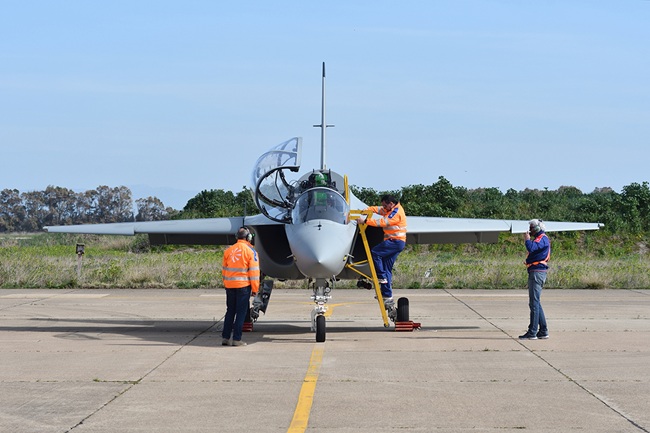
Leonardo is eyeing the Indian Air Force (IAF) requirement for a new advanced trainer for which it intends to propose the M-346T Block 20. In August 2026, the Indian Ministry of Defence (MoD) issued a Request for Information (RFI) for 150 jet trainers for the IAF, with the aim of having the Request for Proposal (RFP) published by December 2027. The RFI was sent to several potential competitors, including Leonardo, AERO and Korea Aerospace Industries (KAI).

A Leonardo spokesperson told FWMag that the company will participate in the tender with the M-346 Integrated Training System (ITS) , proposing the latest configuration of the aircraft, the M-346T Block 20. The spokesperson added that Leonardo is ready to develop and launch an industrial cooperation program in India and that it is working to meet the timelines of the RFI and the subsequent phases of the tender.

The company has so far received orders for 176 aircraft , while over 20 countries have the M-346 in service, have acquired it or train their pilots at the International Flight Training School (IFTS) in Italy.

For Leonardo, the M-346's broad international user base, significant operational flight experience (over 170,000 hours for the entire global fleet), a consolidated training ecosystem, and constant system evolution demonstrate its maturity as an advanced training platform. The company emphasized that "the system's use by multiple operators has generated a significant wealth of real-world experience in operations, training, and support, reducing program risk and supporting long-term capability growth."

The M-346 ITS comprises a Mission Support System (MSS) and a Ground Based Training System (GBTS) , which offers a wide range of simulators and advanced training devices. This data-driven training ecosystem integrates real-world flight, synthetic training, and mission support tools into a single architecture. Integrated interfaces and the onboard Embedded Training System (ETS) allow for the simulation of a wide range of weapons, sensors, and loadouts. The combination of ETS and GBTS allows for the creation and management of complex LVC -type tactical scenarios , with Live (aircraft), Virtual (simulators), and Constructive (computer-generated forces) elements, under the constant supervision of instructors, ensuring realistic and cost-effective training.

 
  • Like
Reactions: spice and YoungWolf