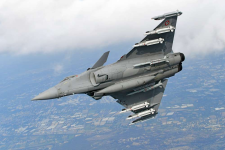
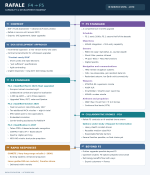
Some news of Rafale F4 and F5 :
Entre le déploiement progressif du standard F4 et la préparation du F5, le Rafale connaît en ce moment une nouvelle phase majeure de son évolution. Alors...

www.meretmarine.com
"
Interview with Armament Engineer General Sébastien, Head of the Rafale Program at the DGA
Mer et Marine: Launched in 2018, the Rafale F4 standard was developed using an incremental approach, with the F4.1, F4.2, and F4.3 sub-standards. What are the advantages of this method?
IGA Sébastien: This approach primarily helps reduce the time between successive system versions. By shortening delivery cycles, we can adapt much more rapidly to operational requirements. When development spans several years, there is a risk of only partially addressing the evolving needs of the armed forces throughout that period. The objective is therefore to deliver new capabilities on a regular basis. For the Rafale, we are now operating at a rhythm of approximately one new version or sub-version every two years, each bringing new functional services.
This approach also offers another advantage: it allows us to incorporate changes during development that were not originally planned. Major capabilities continue to be developed in accordance with the initial specifications, but we can quickly introduce new functionalities as operational requirements evolve. In particular, contract amendments can be used to integrate capabilities that were not necessarily foreseen when development began. This allows us to address emerging needs with relatively short notice, without having to wait several years for the delivery of an entirely new standard.
Where does the deployment of these different sub-standards stand within the French armed forces today?
The F4.1 standard was qualified by the DGA in March 2023. Qualification corresponds to the verification and validation of the entire system before delivery to the armed forces, which then carry out trials and operational introduction. Today, the entire French Rafale fleet has been upgraded to this standard.
The F4.2 standard, meanwhile, was qualified in October 2025. It is currently undergoing an evaluation phase conducted notably by the Air and Space Force’s Military Air Expertise Center (CEAM) and the French Navy’s Aeronautical Test and Acceptance Center (CEPA), with support from DGA facilities. The objective is to assess the new functionalities from an operational standpoint, particularly to validate concepts of employment. Deployment has already begun, with several Rafales converted to F4.2, and the rollout will continue progressively across the fleet through the end of 2026 and the beginning of the following year.
Finally, the F4.3 standard constitutes the last increment of the F4 standard, with qualification expected during 2027. Industrial development is due to be completed by the end of this year, before qualification, operational testing, and deployment activities begin.
Do the F4.1, F4.2, and F4.3 designations also apply to Rafale export customers?
No. These designations are specific to France. Export standards are derived from the French standards, but they have their own names and configurations tailored to the requirements of each customer. Nevertheless, there is a common software baseline and numerous shared technical building blocks across the various Rafale versions.
Rafale F4: New Sensors and Enhanced Connectivity
What are the main capabilities introduced by F4.1?
F4.1 introduces several major developments, beginning with the Scorpion helmet-mounted display. This device, positioned in front of the pilot’s eye, notably facilitates target designation.
The standard also marks an important first step toward collaborative air combat, one of the key pillars of F4. We introduced new data-sharing capabilities between Rafales, notably enabling passive threat localization through the fusion of information collected by multiple aircraft. The principle is to use the passive sensors carried by different fighters to collect information about a threat. By correlating this information through connectivity means, the aircraft can determine the threat’s position. We therefore combine onboard sensor detection capabilities with platform collaboration to achieve localization.
F4.1 also integrates the 1,000-kg AASM modular air-to-ground weapon, with INS/GPS and laser-guidance capabilities. This significantly increases the Rafale’s strike power. An aircraft can carry up to three 1,000-kg AASMs, representing a particularly heavy loadout.
We also improved several aircraft sensors, notably the Talios laser designation pod and the Front Sector Optronics (FSO) system. One of the key developments is the introduction of a new IRST-type infrared channel (Infrared Search and Track), enabling the detection of aerial targets at very long ranges through their thermal signature.
Additional improvements were introduced in radar modes, particularly for tracking ground targets, as well as in the Spectra self-protection system. Finally, the aircraft’s connectivity has been enhanced overall.
And what about F4.2?
One of the most visible enhancements of the F4.2 standard is the integration of two additional MICA missiles under the Rafale’s wings, on station number 3, which had previously been unused. This increases the number of available air-to-air weapons and therefore the aircraft’s engagement capacity in air combat, as well as its self-defense capability during long-range strike missions.
Another major development is the introduction of a supplementary navigation and attack system connected to the aircraft systems. This system takes the form of an Electronic Flight Bag (EFB), essentially a tablet device that can be placed, for example, on the pilot’s knee, similar to those found in some civilian aircraft. Its distinctive feature is that it is directly connected to the Rafale’s navigation and attack systems.
The objective is to provide an open system capable of integrating new applications connected to the aircraft systems through very short development cycles. We particularly want to give the armed forces the ability to develop and integrate their own applications, addressing specific operational requirements while maintaining security.
The EFB provides an appropriate development environment allowing users to introduce applications on their own initiative without modifying the core of the Rafale combat system. The tablet can interface with communication systems and retrieve mission-system data. Applications can then exploit this information and present it to aircrews in forms tailored to their needs.
The F4 standard also opens two new hardpoints for MICA and MICA-NG air-to-air missiles. Each Rafale can therefore carry up to eight air-to-air missiles while retaining three heavy hardpoints for external fuel tanks or air-to-ground weapons.
F4.2 also introduces embedded simulation and, for naval Rafales, carrier landing assistance. How do these capabilities work?
The principle of embedded simulation is relatively simple. Today, when training a pilot in flight for certain combat scenarios, another aircraft is generally required to represent the threat, whether another fighter or a light aircraft acting as an aggressor.
With embedded simulation, we can directly stimulate the Rafale’s sensors using synthetic tracks. These may correspond to pre-programmed scenarios or tracks generated from a ground center and transmitted to the aircraft in real time via a data link.
This effectively brings into the Rafale capabilities that were previously available only in ground simulators. It enables realistic airborne training using the aircraft’s actual combat system without requiring all scenario participants to be physically present. This capability applies equally to Air and Space Force Rafale C and B aircraft and Navy Rafale M aircraft.
The other major development, specific to the Rafale M, is carrier landing assistance. Its objective is to reduce pilot workload during recovery aboard the aircraft carrier.
The system assists the pilot from integration into the landing pattern through the final approach. It provides highly accurate guidance that enables the aircraft to arrive above the flight deck in optimal conditions. The pilot receives indications that can be followed throughout the approach, allowing the system to support precise carrier landings.
Sea trials, notably aboard the aircraft carrier
Charles de Gaulle, have already been conducted to validate the system’s integration before operational deployment.
F4.3 Will Be the Final Increment of the F4 Standard. What Major Enhancements Will It Bring?
One of the main developments concerns the Talios targeting pod, with the introduction of a mode known as ATDR (Automatic Target Detection and Recognition). This is an automatic target detection and recognition capability.
The principle is to allow the pod to automatically scan a geographic area and identify objects that may be of operational interest. To achieve this, we use artificial intelligence techniques, including a neural network embedded within the pod, capable of analyzing imagery and highlighting objects of interest.
The system automatically scans an area, detects various objects, classifies them, and provides a preliminary identification. The pilot can then move between the different detections proposed by the system. When an object is selected, the pod displays a more detailed image, allowing the pilot to visually analyze it and determine whether it corresponds to the target sought as part of the mission.
This enables the pilot to move rapidly from one object to another without having to manually search through all the elements present in a target area. Artificial intelligence is used for the detection and pre-selection of potentially relevant objects, while the aircrew retains responsibility for assessing their actual operational value.
The other major aspect of F4.3 concerns connectivity. This standard is intended to provide the Rafale with its full sovereign networking capability, notably through the integration of the CONTACT radio.
This radio system performs traditional voice communication functions but also enables the exchange of digital data over an aeronautical network based on the IP protocol, similar to the one used on the Internet. This creates a communication architecture capable of distributing data among multiple platforms.
In addition, F4.3 introduces BLOS (Beyond Line Of Sight) satellite communications, another key component of this aeronautical network. This capability enables information exchange beyond the radio horizon, particularly with command-and-control centers located at great distances.
We are also introducing a significant upgrade to the Spectra self-protection system, including new digital jamming capabilities that will notably improve the system's responsiveness to emerging threats.
Finally, F4.3 will enable the integration of the MICA NG missile.
The MICA NG represents a major evolution in the Rafale's air-to-air weaponry, featuring new seekers in both its electromagnetic-guided (EM) and infrared-guided (IR) versions.
The other major advancement concerns propulsion, with the introduction of a dual-pulse rocket motor. This will significantly improve both engagement range and missile lethality.
As a result, both the EM and IR variants will benefit from upgraded seekers and enhanced propulsion. Integration work is already well advanced, as demonstrated by firing trials conducted from a Rafale flying at supersonic speed.
Accelerated Development to Meet Operational Requirements
The Chief of Staff of the French Air and Space Force recently mentioned the introduction of a new very-long-range air-to-air missile, called COMETE, which could enter service around 2030 on the Rafale F4. How can such a weapon be developed and integrated so quickly?
This topic is not yet sufficiently mature for us to discuss in detail. The Chief of Staff has indeed announced the program, but I cannot provide much additional information at this stage.
However, when the objective is to develop a new capability rapidly, one solution is to build upon technologies and solutions that already work, rather than trying to introduce major innovations simultaneously across every subsystem of a weapon.
For example, with the MICA NG, we sought to achieve major technological advances in several areas of the missile, which naturally requires lengthy development timelines.
If the goal is to move much faster, a different approach can be adopted by retaining proven solutions and concentrating development efforts only on the modifications necessary to meet the new operational requirement.
To give a simple example: if the objective is to increase the range of a missile, one possible approach is to focus primarily on improving its propulsion system, rather than redesigning all of its other subsystems.
That does not mean integration becomes simple. Increasing a missile's range often requires a larger propulsion system, which affects its mass and aerodynamic characteristics. This in turn requires new integration work on the aircraft.
However, by building on an existing solution and adapting it as needed, development can proceed much faster than if the entire missile had to be redesigned from scratch.
From the DGA's perspective, this also requires a different way of working.
This is exactly the philosophy behind the concept of a "combat DGA" promoted by our General Delegate for Armament. We are seeking innovative working methods capable of breaking away from some traditional practices in order to respond more rapidly to military requirements.
This requires strong involvement from all participating industries, ensuring coordinated development of both the missile and its aircraft integration. We must be able to make the right technical trade-offs quickly, with very short decision-making cycles.
The same applies to contracting processes, which we seek to make as agile as possible to avoid delays and allow industry to begin work rapidly.
Rafale F5: A True Mid-Life Upgrade
Let us turn to the Rafale F5. How significant is this evolution compared with previous standards, and what timeline do you foresee for its development?
Our objective is to deliver this capability during the next decade. However, it is important to understand that the Rafale F5 represents a genuine mid-life upgrade of the aircraft. It is not merely a marginal improvement to its sensors or weapon systems.
While we are building on an existing and proven platform, we will thoroughly modernize its sensors, propulsion system, and mission systems to address the challenges of the coming decades, as the Rafale is expected to remain in service with the French armed forces until around 2070. The goal is to provide the aircraft with a new generation of sensors capable of countering future threats while preserving sufficient growth potential for further enhancements.
This will involve a profound transformation of the aircraft's computing and electronic architecture, including a broader integration of artificial intelligence, whose applications we have already begun testing in flight. We aim to provide more adaptive responses to emerging threats that aircrews may encounter. This is an extremely ambitious project that differs significantly from previous standards. We are no longer simply improving existing equipment incrementally; we are conducting a deep modernization of the entire combat system.
As with the F4 standard, do you plan to divide this new version into several increments?
At this stage, we are indeed considering two increments. The idea is first to introduce the new hardware architecture along with the initial major systems and sensors based on that architecture. Subsequently, we will integrate a new generation of sensors and processing systems, fully exploiting the possibilities enabled by the new architecture.
This is currently the overall approach we envision: an initial
F5.1 increment, expected in the early 2030s, followed by
F5.2 in the second half of the decade.
One of the major developments will be the RBE2 XG radar. This will be an entirely new radar that will not reuse the current radar's antenna. We will introduce a new AESA antenna using Gallium Nitride (GaN) transmit/receive modules, replacing the current Gallium Arsenide (GaAs) technology. The advantage of GaN lies in its ability to tolerate higher temperatures and operate at greater power levels.
This will allow us to field a significantly more powerful radar, with a substantial increase in effective detection range. The evolution goes beyond the antenna itself. We are also planning new processing capabilities and operating modes, particularly to address the threat posed by aircraft with extremely low radar signatures.
We will also introduce AI-powered functions into these new processing systems, particularly within radar imaging modes. The concept is similar to the ATDR mode used in the Talios targeting pod. We want to automatically analyze radar-generated imagery to identify objects or facilities of interest. This capability could be used, for example, to locate enemy air defense sites. Radar imagery processing will highlight sought-after objects in much the same way Talios does with its electro-optical sensors.
We will also evolve the radar's operating modes. Today, in certain situations, transitions must be made between different functions, notably between air-to-air and air-to-ground modes. The new radar will include interleaving capabilities, allowing multiple modes to operate simultaneously. We will therefore be able to combine different functions without interrupting one to use another. This will greatly enhance the radar's effectiveness during complex missions, where crews may need to search for and track multiple categories of threats at the same time.
The Rafale F5 must be able to conduct first-entry missions against increasingly capable integrated air defense systems. What developments will be necessary to meet this challenge?
There are two major objectives shaping the F5 standard.
The first is to support the airborne nuclear deterrent component, notably through integration of the future ASN4G missile.
The second concerns the capability to conduct first-entry operations, meaning penetration of airspace protected by integrated air defense systems. Today, surface-to-air defense networks are organized in multilayered architectures combining short-, medium-, and long-range detection and engagement systems. To penetrate such defenses, several Rafale capabilities must evolve.
The first area is navigation. We require an exceptionally resilient navigation system, capable of maintaining very high accuracy in contested electromagnetic environments. We are planning to introduce a new generation of inertial navigation systems based on Hemispherical Resonator Gyroscope (HRG) technology, providing highly accurate positioning. This will enhance navigation resilience when satellite systems are disrupted or jammed.
The second area is communications. Once precise navigation is ensured, platforms must also be able to exchange information even in heavily jammed environments. This is one of the objectives of the new IVDL (Inter Vehicle Data Link), which will be integrated into the F5 standard.
IVDL is a low-probability-of-intercept and highly jam-resistant data link. Conventional radio systems can be relatively easy to detect, especially when transmitting omnidirectionally. By contrast, IVDL aims to provide communications that are extremely difficult to detect, intercept, or jam. This capability is particularly important for penetration missions where multiple platforms must exchange information while maintaining stealth.
Is IVDL a specifically French system? Is it intended to replace Link 16?
It is a sovereign French data link, but it is not intended to replace Link 16.
Link 16 remains the interoperability standard used with allied forces. IVDL meets a different requirement, focusing on communication discretion and resilience. Although sovereign, it could potentially be partially opened to selected partners for information-sharing during joint operations.
We also plan to strengthen satellite communication capabilities through a redundant architecture and enhanced connectivity with the growing number of low-Earth-orbit telecommunications constellations expected in the coming years.
Beyond navigation and communication upgrades, will the Rafale F5 also receive new weapons?
Absolutely.
Once we can navigate precisely and communicate resiliently, we must also be able to detect and engage enemy defense systems deep within hostile territory. This requires both improved sensors and the integration of new weapons tailored to these missions.
Among these will be the future STRATUS-RS missile, developed under the future anti-ship and cruise missile program conducted jointly with the United Kingdom and Italy. This supersonic missile is intended to strike heavily defended targets deep within enemy territory. It will be suitable against naval targets, air-defense sites, and high-value airborne targets such as AWACS aircraft and aerial refueling tankers.
We are also working on several weapons under the Future Air-to-Surface Weapons (AASF) program. One example is the AASM XLR, which will provide significantly greater range than current variants. The AASF program may also include the SmartGlider and SmartCruiser families, lighter weapons capable of operating in swarms and addressing complementary mission requirements.
The objective is to field strike capabilities adapted to different target categories, particularly for long-range suppression of enemy air defenses.
Naturally, integration of the ASN4G nuclear missile remains another fundamental objective of the F5 standard.
Will the aircraft's own performance also improve? At the 2025 Paris Air Show, you mentioned a new M88 engine version and conformal fuel tanks. What other major upgrades are planned?
We are indeed working on an upgraded M88 engine, with thrust increasing from approximately 7.5 to 9 tons under the T-Rex program. This increase will significantly improve Rafale performance in heavy configurations carrying substantial external loads.
We also plan to integrate Conformal Fuel Tanks (CFTs) mounted along the aircraft's fuselage. These tanks will increase fuel capacity while generating less drag than conventional underwing fuel tanks. The objective is to substantially improve both range and combat radius.
Another major development concerns the Spectra self-protection system, which will transition to a digital architecture. Detection and jamming capabilities will be modernized to address future threats. In this field, there is a constant competition between offensive and defensive technologies. Detection systems and missiles continue to improve, and self-protection systems must evolve to remain effective.
We are therefore making substantial investments in this next-generation Spectra system, including fully digital signal-processing chains and advanced digital jamming capabilities.
Significant advances are also planned in electro-optics, beginning with a new pod known as TR (Targeting and Reconnaissance). This system will replace the current Talios pod and combine targeting and reconnaissance functions in a package of similar size, replacing both Talios and the much larger Reco NG pod.
The second major electro-optical enhancement will be a new forward-sector infrared sensor called Silent Killer. This passive infrared sensor will offer greatly improved long-range detection performance, particularly against stealth aircraft.
While stealth aircraft significantly reduce their radar signatures through shaping and materials, it is far more difficult to completely conceal their thermal signatures, which originate from engines and aerodynamic heating. A sufficiently capable infrared sensor can detect such targets through their heat emissions without relying solely on radar.
The future Silent Killer system will therefore provide enhanced passive detection of stealth aircraft at significantly greater ranges. These capabilities will also improve detection of certain drone categories, complementing new radar modes optimized for low-speed targets.
Beyond Rafale
The Rafale F5 is also expected to operate alongside combat drones. Initially, France considered a relatively large stealth drone derived from the nEUROn demonstrator. However, recent DGA information requests regarding collaborative combat systems appear to open the door to more compact drones, similar to American Collaborative Combat Aircraft (CCA). What is the current thinking?
The concept is indeed that Rafale F5 will operate with connected drones capable of participating in collaborative combat, generally referred to as PCA (Autonomous Collaborative Platforms).
Our priority is to identify the solutions that best meet military operational requirements. This is precisely the purpose of the information request issued to industry. We want to evaluate a broad range of options and determine which architectures are most effective for the missions envisioned.
All options remain under consideration. These range from relatively large combat drones, where attrition must remain limited, to smaller expendable systems similar to Remote Carriers, as well as medium-sized collaborative platforms that are less expensive than large combat drones but still reusable.
Several complementary drone families may ultimately be developed to support different missions and progressively expand operational capabilities.
However, we remain in the assessment phase, and no final decisions have been made.
What remains constant is the operational concept: a group or swarm of AI-enabled connected drones coordinated by a conductor, namely the Rafale F5.
The cancellation of the European program that was supposed to lead to the SCAF and NGF creates uncertainty regarding the future of French and European combat aviation beyond 2040. Can Rafale continue evolving beyond F5?
We must distinguish between NGWS (Next Generation Weapon System), which referred to the cooperative development of a next-generation combat system, and France's requirement for a future air combat system, known as SCAF (Future Air Combat System).
Changes in the cooperative framework do not eliminate that requirement.
As mentioned earlier, the Rafale still has many decades ahead of it. The operational environment evolves continuously, and we know new threats will emerge. Consequently, the aircraft's capabilities will need to keep evolving to meet future challenges.
The Rafale platform will therefore continue to evolve long after the F5 standard.
Are you already working on technologies that could be integrated into future standards beyond F5?
Yes, absolutely.
This is a major part of our activity, particularly through upstream research programs designed to mature technologies for future systems. Technological breakthroughs cannot be improvised overnight. They often require preparation years before integration into operational systems.
For example, when we launched the F4 standard in 2018, we simultaneously initiated research studies that laid the groundwork for the Spectra upgrades now planned for F5.
This illustrates the way the DGA operates. We must simultaneously manage short development cycles to quickly deliver new capabilities while preparing technological breakthroughs that may only reach maturity one or two decades later.
These early-stage programs allow technologies to mature to a level where industrial development and operational integration become feasible.
It is also a crucial aspect of DGA's role in supporting the French defense industry. If we want to maintain world-class armed forces and a world-class defense industrial base tomorrow, we must invest today in the technologies we will need.
Final question: the Rafale enjoys strong export success, often with configurations tailored to each customer. Can these export-driven developments also benefit French Rafales?
Yes, certainly.
Export developments are primarily built upon capabilities and upgrades originally developed for the French armed forces, but benefits can also flow in the opposite direction.
When equipment or functionalities are developed at the request of export customers, we may evaluate whether they are also beneficial for our own forces. This has already been the case with certain support and maintenance enhancements, where developments initially funded for export customers have later been leveraged by France.
Although national programs remain the primary driver of the Rafale's evolution, some export-specific adaptations can indeed directly benefit the French armed forces."