ADA AMCA - Advanced Medium Combat Aircraft

  • Thread starter Thread starter Tarun
  • Start date Start date
Isn't 10.5kw cooling capacity for 5th gen radar a bit less ??

F-35 has much higher, specially block 4(current one).

It is good enough. F-35's new cooling capacity is for all the electronics onboard, not just for the radar.

Let's say, AMCA's GaN TRM has 20 watts peak power. So at 300khz PRF (highest for the radar) with a pulse width of 1 µs it will have average power of 6 watts. So with 1530 active TRM, the aperture will have 9.1 KW of average power. And if assumed DRDO managed to achieve overall TRM efficiency (not PAE of GaN amplifier) at 20%, you will end up with 7.2kw of wastage. Which is well within the capacity of 10.5kw cooling system.

Rest can be used to cool back-end processor and other LRUs.

PS: afaik, radars barely operate at such high PRF. Though you can have lower PRF and higher pulse width.

Also not all TRM transmit at the same power. TRM at the edges of aperture area operate at lower power than those in the middle to optimise beam forming and suppress sidelobes. This is called amplitude windowing. So there is that.
 
Last edited:
As general citizens we can observe that it's happening in all stealth jets, manned & unmanned.

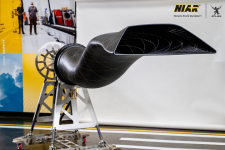
I am not sure if F22 or F35 have any sort of such edged elevation in the inlet duct. But there is a possibility of a slope which could be observed along with the curved surface area at the rear near the cylindrical segment like in the picture below, with a non uniform width and shape throughout to slow down the air speed as you mentioned.

A curved surface area will make the collision with air molecules less non elastic and bend the incoming air smoothly, curved surface with an elevation/slope .


0524-cw-news-frankenstein-inlet-duct.png

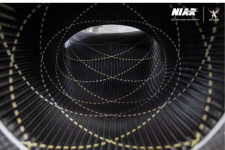
Inside the inlet duct you can observe the grooves to optimize the airflow.

photo_2_niar_wsu_2_fmt.png
 
I am not sure if F22 or F35 have any sort of such edged elevation in the inlet duct. But there is a possibility of a slope which could be observed along with the curved surface area at the rear near the cylindrical segment like in the picture below, with a non uniform width and shape throughout to slow down the air speed as you mentioned.

A curved surface area will make the collision with air molecules less non elastic and bend the incoming air smoothly, curved surface with an elevation/slope .


View attachment 53800

Inside the inlet duct you can observe the grooves to optimize the airflow.

View attachment 53801


By edged elevation if you mean straight duct segments instead of curve, then i already mentioned "theoretical straight segments"
Theoretical straight segments

I can also make the duct more curvy but it'll create more polygons which is good for realistic design but bad for old computer.

The grooves are probably to handle the boundary layer air of the duct.
 
  • Like
Reactions: screambowl
By edged elevation if you mean straight duct segments instead of curve, then i already mentioned "theoretical straight segments"

Okay I ignored that point , appologies, but overall these are pure experimental physics. You design a model and then you simulate fluid dynamics and then calculate pressure at every point.
The grooves are probably to handle the boundary layer air of the duct.

Yes at super sonic speeds and hypersonic speeds, and for acoustic suppression.
 
Okay I ignored that point , appologies, but overall these are pure experimental physics. You design a model and then you simulate fluid dynamics and then calculate pressure at every point.
Yes, today's 3D CAD S/w have got features of simulating physics, particles, fluids, collision, etc. Then industrial grade custom manufacturing S/w have much better capabilities.

Yes at super sonic speeds and hypersonic speeds, and for acoustic suppression.
At every speed.
Hypersonics IDK but for supersonic jets the air needs to slow down below Mach 1 before entering intake if possible, so inside duct it'll be subsonic.
 
"Our programme is AMCA, and AMCA has reached a stage where Requests for Proposals (RFP) have been invited from the shortlisted vendors. They've sought more time because of the complexity and the fact that they are also getting into this space for the first time. We are going to give them some more time. But my understanding is that this is our programme, and we are putting all our eggs in this basket as of now."

 
It's mediocre. Rafale tier
Likely the guy said above, the 60-80KW PTMS (Power and Thermal Management System) is for the entire aircraft, not just the radar. Even in AMCA you'll need to cool down a host of electronics, overall cooling requirements is a lot higher and unlike F-35, there could be discrete cooling systems for them.
 
Likely the guy said above, the 60-80KW PTMS (Power and Thermal Management System) is for the entire aircraft, not just the radar. Even in AMCA you'll need to cool down a host of electronics, overall cooling requirements is a lot higher and unlike F-35, there could be discrete cooling systems for them.
From what I remember F-35 gets about 30-35 kW for its radar. The rafale gets somewhere to 11-11.5 kW.
If the AMCA is getting around 10 kW it's mediocre. Although the bigger radar size and more trms would translate into more range.
 
From what I remember F-35 gets about 30-35 kW for its radar. The rafale gets somewhere to 11-11.5 kW.
If the AMCA is getting around 10 kW it's mediocre. Although the bigger radar size and more trms would translate into more range.
"Gets" vs "would get" is different.
Cooling requirements for a GaN on SiC or sapphire based TRM could be as low as 1/3rd of that of a GaAs based one.
 
  • Informative
Reactions: Sathya
From what I remember F-35 gets about 30-35 kW for its radar. The rafale gets somewhere to 11-11.5 kW.
If the AMCA is getting around 10 kW it's mediocre. Although the bigger radar size and more trms would translate into more range.
Source for rafale ? As it's peak power output is <=10kw, while Virupaksha on super sukhoi will be around 25kw.

I think AMCA cooling of just 10.5kw is still low as it is lower than what F35-4 will have.

Even turks planned a peak power of 40kw for their radar on Kaan.

Amca having peak output of just 25kw in 2035 is lower end of 5th gen.
 
Amca having peak output of just 25kw in 2035 is lower end of 5th gen.
AMCA has fallen in the size trap just like LCA did. You could say it's a self-limiting mediocre design. However, based on the radar trend and GaN breakthroughs at DRDO, the radar itself isn't mediocre like person claims above. If anything, it appears very optimised for the real estate and power it has been made available.
 
The projected timeline for the AMCA’s first flight is the second half of 2028, but it is unlikely to be achieved and may be delayed because we have not yet awarded the contract: IAF Chief AP Singh.

• 2008: MCA development programme begins under DRDO/ADA to be powered by 2xKaveri engine being made for LCA. IAF/HAL start work on FGFA.

• 2010: Medium Combat Aircraft (MCA) programme is renamed AMCA. ADA asks for 2.3 billion for TD and prototypes, refused.

• 2013: Project Definition and Preliminary Design (PD&PD) phase begins after the feasibility study review.

• 2013–2014: Multiple aircraft configurations are evaluated through design studies, wind-tunnel testing and radar cross-section analysis.

• 2014: IAF concluded that FGFA's stealth profile was deeply compromised

• 2015: Basic aircraft configuration is finalised and the detailed programme report is submitted to the IAF.

• 2016: IAF gives concurrence to the programme.

• 2018: The project is permanently frozen. National Security Advisor Ajit Doval formally conveys to a visiting Russian ministerial delegation that India is walking away from the $8.63 billion FGFA project. New Delhi tells Moscow to proceed alone and states India might theoretically buy the finished aircraft much later down the line

• 2017–2018: Project-definition work progresses. In April 2018, the government confirms that the feasibility study is complete and outlines the programme's development phases.

• 2020: The aircraft configuration is frozen following the Preliminary Design Review (PDR) in December. An SPV-based development and production model is proposed.

• 2021: HAL and ADA continue working on the aircraft. HAL projects an early prototype timeline, while the proposed SPV model involving private industry remains under discussion.

• 26 February 2022: HAL Chairman R. Madhavan publicly discusses implementing AMCA through an SPV involving private players, potentially with private-sector majority ownership to reduce procedural delays. No private partner shows up.

• October 2022: DRDO says the critical design process is progressing and reiterates the intention to manufacture AMCA through an SPV involving HAL, DRDO/ADA and private industry.

• November 2022: IAF Chief calls for foreign Collab on AMCA

• 2022: Year is wasted cause of opposition from IAF, "financially unviable"

• February 2023: AMCA reaches a major systems-level Critical Design Review (CDR) milestone. Platform-level design review work continues.

• December 2023: Comprehensive Design Review is reported complete, bringing the aircraft design to a more mature stage.

• 7 March 2024: Cabinet Committee on Security (CCS) approves the approximately ₹15,000 crore AMCA design and prototype-development programme, including five prototypes.

• March 2024: HAL is expected to undertake prototype manufacturing, with metal cutting and preparation of tooling, assembly facilities and supply chains planned

• May 2024: HAL publicly describes the earlier proposed SPV arrangement, with ADA and HAL together holding 50% and a private partner holding the remaining 50%.

• early 2025: The MoD examines alternative execution arrangements and a greater role for private industry. The original SPV approach gives way to a competitive industry-partnership model.

• 27 May 2025: MoD approves the new competitive execution model. Public and private sector Indian companies can compete independently or through JVs/consortia.

• 18 June 2025: ADA issues the EoI inviting companies and consortia to compete for the AMCA DcPP.

• 16 August 2025: Original EoI submission deadline.

• August–September 2025: EoI deadline is extended, ultimately to 30 September. Seven entities reportedly submit responses.

• November 2025: L&T's consortium brings Dynamatic Technologies on board.

• 4 February 2026: Tata Advanced Systems, L&T and Bharat Forge-led groupings as the three technically shortlisted contenders. HAL does not qualify for the prototype-development stage.

• 27 May 2026: ADA issues the RFP to the three shortlisted bidders for the development-cum-production partner contract.

• 27 August 2026: Original RFP bid-submission deadline.

• 28 August 2026: ADA's two-month extension is reported, moving the deadline to 30 October.

• 30 October 2026: Revised deadline for submission of bids.

• 31 October 2026: Technical bids scheduled to open.

1. TASL
2. L&T + BEL + Dynamatic
3. Bharat Forge + BEML + Data Patterns

Oct 2026: IAF chief says we'll consider Su57 if AMCA is delayed

3 weeks after this, "may be delayed because we have not yet awarded the contract"

Now below is the pinch of salt stuff from me,

One consortium is asking for HAL to give up it's facilities. One is asking to bring foreign consultancy of UK and US aerospace firm. And one is just there so number appears bigger on board.

On top of it, all 3 have no clue what AMCA is going to cost, 15,000 cr is nothing. They don't have much room to play around, ADA must take responsibility of production and quality and targets, they won't. And on top of that, it will go for tender. It's not a outright contract for full 120+. Where is financial viability? And if it's delayed, which obviously it will be, IAF goes for Su57, so much for encouragement.

I ain't in favour of HAL, private sector needs a whip which people in charge are not cracking.

And does ADA have capability, to make full jet themselves either?

1000401951.jpg
 
The projected timeline for the AMCA’s first flight is the second half of 2028, but it is unlikely to be achieved and may be delayed because we have not yet awarded the contract: IAF Chief AP Singh.

• 2008: MCA development programme begins under DRDO/ADA to be powered by 2xKaveri engine being made for LCA. IAF/HAL start work on FGFA.

• 2010: Medium Combat Aircraft (MCA) programme is renamed AMCA. ADA asks for 2.3 billion for TD and prototypes, refused.

• 2013: Project Definition and Preliminary Design (PD&PD) phase begins after the feasibility study review.

• 2013–2014: Multiple aircraft configurations are evaluated through design studies, wind-tunnel testing and radar cross-section analysis.

• 2014: IAF concluded that FGFA's stealth profile was deeply compromised

• 2015: Basic aircraft configuration is finalised and the detailed programme report is submitted to the IAF.

• 2016: IAF gives concurrence to the programme.

• 2018: The project is permanently frozen. National Security Advisor Ajit Doval formally conveys to a visiting Russian ministerial delegation that India is walking away from the $8.63 billion FGFA project. New Delhi tells Moscow to proceed alone and states India might theoretically buy the finished aircraft much later down the line

• 2017–2018: Project-definition work progresses. In April 2018, the government confirms that the feasibility study is complete and outlines the programme's development phases.

• 2020: The aircraft configuration is frozen following the Preliminary Design Review (PDR) in December. An SPV-based development and production model is proposed.

• 2021: HAL and ADA continue working on the aircraft. HAL projects an early prototype timeline, while the proposed SPV model involving private industry remains under discussion.

• 26 February 2022: HAL Chairman R. Madhavan publicly discusses implementing AMCA through an SPV involving private players, potentially with private-sector majority ownership to reduce procedural delays. No private partner shows up.

• October 2022: DRDO says the critical design process is progressing and reiterates the intention to manufacture AMCA through an SPV involving HAL, DRDO/ADA and private industry.

• November 2022: IAF Chief calls for foreign Collab on AMCA

• 2022: Year is wasted cause of opposition from IAF, "financially unviable"

• February 2023: AMCA reaches a major systems-level Critical Design Review (CDR) milestone. Platform-level design review work continues.

• December 2023: Comprehensive Design Review is reported complete, bringing the aircraft design to a more mature stage.

• 7 March 2024: Cabinet Committee on Security (CCS) approves the approximately ₹15,000 crore AMCA design and prototype-development programme, including five prototypes.

• March 2024: HAL is expected to undertake prototype manufacturing, with metal cutting and preparation of tooling, assembly facilities and supply chains planned

• May 2024: HAL publicly describes the earlier proposed SPV arrangement, with ADA and HAL together holding 50% and a private partner holding the remaining 50%.

• early 2025: The MoD examines alternative execution arrangements and a greater role for private industry. The original SPV approach gives way to a competitive industry-partnership model.

• 27 May 2025: MoD approves the new competitive execution model. Public and private sector Indian companies can compete independently or through JVs/consortia.

• 18 June 2025: ADA issues the EoI inviting companies and consortia to compete for the AMCA DcPP.

• 16 August 2025: Original EoI submission deadline.

• August–September 2025: EoI deadline is extended, ultimately to 30 September. Seven entities reportedly submit responses.

• November 2025: L&T's consortium brings Dynamatic Technologies on board.

• 4 February 2026: Tata Advanced Systems, L&T and Bharat Forge-led groupings as the three technically shortlisted contenders. HAL does not qualify for the prototype-development stage.

• 27 May 2026: ADA issues the RFP to the three shortlisted bidders for the development-cum-production partner contract.

• 27 August 2026: Original RFP bid-submission deadline.

• 28 August 2026: ADA's two-month extension is reported, moving the deadline to 30 October.

• 30 October 2026: Revised deadline for submission of bids.

• 31 October 2026: Technical bids scheduled to open.

1. TASL
2. L&T + BEL + Dynamatic
3. Bharat Forge + BEML + Data Patterns

Oct 2026: IAF chief says we'll consider Su57 if AMCA is delayed

3 weeks after this, "may be delayed because we have not yet awarded the contract"

Now below is the pinch of salt stuff from me,

One consortium is asking for HAL to give up it's facilities. One is asking to bring foreign consultancy of UK and US aerospace firm. And one is just there so number appears bigger on board.

On top of it, all 3 have no clue what AMCA is going to cost, 15,000 cr is nothing. They don't have much room to play around, ADA must take responsibility of production and quality and targets, they won't. And on top of that, it will go for tender. It's not a outright contract for full 120+. Where is financial viability? And if it's delayed, which obviously it will be, IAF goes for Su57, so much for encouragement.

I ain't in favour of HAL, private sector needs a whip which people in charge are not cracking.

And does ADA have capability, to make full jet themselves either?

View attachment 54508

What’s the need to crack the whip? Who is the participant that wants to bring external consultation that is most reasonable one for me.

KF21 was built using consulting too. A new private sector player in this domain needs hand holding.

There just needs to be enough safe guards for ownership of IP and other relevant factors.

A guaranteed order with bidding is a more reasonable approach. Without order visibility no one will invest.

It seems the powers that be have not bitten the proverbial bullet and are still applying half measures.

Also seriously can you tell which one the three applicants is each one the vagueness is not helpful. Thanks
He said, She said stuff, so don't wanna name. The proposal was considered before but CCS said no foreign tech, strategic project.

1000402031.png

We might have gotten X32, had we taken boeing offer for MRFA too
 
The projected timeline for the AMCA’s first flight is the second half of 2028, but it is unlikely to be achieved and may be delayed because we have not yet awarded the contract: IAF Chief AP Singh.

• 2008: MCA development programme begins under DRDO/ADA to be powered by 2xKaveri engine being made for LCA. IAF/HAL start work on FGFA.

• 2010: Medium Combat Aircraft (MCA) programme is renamed AMCA. ADA asks for 2.3 billion for TD and prototypes, refused.

• 2013: Project Definition and Preliminary Design (PD&PD) phase begins after the feasibility study review.

• 2013–2014: Multiple aircraft configurations are evaluated through design studies, wind-tunnel testing and radar cross-section analysis.

• 2014: IAF concluded that FGFA's stealth profile was deeply compromised

• 2015: Basic aircraft configuration is finalised and the detailed programme report is submitted to the IAF.

• 2016: IAF gives concurrence to the programme.

• 2018: The project is permanently frozen. National Security Advisor Ajit Doval formally conveys to a visiting Russian ministerial delegation that India is walking away from the $8.63 billion FGFA project. New Delhi tells Moscow to proceed alone and states India might theoretically buy the finished aircraft much later down the line

• 2017–2018: Project-definition work progresses. In April 2018, the government confirms that the feasibility study is complete and outlines the programme's development phases.

• 2020: The aircraft configuration is frozen following the Preliminary Design Review (PDR) in December. An SPV-based development and production model is proposed.

• 2021: HAL and ADA continue working on the aircraft. HAL projects an early prototype timeline, while the proposed SPV model involving private industry remains under discussion.

• 26 February 2022: HAL Chairman R. Madhavan publicly discusses implementing AMCA through an SPV involving private players, potentially with private-sector majority ownership to reduce procedural delays. No private partner shows up.

• October 2022: DRDO says the critical design process is progressing and reiterates the intention to manufacture AMCA through an SPV involving HAL, DRDO/ADA and private industry.

• November 2022: IAF Chief calls for foreign Collab on AMCA

• 2022: Year is wasted cause of opposition from IAF, "financially unviable"

• February 2023: AMCA reaches a major systems-level Critical Design Review (CDR) milestone. Platform-level design review work continues.

• December 2023: Comprehensive Design Review is reported complete, bringing the aircraft design to a more mature stage.

• 7 March 2024: Cabinet Committee on Security (CCS) approves the approximately ₹15,000 crore AMCA design and prototype-development programme, including five prototypes.

• March 2024: HAL is expected to undertake prototype manufacturing, with metal cutting and preparation of tooling, assembly facilities and supply chains planned

• May 2024: HAL publicly describes the earlier proposed SPV arrangement, with ADA and HAL together holding 50% and a private partner holding the remaining 50%.

• early 2025: The MoD examines alternative execution arrangements and a greater role for private industry. The original SPV approach gives way to a competitive industry-partnership model.

• 27 May 2025: MoD approves the new competitive execution model. Public and private sector Indian companies can compete independently or through JVs/consortia.

• 18 June 2025: ADA issues the EoI inviting companies and consortia to compete for the AMCA DcPP.

• 16 August 2025: Original EoI submission deadline.

• August–September 2025: EoI deadline is extended, ultimately to 30 September. Seven entities reportedly submit responses.

• November 2025: L&T's consortium brings Dynamatic Technologies on board.

• 4 February 2026: Tata Advanced Systems, L&T and Bharat Forge-led groupings as the three technically shortlisted contenders. HAL does not qualify for the prototype-development stage.

• 27 May 2026: ADA issues the RFP to the three shortlisted bidders for the development-cum-production partner contract.

• 27 August 2026: Original RFP bid-submission deadline.

• 28 August 2026: ADA's two-month extension is reported, moving the deadline to 30 October.

• 30 October 2026: Revised deadline for submission of bids.

• 31 October 2026: Technical bids scheduled to open.

1. TASL
2. L&T + BEL + Dynamatic
3. Bharat Forge + BEML + Data Patterns

Oct 2026: IAF chief says we'll consider Su57 if AMCA is delayed

3 weeks after this, "may be delayed because we have not yet awarded the contract"

Now below is the pinch of salt stuff from me,

One consortium is asking for HAL to give up it's facilities. One is asking to bring foreign consultancy of UK and US aerospace firm. And one is just there so number appears bigger on board.

On top of it, all 3 have no clue what AMCA is going to cost, 15,000 cr is nothing. They don't have much room to play around, ADA must take responsibility of production and quality and targets, they won't. And on top of that, it will go for tender. It's not a outright contract for full 120+. Where is financial viability? And if it's delayed, which obviously it will be, IAF goes for Su57, so much for encouragement.

I ain't in favour of HAL, private sector needs a whip which people in charge are not cracking.

And does ADA have capability, to make full jet themselves either?

View attachment 54508
Since it is being called a 'strategic project', AMCA is likely to be steered directly by the PMO. Imo, this would bring in IAF oversight/project mgmt right from the start and force all players to fall in line.

Foreign consultancy may not be such a bad thing for assembly line automation, digital engineering etc where DPSUs do not match up to global standards.

I do expect some delays as is happening with the C-295W prog (which is a readymade design) but the key factor is political will and uninterrupted funding, imo.

Chasing after FCAS or whatever it is called now would be a big mistake.
 
"AMCA is one such thing and it is not to be seen as you know whether it is again getting delayed, is it worth it? People have started talking like that in the environment. Is it worth going in for a aircraft like AMCA when others are moving on to sixth? AMCA is again an ecosystem being built. This is the first time private people will come in. The first time we will deal with technology like stealth. true sensor fusion, which we can call it, and network-centric warfare. And it is an ideal platform for starting your man-on-man teaming. So this is something which has to be pushed, which has to be supported. And if Indian Air Force is totally for supporting this program, then best part is right from the word go, even during the design stage, we are involved in it. My teams are there, the National Flight Test Center.

The flight testing from the very first flight onward, there will be an Indian Air Force officer who's on deputation to National Flight Test Center who will be flying it. And with the experiences of Tejas flight testing, with the advancement of computing powers and AI and other tools, we will be able to reduce the flight test time reasonably in this. So those things we expect

We are not going to be in the same state that we were when the LCA started flight testing. So I hope that in a decade, you will find a totally different kind of an ecosystem."

: ACM AP Singh


Good that IAF is involved from the get go, including the design stage.

Still no partner, doubt anything is moving forward this year. Proposal for '120' TEDBF with same AMCA consortium pending before CCS, forever most likely now.