Agni & Prithvi Ballistic Missiles : News & Discussions

As for the state of Chinese military electronic technology (including radar)? That notion is a disaster born of stereotypes and marketing hype; the reality you describe simply doesn't exist. It is merely a case of Western media—intent on attacking China and casting it as an adversary—forcibly elevating China to a level it hasn't actually reached. Since China lags behind the US and Russia in terms of hardware, this intangible, invisible "electronic technology" was seized upon and touted as a "unique" Chinese advantage. It is utterly baffling. The only scenario where such a claim might be somewhat plausible is if one conflates Taiwan and TSMC with "China," thereby arguing that Chinese radar and electronic capabilities *could* surpass Russia's.
But based on the capabilities of the Chinese mainland alone? Hardly.

In Chinese, this phenomenon is referred to as 'flattering someone to their downfall“捧杀”.
----------To kill someone by holding them up too high.


The fact is that, even today, China relies on direct Russian imports for critical systems—such as the K3 radar used in manned spaceflight and core target-acquisition radars for satellites and missiles.
The KJ-2000 airborne early warning aircraft, for instance, utilizes a design concept from the Beriev Design Bureau.
Russia has also consistently assisted China in establishing its missile defense systems.
The founder of Huawei—China's largest electronics, telecommunications, and software company—has personally attested that China's acquisition of 4G and 5G technologies stemmed almost entirely from young Russian mathematicians recruited by the firm. These individuals appeared to do nothing but play video games—shunning romance and leisure—while drawing annual salaries of $2 million, only to suddenly achieve a breakthrough in Western algorithms one day. (Just look at modern mathematics and programming competitions: whenever Russians participate, there is hardly any room left for other nations to shine.)
View attachment 52950


“We (Huawei) have a Russian scientist—a young man and a brilliant mathematician.
Just this morning, I asked my team if they could find him a girlfriend; the young man doesn't know how to date—he only knows math. He’s been with the company for over a decade, spending his days playing computer games, and we had no idea what he was actually doing. Our CTO—who manages a team of 50,000 people—even went to Moscow (to our R&D center) to see him in person, but the guy just said hello and walked away. When I personally presented him with an award, all he would say was "Mm," "Mm," "Mm."
He gave me three "Mms," and that was it; we had no clue what he’d been quietly working on all those years. Then, suddenly, he told me, "I’ve achieved a breakthrough in the algorithm for the transition from 2G to 3G." We immediately ran tests in Shanghai, and the results confirmed it—with that single achievement, we surged ahead of the rest of the world.”---------------Translation of the Original Text


Most people’s stereotypical understanding of "electronics" is shaped by consumer goods like color TVs and microwave ovens. Yet, aside from the fact that they run on electricity, radar systems and military equipment share virtually nothing in common with such household appliances.


Personally, I started out as a fan of American weaponry, then became a proponent of Chinese weaponry driven by a sense of nationalism, and finally became a supporter of Russian weaponry.

This progression was an inevitability dictated by the objective accumulation of knowledge.

---------That is also why you can see me critiquing American and Chinese weaponry with such proficiency----------because I was once a fan of them myself and know their ins and outs like the back of my hand. I dare say that, compared to the average fan of American weaponry, my level of knowledge makes me far more qualified than 95% of them


There are gaps and chasms inherent in the very concept of "civilization." The industrial modernization that took place after 1949 merely scratched the surface; one never heard of any Chinese mathematicians or inventors emerging from that era. As for your final point—"why the results were so meager"—
-----------I don't quite understand it either; at the very least, the feat of consistently filtering through various options to select the absolute worst one for implementation-----------is something that, in my view, requires a considerable amount of talent.

It’s like a multiple-choice test with 100 questions, each having four options (A, B, C, D).
Even someone who knows absolutely nothing should still be able to guess correctly 25% of the time.
Yet, in China, the rate can drop as low as 10%—which is a truly astonishing talent.

It is quite true Russia and in general Eastern Europe is very strong in mathematics and programming. And they may have contributed a lot to Huawei and it's development of 2G 3G 4G and 5G technology, but to say it was only them is over simplistic in my opinion. In your own article, 2G and 3G is mentioned but 4G and 5G is not. What is to say Chinese mathematicians and programmers did not learn and absorb the knowledge when working with such people (and working on their own) to create 4G and eventually 5G technology? China also seems to be doing very good in mathematics and computer science competitions such as IOI and IMO and has a large educated population.

If Russia was so strong in signals and systems why did a company there not develop their own mass deployed 2G - 5G systems?

Speaking about military electronics Russia just recently reached (iirc few years ago) AESA radar technology for its fighter jets while China has been employing them for quite some time iirc. Chinese research and production of GaaS and GaN TRM and chips is tbh multiple levels ahead of Russia as per all of the available evidence. For eg PL15 deployed an AESA seeker as far back as 2015, I know not of any such Russian missile which achieved the same at that time. And more importantly China is undeniably ahead in the design and production of the chips required to process the data of such radars, there is no Russian foundry which can match SMIC and China has shown it can design much more complicated chips (GPUs are far more harder to design and make compared to such chips used for DSP in radars and China has shown it can design world class GPUs).

Can you show ke evidence that KJ500 and KJ10000 are also based on Russian technology? Maybe KJ2000 which iirc is an older Chinese AESA radar. Do you have information about the capability of the J10C, J16B and J20 AESA radar? What makes you think they are not world class and are behind their Russian counterparts? Especially the J20 GaN on SiC AESA radar which seems to be ahead than anything Russia has.
China has arguably surpassed Russian capability in many areas (and does Russia even have any blueprints left that China hasnt hacked or license transferred?). The CCP strategy then is simple -- keep India hooked to the Russian teat. Have woomaos trash American/western systems while worshipping Russian tech to strengthen the Rusophile faction of the Indian govt. Of course, down play Chinese advancements to make India complacent and reduce the urgency of modernization Atmanirbhar efforts. Then in a China/India conflict with India using Russian equipment and tactics the CCP can spring "surprise, motherf**ker".
You have a very simplistic way of thinking. If you think online Chinese fan boys of Russia affect Indian gov policy and what the people at South Block decide then all I can say is get help soon.
 
View attachment 52952View attachment 52953
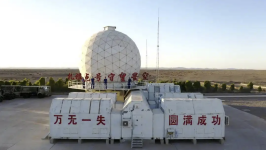
Pictured above is the Russian AESA air surveillance radar purchased by China.
If Chinese radar is superior, then it should be the Russians buying Chinese radar.

PS:
It has a detection range of 2,000 kilometers; for targets with a ±3 dB signal, the positioning accuracy is better than 40 meters or 9 mrad.

Measurement accuracy (RMS value, smoothed over a 20-second interval):
Positioning distance, meters 5m
Azimuth positioning accuracy, milliradians 0.25mrad
Elevation positioning accuracy, milliradians 0.25mrad

Radial velocity (range rate) measurement accuracy, meters/second 0.1m/s
Azimuth angular velocity measurement accuracy, milliradians/second 0.1mrad/s
Elevation angular velocity measurement accuracy, milliradians/second 0.1mrad/s


BTW
------------------------That reminds me of another post about the Su-57; some layman was arguing with me here about radar detection range and RCS—adding several extra “0” to the figures
—and I just have to laugh when I think about it.
When was it purchased by China? Recently or say during 1990s or early 2000s? I would be surprised if it was purchased recently.
 
China is nowhere close to Russia. Even in high end critical & core electronic components Russia is decades ahead & is world leader. Chinese even today rely heavily on other countries mostly Russia for high end stuff.


Here is a small example
Screenshot_2026-07-17-23-24-38-543_com.google.android.youtube-edit.jpg
Screenshot_2026-07-17-23-25-08-657_com.google.android.youtube-edit.jpgScreenshot_2026-07-17-23-25-38-529_com.google.android.youtube-edit.jpgScreenshot_2026-07-17-23-26-58-015_com.google.android.youtube-edit.jpgScreenshot_2026-07-17-23-27-39-917_com.google.android.youtube-edit.jpgScreenshot_2026-07-17-23-28-08-224_com.google.android.youtube-edit.jpg
Screenshot_2026-07-17-23-28-52-137_com.google.android.youtube (1).jpg
 
You have a very simplistic way of thinking. If you think online Chinese fan boys of Russia affect Indian gov policy and what the people at South Block decide then all I can say is get help soon.

What do you mean?

Every comment I write is intercepted by the spooks at South Block, read twice perhaps three times over, with every phrase subjected to exhaustive analysis. Somewhere in a secure conference room, senior officials are locked in fierce debate over the strategic implications of my latest post!

If you've read Shadow of the Hegemon, I'm Locke and Demosthenes rolled into one, my brilliant calculated writings quietly shaping the national security policy of 1.4 billion people from behind a keyboard, half a world away!!

I did seek help... this forum was the treatment they prescribed. :p
 
China is nowhere close to Russia. Even in high end critical & core electronic components Russia is decades ahead & is world leader. Chinese even today rely heavily on other countries mostly Russia for high end stuff.


Here is a small example
View attachment 52954
View attachment 52955View attachment 52956View attachment 52957View attachment 52958View attachment 52959
View attachment 52961
Yea no. Maybe for niche areas like this China is behind. But in general China is way ahead especially in semiconductor design and production.
 
Can't even make a proper TEL. Something like this would be much much nicer.

View attachment 52937
IMO Your TELs are better then us or russian ones in terms of stealth and concealment , the ruskies had the huge landmass to hide them , so does chinese . You not so much , A TEL is way easier to stop then a disguised truck .
This was one of the reason why iranians developed disguised TELs
 
China has arguably surpassed Russian capability in many areas (and does Russia even have any blueprints left that China hasnt hacked or license transferred?). The CCP strategy then is simple -- keep India hooked to the Russian teat. Have woomaos trash American/western systems while worshipping Russian tech to strengthen the Rusophile faction of the Indian govt. Of course, down play Chinese advancements to make India complacent and reduce the urgency of modernization Atmanirbhar efforts. Then in a China/India conflict with India using Russian equipment and tactics the CCP can spring "surprise, motherf**ker".
That line of reasoning of yours—riddled with the "Texas Sharpshooter fallacy"—would actually fare quite well in China; you might want to consider that.
From the Chinese government's perspective, you'd be better off sticking with the F404 and Apache—or better yet, buying some M1A2s to replace the T-90s—and just look at that laughable M777.


It is quite true Russia and in general Eastern Europe is very strong in mathematics and programming. And they may have contributed a lot to Huawei and it's development of 2G 3G 4G and 5G technology, but to say it was only them is over simplistic in my opinion. In your own article, 2G and 3G is mentioned but 4G and 5G is not. What is to say Chinese mathematicians and programmers did not learn and absorb the knowledge when working with such people (and working on their own) to create 4G and eventually 5G technology? China also seems to be doing very good in mathematics and computer science competitions such as IOI and IMO and has a large educated population.

If Russia was so strong in signals and systems why did a company there not develop their own mass deployed 2G - 5G systems?

Speaking about military electronics Russia just recently reached (iirc few years ago) AESA radar technology for its fighter jets while China has been employing them for quite some time iirc. Chinese research and production of GaaS and GaN TRM and chips is tbh multiple levels ahead of Russia as per all of the available evidence. For eg PL15 deployed an AESA seeker as far back as 2015, I know not of any such Russian missile which achieved the same at that time. And more importantly China is undeniably ahead in the design and production of the chips required to process the data of such radars, there is no Russian foundry which can match SMIC and China has shown it can design much more complicated chips (GPUs are far more harder to design and make compared to such chips used for DSP in radars and China has shown it can design world class GPUs).

Can you show ke evidence that KJ500 and KJ10000 are also based on Russian technology? Maybe KJ2000 which iirc is an older Chinese AESA radar. Do you have information about the capability of the J10C, J16B and J20 AESA radar? What makes you think they are not world class and are behind their Russian counterparts? Especially the J20 GaN on SiC AESA radar which seems to be ahead than anything Russia has.

You have a very simplistic way of thinking. If you think online Chinese fan boys of Russia affect Indian gov policy and what the people at South Block decide then all I can say is get help soon.
AESA isn't inherently superior to PESA;
just because your car has a 2.0T engine doesn't mean slapping a turbo on it makes it faster than a Lamborghini's naturally aspirated engine.
It’s not something that can be defined by simple labels.
The most powerful radar in the Chinese military belongs to the Su-35.
All Chinese AESA radars, including the J-20's, have a detection range in the 200-plus km range.
Chinese-made PESA radars have detection ranges in the 100-plus km range.

As for SMIC, weapon systems don't use SMIC chips.
There is no connection whatsoever, nor is there a need for GPU chips. The lithography machines SMIC uses come from ASML; the technology isn't their own.
By your logic, the most powerful radar in the entire universe should be made in Taiwan—but what is the reality?

When the MiG-31 was already using a phased-array radar, what were the Americans doing? By that logic, Soviet technology should have been far ahead of the US.

The KJ-2000 was designed by Beriev—based on the A-50I (the "I" stood for Israel)—featuring three fixed phased-array faces. It was a Russian design with Israeli antennas, though it switched to Chinese antennas after facing US sanctions.
It was an incredibly stupid design; having three faces meant each one was small, which hampered detection range. The latest KJ-3000 has reverted to the A-100/50U style: a back-to-back, mechanically rotating, dual-band phased-array radar.
That alone is laughable enough.
-------------------Continuing down the path of knock-offs signifies the collapse and capitulation of domestic technology.

As for aircraft like the KJ-500, I don't think there is much to discuss; the biggest news stems from a crash that resulted in the loss of a group of 40 senior staff members and scientists, including two generals.

As I mentioned earlier, space surveillance radar is the crown jewel of a nation's radar programs. By comparison, other radars look like toys.

------As for the PL-15, it’s nothing compared to the R-37M; the first missile with an AESA seeker was Japanese, and Russia has similar systems too.
 
  • Like
Reactions: South block
🔔.... Delusions are strong here but that's normal for Chinese & Pakistani fanboys.
Instead of offering a technical response especially to the fact that the Chinese semiconductor industry is ahead of Russia's you called me a Chinese "fanboy". But not surprised tbh considering your chimp level IQ has made you give tarded takes on other subjects as well.
 
I
That line of reasoning of yours—riddled with the "Texas Sharpshooter fallacy"—would actually fare quite well in China; you might want to consider that.
From the Chinese government's perspective, you'd be better off sticking with the F404 and Apache—or better yet, buying some M1A2s to replace the T-90s—and just look at that laughable M777.


AESA isn't inherently superior to PESA;
just because your car has a 2.0T engine doesn't mean slapping a turbo on it makes it faster than a Lamborghini's naturally aspirated engine.
It’s not something that can be defined by simple labels.
The most powerful radar in the Chinese military belongs to the Su-35.
All Chinese AESA radars, including the J-20's, have a detection range in the 200-plus km range.
Chinese-made PESA radars have detection ranges in the 100-plus km range.

As for SMIC, weapon systems don't use SMIC chips.
There is no connection whatsoever, nor is there a need for GPU chips. The lithography machines SMIC uses come from ASML; the technology isn't their own.
By your logic, the most powerful radar in the entire universe should be made in Taiwan—but what is the reality?

When the MiG-31 was already using a phased-array radar, what were the Americans doing? By that logic, Soviet technology should have been far ahead of the US.

The KJ-2000 was designed by Beriev—based on the A-50I (the "I" stood for Israel)—featuring three fixed phased-array faces. It was a Russian design with Israeli antennas, though it switched to Chinese antennas after facing US sanctions.
It was an incredibly stupid design; having three faces meant each one was small, which hampered detection range. The latest KJ-3000 has reverted to the A-100/50U style: a back-to-back, mechanically rotating, dual-band phased-array radar.
That alone is laughable enough.
-------------------Continuing down the path of knock-offs signifies the collapse and capitulation of domestic technology.

As I mentioned earlier, space surveillance radar is the crown jewel of a nation's radar programs. By comparison, other radars look like toys.

------As for the PL-15, it’s nothing compared to the R-37M; the first missile with an AESA seeker was Japanese, and Russia has similar systems too.
Never said having an advanced semiconductor industry automatically equals good radar capabilities but it certainly helps towards such capabilities. Advanced radars need advanced high grade FPGAs and ASICs, and China is definitely ahead of Russia in their fabrication.

On what basis are you saying AESA isnt inherently superior to PESA? Perhaps 1st generation AESA with Gaas TRM has a smaller gap wtr to PESA but now on what basis are you saying PESA can match GaN on SiC based AESA radar? In India our Virupaksha radar which is under testing is almost twice as lighter as the Bars radar despite achieving the same if not higher range of detection and has the ability to queue higher number of missiles. There is undoubtedly a large gap between PESA radars and GaN SiC AESA radars.
That line of reasoning of yours—riddled with the "Texas Sharpshooter fallacy"—would actually fare quite well in China; you might want to consider that.
From the Chinese government's perspective, you'd be better off sticking with the F404 and Apache—or better yet, buying some M1A2s to replace the T-90s—and just look at that laughable M777.


AESA isn't inherently superior to PESA;
just because your car has a 2.0T engine doesn't mean slapping a turbo on it makes it faster than a Lamborghini's naturally aspirated engine.
It’s not something that can be defined by simple labels.
The most powerful radar in the Chinese military belongs to the Su-35.
All Chinese AESA radars, including the J-20's, have a detection range in the 200-plus km range.
Chinese-made PESA radars have detection ranges in the 100-plus km range.

As for SMIC, weapon systems don't use SMIC chips.
There is no connection whatsoever, nor is there a need for GPU chips. The lithography machines SMIC uses come from ASML; the technology isn't their own.
By your logic, the most powerful radar in the entire universe should be made in Taiwan—but what is the reality?

When the MiG-31 was already using a phased-array radar, what were the Americans doing? By that logic, Soviet technology should have been far ahead of the US.

The KJ-2000 was designed by Beriev—based on the A-50I (the "I" stood for Israel)—featuring three fixed phased-array faces. It was a Russian design with Israeli antennas, though it switched to Chinese antennas after facing US sanctions.
It was an incredibly stupid design; having three faces meant each one was small, which hampered detection range. The latest KJ-3000 has reverted to the A-100/50U style: a back-to-back, mechanically rotating, dual-band phased-array radar.
That alone is laughable enough.
-------------------Continuing down the path of knock-offs signifies the collapse and capitulation of domestic technology.

As for aircraft like the KJ-500, I don't think there is much to discuss; the biggest news stems from a crash that resulted in the loss of a group of 40 senior staff members and scientists, including two generals.

As I mentioned earlier, space surveillance radar is the crown jewel of a nation's radar programs. By comparison, other radars look like toys.

------As for the PL-15, it’s nothing compared to the R-37M; the first missile with an AESA seeker was Japanese, and Russia has similar systems too.
Give technical data proof that Su 35 radar is superior to J16B J20 and J10C radar. You have given claims but no supporting technical proofs as far as I know.
 
  • Haha
Reactions: South block
I

Never said having an advanced semiconductor industry automatically equals good radar capabilities but it certainly helps towards such capabilities. Advanced radars need advanced high grade FPGAs and ASICs, and China is definitely ahead of Russia in their fabrication.

On what basis are you saying AESA isnt inherently superior to PESA? Perhaps 1st generation AESA with Gaas TRM has a smaller gap wtr to PESA but now on what basis are you saying PESA can match GaN on SiC based AESA radar? In India our Virupaksha radar which is under testing is almost twice as lighter as the Bars radar despite achieving the same if not higher range of detection and has the ability to queue higher number of missiles. There is undoubtedly a large gap between PESA radars and GaN SiC AESA radars.

Give technical data proof that Su 35 radar is superior to J16B J20 and J10C radar. You have given claims but no supporting technical proofs as far as I know.
These are internal test results. If the J-20's radar were actually better than the Su-35's, and it already had ultra-long-range air-to-air missiles, why would they still be messing around with the PL-15? The fact that they don't have an R-37 equivalent means there is only one explanation: you simply can't capture the tiny RCS return of an R-37 at long range to provide mid-course corrections.
This is just basic common sense.
 
These are internal test results. If the J-20's radar were actually better than the Su-35's, and it already had ultra-long-range air-to-air missiles, why would they still be messing around with the PL-15? The fact that they don't have an R-37 equivalent means there is only one explanation: you simply can't capture the tiny RCS return of an R-37 at long range to provide mid-course corrections.
This is just basic common sense.
My dear sir, I asked for hard based publicly available technical proof based on data but you offered just conjecture.

I mean, doesnt PL17 and PL21 match R37M in range? Just based on this 1 narrow definition which may not even be an efficient way to totally determine a radars efficacy how can we suddenly determine Su 35 has a superior radar?

US also doesnt have an R37M equivalent yet so are you also suggesting Su 35 has a more capable and powerful radar than the APG81 on the F35???
 
  • Haha
Reactions: South block
My dear sir, I asked for hard based publicly available technical proof based on data but you offered just conjecture.

I mean, doesnt PL17 and PL21 match R37M in range? Just based on this 1 narrow definition which may not even be an efficient way to totally determine a radars efficacy how can we suddenly determine Su 35 has a superior radar?

US also doesnt have an R37M equivalent yet so are you also suggesting Su 35 has a more capable and powerful radar than the APG81 on the F35???
I don’t see what kind of "public data" you are supposedly quoting here.
Particularly regarding the data on China—after all, I have lived in China for 40 years and have been active on the internet for over two decades, yet even I am unaware of this public data. So, where exactly did your "public data" come from?
The F-35's radar is, of course, inferior to that of the Su-35. The difference in aperture alone is massive; the advantages of advanced manufacturing nodes (semiconductor processes) are simply not enough to make up for the deficiency in aperture and weight redundancy. This is basic physics.
 
  • Like
Reactions: South block
My dear sir, I asked for hard based publicly available technical proof based on data but you offered just conjecture.

I mean, doesnt PL17 and PL21 match R37M in range? Just based on this 1 narrow definition which may not even be an efficient way to totally determine a radars efficacy how can we suddenly determine Su 35 has a superior radar?

US also doesnt have an R37M equivalent yet so are you also suggesting Su 35 has a more capable and powerful radar than the APG81 on the F35???
Furthermore, things must be compared on an apples-to-apples basis.
Where are the PL-17 and PL-21?
I don't see them.
Besides, analogs with similar parameters existed 30 years ago, like the KS-172.
And the R-37 went through roughly the same duration of product maturation.
There is a world of difference between a "PowerPoint product" and combat-ready equipment—there is often a gap of over a decade, or even 20 years, in between. If one simply ignores such objective discrepancies, it becomes incredibly easy to arrive at the conclusions you mentioned.
By that logic, the T-14 is equipped with four-faced radars, including the millimeter-wave radar that Object 195 was already fitted with 30 years ago. Does this, based on your viewpoint, prove that Russia's electronic technology is superior to that of the United States and China?

Russia's current small missile corvettes, such as the Project 22800 which displaces only a few hundred tons, are packed with AESA antennas.
China has no equivalent analogue to this. Does this prove that Russia's AESA miniaturization and commercialization maturity far surpass those of both China and the United States?
 
My dear sir, I asked for hard based publicly available technical proof based on data but you offered just conjecture.

I mean, doesnt PL17 and PL21 match R37M in range? Just based on this 1 narrow definition which may not even be an efficient way to totally determine a radars efficacy how can we suddenly determine Su 35 has a superior radar?

US also doesnt have an R37M equivalent yet so are you also suggesting Su 35 has a more capable and powerful radar than the APG81 on the F35???
Putting China aside for a moment, the Su-57's CPU performance is ten times that of the F-22, and it is additionally equipped with L-band and side-facing radars.
Why does no one dare to admit that the F-22's radar is inferior to the Su-57's?
It is simply because using truth and rationality to overcome deep-rooted mindsets is an incredibly exhausting task.

Newer things are better than older things; larger things are inherently better than smaller things. An increase in radar aperture by 10% yields a 30% increase in effective gain area—these are the unyielding laws of physics.
Speaking of Chinese radars, here is another hilarious fact:
The strongest naval shipborne radar they have is the Type 346 AESA radar mounted on their destroyers.
Yet, in any given direction, it only has the capacity to guide eight missiles against four targets. (By comparison, the Arleigh-Burke class utilizes the SPY-1 PESA radar on its flanks, paired with SPG-62 illumination radars, allowing it to guide 12 missiles against 6 targets).
Its detection range for the HQ-9B missile is a mere 150 kilometers.
And that is precisely why the missile's operational range is capped right there... because if the damn missile flies any further, their own radar won't even be able to see it, so how on earth is it supposed to provide guidance?
Furthermore, on the Type 052C, the air-search radar actually used a Yagi antenna. Consequently, Chinese nationalists started bragging that Yagi antennas possessed some sort of miraculous anti-missile efficacy. That is, until later models, when they replaced that antenna with the "Flyswatter" radar from the Russian Slava-class—the very type of radar the Chinese used to look down on the most.
1784340650906.jpg
v2-44fc622937de799ae106960c962c3ef9_1440w.jpg

Now here is the real question: do you honestly believe that the small radar on the J-20 could outperform the massive one on their own destroyers (from the Type 052C to the Type 055)?
20230727065539474.jpeg
 
  • Like
Reactions: South block
I don’t see what kind of "public data" you are supposedly quoting here.
Particularly regarding the data on China—after all, I have lived in China for 40 years and have been active on the internet for over two decades, yet even I am unaware of this public data. So, where exactly did your "public data" come from?
The F-35's radar is, of course, inferior to that of the Su-35. The difference in aperture alone is massive; the advantages of advanced manufacturing nodes (semiconductor processes) are simply not enough to make up for the deficiency in aperture and weight redundancy. This is basic physics.
Radar performance is not only from aperture alone it is also from signal processing beam formation and control (which is superior in AESA because thousands of TRM generated signals can be combined indusvidually to search different areas at the same time compared to only one area being searched by mechanical PESA).

Especially in terms of signal processing hardware nobody can match the performance of FPGAs made in the US and they are ahead in the algorithms for DSP undoubtedly. US has been fielding AESA radars for decades with many of them seeing combat across multiple domains from Iraq to now Iran, the algorithms for DSP is obviously superior in the case of the APG81 and other US radars. Russia has access to inferior chips and FPGA than US or even China has so even with advanced algorithms there are hard limits to what they can achieve due to the lower level of the hardware they use for signal processing.

You also didnt mention the performance of Ibris E vs APG81 in EW and contested environment. Do you really think PESA will have a better track quality than AESA in contested environments with large EW emissions?
 
  • Haha
Reactions: South block
Furthermore, things must be compared on an apples-to-apples basis.
Where are the PL-17 and PL-21?
I don't see them.
Besides, analogs with similar parameters existed 30 years ago, like the KS-172.
And the R-37 went through roughly the same duration of product maturation.
There is a world of difference between a "PowerPoint product" and combat-ready equipment—there is often a gap of over a decade, or even 20 years, in between. If one simply ignores such objective discrepancies, it becomes incredibly easy to arrive at the conclusions you mentioned.
By that logic, the T-14 is equipped with four-faced radars, including the millimeter-wave radar that Object 195 was already fitted with 30 years ago. Does this, based on your viewpoint, prove that Russia's electronic technology is superior to that of the United States and China?

Russia's current small missile corvettes, such as the Project 22800 which displaces only a few hundred tons, are packed with AESA antennas.
China has no equivalent analogue to this. Does this prove that Russia's AESA miniaturization and commercialization maturity far surpass those of both China and the United States?
PL17 at least being captive tested:
43465.jpg
Considering your country's pace it will be operational by 2030 thus matching R37M.
 
  • Haha
Reactions: South block
Furthermore, things must be compared on an apples-to-apples basis.
Where are the PL-17 and PL-21?
I don't see them.
Besides, analogs with similar parameters existed 30 years ago, like the KS-172.
And the R-37 went through roughly the same duration of product maturation.
There is a world of difference between a "PowerPoint product" and combat-ready equipment—there is often a gap of over a decade, or even 20 years, in between. If one simply ignores such objective discrepancies, it becomes incredibly easy to arrive at the conclusions you mentioned.
By that logic, the T-14 is equipped with four-faced radars, including the millimeter-wave radar that Object 195 was already fitted with 30 years ago. Does this, based on your viewpoint, prove that Russia's electronic technology is superior to that of the United States and China?

Russia's current small missile corvettes, such as the Project 22800 which displaces only a few hundred tons, are packed with AESA antennas.
China has no equivalent analogue to this. Does this prove that Russia's AESA miniaturization and commercialization maturity far surpass those of both China and the United States?
Where is the T14? Stealthy tank so stealthy it's not even visible during combat!

And didnt you know M1A Abrams has Trophy system (developed not even by USA but by tiny Israel) which uses 4 mmWave radar for its APS system?

And Trophy based tanks have at least seen combat wheraze T14? Missing from action!
 
  • Haha
Reactions: South block
Radar performance is not only from aperture alone it is also from signal processing beam formation and control (which is superior in AESA because thousands of TRM generated signals can be combined indusvidually to search different areas at the same time compared to only one area being searched by mechanical PESA).

Especially in terms of signal processing hardware nobody can match the performance of FPGAs made in the US and they are ahead in the algorithms for DSP undoubtedly. US has been fielding AESA radars for decades with many of them seeing combat across multiple domains from Iraq to now Iran, the algorithms for DSP is obviously superior in the case of the APG81 and other US radars. Russia has access to inferior chips and FPGA than US or even China has so even with advanced algorithms there are hard limits to what they can achieve due to the lower level of the hardware they use for signal processing.

You also didnt mention the performance of Ibris E vs APG81 in EW and contested environment. Do you really think PESA will have a better track quality than AESA in contested environments with large EW emissions?
Could you give me a quantitative metric to prove that an AESA—regardless of the brand, country, assembly/production method, backend software, or aperture size—is inherently superior to a PESA?
Since you claim AESA is so incredibly powerful that any AESA can completely crush a PESA, do you then agree that the radar performance of the Project 22800 corvette is superior to that of an Arleigh Burke-class destroyer?
22800=AESA
SPY-1=PESA
PL17 at least being captive tested:
View attachment 52967
Considering your country's pace it will be operational by 2030 thus matching R37M.


There are plenty of things under internal testing. I am demanding that you keep your story straight—come back and brag to me only when it actually achieves IOC (Initial Operational Capability). By your logic, the Russians are also currently testing photonic radar, so why aren't you bringing up photonic radar as an argument?


Where is the T14? Stealthy tank so stealthy it's not even visible during combat!

And didnt you know M1A Abrams has Trophy system (developed not even by USA but by tiny Israel) which uses 4 mmWave radar for its APS system?

And Trophy based tanks have at least seen combat wheraze T14? Missing from action!


I don't know what kind of garbage the M1A1 is, but you guys can try buying some back to verify it for yourselves.

I don’t know what kind of combat record your M1A1 has achieved in Ukraine, considering you Americans are using 100-year-old machine guns mounted on Humvees for air defense.
But if you can, please list the high-end tank radars of your China and your India, just so I can broaden my horizons.
Otherwise, I’d think I was on a domestic Chinese forum, where after a few words, the M1A2 somehow becomes a Chinese or Indian tank. At the very least, you will claim that piece of garbage on the Arleigh Burke is a PESA, right?

Can I view the fact that your US Army pairs a 12.7mm machine gun with a Humvee as a textbook example of American electronic technology being too garbage to miniaturize missiles and radars for vehicle integration?
After all, the streets are flooded with Pantsir, Buk, and Tor systems—with the Tor even capable of firing on the move now—yet Americans rely on their Black dudes paired with a 12.7mm for air defense.

And then, just like that, the conversation suddenly shifts to Israel.
Who exactly are you comparing here? Is it China, the US, Israel, or India? Or are you bunching all these countries together to go up against Russia?
Please make yourself clear.

At the very least, the Chinese understand that the S-400 absolutely must be deployed in Beijing, rather than relying on other random, messy, domestic-made garbage.
 
Last edited:
  • Like
Reactions: South block