
the USAF realised that while stealth is highly useful it cannot on its own penetrate a highly integrated AD and win a war. This is why the su57 or the j35 on their own wont win wars and is why China still makes a bunch of J16s every single year even though they've started mass producing the j20 and even the j35 in the future.The USAF had almost written off the F-15EX a few years back. Now it is buying 200+ birds learning from the Iran air war experience.
This despite the fact that it is currently working on hypersonic weapons small enough for the F-35s IWBs.
The MKI will be our bomb truck of choice for carrying desi MOAB/Daisy Cutter equivalents (reportedly under dev) + ALBMs like Blue Sparrow.
Sukhoi Su-30MKI
- Thread starter Ashwin
- Start date
You are using an out of date browser. It may not display this or other websites correctly.
You should upgrade or use an alternative browser.
You should upgrade or use an alternative browser.


Comparing super sukhoi to the j-11bg may be slight hyperbole but I'll stand by it being below the J-16.The j-11BG doesn't have thrust vectoring. It's descendant from the su-27 the Chinese procured. The su-30 mki is between the j-11 and j-16. Infact it's better than both if you remove the avionics argument. The j-16 is descendant from their su-30mkk and is designed as their heavier ground striker.
The flankers in fact will be relevant for the IAF uptill 2060 and in fact they will continue to be relevant in 2100 provided we continue to upgrade them. The Chinese have around a 1000 flankers. The Russians have a mix of around 500 flankers.
They aren't going anywhere anytime soon.
Let's not forget it was the mki with brahmos A that wrecked the PAF on 10th May.
The PLAAF or PAF don't have the variety of A2G munitions that can actually be employed by our flankers. Once Rudram 3 and Brahmos NG are produced and integrated it will be a far bigger problem.
The J-16 is simpler a newer airframe. The Chinese have a much more mature indigenous avionics industry, stronger electronics production, and the more composite heavy design work probably make the J-16 family the better long-term bet. The mki may remain very useful and very lethal in certain strike roles, but if we’re talking about who has the cleaner path to staying relevant as a modern networked heavy fighter, I’d put my money on the J-16 family, not on India perfectly executing every pending Sukhoi upgrade on time.
And on thrust vectoring specifically, I honestly don't put much stake in it. I am not aware of any public modern a2a record where aircraft TVC was the decisive factor, whereas the broader trend is very clearly toward sensors, missiles, and networks deciding the fight. It's cool at airshows but I'm not sure how combat relevant it'll be in the 2040s. IMO relying on dogfighting 4th/5th/6th gens is like relying on bayonet charges in modern infantry combat. You're probably going to be killed by a drone.
I actually think the Qing example helps my argument more than yours. The lesson there was not that imported platforms are useless. It was that shiny platforms do not compensate for weak institutions, poor training, bad command coherence, thin logistics, and an incomplete system around them. The system around the fighter is more important than the fighter itself.The Chinese under Qing had faced the same issue when they went against the Japanese and got defeated by a much more dated Japanese navy compared to newly imported ships of the Qing. That is not some new thing.
This is also why I think the J-16 story is stronger than the mki story. China did not just build a nicer Flanker. The KJ-500 AEW&C production has continued rapidly, China has at least 16 Y-20U tankers, and China has also pushed into dedicated EW with the J-16D. So the J-16 sits inside a maturing ecosystem of AEW&C, tankers, EW, sensors, and long range missiles. The IAF is still trying to fill all of those gaps.
And I simply have zero faith in them filling these gaps in a competant or timely manner.
I don't disagree with this.I have already stated that tactical ballistic missiles, loitering munitions and AD needs to be a strategic priority along with 15-20k km ICBM's targetting Chinese and American mainland.
The Armed Forces guys are busy eating kebab and drinking sharaab so it's to be expected they won't care much for indigenisation when they behave like spoilt jocks who want the shiniest new toy.
I will re-iterate the j-16 is a descendant from the su-30 mkk and their technical learnings from the su-35.I'll stand by it being below the J-16.
The J-16 is simpler a newer airframe. The Chinese have a much more mature indigenous avionics industry, stronger electronics production, and the more composite heavy design work probably make the J-16 family the better long-term bet. The mki may remain very useful and very lethal in certain strike roles, but if we’re talking about who has the cleaner path to staying relevant as a modern networked heavy fighter, I’d put my money on the J-16 family, not on India perfectly executing every pending Sukhoi upgrade on tim
It is descendant from the inferior su-30. What they have done is build on it and employed their learnings from the j-10C program and put it in the j-16/j-11/j-16. That is increase use of composites, lower RCS airframe better engines based on their research on the ws-10. And putting in radars and avionics. The same can be done by us for the mki's. There is a reason why I'm shilling for a production cycle of 500 flankers. That is entirely because of producing super-sukhois with new engines, composites and materials and major redesign. The russians won't give a *censored* if you do an under the table deal.
Imagine the huge ecosystem and expansion of Nashik and Koraput facility that can be done. We already have the building blocks with Virupaksha, Composites(Tejas program) the only missing block is the engine and that can be bought from the Russians al-41/51 whichever deemed right. And all this could doneat 1/3 the cost of the entire rafale deal. TBF if we invested 10 billion dollar each in AMCA, TEDBF and Tejas MK2 we would have them all flying by next year.
Point being the su-30mki is a superior airframe than the j-16. What it lacks is deep modernisation and support and that is entirely because of IAF begin obsessed with Western aircrafts rather than building it's own capabilities.
We could have easily license produce the il-76 and produced PHALCON clones, we could have easily procured Embraer fleets and make Netras instead of waiting.This is also why I think the J-16 story is stronger than the mki story. China did not just build a nicer Flanker. The KJ-500 AEW&C production has continued rapidly, China has at least 16 Y-20U tankers, and China has also pushed into dedicated EW with the J-16D. So the J-16 sits inside a maturing ecosystem of AEW&C, tankers, EW, sensors, and long range missiles. The IAF is still trying to fill all of those gaps.

Yeah and it got its a*s kicked by Su-30MKM in guns only dogfights during exercise Cope Taufan 2014. Just go and read it up.The f-22 still exists.
PS: Su-30MKI is a "Super Flanker" while J-16 is nothing but a "Strike Flanker". There is literally no comparison 'cause MKI'S air-to-air prowess is just a notch above. J-16 has advantage currently because of AESA radar + next-gen IRST + PL-17 but with Virupakasha + BEL Dual-Band IRST + R-37M/Astra MK3, MKI will be way better and whatever advatnage J-16 has in BVR shall disappear.

So what? Dog fight with only guns.Any relevance in todays world.Yeah and it got its a*s kicked by Su-30MKM in guns only dogfights during exercise Cope Taufan 2014. Just go and read it up.
I will re-iterate the j-16 is a descendant from the su-30 mkk and their technical learnings from the su-35.
It is descendant from the inferior su-30. What they have done is build on it and employed their learnings from the j-10C program and put it in the j-16/j-11/j-16. That is increase use of composites, lower RCS airframe better engines based on their research on the ws-10. And putting in radars and avionics. The same can be done by us for the mki's. There is a reason why I'm shilling for a production cycle of 500 flankers. That is entirely because of producing super-sukhois with new engines, composites and materials and major redesign. The russians won't give a *censored* if you do an under the table deal.
Imagine the huge ecosystem and expansion of Nashik and Koraput facility that can be done. We already have the building blocks with Virupaksha, Composites(Tejas program) the only missing block is the engine and that can be bought from the Russians al-41/51 whichever deemed right. And all this could doneat 1/3 the cost of the entire rafale deal. TBF if we invested 10 billion dollar each in AMCA, TEDBF and Tejas MK2 we would have them all flying by next year.
Point being the su-30mki is a superior airframe than the j-16. What it lacks is deep modernisation and support and that is entirely because of IAF begin obsessed with Western aircrafts rather than building it's own capabilities.
The Chinese approach to full indigenization of foriegn military hardware is not limited to the J-11/16 alone. They have a long history of assimilating design and electronics tech from Western/Russian mfgrs and across domains at that.
From helos (Fennec/Z-11, Panther/Z-9, Super Frelon/Z-8, Black Hawk/Z-20) to missiles (Crotale/FM-90, Klub/YJ-18, Tor/HQ-7, Buk/HQ-16, S-300/HQ-9).
It is a part of their national strategy of ruthless beg borrow steal. Where industrial espionage wasn't an option, they have successfully leveraged market access to extract core ToT out of many global companies in the commercial domain as well.
In India, we don't/can't differentiate between license assembly and IP/know why transfer. That's been our biggest problem. Foriegn companies like Elta are free to partner with complete novices like DCX as local partners, on a purely commercial basis, ensuring zero tech leaks. As the sole buyer, GoI pulls absolutely no strings with regards to local value addition/substitution.
In India, it works in the reverse. It is the DRDO that's expected to transfer tech to pvt companies to iterate and build on.
You can reiterate that all you want, I'm just saying that the proposed super sukhoi mki upgrade will not be better than the J-16. Maybe it's more agile in some flight envelopes but the J-16 itself will still retain better sensors, EW, datalinks, missiles, and overall support ecosystem. And I'll reiterate that the J-16 is a newer airframe that belonds to a much more mature and healthy aviation industrial base. The eventual J-16 MLU will be the definitive flanker version that all future military historians in 100 years will swoon over.I will re-iterate the j-16 is a descendant from the su-30 mkk and their technical learnings from the su-35.
It is descendant from the inferior su-30. What they have done is build on it and employed their learnings from the j-10C program and put it in the j-16/j-11/j-16. That is increase use of composites, lower RCS airframe better engines based on their research on the ws-10. And putting in radars and avionics. The same can be done by us for the mki's. There is a reason why I'm shilling for a production cycle of 500 flankers. That is entirely because of producing super-sukhois with new engines, composites and materials and major redesign. The russians won't give a *censored* if you do an under the table deal.
Imagine the huge ecosystem and expansion of Nashik and Koraput facility that can be done. We already have the building blocks with Virupaksha, Composites(Tejas program) the only missing block is the engine and that can be bought from the Russians al-41/51 whichever deemed right. And all this could doneat 1/3 the cost of the entire rafale deal. TBF if we invested 10 billion dollar each in AMCA, TEDBF and Tejas MK2 we would have them all flying by next year.
Point being the su-30mki is a superior airframe than the j-16. What it lacks is deep modernisation and support and that is entirely because of IAF begin obsessed with Western aircrafts rather than building it's own capabilities.
We can theory craft the perfect brand new build super sukhoi all day and make a flanker that surpasses all others. New engines, composites, redesigned structures, improved avionics, better weapons integration, expanded Nashik and Koraput, the whole fantasy package. But honestly what's the point? The state has shown no ability to execute something on that scale. Do you seriously think India is capable of building 500+ newly built mkis with deep redesigns while also doing Tejas Mk2, TEDBF, AMCA, tankers, AEW&C, SIGINT/COMJAM, and everything else?
Let's say that India truly had the state capacity, money discipline, and industrial coordination to create a whole new 500 aircraft Super Duper Sukhoi ecosystem, then the obvious question is why spend decades recreating a better version of yesterday’s heavy fighter instead of jumping toward something more future proof?
That is where this whole argument breaks down for me. @lmaoxd this next part is also directed at you.
The way I see it, it's not that the PLAAF and USAF have some love fetish with 4.5+ platforms or see them as some absolutely critical piece to penetrating modern IADs. They are buying them because they need rails and magazine depth inside their already mature combat systems and they need them now.
IMO, these platforms in large quantities only make sense inside the full USAF/PLAAF ecosystem. Being a healthy mix of stealth platforms, tankers, unstealthly munitions depth (like 4.5th fighters or bombers), and networked support. And the crucial piece, both China and the US control the whole pipeline. They control the engines, avionics, subsystems, and production lines. It makes sense for the US/China when the industrial base is already there.
India does not have that position.
So when users here point to the J-16 or F-15EX as an argument for some expanded SU-30mki revival, they are borrowing the logic of the US and China while ignoring the part that actually makes it work. The aircraft is not the strategy. It is one layer inside the strategy. India shouldn't just ape what the US and China are doing. They should make their own path based on what they can sustain and scale.
Unstealthly strike fighters remain vulnerable in dense defended airspace, which is exactly why investing time/resources/attention around a giant manned missile truck concept should be questioned. If you are going to indulge unrealistic ambition, it makes more sense to indulge it in the direction of attritable systems, distributed sensors, and architectures that reduce dependence on imported engines, imported subsystems, and long cycle maintenance/upgrade times.
We could have easily license produce the il-76 and produced PHALCON clones, we could have easily procured Embraer fleets and make Netras instead of waiting.
We could have done literally anything else but didn't. India just doesn't have the ability to make forward looking decisions that will develop the entire air force as a complete system. The IAF and MoD are already strained on fighters and late on every force multiplying program.. why should anyone assume it can suddenly execute a giant super sukhoi industrial revolution on top of everything else?
China did not just talk about a modernized Flanker. It built one, fielded it, and surrounded it with the support architecture needed to make it matter.
India is still debating the brochure.

The USAF had almost written off the F-15EX a few years back. Now it is buying 200+ birds learning from the Iran air war experience.
It was bought to make up for the failure of the F-35 and Boeing needed a fighter jet production line after SH started closing down so the US can continue to maintain two fighter jet companies ever since NGAD and NgAD were delayed. These are the only two reasons.
The only other reason that saw the F-15 carrying a very large ALBM like Kinzhal called ARRW was canceled making it moot.
It was originally chosen as a cheap replacement for ANG's old F-15s before the USAF entered the program fully for the above reasons. It had nothing to do with Iran War or any other war. Purely economics.
When the USAF was asked for the main reason behind the F-15EX purchase over more F-35s, they said it's a lot cheaper than the F-35 and the F-15 is the only way for the USAF to maintain their 72-jet per year plan 'cause the F-35 cannot meet that goal anymore. The USAF is stuck ordering only 48 F-35s a year 'cause it's not Block 4 yet. B4 was supposed to see 72 jets delivered a year. But now 48 F-35s and 24 F-15s will meet the goal.

That's why it would even beat the F15 in combat. If we go ahead with the supersukhoi program and get our act right, we would have a very formidable airforce of a good medium weight fighter like rafale, heavy like Su30MKI, tejas for interception, AMCA and Su57 for penetration roles.This is how(Yaw control), MKI thrashed Eurofighter Typhoons 12:0 in WVR combat during Indradhanush 2015. This is also what makes MKI almost invincible in close-quarter dogfights with CCMs.
It performed decently in WVR it also lost to a mig 29 too. F-22 dominated in BVR.Yeah and it got its a*s kicked by Su-30MKM in guns only dogfights during exercise Cope Taufan 2014. Just go and read it up.
PS: Su-30MKI is a "Super Flanker" while J-16 is nothing but a "Strike Flanker". There is literally no comparison 'cause MKI'S air-to-air prowess is just a notch above. J-16 has advantage currently because of AESA radar + next-gen IRST + PL-17 but with Virupakasha + BEL Dual-Band IRST + R-37M/Astra MK3, MKI will be way better and whatever advatnage J-16 has in BVR shall disappear.
We are dependent on the Amreekans for your entire indigenous aerospace industry. The only aero engines India can produce is the al-31 and the rd-33mk3 without need of foreign assistance. The ge-404 remains a unobtainable carrot. The ge-414 remains in limbo. Which means we only have the Kaveri which still has not been sent for flight trials to Russia.So when users here point to the J-16 or F-15EX as an argument for some expanded SU-30mki revival, they are borrowing the logic of the US and China while ignoring the part that actually makes it work. The aircraft is not the strategy. It is one layer inside the strategy. India shouldn't just ape what the US and China are doing. They should make their own path based on what they can sustain and scale.
Also are we better than the Chinese or Americans that we can forge our own path??
Our aerospace defence backbone is the su-30 and the al-31. Same is true for the Chinese with the al-31 fn and the ws-10.
This forging our own path gave us the Insas, Arjun and Tejas. And we can see how well they have gone.
the USAF realised that while stealth is highly useful it cannot on its own penetrate a highly integrated AD and win a war. This is why the su57 or the j35 on their own wont win wars and is why China still makes a bunch of J16s every single year even though they've started mass producing the j20 and even the j35 in the future.
This is also why I think the J-16 story is stronger than the mki story. China did not just build a nicer Flanker. The KJ-500 AEW&C production has continued rapidly, China has at least 16 Y-20U tankers, and China has also pushed into dedicated EW with the J-16D. So the J-16 sits inside a maturing ecosystem of AEW&C, tankers, EW, sensors, and long range missiles. The IAF is still trying to fill all of those gaps.
The Chinese developed the J-16 'cause their indigenous JH-7 failed. They had to quickly plug this capability gap so the Flanker was chosen over a clean-sheet design that could complement the J-20.
While the MKI has fallen way behind in terms of configuration, the J-16 has nothing on the MKI in terms of performance. TVC matters, not just for WVR combat but overall performance, acceleration, climb, takeoff performance, med-high altitude energy management, fuel efficiency etc.
The lack of an AESA radar hurts the MKI, but it wasn't a quick-fix design like the J-16.
The Russians took the precursor to the J-16's design called Su-30MKK, gave it canards and TVC, which gave it higher dynamic climb and acceleration compared to MKK along with better energy efficiency, pretty similar to MKI, but slightly better, and offered it to the Chinese. But they decided to copy the MKK into J-16 instead.
Due to the weakness of the Flanker airframe in general, even with Bars, the MKI will consistently beat the J-16 in air combat primarily due to its significantly lower energy efficiency, as long as it carries a long range BVRAAM like Astra Mk2. The same story repeats when up against older 4th gen designs like F-16, J-10, and JF-17.
It was bought to make up for the failure of the F-35 and Boeing needed a fighter jet production line after SH started closing down so the US can continue to maintain two fighter jet companies ever since NGAD and NgAD were delayed. These are the only two reasons.
Boeing has sold advanced F-15 versions to KSA, Qatar, Singapore, SoKo etc in the last 2 decades. So the production line was far from closing. Initially, there was political pressure on the USAF to buy more F-15s.
But the realization that an all stealth fighter fleet would be cost prohibitive also played a role in the USAF finally signing up for the EX.
Boeing has sold advanced F-15 versions to KSA, Qatar, Singapore, SoKo etc in the last 2 decades. So the production line was far from closing. Initially, there was political pressure on the USAF to buy more F-15s.
It was mainly meant for ANG, their Cs were supposed to be replaced by F-35s.
But the realization that an all stealth fighter fleet would be cost prohibitive also played a role in the USAF finally signing up for the EX.
No, it had nothing to do with that, cost showed up as an excuse to induct new F-15s. And it only impacts operating costs, procurement cost of F-15EX is still much higher than the F-35A.
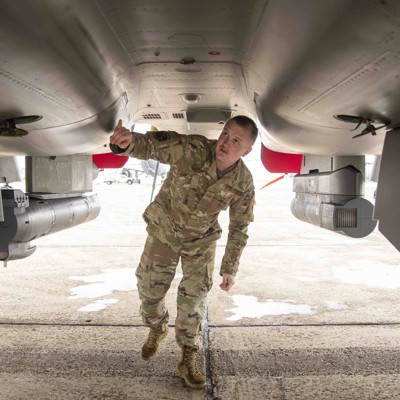
As F-15EX price tags rise, Boeing hunts for ways to control costs
The Air Force expects the flyaway cost to rise, not fall, from Lot 2 to 3.
 www.defenseone.com
You will notice that the F-15 purchase is chasing after F-35 B4's timeline. They expected B4 to be available in the next 1-2 years, so the F-15 orders were also meant to match that schedule. Once B4 got pushed by many years, the F-15 too got a boost in numbers. It won't go beyond this 'cause NGAD will take over. That's how numbers changed from 80 to 104 to 129 to now 267, each 24-jet jump corresponding to the F-35's delays.
Since then they have been pushing the narrative that a 4th/5th mix is the way to go, not because it is the way to go, but because they don't want people asking uncomfortable questions. The Japanese otoh are going for a full 5th/6th gen fleet. They plan on upgrading 68 older F-15s with EX avionics and operate them during the transition until 2040.
The writing's on the wall, the Americans are just playing politics. They intend to keep the F-16 for a while too. All the F-16s were initially planned for a 2025 exit. Now they have pushed the fleet to phase out in the 2040s solely due to the F-35's failure.
It was mainly meant for ANG, their Cs were supposed to be replaced by F-35s.
Agree. Although, EX is believed to be sufficient for most ANG missions.
No, it had nothing to do with that, cost showed up as an excuse to induct new F-15s. And it only impacts operating costs, procurement cost of F-15EX is still much higher than the F-35A.
Since then they have been pushing the narrative that a 4th/5th mix is the way to go, not because it is the way to go, but because they don't want people asking uncomfortable questions. The Japanese otoh are going for a full 5th/6th gen fleet. They plan on upgrading 68 older F-15s with EX avionics and operate them during the transition until 2040.
My read is that the USAF wants to divert more funds to the F-47 program, given the persistent problems with F-35 B4. Acquisition costs per unit should come down over time now that 200+ EX are on order.
It is a pragmatic decision, imo. After all, the USAF faces no threats in its own backyard, other than the occassional Russian bomber patrols. F-15EX is more than enough for the air policing role.
In any case, many of the F-35s maintenance/serviceability problems have been attributed to the ALIS logistics mgmt. The Isreali F-35I has reportedly fared much better since those ac are not linked to ALIS but use an in-house LMS instead.
My read is that the USAF wants to divert more funds to the F-47 program, given the persistent problems with F-35 B4. Acquisition costs per unit should come down over time now that 200+ EX are on order.
This has the opposite effect. If procurement cost is higher, then you will end up with less money for NGAD's R&D.
EX orders are already beyond what USAF has ordered, like 25-50 from Israel and 68 EX avionics for Japan. Logically, it should become higher, but it won't help NGAD at the moment.
It is a pragmatic decision, imo. After all, the USAF faces no threats in its own backyard, other than the occassional Russian bomber patrols. F-15EX is more than enough for the air policing role.
For the ANG, yes. For the USAF, no.
In any case, many of the F-35s maintenance/serviceability problems have been attributed to the ALIS logistics mgmt. The Isreali F-35I has reportedly fared much better since those ac are not linked to ALIS but use an in-house LMS instead.
ALIS/ODIN is a whole different ballgame. The F-35 has not achieved operational standards, and will not fully achieve them before 2033, which is also a tentative date and subject to change. Even initial standards are to be achieved only by 2029-30.
Had the F-35 achieved Block 4 in 2026 as planned, the F-15EX contract would have ended at 129. The USAF's original goal for the F-15EX was to operate 2 squadrons in Japan in order to carry the ARRW. The rest were all meant for ANG.
But now the USAF plans to simply replace all their F-15Es with EXs. Another program that's delayed 'cause they don't have the UCAVs and NGAD that were originally meant to replace them.
F-15C meant to be replaced with the F-22, that failed. Then F-35 and now F-15EX.
F-15E with the FB-22, that failed too. Then it siwtched to UCAVs and NGAD. And now F-15EX.
IAF too has seen such changes. Mig-27 was to be replaced with MMRCA Rafales and Jaguar with semi-stealth AMCA. M2000 and Mig-29 by Gripen/F-16. MKI with FGFA. Post that, Mig-29 with Su-57 and then LCA Mk1A. Now we will have LCA Mk2 and SCAF/GCAP replacing all old jets. Except unlike the USAF, ours were upgrades.
Japan's in the same boat. They plan to buy more F-35s if GCAP sees delays.
This has the opposite effect. If procurement cost is higher, then you will end up with less money for NGAD's R&D.
EX orders are already beyond what USAF has ordered, like 25-50 from Israel and 68 EX avionics for Japan. Logically, it should become higher, but it won't help NGAD at the moment.
The difference in unit costs between the existing F-35A and the EX is well under $10m. The opex savings will obviously be much lower over time.
Given the cost overruns w/B4, you can expect its unit price to be in the $100m+ range.
ALIS/ODIN is a whole different ballgame. The F-35 has not achieved operational standards, and will not fully achieve them before 2033, which is also a tentative date and subject to change. Even initial standards are to be achieved only by 2029-30.
Had the F-35 achieved Block 4 in 2026 as planned, the F-15EX contract would have ended at 129. The USAF's original goal for the F-15EX was to operate 2 squadrons in Japan in order to carry the ARRW. The rest were all meant for ANG.
But now the USAF plans to simply replace all their F-15Es with EXs. Another program that's delayed 'cause they don't have the UCAVs and NGAD that were originally meant to replace them.
F-35 B4 is being primarily designed for ops in the Indo-Pac region and is essentially an MLU prog for the type until F-47 comes along. Otherwise, the existing B3F std is generally considered good enough for theaters like Europe or the ME.
Besides, F-35 production numbers have not changed since the acquisition of the EX. So these are complementary progs meant to reduce dev risk and cost.
The difference in unit costs between the existing F-35A and the EX is well under $10m. The opex savings will obviously be much lower over time.
Given the cost overruns w/B4, you can expect its unit price to be in the $100m+ range.
Boeing claimed EX will come for $80M, but the latest block costs $94M. The USAF pays $82.5M currently for the F-35A. Sure, fixing the F-35's failure will come at a cost, but that's a future cost for now. So there's nothing saved at the procurement end.
Even when it comes to operations, the difference in CPFH is marginal (30-32k vs 35k). While the F-15's is likely already stable, the F-35's will reduce over time, once they get to B4, production stabilizes, and spares and training catch up with requirements. So while the paper value of the F-15 is lower today, the F-35's potential is better once it's mature.
F-35 B4 is being primarily designed for ops in the Indo-Pac region and is essentially an MLU prog for the type until F-47 comes along. Otherwise, the existing B3F std is generally considered good enough for theaters like Europe or the ME.
No such thing. B4 is necessary by default. That's the main FOC model. B4 introduces all the new capabilities they have been advertising over the last 3 decades.
Besides, F-35 production numbers have not changed since the acquisition of the EX. So these are complementary progs meant to reduce dev risk and cost.
That is why the F-15EX is happening in the first place. The F-35 production numbers cannot go up without B4, so the USAF is compensating for the difference with F-15EX. The original plan was to buy 72 F-35As instead of 48 As and 24 EXs. They actually want to raise it to 100+ a year.
US Air Force plans to request 72 fighters every year
Top Air Force leaders have said for years that it needs to buy at least 72 new fighters each year to both modernize its fighter fleet and lower its age.
The fiscal 2024 budget proposal released in March broke that trend by directly asking for money to buy 48 new F-35As and 24 F-15EX Eagle IIs.
“This year, for the first time since I’ve been in this business, there are 72 new fighters in the Air Force’s budget,” Moore said. “We’re super excited about that. … I certainly think you’ll see it again.”
It's fallen since then because of a significant drop in F-35A numbers.
But this is what they hope will be the immediate future.
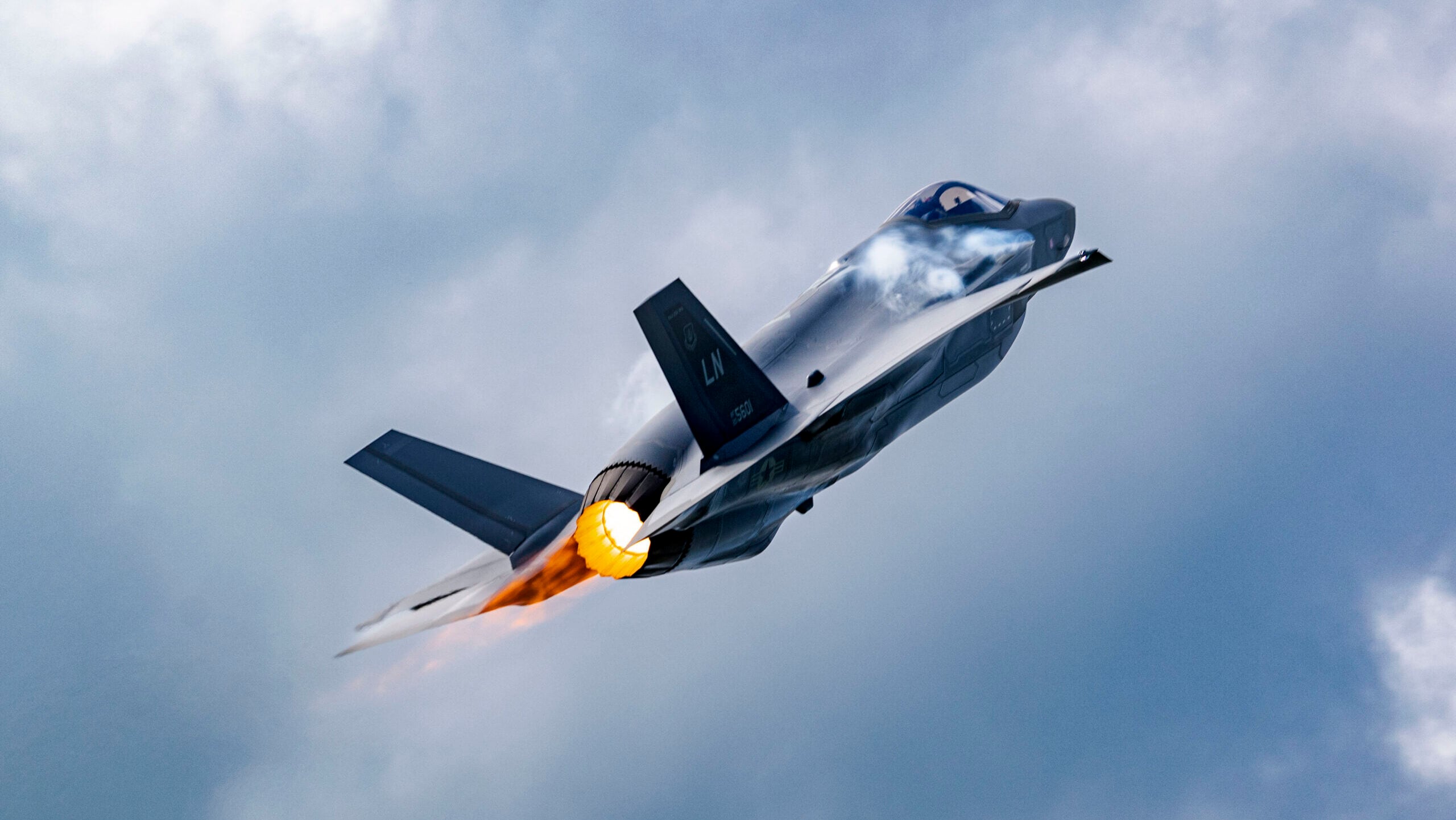
Four reasons to accelerate F-35 acquisition now - Breaking Defense
The US Air Force is falling behind China's in both age and readiness, JV Venable writes, which is why procuring more F-35s is imperative.
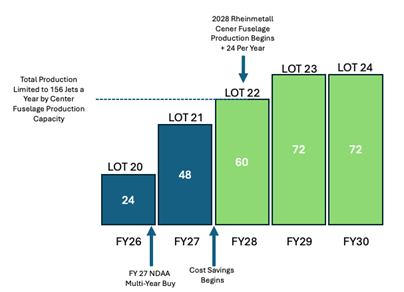
72 F-35s and 24 F-15s will give them the ~100 they actually need to make up for the shortfall before NGAD takes over.
A larger order via multi-year contracts at full spec will reduce cost relative to the F-15EX.
Looks like MKI UPG and Rafale F5 will enter the service somwhere around 2030.