

Dude,be carefull what you wish for. Last time you were asking everyone that when will india take action and you got May 7.
They are celebrating victory in text books..
Dude,be carefull what you wish for. Last time you were asking everyone that when will india take action and you got May 7.

Ok.This paper highlights something much deeper than mere opportunistic “Indian interest”: it reveals a structural realignment of industrial and strategic thinking around 21st-century air combat.
First, it is important to remember what the Future Combat Air System really is. This program has never been just about an aircraft. It is an architecture of sovereignty built around a new-generation fighter, collaborative drones, cloud combat, and complete control of the decision-making and information chain. However, this ambition has been hampered from the outset by an insoluble political contradiction: France and Germany do not pursue the same strategic objective.
For France, the future aircraft must be carrier-based, nuclear-powered, deployable, and fully sovereign. For Germany, it cannot serve as a deterrent or be structured around complete strategic autonomy, since Berlin remains fundamentally tied to NATO and politically opposed to nuclear power. This divergence is not “technical,” contrary to what diplomatic statements claim: it is doctrinal.
The industrial deadlock between Dassault Aviation and Airbus is merely a concrete manifestation of this. Dassault thinks like a coherent system architect, responsible from start to finish, with a clear authority structure. Airbus thinks like a multinational integrator, based on task sharing, ongoing negotiation, and political symmetry. These two cultures can coexist on a transport aircraft or helicopter, but they become explosive on a strategic combat system.
Airbus's proposal for a “two-fighter solution” is therefore an implicit admission: the unified FCAS is probably dead, or at least doomed to be a hollow shell. Two different aircraft, linked by the same digital layer, is no longer a sovereign program, but contractual interoperability. In other words, the infrastructure is saved, but strategic unity is sacrificed.
It is precisely this gap that India is filling.
India's reasoning is remarkably consistent. New Delhi does not need a simple technology transfer. It wants access to the core of the sixth generation: collaborative human-machine combat, sovereign tactical cloud, advanced motorization, and multi-spectral stealth. Its own AMCA program is aimed at the fifth generation, but India knows that it cannot, alone and quickly, overcome all the obstacles to the sixth. Relying on France would allow it to accelerate without placing itself under American tutelage.
And it is no coincidence that India looks to Paris, rather than Berlin or Washington. The Indo-French relationship is asymmetrical but stable, based on strategic trust built up since the 1950s. Unlike other partners, France has demonstrated that it accepts the principle of India's real autonomy, including industrial autonomy. The precedent set by the Rafale, motorization, submarines, and associated technology transfers has left a lasting impression in New Delhi.
There is also a point that is often underestimated: India has learned a very hard lesson from its failure with Russia on the FGFA. It no longer wants a program where the division of labor is unclear, where the final aircraft does not meet the announced standards, and where political dependence becomes an operational handicap. In contrast, France appears to be a demanding, sometimes difficult, but predictable partner.
This scenario reveals an uncomfortable truth for Europe: the “Franco-German couple” does not work in systems of hard sovereignty. It can work on regulation, the economy, and standards. It fails when it comes to nuclear power, power projection, and high-intensity warfare. India's possible entry into a France-centered version of the FCAS would, in fact, be an implicit recognition of this failure.
If this shift were to be confirmed, the consequences would be considerable. France would secure a critical mass partner, both industrially and financially. India would gain access to an exclusive technological club without losing its strategic freedom. And continental Europe would see that the future of its most advanced capabilities is now being played out outside its traditional political framework.
In short, it is not India that is knocking on the door of the FCAS out of opportunism.
It is the FCAS, as it was conceived, that is seeking a strategic coherence that it no longer has in Europe.
And so the central question becomes:
will France choose to save a real industrial and military ambition with India, or to preserve a European political fiction that, in this specific area, no longer holds water?
Your Indian brain isn't that functional either.This is not PAK-FA/Su57 threat either, you Pakistani
retard.
Learn to stay on topic first.

In fact, generations should be defined by how wars are fought. The fifth generation ultimately sought to gain a survivability advantage by being the first to spot the enemy and thus the first to fire, whether in air-to-air or air-to-ground combat. To achieve this, the U.S. focused heavily on stealth—unlike France, for example—but we still pursued the goal of firing first through other technical means. We see that in the fifth generation, the platform continues to concentrate a significant number of capabilities that enable it to fulfill its mission. In the sixth generation, capabilities are no longer concentrated on a single platform, but the effect of those capabilities is concentrated on a single target; and normally, there might be only one sensor or one effector on each of the drones we plan to use to fulfill the mission: as a result, the fighter is now merely the manned part of the system—and it is a part that we might choose not to expose. At the start of the 6th generation, the fragmentation of subsystems will not be as extreme as what I describe, but we will get there—hence the importance of a robust, secure network to ensure the entire system is coordinated.Ok.
Similar issues happened with Eurofighter program, and France went its own separate way.
However I am struggling with the definition of a 6th generation fighter jet.
For USA it was mainly stealth, and net Centric capabilities.
But their F 22 program started in 1981 and the jet was formally inducted in 2005 .
Thats 24 years of development.
It can be argued that what the Americans were trying to develop in 1981 , is now available off the shelf, when it comes to all the net Centric capabilities they wanted, and now it should not take that long.
But the other technologies, such as an actual stealth, low radar and IR signature airframe, and a matching jet engine are still difficult to make , and those who have it won't sell it .
So two questions.
What in 2026 is the definition of a 6th generation fighter jet.
What sort of time frame can a country expect from start to an actual combat ready 6th generation jet ?
Your Indian brain isn't that functional either.
The thread is more connected to my comment, which is about a 5th generation jet program India was part of. The thread is much aligned to that topic, as many 5th generation technologies are relevant to 6th generation program.
There is no relationship wirh petrol prices in Pakistan with this thread
Aye, that means the next stop which is 6th generation, is a concept about multiple platforms working together. Mainly sensor fusion , networking, software Wizardry and human in the loop .In fact, generations should be defined by how wars are fought. The fifth generation ultimately sought to gain a survivability advantage by being the first to spot the enemy and thus the first to fire, whether in air-to-air or air-to-ground combat. To achieve this, the U.S. focused heavily on stealth—unlike France, for example—but we still pursued the goal of firing first through other technical means. We see that in the fifth generation, the platform continues to concentrate a significant number of capabilities that enable it to fulfill its mission. In the sixth generation, capabilities are no longer concentrated on a single platform, but the effect of those capabilities is concentrated on a single target; and normally, there might be only one sensor or one effector on each of the drones we plan to use to fulfill the mission: as a result, the fighter is now merely the manned part of the system—and it is a part that we might choose not to expose. At the start of the 6th generation, the fragmentation of subsystems will not be as extreme as what I describe, but we will get there—hence the importance of a robust, secure network to ensure the entire system is coordinated.
When did Chinese claim that J20 is not VLO?The Chinese themselves say it's not VLO. I don't know what to say beyond that.
They are actually saying on national TV how they are catching up on stealth tech with America using the J-35.
Both Su-57 and J-20 are designed around a "working stealth" concept with air defense in mind. Meaning, they are survivable only inside their own airspace.
I don't know about the J-20's future, but Su-57's future variants are being designed for VLO.
The J-36 is definitely designed for all-aspect multi-spectral stealth, but calling it ELO would be a stretch. But it definitely exceeds the capabilities of the F-22 and F-35. And that's a threat.
The J-20 is a permissive environment fighter. If it cannot penetrate the IAF's ADS, then it's only a missile threat, and missiles are much more easily defeated by EW.

They are celebrating victory in text books..

human in the loop .
Radar invisibility can be replaced with electronic jamming and spoofing.
That should reduce the complexity of airframe design.
When did Chinese claim that J20 is not VLO?
I hope you're not referring to nomenclature of their generation system
J15, is far from being a failure, and is on 3rd iteration with J15T
J35 started as internal TD proje t
I dread the day when there's no man in the loop and weapons are working autonomous. Example is 1983 soviet missile alert .Removing that is the main goal of 6th gen.
Partly true.
One of the biggest goals of airframe designers is to eliminate shaping itself for stealth via the use of metamaterials and other techniques. But until that happens, shaping is necessary. 95% of F-22's stealth comes via shaping, but that's been reduced to 60% on F-35, similar to the goal on AMCA. Su-57 and J-20 are similar, but we see the most advanced effect on the J-35A, which uses a large amount of metamaterials. AMCA will also come with mm, and so will the next variant of Su-57.


Humans will always remain in the loop, doesn't matter whether it's 6th gen or 10th gen fighter jet. HMI will continue to evolve though with AI getting more precise, yet isn't a substitute for NI.I dread the day when there's no man in the loop and weapons are working autonomous. Example is 1983 soviet missile alert .
Shape and material for stealth are very expensive to achieve. Remedial steps are cheaper.
For example the shooting down of F 117 by Yogoslavia in 1999
Chinese 6th gen , tail less design is already flying. Well at lest as per the videos I watched.The clues are in their revelations. The J-35A is said to have an RCS as small as a human palm, which is in the 0.001m2 class (quite a bit bigger), and J-20's RCS is much bigger than the J-35A, whereas the F-22's RCS is that of a single segment on a finger. That makes the J-35 entry-level VLO, the F-22 a proper VLO and J-20 between LO-VLO. This is consistent with Western evaluations of the J-20 too.
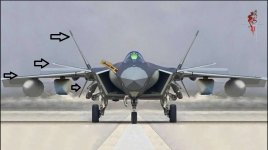
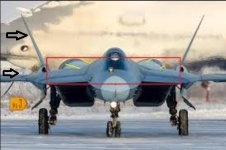
Another clue is the large number of protrusions sticking out of the fuselage relative to the F-22 and Su-57. Wings, tails, canards, strakes, all contribute to RCS. F-22 and Su-57 eliminates those as much as possible while they stick out like a sore thumb on the J-20. The J-35 is a far better design.
View attachment 50983
View attachment 50984
6th gen only retains the wings, and we will eventually see morphing wings on more advanced designs.
The end result is the J-20 is not a true VLO aircraft. But it qualifies as a stealth jet and can operate from greater distances with longer-ranged weapons in order to compensate for the higher RCS relative to American jets. Meaning it can operate from 200 km away and look like an F-22 operating from 50 km away, and modern radars with coopertive targeting can pick both up from reasonable BVR distances too. The Chinese only need to ensure they possess the more advanced sensor tech, and they have been doing that.

Chinese 6th gen , tail less design is already flying. Well at lest as per the videos I watched.
Nobody else has a flying 6th gen prototype yet.

 www.19fortyfive.com
OkAmreeka is still well ahead of your masters. Just that they haven't revealed what their prototypes look like (other than B21 which is 6th gen bomber).
If J20 was stealthy enough, chinese wouldn't need to come up with altogether new design in J35.The clues are in their revelations. The J-35A is said to have an RCS as small as a human palm, which is in the 0.001m2 class (quite a bit bigger), and J-20's RCS is much bigger than the J-35A, whereas the F-22's RCS is that of a single segment on a finger. That makes the J-35 entry-level VLO, the F-22 a proper VLO and J-20 between LO-VLO. This is consistent with Western evaluations of the J-20 too.
America is your master not oursOk
Your master is ahead of our master.
At least this is what your post implies.
If J20 was stealthy enough, chinese wouldn't need to come up with altogether new design in J35.
Designwise, J35 is much better than J20.
 . We all saw how Fauji leader Munir went to Washington to do the annual lund chattna ceremony of Amreekan president that every Pak PM has done every year. Strange people, your leader is in bed with Trump, you beg money from American institutions like IMF World Bank and you call Americans our master .
It never does. Leave you people, Hitler is a prime example why cousin marriage is dangerous.It's works fine.
I dread the day when there's no man in the loop and weapons are working autonomous. Example is 1983 soviet missile alert .
Shape and material for stealth are very expensive to achieve. Remedial steps are cheaper.
For example the shooting down of F 117 by Yogoslavia in 1999
Chinese 6th gen , tail less design is already flying. Well at lest as per the videos I watched.
Nobody else has a flying 6th gen prototype yet.
SCAF would make sense but it has a longer development cycle and will come online in 2040's. The GCAP if japan takes leadership in it will be online by 2035. AMCA should get inductedYep, GCAP is the fastest option. But integrating it with our IADS is not gonna be easy. At least the French would have done some work via Rafale, and it will be easier to integrate SCAF with our IADS post the Rafale experience.
In the end it depends on how much we want to invest and what sort of workshare we will get. GCAP gets us nothing, while SCAF is still up for negotiations.
Let's see what Germany does.
SCAF would make sense but it has a longer development cycle and will come online in 2040's. The GCAP if japan takes leadership in it will be online by 2035. AMCA should get inducted

My vote is on SCAF. The train for GCAP left the station quite a few years ago.SCAF or GCAP? Make your bets, folks.


