
India eyes 6th generation FCAS, looks at tying up with France for possible collaboration

1. Yes. It will take decades. More reason to not be hoodwinked again. I am sure some officials at high level back in 1950s, 1990s, 2000s,2010s would have said same thing while pondering over Marut, LCA, Kaveri and their funding. I have not made any personal comments, I am genuinely surprised over your take on 6th gen engine vis a vis India.

2. Comparing India's ecosystem with America is whole another issue. Let's save that discussion for other thread since it will open history chapters before from WW1.
> But war doesn't wait for decades. This time our bad situation could be exploited.
> It is natural for different people to think differently & next 15 yrs are lot of time with current evolving H/w & S/w technologies for R&D. We know that USA started R&D during WW times but today's era is a speedy automated one.

3. "There should be options to safeguard against army twisting".. Yes. But that doesn't happen by window shopping for another foreign engine. How are you gonna build an airframe like that? Even if by chance, two foreign nations have similar engines.. enabling feasible development of same airframe for both.. no one is going to sell you engine without exclusive guarantees. And the other vendor is not gonna keep its supply chain ready for "just in case" we need an option 20 years later. Even 404,135,177.. all are engines built for different platforms. So, even if IAF flies several categories of next gen platforms.. that doesn't mean that it will have several engine choices for each platform.
How will you negate arm twisting in that situation? Without self reliance.
> If Engine self reliance will take 5-10 years then why to sit idle for the airframe? A big geography like India can never be defended by only light & medium jets due to their limitations on fuel, payload, electricity. Hence GTRE or JV needs to aim for high thrust engine & a matching airframe.🤷‍♂️

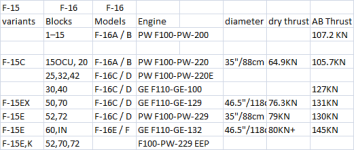
> By options i don't mean 2 engines powering 1 jet, although techies can think such things after noticing F-15, F-16 using F100 & F110 engine variants. I wonder if they used plugs to fill gaps.
1772116879547.png
Then Russians also have series of engines & derivatives used in their Su-3X jets.
Any Indian aviation enthusiast will think that F414 engine for medium jet then why not a heavy engine for heavy jet. 🤷‍♂️

> If J-20 started with AL-31 then why IAF operating 200+ Su-30MKIs not going for local heavy jet R&D with Al-31? Bcoz it is old engine?
Why not use AL-41? Bcoz it is new engine?

> TAI Kaan uses F110 engines. So i imagined a heavy jet using F100 or F110 engines when USA wanted to sell 4gen jets in MRCA tender.

> USA delayed F404 engines. USA twisted Turkey's arm as it purchased S-400 SAM. So getting F110 engine would be tough. Kaveri engine not ready.
Now AL-51 is new & AL-41 is old but good. Their hybrid Iz-177 also there. But people don't wan't those either.

So India neither did self R&D nor use either US or Russian heavy engine & hence now thinking on importing Su-57 & joining FCAS.

4. Your idea of different teams of DRDO looking into different things is already how it's different labs function. But you can't jump to 200+ thrust without achieving 98+ thrust. The thrust doesn't increase without advancing the science behind it. It includes ceramics, cooling , TVC too. Even the PPP partners need the required level of tech to develop higher thrust.
Your idea works in cases of US who have spent century developing engines from scratch. Once Pratt& Whitney have a 150+ KN engine.. they have the institutional knowledge continuity to now tweak it for a 50+, 70+ thrust engines. Not for India where our best iteration so far has been around 50+ dry thrust. Wether PPP or DPSU or Pvt ltd.. all will need to spend time, moolah and energy of their own to advance the same things DRDO is working on.
That's what the engine JV and AMCA project is supposed to do btw.
> But JV means we don't need to start from scratch as foreign makers are well experienced with small to big engines & have confidence.

> If we compare 2 engines say F404 weighing 1 ton (391cm x 71cm) giving 49/79 KN thrust, with & F110 weighing 1.84 tons (462cm x 92cm) giving 84/145 KN thrust, so their mould, parts are of different size to start with. The JV engne would not start with F404 class, but F110 class.

> 10-15 years is good time to get to 200 KN class with economic improvements, increasing funding, metallurgic R&D, supercomputing, robotics, other automations, AI/ML, etc.

> Let GTRE take its time for Kaveri.

> I do understand aero-science to certain degree, the engine parameters like # of stages of LPC, HPC, HPT, LPT, crystal blades, film cooling, transpiration cooling, OPR, BPR, fuel types, fuel-air mix ratio, TET, design of combustor, flame holder, velocity triangle, CD duct, air mass flow, etc. All these things together create the desired thrust. And reading the specs & derivations & modifications, indeed some of these parameters are added, subtracted or modified in some ways.

> What do engine makers actually do for 5-10 years every day, 8-9 hrs/day of duty? They do calculations, try CFD models, make physical engines, test them for hours every day, check for malfunctions, stability, safety, etc. Right? Sometimes test engines melts, cracks, explodes too.

> But in the end i'm noticing pessimism rather than optimism.

We can discuss engine technology in this thread


5. We don't have any project anytime soon which requires 2x F135 class engines 🤷. So, your point about will China's J-35, 50 wait is moot. Which airframe are you gonna fit that 6th gen engines on? Even AMCA isnt coming before 2040. No amount of 117,177,135 ( which themselves aren't 6th gen) is gonna overwhelm China if we have to depend on others for spares. Spares which might come from China too. Btw, very optimistic of you to think about India developing 6th gen engines by 2046 by developing step by step. It will be good if our own R&D'd 5th gen engines are in production by then. And it's normal and we need not be dettered by it.
> Exactly, not any time soon as per IST (Indian Stretchable Time):LOL::ROFLMAO: Because new gen project takes 10-20 years broadly, so better to begin the soft/paper/CAD/CFD tasks today. Then we can have a prototype in 10 yrs by 2035 & IOC by 2040-45.

> IMO the airframe is going to be DIY bcoz France may not modify FCAS to carry bigger weapons like Brahmos-NG, Rudram, etc.

> The production 6gen engine should be JV. The existing engines like AL-41, Iz-177 can be for TD jets.

> let's hope GTRE can make production ready 5gen engine in 15-20 years for AMCA Mk2 while its Mk1 will be powered by F414 with 80% ToT.

6. You idea and approch would make sense if you were talking about Engines for Tejas. But you're leapfrogging too much.
Our neighborhood has a Russian couple. Mrs Sukhoi delivered a baby boy & astonishingly named him Tejas.

1772133903929.jpeg
 
  • Like
Reactions: Rajput Lion
We aren't even spending on Rafale deal or Engine deal yet..
Not to mention Mk2 / Amca deal

FCAS investment for TEDBF will be for smaller numbers, we would buy off the shelf when time comes rather than investing now.. can we afford for large investment now ?
( That be equivalent to re allocating funds of TEDBF development cost and maybe even second batch of 31 Rafale M )

We can only provide market for FCAS development not the investment fund IMO.

Offcourse, considering Chinese threat, investing in Su 57 in short term for air force , FCAS in long term for navy is ideal .
I think TEDBF is dead on arrival. Whats the point of spending money developing a 4th gen naval fighter that at best will get a few squadrons worth of orders and be obsolete by the time its ready to be produced?

I feel similarly about tejas mk2 and AMCA but those might actually happen. In my view those are just pork barrel spending to keep India somewhat "in the game" so to speak. I don't believe they will come in any reasonable time frame and I don't believe they will play any significant role against the adversaries India will face. Maybe the AMCA1 will be somewhat relevant in the 2040s/2050s but the mk2 will only be useful for expenaive air strikes on guerrillas or smaller neighbors (maybe we'll be on op sindoor 7 by the time it comes out). Even then it'll be so outdated you're basically guaranteed to take losses for any mission against even moderately supplied opponents.

SU-57 feels like a waste unless they decide to just scrap the super sukhoi program alltogether.

Instead of DIY airframe, Babus already looking for HRFA tenders. :ROFLMAO:
Deep down, in your heart of hearts, do you believe India will be able to develop and mass produce an indigenous 6th generation fighter within the next 30 years? It's not just the airframe but all the other technologies associated. I wish all the best for India and its local industry but I just do not have any faith in it happening.

It's time to stop day dreaming and seriously think about the survival of the state. The world is becoming increasingly fractured and unstable. BMD tech is proliferating everywhere. Nukes wont safe guard India forever and the relative peace dividends that have made India's defense establishment so lethargic will run out. It won't be tomorrow but by the end of the century India will probably look a lot different than it does today. A strategic partnership with France tips the scales in a more positive outcome. FCAS and Rafale are just a few keys.
 
Last edited:
Deep down, in your heart of hearts, do you believe India will be able to develop and mass produce an indigenous 6th generation fighter within the next 30 years? It's not just the airframe but all the other technologies associated. I wish all the best for India and its local industry but I just do not have any faith in it happening.

It's time to stop day dreaming and seriously think about the survival of the state. The world is becoming increasingly fractured and unstable. BMD tech is proliferating everywhere. Nukes wont safe guard India forever and the relative peace dividends that have made India's defense establishment so lethargic will run out. It won't be tomorrow but by the end of the century India will probably look a lot different than it does today. A strategic partnership with France tips the scales in a more positive outcome. FCAS and Rafale are just a few keys.
As a common citizen i'm also frustrated but faith keeps us alive & stable, otherwise what to do in forums like this.
Looking at progress of J-20, J-35, J-36, J-50, Kaan, KF-21, FCAS, GCAP, etc, let's give domestic & international PPP a chance otherwise India will defintely be a laughing stock for this entire milleinnium.
Please don't treat 6gen as UFO. 🛸 :ROFLMAO: In short 6gen focus on MUMT, more payload, range, loitering, VCE, DEW, improved RAS & RAM.
DRDO has made RAS, RAM, working on DEW & MUMT.
We need more types of UAVs & a true fighter UCAV.
If we can get at least 150-180 KN VCE by JV then also fine.
Lets give GTRE 15 yrs till 2040 to make 5gen engine.
Airframe i think we can design.
Engineering needs not just grades but also will power, creativity & timely action but it does start with day dreaming.
 
You're right it wasn't designed in the 80's's then, The Rafale A first flew in 1986, so it was designed in the 70's Thanks for making me google the Rafale A

Really you want to count a drone? Heck I can make a RC model airplane too
Rafale C has not a single shape in common with Rafale A. Only a global design.

Drone : we are speaking of a drone able to carry 2 x 250kg bombs. Good luck with your toy.
 
Kaveri 1.0 did not meet requirements, 45 kN and 75 with AB. We proceeded with KDE for Ghatak which is currently at 48.5 kN. With new AB, we are at 77-78 kN right now, expected to cross 80 kN. 4th gen engine.

Kaveri 2.0's aim is to get to a minimum of 55 kN using SCB and blisk, up to 58 kN. F404 is at 53 kN and 85 kN AB, F414 is at 58 kN and 98 kN AB. Our goal is to get to F414's performance. Since Kaveri is flat-rated to +30C, 55 kN comfortably surpasses F404 at all altitudes and almost matches the dry thrust of F414 at high altitude, but very comfortably surpasses F414 below 25000 feet, which is sufficient. We could see this engine fully developed by 2035. 4.5th gen engine.

There's no Kaveri 3.0 at the moment.

France will help get us a 5th gen engine by 2038 for AMCA and TEDBF and it's expected to be upgraded to a 140 kN VCE 6th gen engine before 2050. This engine is likely to power the IN's next jet after TEDBF.

In the 2030s, we will begin the development of a hybrid engine for 7th gen meant for the late 2050s.
 
Rafale C has not a single shape in common with Rafale A. Only a global design.

Drone : we are speaking of a drone able to carry 2 x 250kg bombs. Good luck with your toy.
So where is this magical nuron, last I heard, all the others are gone? Collaborators: Led by France, with partners including Italy, Sweden, Spain, Greece, and Switzerland.

I can only see 2 US and one Israeli 🤣


Northrop Gunman RQ-5 Hunter​

The RQ-5 Hunter were procured as reconnaissance drones in 1995.

EADS Harfang / IAI Heron​

The four Harfang (French for snowy owl) drones are used by the French Air Force in Afghanistan and at Opération Serval. The drone is a further developed IAI Heron. As with the original sample from Israel Aerospace Industries, the drone is classified in the Medium Altitude Long Endurance category. While the aircraft was taken over by IAI, EADS and Thales contributed the reconnaissance equipment.

MQ-9 Reaper​

The French Air Force has six MQ9 Reaper from the US company General Atomics. The MALE (medium altitude, long endurance) class drones are used in “Operation Barkhane” to combat Islamist terrorist groups. Three drones are constantly stationed in Niamey, Niger.

After the decision to arm the Reaper was to be equipped with four 250 kg laser-guided GBU-12 bombs each.
 

India pitches to join Future Combat Air System with France


At the 6th India-France Annual Defence Dialogue in Bengaluru, this Feburary, India expressed its interest in joining France’s futuristic sixth-generation fighter jet programme.

The proposal was discussed in a meeting by India’s Defence Minister Rajnath Singh, where Minister of the Armed Forces and Veterans Affairs of France Catherine Vautrin were also present.

According to official sources, Mr. Singh presented India’s intent to participate in the co-development and co-manufacture of a sixth-generation combat aircraft under the Future Combat Air System (FCAS) programme.

The ambitious project was originally launched by France and Germany in 2017, with Spain joining the initiative in 2019. India’s participation would mark a significant expansion of defence-industrial cooperation between New Delhi and Paris.

The FCAS programme aims to develop a next-generation air combat system centred around a sixth-generation fighter, supported by unmanned systems and advanced network-centric warfare capabilities.

In addition to discussions on advanced fighter collaboration, India also pitched for the export of India’s indigenous Pinaka Multi-Barrel Rocket Launcher (MBRL) system to France. Sources indicated that dialogs on the potential sale progressed positively.

“We are under talks for the export of India’s Pinaka Multi-Barrel Rocket Launcher to France. It was one of the key points in the meeting and discussions were on a positive note,” an official said.

India’s push for collaboration in sixth-generation fighter development comes even as it advances its own fifth-generation stealth programme, the Advanced Medium Combat Aircraft (AMCA).

In May 2025, the government approved the development of the AMCA, with the first flight expected around 2028–29 and induction planned by 2035. For the first time India has opened the bid for AMCA to private companies.

India’s earlier attempt at a fifth-generation fighter programme through the joint Fifth Generation Fighter Aircraft (FGFA) project with Russia was discontinued in 2018 over various issues.

Meanwhile, India’s defence exports have reached a record high of ₹23,620 crore. It exports to over 100 nations, including to United States, France and Armenia. The government aims to achieve defence manufacturing worth ₹3 lakh crore and ₹50,000 crore in defence exports by 2029.
 
It may or may not match 6th gen profile, but 5 years ago I had predicted that the Mig21 design is not obsolete, rather an advance one.

Imagine Mig 21 with all the electronics of Mirage2K /Rafale. This is what IAF wanted.

What are aerodynamic characteristics of 3rd gen fighter kindly elaborate? India did upgrade mig 21, but it's frame got old, metal loses it's strength due to weathering and worn and torn and hence not safe to fly. Otherwise no issues.


  • Like
Reactions: Rajput Lion
I believe we already have an option

IHI XF9-1 currently at 107 - 147 kn should be able to increase up to 196 kn
AFAK India rejected this engine as it is too big.

I've also throught the same from time to time. But will Japan independently help India like France is another thing, especially being US ally.
Not much detail is there about XF9 but its inlet dia. is <100cm (that of F119) & yet it produces 108/147 KN near that of F119 (116/156 KN).
I'm not journalist or historian so IDK if Japan proposed its variant for GCAP which would probably be bigger than FCAS.
 
India looking to join one of two European consortia developing 6th-gen fighter jets: Par Panel report

New Delhi [India], March 18 (ANI): At a time when India is looking to strengthen its Air Force, the Defence Ministry has informed the Standing Committee on Defence that it is looking to join one of the two European global consortia working on developing sixth-generation fighter aircraft.

The Committee said one of the consortiums has the UK, Italy and Japan, while the other one comprises Germany and France.
"The Committee have been informed that two consortia are working on the sixth-generation aircraft. One is a consortium of the UK, Italy, and Japan and the other is a consortium of France and Germany and both are developing aircraft," the Committee said in its report tabled in Lok Sabha today.

"The Committee have also been informed that the Air Force will try to join forces with one of the consortia and begin considering a sixth-generation fighter right away with a view to ensuring that they do not lag behind in achieving the target for advanced aircraft,"
India has been showing keen interest in the global sixth-generation fighter jet development efforts in recent times.

Recently, the Chinese Air Force also released visuals of its sixth-generation fighter jets, which are under development.

The Chinese have also fully developed fifth-generation fighters, which they would also be sharing with Pakistan in the near future.
On the indigenous fifth-generation fighter jets, the Committee said, "The Advanced Medium Combat Aircraft (AMCA) has been developed the design and discussions for its making are currently."

The Indian Air Force has plans to induct six squadrons of these fifth-generation fighter jets and deploy them from 2035 onwards.
India has also chosen to co-develop a strong 110-120 KN engine with a French company and that will be used to power the indigenous fifth-generation planes. (ANI)
 
India looking to join one of two European consortia developing 6th-gen fighter jets: Par Panel report

New Delhi [India], March 18 (ANI): At a time when India is looking to strengthen its Air Force, the Defence Ministry has informed the Standing Committee on Defence that it is looking to join one of the two European global consortia working on developing sixth-generation fighter aircraft.

The Committee said one of the consortiums has the UK, Italy and Japan, while the other one comprises Germany and France.
"The Committee have been informed that two consortia are working on the sixth-generation aircraft. One is a consortium of the UK, Italy, and Japan and the other is a consortium of France and Germany and both are developing aircraft," the Committee said in its report tabled in Lok Sabha today.

"The Committee have also been informed that the Air Force will try to join forces with one of the consortia and begin considering a sixth-generation fighter right away with a view to ensuring that they do not lag behind in achieving the target for advanced aircraft,"
India has been showing keen interest in the global sixth-generation fighter jet development efforts in recent times.

Recently, the Chinese Air Force also released visuals of its sixth-generation fighter jets, which are under development.

The Chinese have also fully developed fifth-generation fighters, which they would also be sharing with Pakistan in the near future.
On the indigenous fifth-generation fighter jets, the Committee said, "The Advanced Medium Combat Aircraft (AMCA) has been developed the design and discussions for its making are currently."

The Indian Air Force has plans to induct six squadrons of these fifth-generation fighter jets and deploy them from 2035 onwards.
India has also chosen to co-develop a strong 110-120 KN engine with a French company and that will be used to power the indigenous fifth-generation planes. (ANI)

Their airframe and engine and our avionics, probably the way it's gonna be.
 
Their airframe and engine and our avionics, probably the way it's gonna be.
Both GCAP & FCAS has partner countries/industries that are interested in developing radars/sensors/avionics etc. Mitsubishi is developing sensors GCAP, Thales/Airbus would do the same for FCAS.

I doubt they would give up any workshare to us. Unless the sensors/avionics we develop aren't for everybody but just for our use.
 
Both GCAP & FCAS has partner countries/industries that are interested in developing radars/sensors/avionics etc. Mitsubishi is developing sensors GCAP, Thales/Airbus would do the same for FCAS.

I doubt they would give up any workshare to us. Unless the sensors/avionics we develop aren't for everybody but just for our use.

Yeah, that's the idea. They develop a version they are happy with, with whatever workshare they have decided amongst themselves, while we develop an independent cloud and avionics. MKIzation, essentially. Maybe Super-MKIzation.

Airframe and engine designs may have already been finalized for both programs by now, considering both are in the engineering phase. By the time we negotiate and enter the program, the prototypes will be flying. Pretty much a repeat of FGFA, but without as much of an airframe design element.

Things only change if SCAF fails and goes back to the drawing board. There are no takers for Dassault's common-sense position in Airbus.
 
Nice to see IAF being proactive rather than chasing the trend. PLAAF's huge lead over us in 5th gen fighters was a key eye opener to IAF. If we join now, at least we can hope to get first 6th gen fighters between 2040-45. So a max gap of 5-10 years vis-a-vis the Chinese. Compare that to PLAAF having 5th gen J-20 being operational in 2017 while ours is still nowhere in sight.
 
Nice to see IAF being proactive rather than chasing the trend. PLAAF's huge lead over us in 5th gen fighters was a key eye opener to IAF. If we join now, at least we can hope to get first 6th gen fighters between 2040-45. So a max gap of 5-10 years vis-a-vis the Chinese. Compare that to PLAAF having 5th gen J-20 being operational in 2017 while ours is still nowhere in sight.

No, it wasn't the J-20, it was the 6th gen. The J-36 alone significantly complicates life for us, and they are on their way to get more 6th gen types. The J-20, their first attempt, isn't that serious of a threat. The J-35 is also limited by range, so it's not a real threat.

The reasons being the J-20 isn't VLO, it's only LO, a missile seeker that gets close enough will defeat it, something even ACM Dhanoa pointed out. And it has to operate from bases outside Qinghai-Tibet to be effective. And with mid-air refueling and transit time, its presence over Tibet while managing massive traffic to sustain numbers is quite prohibitive. They need 3-4 hours per sortie whereas we need less than 30 minutes. They need 4-5 jets for every jet we have.

J-35 is near-VLO, not yet VLO, but does not have the range to operate from distant bases. So managing its traffic will be very complicated.

That's also why they need massive numbers, which they do not have yet. If they get into a shooting war today, they don't have the tech to get through our ADS. If they start one in 2030, they still won't have enough numbers that can help them go beyond just air defense and will still not have the tech to fight our ADS.

But with J-36, they will have speed, range, and true multi-spectral VLO. That actually complicates our posture quite a lot. By 2035, they will have this jet operational in decent numbers, and likely even have the H-20 available. And they should start receiving their real 6th gen jets in the form of J-XX and JH-XX, and we won't have an answer for these two without an equivalent of our own.

China's currently producing 200 jets a year, and that will climb up to 350 or 400 by 2028. Then they gotta keep that up for a few years before they get a massive 5th gen fleet, and then a few more years for a few hundred to a thousand 6th gen. They need at least 5000+ 5th and 6th gen jets to challenge the US, so they still need a decade of uninterrupted production. The same for their ships and subs.

What complicates their life is the bulk of their fighter production happens just 800 km away from India. So they can't afford to get into a shooting war with India until they get their US-beating force first.

So we need a 6th gen counter in 2040, roughly a few years after the Chinese and Americans get it.
 
Both GCAP & FCAS has partner countries/industries that are interested in developing radars/sensors/avionics etc. Mitsubishi is developing sensors GCAP, Thales/Airbus would do the same for FCAS.

I doubt they would give up any workshare to us. Unless the sensors/avionics we develop aren't for everybody but just for our use.
We can't contribute anything on R&D level, only money can provide.
 
Both GCAP & FCAS has partner countries/industries that are interested in developing radars/sensors/avionics etc. Mitsubishi is developing sensors GCAP, Thales/Airbus would do the same for FCAS.

I doubt they would give up any workshare to us. Unless the sensors/avionics we develop aren't for everybody but just for our use.
Nice to see IAF being proactive rather than chasing the trend. PLAAF's huge lead over us in 5th gen fighters was a key eye opener to IAF. If we join now, at least we can hope to get first 6th gen fighters between 2040-45. So a max gap of 5-10 years vis-a-vis the Chinese. Compare that to PLAAF having 5th gen J-20 being operational in 2017 while ours is still nowhere in sight.
The solution to my mind is to go in for dual programs just like China & the US have for their 5th & 6th Gen programs & Russia would too if it had the financial wherewithal vide the Su-75.

If we're indeed going in for the Su-57 we'd be having a dual 5th Gen Program too irrespective we procure it off the shelf or go in for deep indigenization a la the MKI zation program .

We adopt the same policy for the 6th Gen program. Be the lesser partner in the JV & simultaneously launch another program on our own .

All such permutations & combinations are possible if we have the will . Not if we're miserly with our finances as Baniya No 1 has proved all these years & still is even if he's pretended to have rectified the situation to an extent.

Btw if this oil crisis deepens as usual many defence project will come undone. And all this is happening in the backdrop of 2030.

Alhamdulillah !
 
No, it wasn't the J-20, it was the 6th gen. The J-36 alone significantly complicates life for us, and they are on their way to get more 6th gen types. The J-20, their first attempt, isn't that serious of a threat. The J-35 is also limited by range, so it's not a real threat.
Even USAF is worried about J-20 + PL-15 combo. If we weren't then we now definitely are post last years' Ops.
The reasons being the J-20 isn't VLO, it's only LO, a missile seeker that gets close enough will defeat it, something even ACM Dhanoa pointed out. And it has to operate from bases outside Qinghai-Tibet to be effective. And with mid-air refueling and transit time, its presence over Tibet while managing massive traffic to sustain numbers is quite prohibitive. They need 3-4 hours per sortie whereas we need less than 30 minutes. They need 4-5 jets for every jet we have.
J-20 is VLO, especially from front with lower RCS than -30dBsm. The newer variant J-20A with WS-15 engines are even less prominent on radar and with WS-15 they can even supercruise at Mach 1.5+.
J-35 is near-VLO, not yet VLO, but does not have the range to operate from distant bases. So managing its traffic will be very complicated.
J-35 was rejected by PLAAF for J-20. It isn't superior than J-20 in any attribute, be it stealth, supercruise, range etc.
That's also why they need massive numbers, which they do not have yet. If they get into a shooting war today, they don't have the tech to get through our ADS. If they start one in 2030, they still won't have enough numbers that can help them go beyond just air defense and will still not have the tech to fight our ADS.

But with J-36, they will have speed, range, and true multi-spectral VLO. That actually complicates our posture quite a lot. By 2035, they will have this jet operational in decent numbers, and likely even have the H-20 available. And they should start receiving their real 6th gen jets in the form of J-XX and JH-XX, and we won't have an answer for these two without an equivalent of our own.

China's currently producing 200 jets a year, and that will climb up to 350 or 400 by 2028. Then they gotta keep that up for a few years before they get a massive 5th gen fleet, and then a few more years for a few hundred to a thousand 6th gen. They need at least 5000+ 5th and 6th gen jets to challenge the US, so they still need a decade of uninterrupted production. The same for their ships and subs.

What complicates their life is the bulk of their fighter production happens just 800 km away from India. So they can't afford to get into a shooting war with India until they get their US-beating force first.

So we need a 6th gen counter in 2040, roughly a few years after the Chinese and Americans get it.
+1.
 
  • Like
Reactions: Sathya