
By any chance have they outfitted the 300mm calibre tubes with 214mm calibre Guided Pinaka rounds?
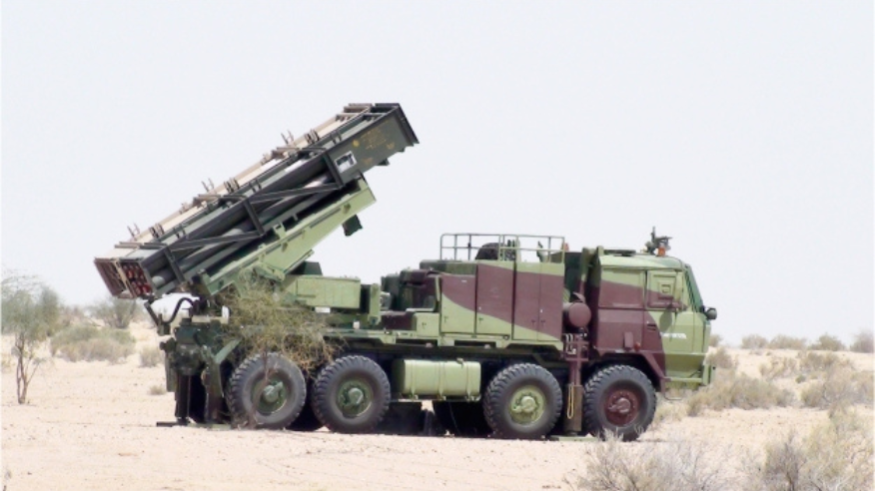
Pinaka Multi Barrel Rocket Launching System
- Thread starter Gautam
- Start date
You are using an out of date browser. It may not display this or other websites correctly.
You should upgrade or use an alternative browser.
You should upgrade or use an alternative browser.


Indian forces are always playing catch up. There is no procurement plan that does not go off the rails and in the end it becomes an emergency procurement. All the gears in the system are in need of a review and overhaul. Everybody is waiting for a decent mantri or babu to come along and do atleast the minimum to move things along. Let's see what ends up happening in the MBRL space.

Adding to the comment above:
If there exists a need, there needs to a plan to meet that need. The development of the system to meet that need should commence decades before in order to give the planners and the organisation responsible a good chance of meeting it. There was a discussion on a thread regarding product development and lifecycles. Analyse if the DRDO and its partners were funded enough and given the time to make Pinaka a relevant system when it comes to MLRS systems. Why is the 120kms and beyond strike capability delayed?
Weapon system development is a very boring and long process (mostly, it will decrease as new methods and technology is introduced). It consumes vast amount of resources and needs massive amount of man/machine input. If there is no co-operation between cogs then the results will be disappointing. It is not a vanilla B2B as it is made out to be. A defence contractor is not the usual hardware maker selling their wares to the govt.
Just my plain take. My 2 cents.
If there exists a need, there needs to a plan to meet that need. The development of the system to meet that need should commence decades before in order to give the planners and the organisation responsible a good chance of meeting it. There was a discussion on a thread regarding product development and lifecycles. Analyse if the DRDO and its partners were funded enough and given the time to make Pinaka a relevant system when it comes to MLRS systems. Why is the 120kms and beyond strike capability delayed?
Weapon system development is a very boring and long process (mostly, it will decrease as new methods and technology is introduced). It consumes vast amount of resources and needs massive amount of man/machine input. If there is no co-operation between cogs then the results will be disappointing. It is not a vanilla B2B as it is made out to be. A defence contractor is not the usual hardware maker selling their wares to the govt.
Just my plain take. My 2 cents.


A very well balanced take on the PULS controversy:
The Pinaka MBRL timeline and other relevant data (presented by Gemini):
As of early 2026, the Indian Army operates approximately 8 Pinaka Regiments, with induction continuing toward a near-term target of 10 regiments.
In military terms, the Pinaka is deployed not just as individual trucks, but as a comprehensive Regiment. Understanding the composition of a single regiment gives a clearer picture of the scale:
Total Firepower: A single regiment of 18 launchers can fire nearly 216 rockets in roughly 44 seconds, neutralizing an enemy target area of approximately 1,000 meters × 800 meters.
The development to strike beyond 120kms started in the year 2023-24.

 swarajyamag.com
The development of rockets having a range of 120-200km and pinpoint accuracy is an attempt to counter China and Pakistan's joint efforts to develop long-range multi-barrel rocket systems.
So the question is - Who was sleeping on the extended range rockets? IA or DRDO and its partners?
SOLAR Industries had submitted a plan 3-4 years ago to develop such rockets.

 www.livemint.com
As of early 2026, the Indian Army operates approximately 8 Pinaka Regiments, with induction continuing toward a near-term target of 10 regiments.
- Operational Regiments: ~8 Regiments (Raised and operational by late 2025).
- Immediate Target: 10 Regiments (Expected completion by 2026).
- Long-Term Goal: The Defence Acquisition Council (DAC) has previously approved a total of 22 regiments to fully replace older artillery systems.
 What Constitutes a "System"?
In military terms, the Pinaka is deployed not just as individual trucks, but as a comprehensive Regiment. Understanding the composition of a single regiment gives a clearer picture of the scale:| Launcher Vehicles | 18 | The core firing units (3 batteries of 6 launchers each). |
| Loader Vehicles | 18 | Replenishment vehicles carrying extra rocket pods. |
| Command Posts | 15 | Digicora MET radar, fire control, and battery command posts. |
| Support Vehicles | ~30+ | Meteorology, maintenance, and communication vehicles. |
Total Firepower: A single regiment of 18 launchers can fire nearly 216 rockets in roughly 44 seconds, neutralizing an enemy target area of approximately 1,000 meters × 800 meters.
| 1981 | Project Conception | The Ministry of Defence sanctions the project to develop a long-range artillery rocket system to replace the Soviet BM-21 Grad. |
| 1986 | Development Begins | The DRDO officially commences active development following the Indian Army's General Staff Qualitative Requirement (GSQR). The Armament Research and Development Establishment (ARDE) leads the project. |
| 1995 | First Prototype Trials | The first major developmental trials of the Pinaka Mk-I rocket system are conducted, validating the basic design and propulsion. |
| 1999 | Combat Debut (Kargil) | Though still in the final developmental stages, Pinaka is deployed during the Kargil War. It successfully neutralizes high-altitude enemy positions, proving its efficacy in mountain warfare. |
| 2000 – 2005 | User Trials & Refinement | Extensive user trials are conducted by the Indian Army in various terrains (desert and high altitude). ARDE announces work on a longer-range variant (Mk-II) in 2005. |
| 2006 – 2010 | Induction of Mk-I | The Pinaka Mk-I is officially inducted into the Indian Army. The first regiments are raised, featuring a range of roughly 38–40 km. |
| 2013 – 2016 | Guided Pinaka Development | DRDO begins testing the Guided Pinaka rocket. By 2016, successful tests demonstrate significantly improved accuracy using navigation, guidance, and control kits. |
| 2019 | Extended Range Tests | Successful tests of the Pinaka Mk-II (Extended Range) are conducted, pushing the range capacity to approximately 60–90 km. |
| 2020 | Mk-I Enhanced (ERP) | DRDO successfully tests the "Pinaka Mk-I Enhanced" rocket, bridging the gap between Mk-I and Mk-II with a range of approx. 45 km. |
| 2022 | First Export Success | India secures its first major export order for the Pinaka system from Armenia, marking a milestone in India's defense export capabilities. |
| 2024 | Long-Range Guided Tests | Maiden flight tests of the Guided Pinaka Long Range system are conducted, aiming for ranges up to 120 km with high precision. |
The development to strike beyond 120kms started in the year 2023-24.
DRDO Begins Developing 200 Km Range Guided Rockets For Pinaka Systems To Counter China, Pakistan's Joint Efforts
Long-range rockets are being developed for the indigenous Pinaka systems, which will have the capability to hit targets distanced over 200 km, the Eco
swarajyamag.com
The development of rockets having a range of 120-200km and pinpoint accuracy is an attempt to counter China and Pakistan's joint efforts to develop long-range multi-barrel rocket systems.
So the question is - Who was sleeping on the extended range rockets? IA or DRDO and its partners?
SOLAR Industries had submitted a plan 3-4 years ago to develop such rockets.
Solar Industries: Is it exploding its way to success? | Stock Market News
In Aug '22, the DAC cleared Solar to compete in bids to manufacture two versions of the Pinaka rockets. Company is the first in the private sector to qualify for manufacturing the rockets. Solar would participate in upcoming Pinaka tenders and hopes that its commercialisation will commence from...
www.livemint.com
Last edited:
Anyone who is peddling that Pinaka is a nascent system or 'does not work as well as X' is taking you for a ride. The system will not improve on its own. You have to work with the OEM post procurement so that the version that comes after will be better. The lack of vision and the tendency to have a knee jerk response to an immediate need post an 'incident' is pretty much how things are getting done since several years.
PULS is needed because things are heating up and we do not have our own rockets ready. The Pakistanis are taking help from the Chinese and are putting such systems to use. Who asked you not to begin working on it as soon as the rest of competing forces around you started working on their own versions? The Chinese PHL series that goes beyond 200kms was shown in 2018-19. It took IA 5 years to notice that the Chinese had this capability?
Secondly, you'll follow trends for systems based on stuff being made by Norinco? If you need a wider coverage and greater ranges, then have the MoD working on it as soon as the need arises.
There exists a serious gap even when it comes to putting requirements to paper. They keep changing and they never realise what might be needed 5-10 years down the line.
PULS is needed because things are heating up and we do not have our own rockets ready. The Pakistanis are taking help from the Chinese and are putting such systems to use. Who asked you not to begin working on it as soon as the rest of competing forces around you started working on their own versions? The Chinese PHL series that goes beyond 200kms was shown in 2018-19. It took IA 5 years to notice that the Chinese had this capability?
Secondly, you'll follow trends for systems based on stuff being made by Norinco? If you need a wider coverage and greater ranges, then have the MoD working on it as soon as the need arises.
There exists a serious gap even when it comes to putting requirements to paper. They keep changing and they never realise what might be needed 5-10 years down the line.
Last edited:
What you or I call catch up is a very well adopted national level policy of being reactive, which is ingrained into the modus operandi of our doctrine, SOP, capability enhancement process. This means the first escalatory move should come from the enemy which will make the case for acquiring a similar force multiplier (but of improved spec either matching or exceeding than the enemy capability) obvious rather than being proactive and develop a first in the class type capability. This is just a national level policy adopted by every single sakeholder like the Govt, politicians, MEA, think tank & military all.Indian forces are always playing catch up.
You do not have to like it, you have to abide by it. This policy was created to make our armed forces remain as an importer army for the foreseeable future where license mfg & major import from one or 2 strategic partners would be enough to keep national security while Nukes prevent the other case. Until some credible threat emerges somewhere, this policy will not change. By my experience so far, it will take 50+ years to even reduce the current habit of license mfg termed as aatmanirbhar indigenous product shamelessly.
While the other points are true, this one is not so much. Political willingness is key to any major procurement or development in our country. Not a single page can be turned without political will. Most people who have not worked in or around the establishment would never understand why defence business is so so sensitive treated , or why orders are such occasional. This sector and its associated user base, political wing, Govt involvement everything work on its own pace and urgency. What you might be observing as crawl pace today can be superfast within a few months IF needed.There exists a serious gap even when it comes to putting requirements to paper. They keep changing and they never realise what might be needed 5-10 years down the line.
Why this is valid re the putting requirement part , take the case of a pvt org like Solar Industries offering to make long range mbrl. If it were 1980 or 1990 and Solar had done that unilaterally , they would have been shut down within a year citing national security. All hell would have broken loose, income tax, industrial governing bodies, licensing bodies, NSA all agencies would be after Solar grp ownership, 24 x 7 under watching eyes and you can bet good they would have found some faulty reason to build a case against Solar and link it with terrorist org, that it might be selling sensitive stuff to anti-national activity. All of this because you can not be involved in weapon sales unilaterally without major permission & direct watch+influence by the Govt side aka under political instrument watch.
So if the maker is under such constraint wrt the industry partner, it is not too different for the forces. Say today we are building conventional missile force 500 km , 800km, 1500km range. So why Prithvi as conventional use was restricted to sub 200-500km in those days? Because again the Govt, MEA, economists and other stakeholders did not want to disrupt foreign relationship by actively pursuing longer range conventional weapons. Therefore Agni tech did not flow into prithvi class except for defensive measure.
The armed forces had to abide by because if the initial verbal discussion between armed forces and Govt did forbid any such long range or sort of weapons you want to make , what is the point of raising such a case & look forward to MoD meet? that is just time waste & the file will only find the trashbox faster, the chief would be held responsible & sacked. You can not make your boss sign a file he did not approve beforehand, even though your boss ie RM can change every 5 years with new Govt.
Above constraints play serious part in our case or in many other nation cases also, so wanting x or y event could have happened is futile. It is not that they do not understand reality. Everyone is realist when it comes to survival, esp the politics section in our country.
The cut money, influence game is another but that's for another day.
The army is always reactive, prahar was tested decade backs, if the army had stuck with the project we currently would have better system, prahar would have been refined further more, it would have gotten the range of 300km, better guidance systems, & better soild fuel propellent, composite materials, but like as usual army showed no interest, prahar became tech demonstrater,no Thier reactive mentality kicked in and they want 150-300 Guided rockets,Anyone who is peddling that Pinaka is a nascent system or 'does not work as well as X' is taking you for a ride. The system will not improve on its own. You have to work with the OEM post procurement so that the version that comes after will be better. The lack of vision and the tendency to have a knee jerk response to an immediate need post an 'incident' is pretty much how things are getting done since several years.
PULS is needed because things are heating up and we do not have our own rockets ready. The Pakistanis are taking help from the Chinese and are putting such systems to use. Who asked you not to begin working on it as soon as the rest of competing forces around you started working on their own versions? The Chinese PHL series that goes beyond 200kms was shown in 2018-19. It took IA 5 years to notice that the Chinese had this capability?
Secondly, you'll follow trends for systems based on stuff being made by Norinco? If you need a wider coverage and greater ranges, then have the MoD working on it as soon as the need arises.
There exists a serious gap even when it comes to putting requirements to paper. They keep changing and they never realise what might be needed 5-10 years down the line.
After so many of conflicts the still don't learn nothing always the reactive mentality, when PLA was firing 200-300km Guided rockets in xinzhang provience they never thought that they too needed Guided rocket artillery in the same category,
We have the industrial base, the technology & raw materials to manufacture guided rockets in huge numbers, if our think tank were little bit smarter, the PAF bases would have been taken care in the first hours of conflict with guided rockets,
The other aspect to that is while we did not induct prahaar, which was 2014 standard AAD airframe derivative , possibly high rcs because due to being conceptualised as an interceptor primarily, its airframe design was not fine tuned to be used as an attack missile with enough stealth aspect, say SRBM class use which is different to use case of long range MBRL as a precision strike.The army is always reactive, prahar was tested decade backs, if the army had stuck with the project we currently would have better system, prahar would have been refined further more, it would have gotten the range of 300km, better guidance systems, & better soild fuel propellent, composite materials, but like as usual army showed no interest, prahar became tech demonstrater,no Thier reactive mentality kicked in and they want 150-300 Guided rockets,
After so many of conflicts the still don't learn nothing always the reactive mentality, when PLA was firing 200-300km Guided rockets in xinzhang provience they never thought that they too needed Guided rocket artillery in the same category,
We have the industrial base, the technology & raw materials to manufacture guided rockets in huge numbers, if our think tank were little bit smarter, the PAF bases would have been taken care in the first hours of conflict with guided rockets,
In addition, the first gen guidance scheme, for pinaka DRDO say 1-1.5% of range. That may be acceptable for something 40km as area weapon, you get low error. But similar module guidance at long range, even if it is 0.5% of range , you get huge error margin. Therefore what do you get by inducting old prahaar ? an unoptimized air-frame design (because it was one proven airframe drdo had data on hand) , too high cep , collateral damage creating political controversy. Not very fit for purpose.
But what did we gain from Prahaar? long range conventional strike via mobile platform, gained knowledge on requirement for miniaturised gnc module, mission planning software, possibly many other things. This knowledge pool was vital to go for a next iteration, but now instead of using old AAD airframe, the sagarika airframe was cleared which was top class. Therefore it is better to go with that as SRBM option and Pralay came.
Now the need for the original still exists , and it needs a low footprint small compact design missile system. So now with enough building block available, we can make such a small atacms equivalent ourselves. To improve further, we can get some foreign systems in like LORA etc and implement feature from those. All these are now multi domain system of systems, not just general aim then fire and forget. Now full system is digital, mission planning to guidance to quick disperse mobility, everything has improved. SO even if prahaar failed, Pralay and LRGR should coexist as proof of success, along with imported LORA etc as force multiplier.
Certain technology gap does exist in terms of material availability, grade, pricing wise, electronic items, electrical items, high end sensors etc. Defence requirement is at low volume end hence cost is high. COTS item can not serve the whole bill of material, line items. Many are BTS esp for use specific. Pinaka alone can use 3-4 types of fuze thereby different pcb combo. So all of this does play vital role both in development & mass produce.
Though no system is fool proof, the US has a strong culture of govt oversight and accountability (GAO, CRS, CBO, DoD IG, ...) which helps to weed out incompetence. As a democracy, I expect India to have similar systems but it clearly isn't functioning and is in need of overhaul. Facts are not being allowed to come to light so things are debated endlessly.
- Was there a failure of foreign intelligence to identify threats like enemy long range MRBL program developments?
- Or was intel provided (or at least became obvious once Norinco made it public) but there was a failure of Army think tanks who dismissed it?
- Or was a recommendation made to pursue but qualitative requirements not worked out?
- Or was QR worked out, but didn't get DRDO research funding?
- Or was research funding available but DRDO couldn't come up with a proposal in time and/or sabotaged private industry efforts?
- Or were proposals available but ignored by MoD because someone wanted that supplemental import lobby income?
- And how much time was lost in each step waiting for a babu's rubber stamp?
But most importantly, if the public is just willing to swallow that things will never change and the system will just be slow and reactive with zero accountability, then why would things ever change?
- Was there a failure of foreign intelligence to identify threats like enemy long range MRBL program developments?
- Or was intel provided (or at least became obvious once Norinco made it public) but there was a failure of Army think tanks who dismissed it?
- Or was a recommendation made to pursue but qualitative requirements not worked out?
- Or was QR worked out, but didn't get DRDO research funding?
- Or was research funding available but DRDO couldn't come up with a proposal in time and/or sabotaged private industry efforts?
- Or were proposals available but ignored by MoD because someone wanted that supplemental import lobby income?
- And how much time was lost in each step waiting for a babu's rubber stamp?
But most importantly, if the public is just willing to swallow that things will never change and the system will just be slow and reactive with zero accountability, then why would things ever change?
The pla started thier high altitude artillery drills from 2012 xinjiang testing thier PHL-03 300mm rockets later in 2014 they test the accuracy of the rocket artillery along with thier type 05 155 howitzer at a sea level of 4000m, and in 2016 they started thier theater level exerices and in 2018 they satrted thier annual large scale exercises under a unified command structure, do the think tank not aware it? they were aware of it what was going on the other side of the border, the orf was many articles reporting it, the army the govt everyone knew it, when somebody was conducting high altitude large scale exercises it should alarmed you, yet they continuosly ignored it, that almost a 15 years period,- Was there a failure of foreign intelligence to identify threats like enemy long range MRBL program developments?
- Or was intel provided (or at least became obvious once Norinco made it public) but there was a failure of Army think tanks who dismissed it?
- Or was a recommendation made to pursue but qualitative requirements not worked out?
- Or was QR worked out, but didn't get DRDO research funding?
- Or was research funding available but DRDO couldn't come up with a proposal in time and/or sabotaged private industry efforts?
- Or were proposals available but ignored by MoD because someone wanted that supplemental import lobby income?
- And how much time was lost in each step waiting for a babu's rubber stamp?
we lost one war and we still are facing its consquences, the geography got changed the politics the demographics but one thing didnt change was the laid back attitude which cost as the war, its still the same situation like .303 lee enfiled vs type 56 & sks , now the Pakistanis have long range artillery rockets but we still trying to catch up, importing our way to meet the requirements,
The pla started thier high altitude artillery drills from 2012 xinjiang testing thier PHL-03 300mm rockets later in 2014 they test the accuracy of the rocket artillery along with thier type 05 155 howitzer at a sea level of 4000m, and in 2016 they started thier theater level exerices and in 2018 they satrted thier annual large scale exercises under a unified command structure, do the think tank not aware it? they were aware of it what was going on the other side of the border, the orf was many articles reporting it, the army the govt everyone knew it, when somebody was conducting high altitude large scale exercises it should alarmed you, yet they continuosly ignored it, that almost a 15 years period,
we lost one war and we still are facing its consquences, the geography got changed the politics the demographics but one thing didnt change was the laid back attitude which cost as the war, its still the same situation like .303 lee enfiled vs type 56 & sks , now the Pakistanis have long range artillery rockets but we still trying to catch up, importing our way to meet the requirements,
Let's propose some solutions:
How about foreign EP is only allowed if the item is already called out in TPCR (with reasonable MoQs) and DRDO/private industry doesn't have a production ready solution in 6 months? Any deviation needs to go beyond DAC/RM, say PMO approval?
Thanks for the insight. I have never worked for a DPSU and I cannot speak about the political implications and inner workings (for MoD) as well. I understood the gist of what you were trying to get at. There were plenty of opportunities to begin developing these and they would have been acquired via normal procurement process. The angle that makes sense here is that a babu or a neta decided that importing them would be better or the requirement was delayed due to xyz reasons that is best known to MoD or the forces.While the other points are true, this one is not so much. Political willingness is key to any major procurement or development in our country. Not a single page can be turned without political will. Most people who have not worked in or around the establishment would never understand why defence business is so so sensitive treated , or why orders are such occasional. This sector and its associated user base, political wing, Govt involvement everything work on its own pace and urgency. What you might be observing as crawl pace today can be superfast within a few months IF needed.
Why this is valid re the putting requirement part , take the case of a pvt org like Solar Industries offering to make long range mbrl. If it were 1980 or 1990 and Solar had done that unilaterally , they would have been shut down within a year citing national security. All hell would have broken loose, income tax, industrial governing bodies, licensing bodies, NSA all agencies would be after Solar grp ownership, 24 x 7 under watching eyes and you can bet good they would have found some faulty reason to build a case against Solar and link it with terrorist org, that it might be selling sensitive stuff to anti-national activity. All of this because you can not be involved in weapon sales unilaterally without major permission & direct watch+influence by the Govt side aka under political instrument watch.
So if the maker is under such constraint wrt the industry partner, it is not too different for the forces. Say today we are building conventional missile force 500 km , 800km, 1500km range. So why Prithvi as conventional use was restricted to sub 200-500km in those days? Because again the Govt, MEA, economists and other stakeholders did not want to disrupt foreign relationship by actively pursuing longer range conventional weapons. Therefore Agni tech did not flow into prithvi class except for defensive measure.
The armed forces had to abide by because if the initial verbal discussion between armed forces and Govt did forbid any such long range or sort of weapons you want to make , what is the point of raising such a case & look forward to MoD meet? that is just time waste & the file will only find the trashbox faster, the chief would be held responsible & sacked. You can not make your boss sign a file he did not approve beforehand, even though your boss ie RM can change every 5 years with new Govt.
Above constraints play serious part in our case or in many other nation cases also, so wanting x or y event could have happened is futile. It is not that they do not understand reality. Everyone is realist when it comes to survival, esp the politics section in our country.
The cut money, influence game is another but that's for another day.
As you've pointed out earlier, 120kms is under testing already (1st test done). There are no trust me bro sources here. Folks can check out the press release for themselves.
I am tired of people using the usual trope of DRDO having no funding/being inefficient/laid back. Let's call it as it appears to be.
They will still find some loopholes,How about foreign EP is only allowed if the item is already called out in TPCR (with reasonable MoQs) and DRDO/private industry doesn't have a production ready solution in 6 months? Any deviation needs to go beyond DAC/RM, say PMO approval?
Like how they created in IDDM

L&T has been awarded a supply order by the Corps of Electronics and Mechanical Engineers (EME) of the Indian Army, for the overhaul, upgrade and obsolescence management of the indigenous Pinaka Multi-Rocket Launcher Systems.
This unique partnership between a domestic private OEM (Original Equipment Manufacturer) and the Indian Army, for sustenance of frontline artillery systems, is a significant step for product lifecycle support of Made-in-India, in-service artillery systems.
The partnership with the Corps of EME of the Indian Army aims to enhance long-term operational availability and modernisation of Pinaka regiments currently in service with the Indian Army.
The programme will focus on managing outdated components, upgrading critical sub-systems and providing sustained technical support to the Army Base Workshops. This affiliation shall also re-enforce Public Private Partnership model in defence sustenance and lifecycle support for frontline artillery systems.
I went through the thread and saw that this article has not been added. Fairly recent. The interview already exists in video format was posted by a member earlier.
 chakranewz.com
Dr. Raju outlined the currently operational variants: the Pinaka Mk-I with a range of 37.5 km. Then there's the enhanced Pinaka which can hit targets at 50 km and finally the Guided Pinaka with a range of 75 km.
The Guided Pinaka was inducted into the Indian Army in late 2024. During trials, it achieved a Circular Error Probable (CEP) of just 2–3 metres—far exceeding the Army's requirement of 40 metres. "It's almost like a cruise missile," Dr. Raju noted.
Dr. Raju emphasised that while the launcher platform will remain unchanged, the rockets themselves will be redesigned to meet longer-range and multi-service operational needs.
Looking ahead, ARDE is developing new variants using the existing launcher platform. Dr. Raju revealed that a 120 km-range Pinaka variant has already been completed. Another vairant: a 300 km-range version which would be comparable to the U.S. Army’s Tactical Missile System (ATACMS), is under development as a new category of precision strike weapon.
DRDO Developing Longer-Range Variants of Pinaka Rocket System
In an exclusive interview with Chakra News, Dr. A. Raju, Director of the Armament Research and Development Establishment (ARDE), has confirmed that the Defence Research and Development Organisation (DRDO) is working on advanced variants of the indigenous Pinaka rocket system with extended range...
chakranewz.com
Dr. Raju outlined the currently operational variants: the Pinaka Mk-I with a range of 37.5 km. Then there's the enhanced Pinaka which can hit targets at 50 km and finally the Guided Pinaka with a range of 75 km.
The Guided Pinaka was inducted into the Indian Army in late 2024. During trials, it achieved a Circular Error Probable (CEP) of just 2–3 metres—far exceeding the Army's requirement of 40 metres. "It's almost like a cruise missile," Dr. Raju noted.
Dr. Raju emphasised that while the launcher platform will remain unchanged, the rockets themselves will be redesigned to meet longer-range and multi-service operational needs.
Looking ahead, ARDE is developing new variants using the existing launcher platform. Dr. Raju revealed that a 120 km-range Pinaka variant has already been completed. Another vairant: a 300 km-range version which would be comparable to the U.S. Army’s Tactical Missile System (ATACMS), is under development as a new category of precision strike weapon.


Excellent, our own LORA (~600mm) and Rampage (300mm) soon.Next-Generation Variants
Looking ahead, ARDE is developing new variants using the existing launcher platform. Dr. Raju revealed that a 120 km-range Pinaka variant has already been completed. Another vairant: a 300 km-range version which would be comparable to the U.S. Army’s Tactical Missile System (ATACMS), is under development as a new category of precision strike weapon.
Separate variants are being developed for the Indian Navy and a potential air-launched version for the Indian Air Force. These future variants are expected to be designated Mk-3 and Mk-4.
Dr. Raju emphasised that while the launcher platform will remain unchanged, the rockets themselves will be redesigned to meet longer-range and multi-service operational needs.
