Sukhoi Su-30MKI

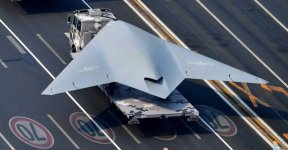
I don't know why you think they don't have obvious help, judging by the appearance, They generally adopt tailless layout and lambda wing or large delta wing
A drone with this layout has a significantly smaller RCS value than any fifth-generation fighter.This means they are almost impossible to detect
The GJ-11 was first publicly displayed at the 2019 National Day military parade, and recently the Americans discovered that it was deployed in large numbers at the Shigatse base.
If a war breaks out now, these drones could be useful
they will be very usefull but simply having a tailess design doesnt mean its better with rcs. RAM and the engines and the shaping of the engines inlets also matters.

the gj11 has engines that are not buried as deeply as the j20(from the naked eye ofc) and this leads to radar returns higher than the j20. it is also not as optimised for stealth from the side. IT will not be manufactured to the same tolerances as the j20 simply because that would bee too expensive to do so. It will also have very little to no EW of its own and this leads to a much higher chance of it being detected.

you also have to realise that these will be going against VHF and S band radars(as far as i know these can and do provide cues to air defence) and so will not be undetected. india(in the absense of its own stealth craft) has been investing very heavily into anti stealth detection measures.

"I don't know why you think they don't have obvious help". No, they will be very useful for SEAD/DEAD but will face the same limitations as other stealth craft when going against an proper networked air defence. especially one on ground.

i simply dont know enough about this drone and nobody really does except the the makers themselves and this will be a well guarded secret so it is quite useless to speculate unless we have access to top secret info. I may be completely wrong with my deductions or i may be right, i simply do not know.
 
the statement that "there's no standard for shape" isn't quite right; in engineering, the standard baseline is always a "worst-case" target
Already addressed that, early 4th gen non stealth planes are not worst case scenerio shape wise, even if design of early 4th gen like mig29 did not take into account rcs reduction.

. A 4th gen fighter, with all its right angles and flat surfaces, is actually full of these "worst-case" features.
Shaping reduces the the mirror-like specular "glint" , and thats what provides the bigger reduction , but to
Indeed.

But shaping is not the only way to reduce these reflectors angles that cause sharp spike over median in RCS.
You can for example also use RAM/RAS materials as an alternative.
And that's basically what is happening to these already in production 4th gen aircraft, these extra reflective areas get a more heavy coating of more effective ram.

And if you really want to you can also add a relatively thicker layer in those specific areas without worrying about weight, though maintinence will suffer a lot, but if we're purely talking about rcs reduction ability than it can fully compensate .


Materials, like ram and ras, are the essential "cleanup" crew.
An f35's rcs from references quoted by officials is said to be median 0.0005-0.001m2.
From the earlier 0.06m2 median from shape alone.
The reduction is of 17.8-20.8 dbsm

The reduction is more than just clean up if the effect of reduction somewhat surpasses what we saw with shaping.


I never said application of shaping is saturated in practice,but its evolution is limited, as theoretically we already know the most optimal shapes.
 
I don't know why you think they don't have obvious help". No, they will be very useful for SEAD/DEAD but will face the same limitations as other stealth craft when going against an proper networked air defence. especially one on ground
You think that UHF/vHF band radar can effectively detect stealth aircraft, which is half right. These bands of radar cannot effectively determine the specific location of the aircraft. It can only tell you that there is an aircraft in the air, but it cannot tell you where the aircraft is.
Moreover, radars in these bands are extremely susceptible to interference, and you know, the J-16D, Yun-8/9 electronic warfare aircraft, there are many in the PLA.
 
The reduction is more than just clean up if the effect of reduction somewhat surpasses what we saw with shaping.
Again, Shaping from what to what exactly ? like , what is the reference and what is the optimised shape you are talking about here ?

The other two points : Agreed
And if you really want to you can also add a relatively thicker layer in those specific areas without worrying about weight,
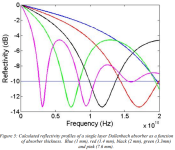
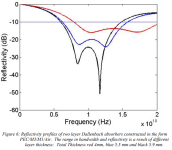
A thicker Layer does not necessarily mean better characteristics . Usually, Its a function related to bandwidth . see below :
1761560638533.png
1761560574347.png

Also , you can search for 'Rozanov bound' to get into the details . really interesting .
 
  • Like
Reactions: marich01
they will be very usefull but simply having a tailess design doesnt mean its better with rcs. RAM and the engines and the shaping of the engines inlets also matters.

the gj11 has engines that are not buried as deeply as the j20(from the naked eye ofc) and this leads to radar returns higher than the j20. it is also not as optimised for stealth from the side. IT will not be manufactured to the same tolerances as the j20 simply because that would bee too expensive to do so. It will also have very little to no EW of its own and this leads to a much higher chance of it being detected.
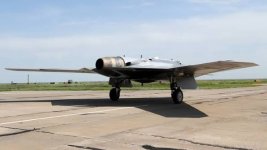
The engine problem you mentioned only applies to this simple Russian drone.
images (2)_1761560974012.jpeg
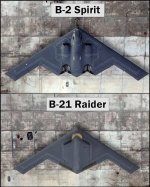
As for the GJ11, its overall design is the same as the American B-21, with a trapezoidal tail nozzle.
Because they all require omnidirectional -40dB stealth
images (2)_1761561328747.jpeg
GJ-1024x535.jpg
 
You think that UHF/vHF band radar can effectively detect stealth aircraft, which is half right. These bands of radar cannot effectively determine the specific location of the aircraft. It can only tell you that there is an aircraft in the air, but it cannot tell you where the aircraft is.
I don't wish to enter between the argument you guys are having.

But.
 
The core technical difficulty of meter-wave anti-stealth radar stems from its inherent physical wavelength characteristics, primarily resulting in low accuracy, poor low-altitude performance, large size, and weak anti-interference capabilities. However, several optimization methods are available.
1. AESA: Utilizing ESA in both azimuth and elevation, digital beamforming (DBF) technology enables multiple adaptive beams, significantly improving angular measurement accuracy and resolution while also providing robust adaptive anti-interference capabilities.
2. Super-resolution angular measurement algorithms: Utilizing spatial spectrum estimation techniques such as MUSIC and ESPRIT, these algorithms overcome the constraints of traditional Rayleigh limits, significantly improving angular measurement accuracy while maintaining the same physical aperture.
3. Multiple-Input Multiple-Output (MIMO) technology: Transmitting orthogonal waveforms and performing matched filtering at the receiver effectively expands the radar's virtual aperture, significantly improving angular resolution and target recognition capabilities.
4. Advanced Clutter Suppression and Signal Processing Technology: Utilizing Space-Time Adaptive Processing (STAP) technology to jointly process spatial and temporal information, the radar effectively suppresses ground clutter and slow-moving clutter, enhancing detection of low-speed, stealthy targets. Furthermore, the radar utilizes more sophisticated pulse compression technology and broadband signals to improve range resolution.
 
  • Like
Reactions: Rajput Lion
The core technical difficulty of meter-wave anti-stealth radar stems from its inherent physical wavelength characteristics, primarily resulting in low accuracy, poor low-altitude performance, large size, and weak anti-interference capabilities. However, several optimization methods are available.
1. AESA: Utilizing ESA in both azimuth and elevation, digital beamforming (DBF) technology enables multiple adaptive beams, significantly improving angular measurement accuracy and resolution while also providing robust adaptive anti-interference capabilities.
2. Super-resolution angular measurement algorithms: Utilizing spatial spectrum estimation techniques such as MUSIC and ESPRIT, these algorithms overcome the constraints of traditional Rayleigh limits, significantly improving angular measurement accuracy while maintaining the same physical aperture.
3. Multiple-Input Multiple-Output (MIMO) technology: Transmitting orthogonal waveforms and performing matched filtering at the receiver effectively expands the radar's virtual aperture, significantly improving angular resolution and target recognition capabilities.
4. Advanced Clutter Suppression and Signal Processing Technology: Utilizing Space-Time Adaptive Processing (STAP) technology to jointly process spatial and temporal information, the radar effectively suppresses ground clutter and slow-moving clutter, enhancing detection of low-speed, stealthy targets. Furthermore, the radar utilizes more sophisticated pulse compression technology and broadband signals to improve range resolution.
does the indian VHF radar not have these?? im confused?
 
h
View attachment 47338
View attachment 47339
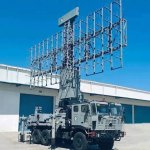
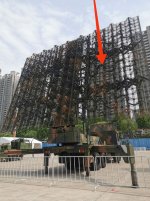
I don't know the specific performance of the Indian radar, but at least from the appearance, it is a similar version of the meter-wave early warning radar developed by China around 2000, and the antenna area is much smaller than that of China.
from what ive been researching the DRDO-BEL radar has specs of the tech used roughly on par with the jy27V but the the range is only about 400km at most vs the 600ish of the jy27V. probably due to the much larger aperture of the jy27V.
 
  • Like
Reactions: RationalGuy
h

from what ive been researching the DRDO-BEL radar has specs of the tech used roughly on par with the jy27V but the the range is only about 400km at most vs the 600ish of the jy27V. probably due to the much larger aperture of the jy27V.
I don't know the specific performance of these two radars, and I don't think you know either, so I can only make some brief judgments based on their appearance.
India's anti-stealth radar uses a very old Yagi antenna that has been used on radars since before World War II, while your jy27V radar obviously uses a T/R component and is an AESA radar..

images (2)_1761566506748.jpeg
IMG_20251027_200037.jpg
 
  • Haha
Reactions: South block
I don't know the specific performance of these two radars, and I don't think you know either, so I can only make some brief judgments based on their appearance.
India's anti-stealth radar uses a very old Yagi antenna that has been used on radars since before World War II, while your jy27V radar obviously uses a T/R component and is an AESA radar..

View attachment 47347
View attachment 47348
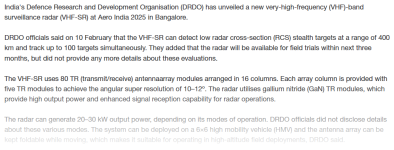
huh, it seems we havent gone far enough with antenna tech yet. as for the specs the indian one has been officially stated to be a GaN t/r based AESA with a range of about 400km. thats about it

then the indian radar is a generation behind unless its different from what is being shown
 
I don't know the specific performance of these two radars, and I don't think you know either, so I can only make some brief judgments based on their appearance.
India's anti-stealth radar uses a very old Yagi antenna that has been used on radars since before World War II, while your jy27V radar obviously uses a T/R component and is an AESA radar..

View attachment 47347
View attachment 47348
The DRDO one is GaN based . It is pretty close to SoA , if not SoA . Further Details :
1761570524675.png


indian radar is a generation behind
Probably one of the few places we are rockin it , imho .
 
Again, Shaping from what to what exactly ? like , what is the reference and what is the optimised shape you are talking about here ?
Already told that


A thicker Layer does not necessarily mean better characteristics . Usually, Its a function related to bandwidth . see below :
Doesn't need to necessarly, thickness is generally correlated with more absorption, help in achieving more Reflection Loss (RL), allows creation of more layers with graded impedance profiles, helps in better absorbtion of wider bandwidth especially effective against lower frequencies.
Etc.

In general terms, Just like a bigger radar/more TRM Doesn't necessarly means better performance, but size does help in achieving better performance.
The core technical difficulty of meter-wave anti-stealth radar stems from its inherent physical wavelength characteristics, primarily resulting in low accuracy, poor low-altitude performance, large size, and weak anti-interference capabilities. However, several optimization methods are available.
1. AESA: Utilizing ESA in both azimuth and elevation, digital beamforming (DBF) technology enables multiple adaptive beams, significantly improving angular measurement accuracy and resolution while also providing robust adaptive anti-interference capabilities.
2. Super-resolution angular measurement algorithms: Utilizing spatial spectrum estimation techniques such as MUSIC and ESPRIT, these algorithms overcome the constraints of traditional Rayleigh limits, significantly improving angular measurement accuracy while maintaining the same physical aperture.
3. Multiple-Input Multiple-Output (MIMO) technology: Transmitting orthogonal waveforms and performing matched filtering at the receiver effectively expands the radar's virtual aperture, significantly improving angular resolution and target recognition capabilities.
4. Advanced Clutter Suppression and Signal Processing Technology: Utilizing Space-Time Adaptive Processing (STAP) technology to jointly process spatial and temporal information, the radar effectively suppresses ground clutter and slow-moving clutter, enhancing detection of low-speed, stealthy targets. Furthermore, the radar utilizes more sophisticated pulse compression technology and broadband signals to improve range resolution.
Fu*ker copy pasted AI sh*t.
 
I don't know how this Indian came up with such detailed data.
He's Indonesian.
Working in radar field.
An expert on the topic.


The JY-27a radar is one of the PLA's active equipment.
Without so much data being released, he is probably just making assumptions
Its not about jy27 v uniquely.

Its about that, its possible for VHF radars to get weapons grade lock on aerial target.
Unlike the common myth than vhf etc can only detect and not track.
 
  • Like
Reactions: RationalGuy
The DRDO one is GaN based . It is pretty close to SoA , if not SoA . Further Details :
View attachment 47349


Probably one of the few places we are rockin it , imho .
hmm but china has a pretty big head start when it comes to VHF radars specifically. We are probably close to them in other forms but theyve been working on their VHF for 3 decades now while we have only done about a decades worth of work at most.

as for the other radars some of ours is much better like the virupaksha but most of it is pretty equal.
 
Already told that


Doesn't need to necessarly, thickness is generally correlated with more absorption, help in achieving more Reflection Loss (RL), allows creation of more layers with graded impedance profiles, helps in better absorbtion of wider bandwidth especially effective against lower frequencies.
Etc.

In general terms, Just like a bigger radar/more TRM Doesn't necessarly means better performance, but size does help in achieving better performance.

Fu*ker copy pasted AI sh*t.
I posted in AMCA thread sometime back about a metamaterial which absorbs 98-99% RF waves. This has already been lab tested by our scientists. Materials have come a long way from what was present in 1st gen stealth tech.
 
How do you know this? China's most outdated YJ-91 and YJ-83 missiles also have a range of 190-280 km.
Not to mention, China publicly displayed the AKF98A and KD-88C at the Zhuhai Air Show, and the YJ-15, YJ-17, YJ-19, and YJ-20 at the Victory Parade.


This tactic was simulated by China in 2017, when two J-20 attacked a formation consisting of 10 J-10C/J-11, one KJ2000, and one Y8 electronic warfare aircraft.
The result was a 10-0 victory.This is news reported by the CCP official newspaper
This also verifies the ineffectiveness of China's tactical conception of facing F22 without J20.
I am talking about ARM only, not anti ship missiles. YJ15-YJ20 are ARM? Do they have anti radiation capability? Your main ARM is a copy of KH11 as one guy said and its range is only 150 km. India's Rudram Mk2 alone can reach up to 300 km and the upcoming Rudram Mk3 can reach 550 km, has satellite data link and is capable of travelling at hypersonic speeds, far further and faster than any current Chinese ARM, definitely way better than YJ91.