2026-2027Resident experts by when do you think we will induct Rudram 2 and Rudram 3?
RudraM Series Air-launched Missiles : Updates & Discussions
- Thread starter Ashwin
- Start date
You are using an out of date browser. It may not display this or other websites correctly.
You should upgrade or use an alternative browser.
You should upgrade or use an alternative browser.


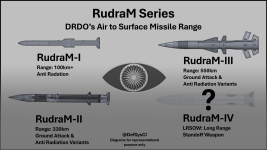

Are we going to induct the RudraM-I?
We probably will if we aren't already. A 100-150 km range missile it isn't exactly a short-range missile. The range just looks less impressive, compared to the other missiles.Are we going to induct the RudraM-I?
What the M-1 lacks in range is made up for with unit cost. This is especially true as stealthy armed wingman drones comes to the scene. The other missiles are too heavy to be fired from a wingman drone. Deploying a M-1 missile from a wingman will always cost less than deploying a M-2 or M-3 from a heavy fighter.

As we know, these Rudram missiles are for dual purposes as ARM roles or air-to-ground roles, so for Rudram 1 with 100 km as ARM, it should be good for the IAF, IMO.We probably will if we aren't already. A 100-150 km range missile it isn't exactly a short-range missile. The range just looks less impressive, compared to the other missiles.
What the M-1 lacks in range is made up for with unit cost. This is especially true as stealthy armed wingman drones comes to the scene. The other missiles are too heavy to be fired from a wingman drone. Deploying a M-1 missile from a wingman will always cost less than deploying a M-2 or M-3 from a heavy fighter.

Real range of NGARM is 200 kms, maybe even more than that as we always understate our missile's range.As we know, these Rudram missiles are for dual purposes as ARM roles or air-to-ground roles, so for Rudram 1 with 100 km as ARM, it should be good for the IAF, IMO.
Rudram 1 is likely de-linked from the program and after NGARM designation comes under DRDL ASL&V group that handle all the astra etc. Deliverable based R2 R3 all are being done by RCI. There must be some reason, esp with TD mentioned in project. Warhead trials was mentioned in 2024 July NL , so probably IAF will take a call. Since ADANI def got it, most likely some order will be done.Are we going to induct the RudraM-I?
NGARM can do speed/thrust variation , top speed 2 mach close it would obviously lose range hence close to 100-120km max launch range in a quick reaction mode where pilot has locked onto target signature. Otherwise in seek and destroy role, the missile can not move fast like at mach 2 and seek the target signature in the general area hence speed drops to 0.8 mach level aka range increases to almost 200km obviously to seek the target over large terrain. Since target can remain hidden behind valley/hills, going at 2 mach over it and then turning back is not possible so a lower speed is ideal in this mode.Real range of NGARM is 200 kms, maybe even more than that as we always understate our missile's range.




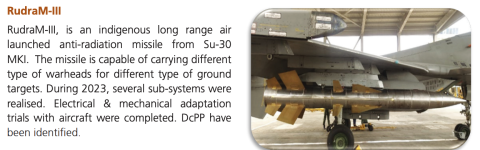
Interestingly, though Rudram III is an air-launched missile, it uses a booster phase and a separation technique, so in the terminal phase, the tail fin section is going to be separated. The design seems to be pretty complex for an ARM design and IMO it might be intended for use against aerial targets.
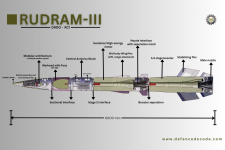
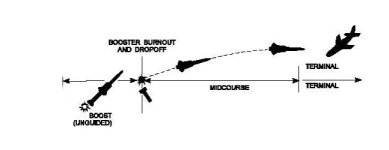
Its not for seek and destroy role, ie typical sead mission in a contested battlefield perhaps. That role requires covering a large sector at a slower speed so the seeker system can pick up the target at a smaller range compared to when the carrier aircraft got the radar lock on the target radar and launched it afterwards. In fact the poster before showed radar installation ie a large fixed target object.Interestingly, though Rudram III is an air-launched missile, it uses a booster phase and a separation technique, so in the terminal phase, the tail fin section is going to be separated. The design seems to be pretty complex for an ARM design and IMO it might be intended for use against aerial targets.
Given that level of standoff distance to be covered, and likely in the speed/kinetic impulse regime that is planned for R2 , obviously it needed both dual pulse config and a booster. What we have learned from the general literature based knowledge so far, almost certainly it will be able to hit something at 600km away within 7-8 mins of launch, probably for less time.
To hit aerial maneuvering target, it will prob need some modification in airframe and a different programmed obc.

So its for "fixed" installations?Its not for seek and destroy role, ie typical sead mission in a contested battlefield perhaps. That role requires covering a large sector at a slower speed so the seeker system can pick up the target at a smaller range compared to when the carrier aircraft got the radar lock on the target radar and launched it afterwards. In fact the poster before showed radar installation ie a large fixed target object.
Given that level of standoff distance to be covered, and likely in the speed/kinetic impulse regime that is planned for R2 , obviously it needed both dual pulse config and a booster. What we have learned from the general literature based knowledge so far, almost certainly it will be able to hit something at 600km away within 7-8 mins of launch, probably for less time.
To hit aerial maneuvering target, it will prob need some modification in airframe and a different programmed obc.
In that case it probably wouldn't need a AR seeker
So isn't it a precision ground strike missile, rather than a arm missile, like you can hit fixed radar installations with brahmos or any other precision missile.
Rudram-3 is a hypersonic ALBM in the same class as ROCKS/Blue Sparrow. ROCKS reportedly also has an optional passive seeker.Interestingly, though Rudram III is an air-launched missile, it uses a booster phase and a separation technique, so in the terminal phase, the tail fin section is going to be separated. The design seems to be pretty complex for an ARM design and IMO it might be intended for use against aerial targets.
View attachment 45679View attachment 45683
The massive tail control surfaces are likely for maneuverability immediately after launch.
What is AR seeker ? its usually rf, phh type seekers. IIR seeker will aid in precision targeting beating any countermeasure (smokescreen etc).So its for "fixed" installations?
In that case it probably wouldn't need a AR seeker
So isn't it a precision ground strike missile, rather than a arm missile, like you can hit fixed radar installations with brahmos or any other precision missile.
fixed installation does not mean its a small footprint on the ground. Think of a big dome on a remote site and within that site the dome sits somewhere. So a computer would not know unless it fed signal analyse and algo determine its a radar signal emitting object and locks onto that position. Hence missile need the seeker for precision targeting.
As per the poster shown in Hyderabad, its also dual purpose. Of course anything can hit a radr installation, but compared to R3 class missile a brahmos will take 10min+ to get to the target and its a deep penetration kind of missile with high terminal velocity. In comparison R3 also retain good impact velocity but does not need to penetrate few meters of concrete or take 10+ mins to reach the target so enemy reaction time is less. Both missiles are good enough to evade and stay below that radars tracking horizon.
Do not know if its rocks or the other israeli air launched stuff, but read in their site that the missile after launch takes a ballistic trajectory. None of our missiles ever follow a ballistic trajectory hence these are so much computation exhaustive (and takes time to be perfect).Rudram-3 is a hypersonic ALBM in the same class as ROCKS/Blue Sparrow. ROCKS reportedly also has an optional passive seeker.
The massive tail control surfaces are likely for maneuverability immediately after launch.

A slide on Rudram 3 from Aero India 2025Rudram 2 Brochure from Defence Expo 2022
View attachment 44430
Common features:
Propulsion : Solid Rocket Motor
Navigation : INS + SATNAV
Actuation : EMA
Range : 50-300 Km
Launch Platform : Su 30MKI & Mirage 2000
Launch Mach : 0.5 to 1.5
Launch Alt : 3 to 15 Km
Apogee : 40 km
Time of Flight : 400sec
Mach number : Peak (5.5) Touchdown (>1.0)
WH Weight : 200 Kg class
Control : Aerodynamic
ARM Role
Seeker : PHH+IIR
Warhead : PF-155 Kg
Impact Angle : 40°-50°
Target : Radar Installations
Ground Attack Role
Seeker : IIR
Warhead : PCB-200 Kg
Impact Angle : 80°
Target : Bunkers, Air Strips, Hangars
Rudram 2 Brochure from Vigyan Vaibhav 2025
View attachment 44431
Specifications
Range : 50 - 300 km
Diameter : 455 mm
Length : 4995 mm
Mass : 1025 kg
Propulsion : Solid Rocket Motor
Navigation : INS + SATNAV
Actuation : EMA
Launch Platform : Su 30MKI
Launch Mach : 0.5 to 0.9
Launch Alt : 3 to 11 Km
Apogee : 40 km
Time of Flight : 300sec
Mach number : Peak (5.5) Touchdown (>1.0)
WH Weight : 200 Kg class
Control : Aerodynamic
Ground Attack Role
Seeker : IIR
Warhead : PCB-200 Kg
Impact Angle : 80°
Target : Bunkers, Air Strips, Hangars
ARM Role
Seeker : RF seeker
Warhead : PF-155 Kg
Impact Angle : 40°-50°
Target : Radar Installations
--------------------------------------------------------------
Rudram 3
Brochure from Vigyan Vaibhav 2025
View attachment 44432
Rudram 3 Brochure from Defence Expo 2022
View attachment 44433
RudraM- 3 is an Air to Surface missile capable of neutralizing Radiating targets and ground targets including Bunkers, Buildings, Shelters at long ranges.
SALIENT FEATURES
Capable to be launched trom Su-30mki
Passive and Active dual mode seeker
Possible lock on before launch
Highly manoeuvrable missile
All weather Day and night capability
All thorough supersonic
CURRENT STATUS
Under Devlopment
LAB
Research Centre Imarat Hyderabad as Nodal Lab
Unknown Origin Schematics of Rudram 3 (possibly for a scale model)
View attachment 44434
View attachment 44435
Projected Specifications (My guestimates)
Range : 500- 550 km
Diameter : 560 mm
Length : 6000 mm
Mass : 1.6 -1.8 ton
Propulsion : 2 Stage Solid Rocket Motor
Navigation : INS + SATNAV
Actuation : EMA
Launch Platform : Su 30MKI
Launch Mach : ?
Launch Alt : ?
Apogee : ?
Time of Flight : ?
Mach number : ?
WH Weight : 150 Kg class (125 kg PCB warhead)
Control : Aerodynamic
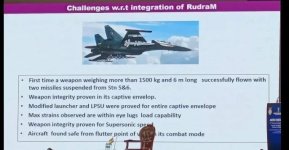
Mass of the Missile Confirmed to be >1500 kg
Challenges w.r.t integration of RudraM
• First time a weapon weighing more than 1500 kg and 6 m long successfully flown with two missiles suspended from Stn 5&6.
• Weapon integrity proven in its captive envelop.
• Modified launcher and LPSU were proved for entire captive envelope
• Max strains observed are within eye lugs load capability
• Weapon integrity proven for Supersonic sp
• Aircraft found safe from flutter point of its combat mode
Last edited: