

United States Navy (USN) : News & Discussions
- Thread starter Nick
- Start date
You are using an out of date browser. It may not display this or other websites correctly.
You should upgrade or use an alternative browser.
You should upgrade or use an alternative browser.


New Beach Landing Vessel For The Marine Corps Breaks Cover (Updated)
The Ancillary Surface Craft is part of a growing fleet of new amphibious vessels that is helping lay the groundwork for future Marine island-hopping operations.

New Beach Landing Vessel For The Marine Corps Breaks Cover (Updated)
The Ancillary Surface Craft is part of a growing fleet of new amphibious vessels that is helping lay the groundwork for future Marine island-hopping operations.
 www.twz.com
Liberator: Understanding the U.S. Navy’s New Seabed Carrier Killer
Liberator: Understanding the U.S. Navy's New Seabed Carrier Killer - Naval NewsLiberator has emerged from the U.S. Navy’s budget as a high-end standoff capability for uncrewed undersea vehicles (UUVs), enabling the deployment of heavyweight torpedoes on the seafloor.
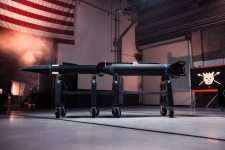
In 2025, the U.S. Navy quietly unveiled its Liberator program as an effort focused on developing, testing, and fielding a containerized heavyweight torpedo for expeditionary and contested environments.
The system is intended to serve as an extension of the U.S. Navy’s Orca Extra Large Uncrewed Undersea Vehicle (XLUUV) submarine as a stealthy, covert insertion tool for further employment of the service’s Mark 48 Advanced Capability (ADCAP) heavyweight torpedo. The deployable system, with its containerized (and encapsulated) ADCAP, appears to be designed around the Orca’s 10-meter-long multi-purpose payload module based on an attached requirement for Hunter — a known Orca payload delivery system — which, according to the budget documents, depends on Liberator’s development and testing to be tested and fielded.
In operational environments, Liberator could covertly be deployed from Orcas or other platforms to the seafloor of contested or denied waters some time in advance to patiently await high-value adversary submarines and surface ships.
Orcas and other XLUUVs could drop dozens of Liberator payloads in maritime chokepoints or hostile waters — all wielding ship-killing heavyweight torpedoes that have long been used as the final death blow during SINKEX ship-sinking test events.
US Navy Awards Castelion $90M for Blackbeard Hypersonic Weapon EOC
US Navy Awards Castelion $90M to Advance Blackbeard Hypersonic WeaponThe US Navy has awarded Castelion an $89.9M contract to advance the Blackbeard hypersonic strike weapon toward Early Operational Capability (EOC) by 2028.
**920km actually.Blackbeard is a compact, low-cost long-range hypersonic strike weapon designed specifically for high-rate mass production. Blackbeard features vertically integrated propulsion and guidance systems optimized to achieve speeds exceeding Mach 5 with an operational strike range of up to 500 nautical miles (approx. 800 km).**
While initially tested for land-based platforms, Blackbeard has quickly become a pivotal element of U.S. Navy carrier aviation strategy. The Navy is heavily prioritizing the weapon for integration onto the F/A-18E/F Super Hornet fleet, providing carrier air wings with a rapid-response, standoff hypersonic capability to penetrate modern anti-access/area-denial (A2/AD) bubbles.
95lb warhead seems to be the rumour.Blackbeard trades heavy warhead payload for unit affordability—aiming for production costs under $500,000 per round. By enabling high-volume magazine capacity on aircraft carriers, Blackbeard aims to compress enemy decision-making timelines and offer the U.S. Navy scalable, conventional strike volume across contested maritime environments.
Last edited:
FNSS Unveils U-MAV Unmanned Amphibious Vehicle
FNSS Unveils U-MAV Unmanned Amphibious Vehicle - Naval News
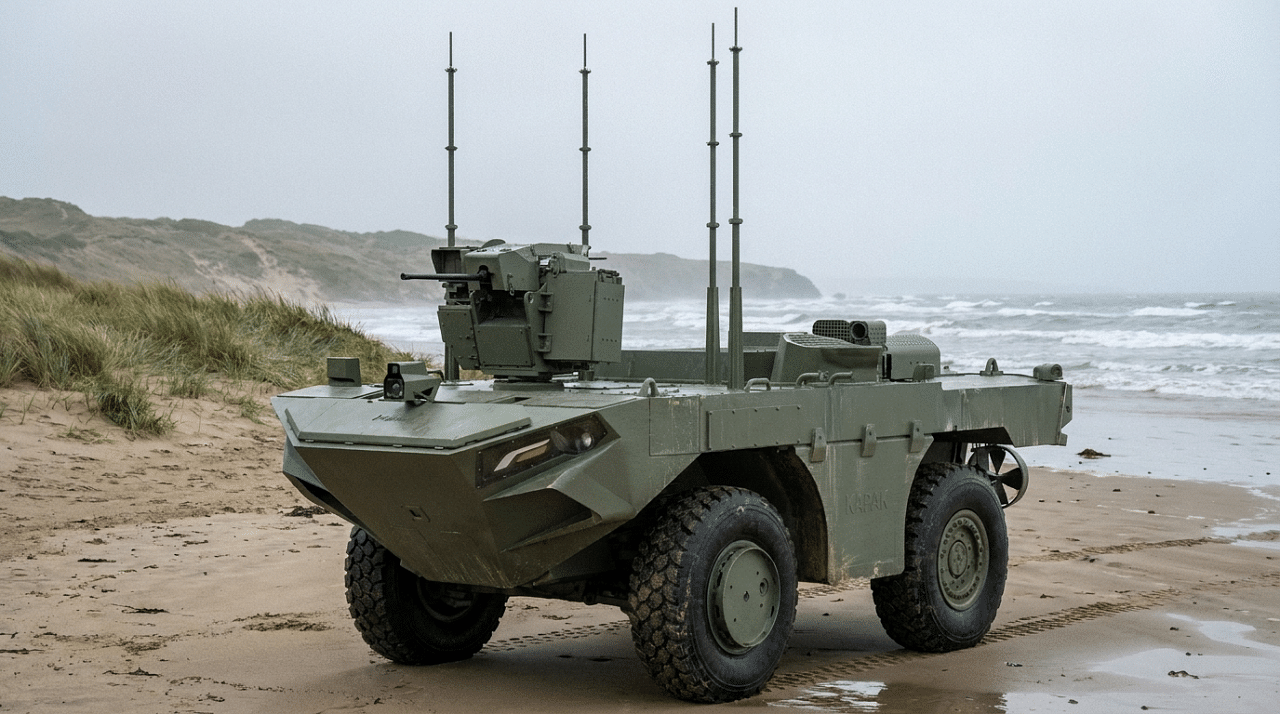
FNSS has unveiled the U-MAV Multi-Purpose Modular Unmanned Amphibious Vehicle (known as ZAHA) at TEKNOFEST Mavi Vatan.
 www.navalnews.com
The 8-ton platform transits from sea to shore without interruption, reaching 7 knots ashore and 70 km/h on land. Its modules can be changed in the field in approximately 40 minutes allowing ten different mission variants, from Fire Support and Mine Clearance to Electronic Warfare (EW) and Casualty Evacuation (CASEVAC).
US Navy RFI Details Plans for Carrier-Based Collaborative Combat Aircraft (CCA)

U.S. Navy RFI Details Plans for Carrier Collaborative Combat Aircraft
The US Navy officially issued an RFI for carrier-based Collaborative Combat Aircraft (CCA) to boost air wing mass alongside F/A-18E/F and F-35C fighters.
www.navalnews.com
The US Navy officially issued an RFI for carrier-based Collaborative Combat Aircraft (CCA) to boost air wing mass alongside F/A-18E/F and F-35C fighters.
SubSea Craft Unveils Modular Payload Cassettes for MARS USV
SubSea Craft Unveils Modular Payload Cassettes for MARS USV - Naval NewsSubSea Craft (SSC) has unveiled a new modular payload cassette system for MARS, their compact Unmanned Surface Vessel (USV), enabling the delivery of mission-configurable effects in contested environments.
Potential payload cassettes include loitering munitions, miniature torpedoes, Unmanned Aerial Vehicles (UAVs), sonobuoys and other mission-specific equipment, all delivered from the same core platform.
The payload cassette system has already supported the successful integration of the Anduril ALTIUS loitering munition, demonstrating MARS’ ability to rapidly integrate and deploy new effectors through a simple cassette exchange without modification to the vessel itself.