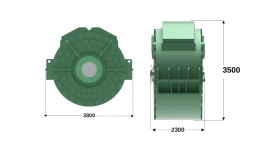
Project-76 Indigenous Diesel-electric Submarine (SSK) Program

Just a small correction: I think you meant type 214 rather than type 216.
As far as I'm aware, type 216 never progressed beyond the conceptual stage.

While Germany and Italy operate the Type 212A which is more stealthy because of it's non magnetic hull, the type 214 has much longer range, depth and endurance suited for our needs along with being longer. Our Type 214 might also incorporate technologies from the Type 212CG being developed for the Norwegian and German Navies.

That said, I do agree it's worth discussing a mix of additional Scorpènes and German submarines would provide the best balance between fleet numbers, capability, and technology absorption.

The CD, the Dakar, the 218, everything TKMS has sold after the baseline 214 is a derivative of the 216 concept.

Now what is coming in p75i, i cannot say for sure. But what I last remember discussing with Ashwin is that it's not exactly 214 or a derivative of 214.
 
  • Like
Reactions: Lolwa
But aip do take money, space and weight and volume

Why not just use those resources and add a bigger li-ion battery ?

Thats what Japanese did.

Anyways what u said, "Best of both world" is already in any aip subs except of li-ion its lead acid and its low energy dense

As lead acid was low energy dense hence having seperate aip was good idea but now with li-ion(and then ssb) , we can get 2-3 weeks of underwater as low speed with only li-ion


Infact i would say, semi sold state batteries are produced at industrial scale

We should get them,
they are much safer than li-ion or aip or any thing else

They also offer much better energy density and much better cycle life

My opinion:
go with semi sold for first 6 boat and fully solid with next 6(obv x shape rudder and all other things are necessary too)

We dont want/need 2000s submarine(scorpion) in 2035

Just because it fits Japan's use-case doesn't mean it's the solution for everyone. It depends on what our requirements are.

As I said, KSS-III uses an AIP+LIB setup, as that fits the Korean requirement. Our P-75I specifically required AIP + LIB:


FBz-Y4lVUAMF081.jpg

Among other upcoming boats, the Type-212CD (for Germany & Norway) also uses a Fuel Cell AIP + LIB setup. So it's apparent that there are several merits to this type of setup. The Japanese may consider LIB-only configuration as sufficient for their use case in the littorals of the First Island Chain or close by, but the same need not be true for everyone else.
 
HKQvZuHbIAATa4V
 
The biggest irony is that our scorpenes still don't have AIP. While the pakistanis have 2 submarine classes with AIP's.
And we have members here who are crying about the French milking us instead of pointing out the ridiculous procurement process.
Also our scorpenes still don't have any actual offensive capabilities.
Reported as of March this year, INS Khanderi (2nd of the lot) will head towards the refit this July, and is set to be the 1st one to receive the DRDO AIP. The AIP plug addition is expected to be completed by the end of this year.


Reported as of March this year, INS Khanderi (2nd of the lot) will head towards the refit this July, and is set to be the 1st one to receive the DRDO AIP. The AIP plug addition is expected to be completed by the end of this year
Same for heavy torps. They were part of the same deal. Naval Group is to help MDL integrate both EHWT and AIP.
NMRL's fuel cell based AIP is far quieter than anything Pakistanis are fielding. That'll give the navy some of its underwater edge. Now if they can sort out P75I and P76 in a reasonable timeframe.
 
Reported as of March this year, INS Khanderi (2nd of the lot) will head towards the refit this July, and is set to be the 1st one to receive the DRDO AIP. The AIP plug addition is expected to be completed by the end of this year.


Big vote of confidence from the IN.

As per some reports, NMRLs AIP was earlier going to be tested at sea on an old Kilo class hull before going aboard an operational boat.

Same for heavy torps. They were part of the same deal. Naval Group is to help MDL integrate both EHWT and AIP.
NMRL's fuel cell based AIP is far quieter than anything Pakistanis are fielding. That'll give the navy some of its underwater edge. Now if they can sort out P75I and P76 in a reasonable timeframe.

Apparently, Malaysian Scorpenes are already integrated with Black Shark torps. So the Kalvaris will likely get theirs almost as soon the first batch arrives.

The IN also has an RfI out for a new SLCM which could well find its way to the Kalvari class, esp if the IN picks Scalp Naval.
 
Last week's Chakra News episode has an interesting thumbnail art of the P-76 (the image isn't actually shown in the video, only in the thumbnail):


P76 thumbnail.jpg

P76 thumbnail 2.png

It's quite obviously AI-generated (possibly using the display model handed to Modi as a reference), but it's interesting nevertheless.
 
I don't know if this was posted before, posting this anyway. Medha Servo is making the electric motor to be used on the P76 class subs:
1792235290270.png
It is a 4.5 MW PMSM unit. Torque figures are not mentioned.
1792235301345.png

They have a prototype motor operational in their Kondakal, Telangana plant. Minister Vaishnaw recently visited this plant. If the video is anything to go by, seems like a quiet motor:

View attachment P-76 motor proto.mp4

The P-76 sub is said to be 3000-4000 tons submerged. A 4.5 MW motor is fine for a 3000-ton sub, that will give it a power-to-weight ratio similar to the Kilo class subs. But if it's a 4000-ton sub, it might be struggle in a hunter-killer role. I suppose the displacement will depend on whether or not it gets a VLS. But then if the 76 subs get VLS, these subs will probably not be used for hunter killer missions. That job will be left up to the Kalvari, P75I & the P77.

The sub will borrow tech developed for other sub programs. DRDO's AIP is supposed to be scaled up from a 13.5 kW to 20 kW unit. That would allow an estimated 16-18 days of endurance in low-speed mode & about 2.5-3 days in max speed.

Sonars, comms, periscopes, weapons etc. can all be borrowed from other projects. Wonder if they will go for a pumpjet.
 
Are we gonna use DMR-292A steel for P76 ?
Probably.

Is it equivalent to HY-100 ?
No. DMR-292A is an equivalent to HY-80. DMR-292A & HY-80 are in the 550 MPa+ yield strength class. HY-100's yield strength is much higher (690 MPa class). Higher yield strength gives a submarine greater diving depth.

The primary difference in composition between DMR-292A & HY-100 is carbon & nickel percentages. DRM-292A has 0.1% C & 1-1.5% Ni. HY-100 has 0.2% C & 2.5 - 4% Ni. But the advantage of the 292A is that it is very easily weldable & it retains much of its strength & toughness at sub-zero temperatures.

DMR-292A will do just fine for P-76. Many natural weak spots of the hull like hatches, propeller shaft bushings, torpedo tubes, VLS tubes etc. will use other stronger alloys. Like say MIDHANI's Titan-26 for bushings, Cu-Ni-90/10 & 70/30 for internal tubes, AIP tanks & cooling systems, DMR-1700 for VLS & torpedo tubes.

DMR-1700 is an interesting alloy. It is an aerospace grade steel with yield strength 1600 MPa+ & tensile strength of 1980 MPa+. It is on par if not better than Maraging Steel-250 in every parameter yet cheaper to produce. Maraging steel uses very high doses of Nickel & Cobalt & needs modern arc melters to produce high purity alloys. DMR-1700 is produced through Ladle refining & vacuum de-gassing route. Almost every major steel plant in India has these facilities. Scaling up production of the DMR-1700 will not be an issue. DMRL estimates once production ramps up, DMR-1700 would be 1/4th to 1/10th (depending on purity) the price of equivalent alloys.

For armour application, DMR-1700 can achieve 20-25% weight reduction for equivalent protection levels when compared to RHA. D6ac grade steel used on the SRBs of the Space shuttle has a yield strength of 1450 MPa & tensile strength of 1600 MPa. This is an old alloy but still considered an industry standard. D6ac needs an oil/salt bath quenching to prevent bending, wrapping & stress fractures. DMR-1700 sheets can be produced via standard industrial hot rolling & hot pressing.

DMRL hasn't fully revealed DMR-1700's composition.
 
I suppose the displacement will depend on whether or not it gets a VLS. But then if the 76 subs get VLS, these subs will probably not be used for hunter killer missions.
The IN likely wants fit HCM on P76 which would require VLS launch. These missiles need huge solid boosters to breach the water surface which would make tube launch impractical (even via 650mm tubes?)

If not a full VLS, we might see a VLS plug fitted into a lengthened sail (as seen on the Israeli Dakar class SSK) to keep the weight down. I wonder if P-75I might come a sail configuration similar to the Dakar class.
 
The IN likely wants fit HCM on P76 which would require VLS launch. These missiles need huge solid boosters to breach the water surface which would make tube launch impractical (even via 650mm tubes?)

The P75I will probably be a modified variant of the German Type-212CD. This is a guess based on the displacement, 212CD is the closer fit. Given, that P75I & P76 would be similar is size. For now, we can rely on the size of the 212CD.

For submarine VLS the length of the missile is the most critical dimension. The 212CD has a beam size of 10 m. So, the max length of missiles a sub this size can accommodate is ~8.5-9 m. Brahmos is 8.4 m in length.

I don't know if the P75I will have VLS. But if it is indeed based on the 212CD, then a VLS is doable. Same story for P76, a sub this size should be able accommodate Brahmos, Pralay, LR-LACM, SMART etc. Future ET-LDHCM has to be in this size range.

Of course, the P75I & P76 will have a torpedo magazine that can carry 30 charges (heavy weight torpedo & SLCMs).

If not a full VLS, we might see a VLS plug fitted into a lengthened sail (as seen on the Israeli Dakar class SSK) to keep the weight down. I wonder if P-75I might come a sail configuration similar to the Dakar class.

I hope not. Israelis are doing that to fit in a SLBM onto a SSK. A SSBK if you will. A stretched sail will add significant hydro-dynamic drag to the submarine. The increased weight & drag will slow down the submarine significantly. That's fine for a deterrence patrol, not for an attack submarine.
 
Do we have any information if they will have capability to launch sea-spider ATT ?
No idea.

Or are we developing indiginious ATT for surface and submerged ships ?
IN used the Mareech ATDS. But that is a soft-kill system. We don't have a hard-kill system yet. BDL & Rafael has been pitching the Torpbuster SP & SHADE systems to the IN. IN has evaluated these systems in 2021. NSTL has started work on a hard-kill solution. In the meantime, NSTL has developed "Mohini" acoustic expendable countermeasure system for submarines.

A domestic hard-kill solution still looks like a few years away. IN seems to be willing to wait it out.
 
The P75I will probably be a modified variant of the German Type-212CD. This is a guess based on the displacement, 212CD is the closer fit. Given, that P75I & P76 would be similar is size. For now, we can rely on the size of the 212CD.


Could be. Rajnath Singh was taken around a U212A on a visit to Germany. So the IN may be getting 212CD minus non mag steel and other NATO classified tech.

That said, TKMS offered the T216 design for the Australian sub prog which eventually turned into the AUKUS SSN. So you never know what it might turn out to be.
 
Last edited:
For submarine VLS the length of the missile is the most critical dimension. The 212CD has a beam size of 10 m. So, the max length of missiles a sub this size can accommodate is ~8.5-9 m. Brahmos is 8.4 m in length

I'd say the weapon of choice for P-75I is the Brahmos NG. Sub surface deployment was always the primary design driver for NG. The IAF is otherwise quite happy using Brahmos-A.
 
Could be. Rajnath Singh was taken around a U212A on a visit to Germany. So the IN may be getting 212CD minus non mag steel and other NATO classified tech.

That said, TKMS offered the T216 design for the Australian sub prog which eventually turned into the AUKUS SSN. So you never know what it might turn out to be.
Yep. We will have to wait & watch.

I'd say the weapon of choice for P-75I is the Brahmos NG. Sub surface deployment was always the primary design driver for NG. The IAF is otherwise quite happy using Brahmos-A.
Could be. I was going by max length of missile that can be accommodated in a 3000-4000 ton submarine. The Brahmos-A is excellent but given its size & weight it is limited to some specially modified Su-30 airframes. NG could be quite useful to the IAF as well, it could be deployed from Su-30s, Mig-29s, Mirages, Tejas etc. Provides a lot of flexibility.

Although, NG is not really a one-to-one replacement for the Brahmos-A.

IMO, a low-obserable (proper geometric stealth and costings) long range vector is missing
True. I am hoping the CATS Hunter will take up that role:

The Hunter will come with a ~300km range. Not really long range. I hope DRDO tries to make a stealthy version of the LR-LACM in the future.
 
I was reading about chinease (experimental ?) Type 041 submarine.

How people here think about it ??

I mean Japanese soryu class(4200 tonnes submerged) has 6MWe to move it at 20knot underwater.

So why not build a natural circulation reactor with 35MWth ?

It will be easily able to move sustained 8-10knots at silent and 20 knots sustained but some noise penalty.

I have no idea about how the reactor cost scale with reactor size.

Will it be too costly comapred to SSK ?

Isn't a 3-4 tonnes pure hunter killer SSN necessity when kill-chain for submarine launched antiship missiles is destroyed ?

Chinese CBG with awacs and J-35 can destroy any naval aerial surveillance assets of IN so having a large but cheaper(comapred to 10,000+ tonnes SSGN hybrid) a necessity ?

@Parthu any idea about cost factor of these cheaper SSN ? just using a small reactor of 35MWth ?