Pinaka Multi Barrel Rocket Launching System

Look Frenchies are never going to seriously buy our gear, those news are just idle gossip & were intended for their deals to speed up.
I think it was very evident from the get go, anyone with even half a brain cell knew what the Frenchies were trying to do, but that is besides the point bcz every single thing pointed out in that paper has merit independent of whatever the French were planning


This was probably an offer by us , a Brazil like give and take proposal which they will never seriously consider or use.
It was very foolish and naive of us, can't believe someone even thought this was a good idea, like you said it is pretty self evident they would never even seriously consider or use it.


First point is, the current Pinaka is MBRL an area weapon, Its role is to neutralise an area of approx 1km x 1 km/ 800 meter whatever.
Frenchies are looking for a precision MLRS where it is for pinpoint strike role at longer distance with 1 or 2 rockets, maybe 5-6 together.
I am not disagreeing with you but Area weapons from other countries (like to Koreans) have better CEP than 800 metres (at least they claim they do)

As for the French, while their demands for accuracy are different from ours and we have different priorities, would I be wrong in saying that Guided Pinaka can do better in terms of CEP.

Until the new variants are ready & established , we are unlikely to get any serious traction beyond the 122mm grad consumables ie rockets.
Agreed


DRDO initiated the long range guided rocket project much behind than others ,
Because the Army never asked for it, and the MoD or Netas never pushed for it,
Infact we were buying Smerch right after Inducting Pinaka,
And even the Smerch was not pursued diligently because Army saw no use for long Range MLRS, so no wonder DRDO never worked on it.

Infact correct me if I am wrong Solar Defence proposed a long Range MLRS but Army showed no interest and that was silently shelved.

But miraculously in big 2025 Army realised we need long Range MLRS and bamm we imported PULS MLRS instantly.

The truth is before 2025 army was not interested in long Range MLRS.


it means LRGR will be based on mature tech & can take lesser development time.
Still won't be ready by 2030,

Also if it will take less development time and the tech is already mature why aren't we developing the entire Range of MLRS like the Chinese, why aren't we developing our very own PHL 191

Are we waiting for the Army to have another revelation so that we can start development in 2030 and order it in 2040 just like Guided Pinaka

Guided Pinaka was tested in 2017 and a decade later in 2026 we still haven't ordered it.


IA ordering PULS is to gain experience on such a long range MLRS , features from it will be incorporated into our LRGR like systems. Without hands on training & use, army can not even write a GSQR properly, PSQR can be written as a fantasy weapon system like they do every time, often stretches the feasibility of a weapon system.
If we need to order foreign weapon to gain experience every single time what does it say about Army's competence.

Will we be also ordering mercenaries and Generals from Ukraine to gain experience in drone warfare and it's related command structure or are we going solo.

Indian army's inability to write coherent QRs only shows it's incompetence and nothing else.

It doesn't take a genius to figure out carrying 8 meter long Fire sticks (Smerch) on a 4x4 is utterly ridiculous, but somehow we have a QR from the army saying just that.


About the precision & jamming part, so in high jamming & spoofing environment the author can doubt the Indian system but not the EU/usa made one, we can guess why.
I have no doubt the reason for author's doubt is nefarious (borderline xenophobic even) but like you said earlier our LRUs for our GNC kits come from the outside.
If push comes to shove EU/USA can reconfigure these LRUs easily, but can we.


Is it any surprise why gps co-ordinate fed bombs started failing in Ukraine once high ew was deployed. Our module is designed with multi redundant channel so when gps is denied it switched to ins and cep remains very good now that precision of ins has become better than before. This was always need of the hour for us because we face ew degraded environment, therefore none of our missile ever rely on external signal. Very basic usp of ins being dead reckoning in nature.
Agreed but I think it's a bit disingenuous to compare INS with GPS, INS has its own inherent limitations
Also what is your basis for saying that others don't have INS just as good as ours, if switching to INS keeps in GPS denied environment keeps our CEP good won't that be the case with others too,

Lastly, show me one MBRL/MLRS made by western oems that flies at speed > 4 mach class. (I genuinely do not know).
Guided pinaka flies mach 3.4 i think, anything with guidance kit need to fly at reduced speed.
Genuinely curious, How is this even relevant ?
 
Last edited:

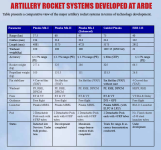
These are the latest figures in terms of CEP that I had come across. I do not know where the 60m is being picked from. Let us know the source. The requirement, stated to be 40m, has been met for IA.
60m was the CEP of Guided Pinaka

This was from DRDO tech focus, you can check this thread you will find the relevant snapshots
1773566412063.png
As for the 2-3 m CEP, that's not how CEP is calculated, you don't take the best result and use that as CEP
 
60m was the CEP of Guided Pinaka

This was from DRDO tech focus, you can check this thread you will find the relevant snapshots

As for the 2-3 m CEP, that's not how CEP is calculated, you don't take the best result and use that as CEP
Thank you for the table. I understand how the CEP is being cited and quoted (you'll note I avoided stating the best figures and went on to state that the 40m requirement of IA was being met by the present version). The error radius will never be larger than 60 meters under standard operating conditions. The actual accuracy in a given strike might be 40 meters or 50 meters, but the manufacturer guarantees the 50% spread will not exceed the 60-meter mark. It is a "worst-case" threshold (the image uses the "less than or equal to" symbol (<=) alongside a CEP value).
 
Last edited:
Note - The data being cited or discussed here for CEP comes from 2020/2019 or before that CY.

It is disappointing that the CEP values have not been made public since that time by ARDE (subsequent testing/development has happened since then).


Last edited:

Army adds Pinaka regiment amid growing focus on long-range firepower

Two more regiments from a batch of six ordered in 2020 are expected to be operationalised next year, which will take the total number of Pinaka regiments in service to ten.

NEW DELHI: The Indian Army has added another Pinaka regiment and is preparing to induct one more by the end of the year as it expands rocket artillery capability along the western and northern frontiers, it is learnt.

“The seventh regiment has already been operationalised. The eighth has been raised and has received more than half its equipment. It is currently undergoing conversion and should become operational before the end of the year,” sources in the defence establishment said.

Two more regiments from a batch of six ordered in 2020 are expected to be operationalised next year, which will take the total number of Pinaka regiments in service to ten.

The Army had ordered four Pinaka regiments between 2010 and 2020, with expansion accelerating after the Galwan Valley clash with Chinese troops in eastern Ladakh.

That year, the defence ministry inked contracts worth about Rs 2,580 crore with BEML, Tata Power Company Limited and Larsen & Toubro for six additional Pinaka regiments. The order included 114 launchers equipped with Automated Gun Aiming and Positioning Systems, 45 command posts and 330 support vehicles.

In artillery parlance, a regiment is the basic operational formation and typically comprises three batteries. Each battery operates six Pinaka launchers, giving a regiment 18 launchers in combat configuration. Two additional launchers are generally maintained for training and wartime replacement.

A single battery of six launchers can fire 72 rockets in about 44 seconds, covering an area of roughly 1,000 by 800 metres. Such barrages are intended to neutralise troop concentrations, artillery positions, logistics hubs and other high-value targets within minutes.

The Army fields multiple variants of the Pinaka system with progressively longer strike ranges. The original Mk-I rockets can strike targets at 37–40 km, the extended-range Mk-II reaches about 60 km, while guided Pinaka rockets can engage targets at around 75–90 km with greater accuracy.

In December last year, DRDO successfully tested a long-range guided rocket (LRGR) from a Pinaka launcher at a range of about 120 km with textbook accuracy. France is understood to be showing interest in this variant.

The requirement for a long-range, deep-strike rocket capability was identified during Operation Sindoor, following which the Army acquired two Indo-Israeli Suryastra long-range rocket launcher systems under the Emergency Procurement (EP) mechanism. The systems are currently undergoing live-fire trials before subsequent orders.

At present, the Army fields about 15 rocket artillery regiments across three platforms: seven Pinaka regiments, three Russian-origin Smerch systems and five older BM-21 Grad units. The Army plans to gradually replace the ageing Grad systems with additional Pinaka units, with long-term plans to expand the Pinaka fleet to about 22 regiments.

During Operation Sindoor last year, Pakistan fired a Fatah-II guided rocket that was intercepted by Indian air defence units over Sirsa in Haryana. Pakistan has claimed the system has a range of up to 400 km. In August last year, Pakistan also announced the creation of an Army Rocket Force Command (ARFC) to manage long-range rockets and missiles, modelled on its ally, China.

China, meanwhile, fields a far larger and more integrated rocket artillery capability. The PLA Ground Force operates systems such as the PHL-16 multiple launch rocket system, claimed to fire guided rockets to about 130 km and tactical missiles approaching 290 km. Integrated with satellites, drones and digital command networks, these systems allow Chinese forces to detect and strike targets deep inside contested areas along the Line of Actual Control (LAC).

In January this year, Army Chief Gen. Upendra Dwivedi said the military was working on the creation of a dedicated rocket-cum-missile force to manage conventional ballistic missiles, cruise missiles and multi-barrel rocket launcher systems.
 

Army adds Pinaka regiment amid growing focus on long-range firepower

Two more regiments from a batch of six ordered in 2020 are expected to be operationalised next year, which will take the total number of Pinaka regiments in service to ten.

NEW DELHI: The Indian Army has added another Pinaka regiment and is preparing to induct one more by the end of the year as it expands rocket artillery capability along the western and northern frontiers, it is learnt.

“The seventh regiment has already been operationalised. The eighth has been raised and has received more than half its equipment. It is currently undergoing conversion and should become operational before the end of the year,” sources in the defence establishment said.

Two more regiments from a batch of six ordered in 2020 are expected to be operationalised next year, which will take the total number of Pinaka regiments in service to ten.

The Army had ordered four Pinaka regiments between 2010 and 2020, with expansion accelerating after the Galwan Valley clash with Chinese troops in eastern Ladakh.

That year, the defence ministry inked contracts worth about Rs 2,580 crore with BEML, Tata Power Company Limited and Larsen & Toubro for six additional Pinaka regiments. The order included 114 launchers equipped with Automated Gun Aiming and Positioning Systems, 45 command posts and 330 support vehicles.

In artillery parlance, a regiment is the basic operational formation and typically comprises three batteries. Each battery operates six Pinaka launchers, giving a regiment 18 launchers in combat configuration. Two additional launchers are generally maintained for training and wartime replacement.

A single battery of six launchers can fire 72 rockets in about 44 seconds, covering an area of roughly 1,000 by 800 metres. Such barrages are intended to neutralise troop concentrations, artillery positions, logistics hubs and other high-value targets within minutes.

The Army fields multiple variants of the Pinaka system with progressively longer strike ranges. The original Mk-I rockets can strike targets at 37–40 km, the extended-range Mk-II reaches about 60 km, while guided Pinaka rockets can engage targets at around 75–90 km with greater accuracy.

In December last year, DRDO successfully tested a long-range guided rocket (LRGR) from a Pinaka launcher at a range of about 120 km with textbook accuracy. France is understood to be showing interest in this variant.

The requirement for a long-range, deep-strike rocket capability was identified during Operation Sindoor, following which the Army acquired two Indo-Israeli Suryastra long-range rocket launcher systems under the Emergency Procurement (EP) mechanism. The systems are currently undergoing live-fire trials before subsequent orders.

At present, the Army fields about 15 rocket artillery regiments across three platforms: seven Pinaka regiments, three Russian-origin Smerch systems and five older BM-21 Grad units. The Army plans to gradually replace the ageing Grad systems with additional Pinaka units, with long-term plans to expand the Pinaka fleet to about 22 regiments.

During Operation Sindoor last year, Pakistan fired a Fatah-II guided rocket that was intercepted by Indian air defence units over Sirsa in Haryana. Pakistan has claimed the system has a range of up to 400 km. In August last year, Pakistan also announced the creation of an Army Rocket Force Command (ARFC) to manage long-range rockets and missiles, modelled on its ally, China.

China, meanwhile, fields a far larger and more integrated rocket artillery capability. The PLA Ground Force operates systems such as the PHL-16 multiple launch rocket system, claimed to fire guided rockets to about 130 km and tactical missiles approaching 290 km. Integrated with satellites, drones and digital command networks, these systems allow Chinese forces to detect and strike targets deep inside contested areas along the Line of Actual Control (LAC).

In January this year, Army Chief Gen. Upendra Dwivedi said the military was working on the creation of a dedicated rocket-cum-missile force to manage conventional ballistic missiles, cruise missiles and multi-barrel rocket launcher systems.

So each regiment will have 18-20 launchers (the 2020 order for 6 regiments with 114 launchers would give each regiment 19 launchers).

10 regiments as per currently funded procurements will give us between 180 to 200 launchers in total. The prescribed eventual requirement of 22 regiments would give us between 396 and 440 launchers in total.

I believe the LRGR-120/300 rockets would only be included in these 12 regiments that are yet to be funded.

EDIT: Must say, while this is sizeable, it's not as much as I think we'll need. Remember we'll be retiring the Grads & Smerches too probably won't be around for long after LRGRs come in. Eventually we might come up with ballistic missiles or large loitering munitions that utilize the same launcher as well. That'll push need for numbers even higher.

Even Poland is procuring more than this (300 Chunmoo & 200 HIMARS).
 
Last edited:
Thank you for the table. I understand how the CEP is being cited and quoted (you'll note I avoided stating the best figures and went on to state that the 40m requirement of IA was being met by the present version). The error radius will never be larger than 60 meters under standard operating conditions. The actual accuracy in a given strike might be 40 meters or 50 meters, but the manufacturer guarantees the 50% spread will not exceed the 60-meter mark. It is a "worst-case" threshold (the image uses the "less than or equal to" symbol (<=) alongside a CEP value).

We are going to test RAMJET powered artillery by 2028. The great thing about this RAMJET powered MBRL artillery is that it will not compromise in warhead. i.e it will not fit into rocket to compromise warhead space but will be attached as attachment.

Ultimate aim right now is to extend the range of MBRL upto 500 k.m. This will be very useful in conflict against China as a counter of Chinese rockets of 300 K.M. range. We do have Pralay and Brahmos MK3 for specific role of hitting target behind mountains.
 
We are going to test RAMJET powered artillery by 2028. The great thing about this RAMJET powered MBRL artillery is that it will not compromise in warhead. i.e it will not fit into rocket to compromise warhead space but will be attached as attachment.

Ultimate aim right now is to extend the range of MBRL upto 500 k.m. This will be very useful in conflict against China as a counter of Chinese rockets of 300 K.M. range. We do have Pralay and Brahmos MK3 for specific role of hitting target behind mountains.
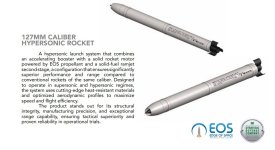
This is how I assume the Ramjet 122mm would look like.
1774343375480.jpeg

Not sure how practical this is from an economic perspective though.
 

HGcXl8YboAUf0oN
 
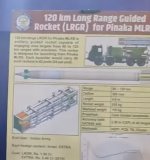
Pinaka LRGR Brochure (Most Likely Reused Brochure from Vigyan Vaibhav 2025)

1776792683952.jpeg
1776792693040.jpeg

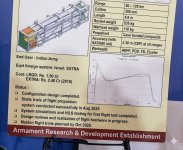
AI enhanced Version
1776792786127.jpeg

120 km range LRGR for Pinaka MLRS is an artillery guided rocket capable of engaging area targets from 80 to 120 km ranges with precision. This rocket is designed for launching from Pinaka MLRS. Each launcher would carry 08 such rockets in 02 pods (04 per pod).

Range : 80-120 km
Caliber : 300 mm
Length : 4.8 m
Rocket Weight : 535 kg
Warhead Weight : 110 kg
Propellent : Case Bonded Composite
Accuracy (with SATNAV Aid) : < 30m CEP at all ranges
Warhead : HEPF, PCB, TB, Cluster


End User : Indian Army
Equivalent Foreign System : Israel - EXTRA
Cost : LRGR - Rs 1.50 Cr VS EXTRA - Rs 2.40 Cr (2018)

Status :
Configuration Design Completed
Static trials of flight propulsion system conducted successfully in August 2025.
System Simulations and HILS testing for first flight test completed
Design reviews and realization of flight hardware in progress.
Maiden flight trials planned by October 2025.

Source :
 
CEP will need improvement (around 10m) if IA is going to use the 120km and beyond for deep precision strikes. If the parameter sees improvement, this can be an option which can act in addition to or independent of the SOWs that the IAF happens to possess. Also, quite the price difference.
1776792786127.jpeg

Range accuracy chart, AFAIK between 20km-100km range its CEP is between 15-20m, from 110-120km its CEP is <5m2
 
View attachment 51182

Range accuracy chart, AFAIK between 20km-100km range its CEP is between 15-20m, from 110-120km its CEP is <5m2
The highest peak of the curve never crosses the 30-meter line. If you look at the specification table above the graph, it states: Accuracy (with SATNAV aid): <= 30m (CEP) at all ranges.

This graph serves as the visual proof of that claim, demonstrating that regardless of whether the target is 20 km away or 100 km away, the system's guidance keeps the margin of error safely under that 30-meter threshold.

The margin of error can do with improvement if it is to be used as a precision strike option. If you are using it as an suppression weapon system, then it is fine.
 
CEP will need improvement (around 10m) if IA is going to use the 120km and beyond for deep precision strikes. If the parameter sees improvement, this can be an option which can act in addition to or independent of the SOWs that the IAF happens to possess. Also, quite the price difference.
That ≤30 m could be Army's cap requirements. ARDE director did mention getting 2-3 m CEP with the 214 mm guided Pinaka in user trials against what Army wanted at ≤40 m CEP (and you would have noticed they write ≤40 m in not all if majority of the charts).

 
Last edited:
That ≤30 m could be Army's cap requirements. ARDE director did mention getting 2-3 m CEP with the 214 mm guided Pinaka in user trials against what Army wanted at ≤40 m CEP (and you would have noticed they write ≤40 m in not all if majority of the charts).

I know. If you follow my posts on the thread, I had stated this a few posts back. I made that post about the CEP (10m) for the production variant (whenever that happens). It would ensure that the ER/Longer variants are able to meet certain standards when it comes to precision munitions. I am aware that the ARDE is fond of quoting ranges that might be on the lower end of things (that just meet the requirement quoted on paper). Just an observation.

I am thinking of using these along the lines of Chunmoo.

Google Search Results : The K239 Chunmoo multiple rocket launcher system, developed by Hanwha Aerospace, is highly precise, with guided munitions featuring a Circular Error Probable (CEP) of 15 meters or less. Its 239mm CGR-080 rockets have an 80 km range and a ~15m CEP, while larger, longer-range guided options can achieve even higher accuracy (under 2 meters in some configurations)

Source:
The CGR-080 is a 239 mm caliber precision-guided missile featuring a range of 80 km and a CEP (Circular Error Probability) of 15 meters. Guided by a GPS/INS guidance system, these missiles will serve as the core ammunition for Poland’s Homar-K (Polish variant of the Chunmoo Multiple Rocket Launcher System).

 
Last edited:
  • Like
Reactions: YoungWolf