People's Republic of China (PRC) : News & Discussions

Uttaragand?
Yup. It's the rump of Uttar Pradesh organised as a separate state since 2000 ruled for the first time by 'Na main nar hoon na nari hoon, main toh Narain Dutt Tiwari hoon ' as the first CM who also was a CM of UP once upon a time. <- Trivia.
 
China's Xi pays respect to Mao ahead of 70-year celebrations

China's Xi pays respect to Mao ahead of 70-year celebrations


CHRISTOPHER BODEEN

Associated PressSep 30, 2019, 9:26 AM


Sign Up

By subscribing, you are agreeing to Yahoo's Terms and Privacy Policy

07dc540a502bfe0e1c07eadff18dadc8

View photos

Schoolchildren carry flowers as they walk past floral wreaths at the Monument to the People's Heroes during a ceremony to mark Martyr's Day at Tiananmen Square in Beijing, Monday, Sept. 30, 2019, ahead of a massive celebration of the People's Republic's 70th anniversary. (AP Photo/Mark Schiefelbein, Pool)

More
BEIJING (AP) — Chinese Communist Party leader and President Xi Jinping led other top officials Monday in paying respects to the founder of the Communist state, Mao Zedong, ahead of a massive celebration of the People's Republic's 70th anniversary that will emphasize its rise to global prominence.

The unusual move saw Xi bow three times to Mao's statue at his mausoleum in the center of Beijing's Tiananmen Square and pay his respects to Mao's embalmed corpse, which has lain in state in the hulking chamber since soon after his death in 1976. It was believed to be the first visit to the mausoleum by Xi and other officials since 2013, the 120th anniversary of Mao's birth.

Xi also ascended the nearby Monument to the People's Heroes to pay further tribute on what has been designated Martyr's Day, just ahead of Tuesday's National Day festivities, which will be marked by a massive military parade through the center of the city of 20 million people.

Along with other top party officials, more than 4,000 Chinese including elderly military veterans and retired senior officials, "relatives of martyrs, honorees of national medals and honorary titles," and members of the party's youth organization visited the monument to lay flowers and wreathes.

Sept. 30 was designated Martyr's Day by China's legislature in 2014, a year after Xi became president and began redoubling propaganda efforts to promote patriotism and glorify the party, as well as to cultivate a cult of personality surrounding himself unseen since the time of Mao.

The nationwide celebrations seek to highlight China's enormous transformation from an impoverished state ravaged by Japan's World War II invasion and a following civil war into the world's second-largest economy. China now sits on the cutting edge of breakthrough technologies such as artificial intelligence and 5G communications and its growing military and diplomatic clout increasingly challenges U.S. leadership.

On Tuesday, Xi is expected to preside from atop iconic Tiananmen Gate over a parade that will display China's rapidly developing arsenal, possibly including the nuclear-capable Dongfeng 41 missile that could reach the United States in 30 minutes. Plans call for 15,000 troops, more than 160 aircraft and 580 pieces of military equipment to take part in the event.

The display of military prowess is seen as a way to underscore Beijing's ambition to enforce claims to self-governing Taiwan, virtually the entire South China Sea and territory held by Japan.

The anniversary comes as China appears more stable than ever, 30 years after the party used its military to crush a pro-democracy movement centered on Tiananmen Square. Xi has revived theatrical expressions of love of party and state that were popular under Mao and has rallied the nation to his call for the attainment of a "Chinese Dream" of global prominence, all while cracking down ruthlessly on any sign of political dissent.

Xi faces no serious political rivals and has brought the party to heel through a wide-ranging anti-corruption drive. Last year, he cemented his role as China's most powerful ruler of the modern era by amending the constitution to remove presidential term limits, sweeping away years of efforts to systematize leadership transitions and prevent the concentration of power in any one individual.

At the same time, Xi faces a slowing economy, aging population and an ongoing dispute over trade and technology with the U.S. that has restricted China's access to American technology and hit its imports with tariffs. Beijing has responded with duties on American products, and the escalating trade war threatens the global economy.

Xi also faces persistent anti-government protests in the semi-autonomous region of Hong Kong, where demonstrators and police clashed for a second straight day on Sunday. That sparked further chaos in the city's business and shopping belt and drew fears of more ugly scenes during the weeklong National Day holiday.

Protesters are planning to march again Tuesday despite a police ban, posing a possible embarrassment to Xi.

The protracted unrest, approaching four months, has battered Hong Kong's economy, with tourism plunging.

Many people view China as chipping away at the autonomy and freedoms Hong Kong was promised when the former British colony returned to Chinese rule in 1997.

Beijing has accused the U.S. and other foreign powers of fomenting the unrest in a bid to smear its reputation and weaken its control.
 
Samsung ends mobile phone production in China
Samsung Electronics Co Ltd (005930.KS) has ended mobile telephone production in China, it said on Wednesday, hurt by intensifying competition from domestic rivals in the world’s biggest smartphone market.

The shutdown of Samsung’s last China phone factory comes after it cut production at the plant in the southern city of Huizhou in June and suspended another factory late last year, underscoring stiff competition in the country.

The South Korean tech giant’s ceased phone production in China follows other manufacturers shifting production from China due to rising labor costs and the economic slowdown.

Sony also said it was closing its Beijing smartphone plant and would only make smartphones in Thailand.

But Apple (AAPL.O) still makes major products in China.

Samsung’s share of the Chinese market shrank to 1% in the first quarter from around 15% in mid-2013, as it lost out to fast-growing homegrown brands such as Huawei Technologies and Xiaomi Corp (1810.HK), according to market research firm Counterpoint.

“In China, people buy low-priced smartphones from domestic brands and high-end phones from Apple or Huawei. Samsung has little hope there to revive its share,” said Park Sung-soon, an analyst at Cape Investment & Securities.

Samsung, the world’s top smartphone maker, said it had taken the difficult decision in a bid to boost efficiency. It added it would however continue sales in China

“The production equipment will be re-allocated to other global manufacturing sites, depending on our global production strategy based on market needs,” it said in a statement, without elaborating.

Samsung declined to specify the Huizhou plant’s capacity or its numbers of staff. The factory was built in 1992, according to the company.

FILE PHOTO: The logo of Samsung Electronics is seen at its office building in Seoul, South Korea January 7, 2019. REUTERS/Kim Hong-Ji/File Photo

South Korean media said it employed 6,000 workers and produced 63 million units in 2017.

That year, Samsung manufactured 394 million handsets around the world, according to its annual report.

The company has expanded smartphone production in lower-cost countries, such as India and Vietnam, in recent years.
Samsung ends mobile phone production in China
 
China and Taiwan clash over Wikipedia edits

China and Taiwan clash over Wikipedia edits
By Carl MillerBBC Click

_109094028_4dd54728-a06c-4715-beb3-46fefa151b6f.jpg

Ask Google or Siri: "What is Taiwan?"

"A state", they will answer, "in East Asia".

But earlier in September, it would have been a "province in the People's Republic of China".

For questions of fact, many search engines, digital assistants and phones all point to one place: Wikipedia. And Wikipedia had suddenly changed.

The edit was reversed, but soon made again. And again. It became an editorial tug of war that - as far as the encyclopedia was concerned - caused the state of Taiwan to constantly blink in and out of existence over the course of a single day.

"This year is a very crazy year," sighed Jamie Lin, a board member of Wikimedia Taiwan.

"A lot of Taiwanese Wikipedians have been attacked."

Edit wars
Wikipedia is a movement as much as a website.

Anyone can write or edit entries on Wikipedia, and in almost every country on Earth, communities of "Wikipedians" exist to protect and contribute to it. The largest collection of human knowledge ever amassed, available to everyone online for free, it is arguably the greatest achievement of the digital age. But in the eyes of Lin and her colleagues, it is now under attack.

_109094037_2612e6f4-b408-4207-96e7-d5cf476f033d.jpg
Image captionJamie Lin - seen on the left - is one of many Taiwanese Wikipedians concerned about changes being made to the online encylopedia
The edit war over Taiwan was only one of a number that had broken out across Wikipedia's vast, multi-lingual expanse of entries. The Hong Kong protests page had seen 65 changes in the space of a day - largely over questions of language. Were they protesters? Or rioters?

The English entry for the Senkaku islands said they were "islands in East Asia", but earlier this year the Mandarin equivalent had been changed to add "China's inherent territory".

The 1989 Tiananmen Square protests were changed in Mandarin to describe them as "the June 4th incident" to "quell the counter-revolutionary riots". On the English version, the Dalai Lama is a Tibetan refugee. In Mandarin, he is a Chinese exile.

Angry differences of opinion happen all the time on Wikipedia. But to Ms Lin, this was different.

"It's control by the [Chinese] Government" she continued. "That's very terrible."

'Socialist values'
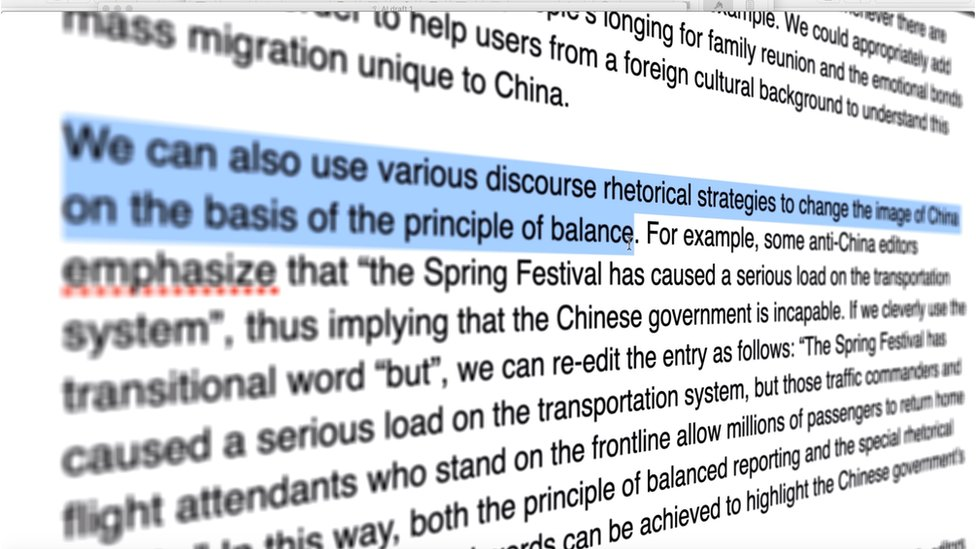
BBC Click's investigation has found almost 1,600 tendentious edits across 22 politically sensitive articles. We cannot verify who made each of these edits, why, or whether they reflect a more widespread practice. However, there are indications that they are not all necessarily organic, nor random.

Both an official and academics from within China have begun to call for both their government and citizens to systematically correct what they argue are serious anti-Chinese biases endemic across Wikipedia. One paper is called Opportunities And Challenges Of China's Foreign Communication in the Wikipedia, and was published in the Journal of Social Sciences this year.

In it, the academics Li-hao Gan and Bin-Ting Weng argue that "due to the influence by foreign media, Wikipedia entries have a large number of prejudiced words against the Chinese government".

They continue: "We must develop a targeted external communication strategy, which includes not only rebuilding a set of external communication discourse systems, but also cultivating influential editors on the wiki platform."

They end with a call to action.

"China urgently needs to encourage and train Chinese netizens to become Wikipedia platform opinion leaders and administrators… [who] can adhere to socialist values and form some core editorial teams."

Shifting perceptions
Another is written by Jie Ding, an official from the China International Publishing Group, an organisation controlled by the Chinese Communist Party. It argues that "there is a lack of systematic ordering and maintenance of contents about China's major political discourse on Wikipedia".

It too urges the importance to "reflect our voices and opinions in the entry, so as to objectively and truly reflect the influence of Chinese path and Chinese thoughts on other countries and history".

"'Telling China's story' is a concept that has gained huge traction over the past couple of years," Lokman Tsui, an assistant professor at the Chinese University of Hong Kong, told BBC Click. "They think that a lot of the perceptions people have of China abroad are really misunderstandings."

To Tsui, an important shift is now happening as China mobilises its system of domestic online control to now extend beyond its borders to confront the perceived misconceptions that exist there. Wikipedia has confronted the problem of vandalism since its beginning. You can see all the edits that are made, vandalism can be rolled back in a second, pages can be locked, and the site is patrolled by a combination of bots and editors.

People have tried to manipulate Wikipedia from the very beginning, and others have worked to stop them for just as long.

_109094031_e2b89896-3750-46e7-8cf0-570dffeb7fd6.jpg
Image copyrightGETTY IMAGESImage captionHong Kong's protests are one topic where there has been a back-and-forth over edits to descriptive words
However, much of the activity that Lin described isn't quite vandalism. Some - such as Taiwan's sovereignty - is about asserting one disputed claim above others. Others, subtler still, are about the pruning of language, especially in Mandarin, to make a political point.

Should the Hong Kong protests be considered "against" China? Should you call a community "Taiwanese people of Han descent", or "a subgroup of Han Chinese, native to Taiwan"?

It is over this kind of linguistic territory that many of the fiercest battles rage.

Coordinated strategy?
The attacks are often not to Wikipedia's content, but rather its community of Wikipedians.

"Some have told us that their personal information has been sprayed [released], because they have different thoughts," Lin said.

There have also been death threats directed at Taiwanese Wikipedians. One, on the related public Wikimedia Telegram Channel, read "the policemen will enjoy your mother's forensic report". And elections to administrator positions on Wikipedia, who hold greater powers, have similarly become starkly divided down geopolitical lines.

Attributing online activity to states is often impossible, and there is also no direct, proven link between any of these edits and the Chinese government.

"It's absolutely conceivable," Tsui continued, "that people from the diaspora, patriotic Chinese, are editing these Wikipedia entries. "But to say that is to ignore the larger structural coordinated strategy the government has to manipulate these platforms."

_109106428_extract-nc.png
Image captionIt has been argued that minor changes to Wikipedia entries can change readers' perceptions
Whilst unattributed, the edits do happen against the backdrop where a number of states, including China, have intensified attempts to systematically manipulate online platforms. They have done so on Twitter and Facebook, and researchers around the world have warned of state-backed online propaganda targeting a range of others.

Compared with almost any other online platform, Wikipedia makes for a tempting, even obvious, target.

"I'm absolutely not surprised," said Heather Ford, a senior lecturer in digital cultures at the University of New South Wales, whose research has focused on the political editing of Wikipedia. I'm surprised it's taken this long actually… It is a prioritised source of facts and knowledge about the world."

Of course, every state cares about its reputation.

"China is the second largest economy in the world and is doing what any other country in this status would seek," said Shirley Ze Yu, a visiting senior fellow at the LSE. "Today China does owe the world a China story told by itself and from a Chinese perspective. I think it's not only Chinese privilege, it's really a responsibility".

Taiwan is itself locked in a messaging war with China, with its own geopolitical points to make and many of the misconceptions may be genuine ones, at least in the eyes of the people who edit them.

So does this amount to telling China's story, or online propaganda?

At least on Wikipedia, the answer depends on where you fall on two very different ideas about what the internet is for. There is the philosophy of open knowledge, open source, volunteer-led communities.

But it may now be confronted by another force: the growing online power of states whose geopolitical struggles to define the truth now extend onto places like Wikipedia that have grown too large, too important, for them to ignore.

* The Chinese Embassy was approached for a comment but we did not receive a reply.

 
Chinese orienteering military athletes disqualified for cheating
The entire Chinese orienteering team has been disqualified for cheating at the Military World Games (MWG) in Wuhan, central China, organisers say.

The home team finished first, second and fourth in the women's middle-distance race and second among the men.

But it was soon discovered that they had been illegally aided by spectators and had used markings and small paths prepared for them during Sunday's race.

Their results were annulled after an appeal by other competing teams.

In a statement, the International Orienteering Federation (IOF), whose rules govern MWG competitions, said the competition "was unfortunately overshadowed by extensive cheating by the Chinese team".

The IOF said it had rejected an appeal from the Chinese athletes, and upheld the disqualification ruling.

The MWG are held every year, bringing together army athletes from around the world.

In orienteering, competitors find their way from one point to another using only a map and a compass, with the winner being the person who completes the course in the fastest time.

In April, three Chinese marathon runners were banned from competing for life after breaking the rules at the Boston Marathon.
China orienteering team disqualified for cheating