Lockheed Martin F-35 Lightning and F-22 'Raptor' : News & Discussion

Before revealing of F-47 there were many speculations of high supersonic high swept wing strike fighter.But then LM went out, otherwise it might have produced some X-jet from existing fuselage, rather than full clean-sheet design.
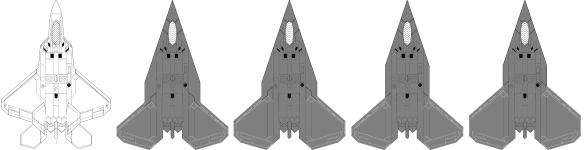
Imagine if F-22 Raptor married SR-72 Dark Star concept & reproduced SF-94 Dark Raptor.🦅⭐💍 👨‍👩‍👧

SR-72 Darkstar & F-22 Raptor.jpg


F-22 edited NGAD derivative protoype drawing, top view,cropped, PNG, V6a,b,c,d collage, dark g...png
 
Americans will probably have better or equally competent algorithm and hardware tech for APG 81 as comapred to RBE-2.
"probably". It is the key word.

It remembers me another history : when France decided to built it own deterrent sub and missile, Admiral Rickover, the US specialist, said "they will never succeed" because it was a so hard task for the great USN.
But we succeed.

Good day.
 
Fanboys are funny, They think the old Rafale radar is 5th gen

As to the nukes------

The US did not directly build or supply nuclear submarines to France. the US provided secret technical assistance on nuclear development in the 1970s and 1980s, allowing France to perfect its sovereign submarine programs (like the Le Redoutable-class SSBN).
Wikipedia +4


Historical Nuclear Collaboration

  • Secret Assistance: According to declassified historical records, the U.S. (under the Nixon and Kissinger administrations) secretly aided the French nuclear program in the 1970s and 1980s. This assistance helped France mature its weapons and reactor technology.
    Wikipedia

  • Civilian Reactor Licensing: France licensed Westinghouse Pressurized Water Reactor (PWR) technology from the U.S. for its commercial nuclear power grid. This allowed France to master uranium enrichment and reactor efficiency, indirectly benefiting its naval capabilities.
 
Fanboys are funny, They think the old Rafale radar is 5th gen

As to the nukes------

The US did not directly build or supply nuclear submarines to France. the US provided secret technical assistance on nuclear development in the 1970s and 1980s, allowing France to perfect its sovereign submarine programs (like the Le Redoutable-class SSBN).
Wikipedia +4


Historical Nuclear Collaboration

  • Secret Assistance: According to declassified historical records, the U.S. (under the Nixon and Kissinger administrations) secretly aided the French nuclear program in the 1970s and 1980s. This assistance helped France mature its weapons and reactor technology.
    Wikipedia

  • Civilian Reactor Licensing: France licensed Westinghouse Pressurized Water Reactor (PWR) technology from the U.S. for its commercial nuclear power grid. This allowed France to master uranium enrichment and reactor efficiency, indirectly benefiting its naval capabilities.
So, the US first declares that we’ll never succeed, and then helps us succeed? That’s certainly credible—a perfect illustration of the US's exemplary benevolence!
 
  • Like
Reactions: Bon Plan
No new PC:( but old S/w version but finally get to experiment & learn.
But this drawing i used so far for 2D edits has errors, some junction points don't match neither with real F-22 nor within the drawing's views. IDK by which tool the artist made it.
After this will be AMCA Mk1 & Mk2, 5gen TEDBF, 6gen AHCA, 5/6gen CCAs, next gen weapons, then some vehicles with wheels & tracks which are the tougher things, etc.:geek:😎

F-22 Raptor.blend-2.jpg
 
Last edited:
  • Like
Reactions: Photon Vish
So, the US first declares that we’ll never succeed, and then helps us succeed? That’s certainly credible—a perfect illustration of the US's exemplary benevolence!

All things are true, declassified records show they helped, there was a statement from the Admiral, it would be interesting to see the context of why it was said

If you are that butt hurt, you can say France helped git rid of British rule, so they owe you

Admiral Rickover, the US specialist, said "they will never succeed" AND According to declassified historical records, the U.S. (under the Nixon and Kissinger administrations) secretly aided the French nuclear program in the 1970s and 1980s. This assistance helped France mature its weapons and reactor technology.
 
I'll just plop this here.

Well cut my legs & call me shorty! How is the USAF planning to fit in this beast into the IWB of the F-35 Paddy. Besides when is this wunderwaffe expected? By the end of this decade or the next or closer to 2050 ?

In which case what's the point of equipping the next generation of TFs with a 1 MW generator for DEW like the one RR is developing for GCAP, Paddy?
 
As to the nukes------

The US did not directly build or supply nuclear submarines to France. the US provided secret technical assistance on nuclear development in the 1970s and 1980s, allowing France to perfect its sovereign submarine programs (like the Le Redoutable-class SSBN).
False. As susual with you.

-General De Gaulle would never had permit a US help, at least at the beginning.
-Le Redoutable SSBN was ordered in 1963 and launched in 1967... so no need of assistance in 70's or 80's

The sole help in the french deterrent program was a GB information (given by Sir William Cook) during the french race to thermonuclear warhead : we spare 6 months and a nuc trial, because the GB good advice was already on the french trials agenda. This advice, given in the form of a "Yes" or "No" to a question about a french researcher Carayol nuc configuration.
 
let me fill in a little gap


Before becoming one of the world’s top nonproliferation cops, France served as a global nuclear supplier. During the Cold War arms race, the French government was among those that provided Israel, India, South Africa, Iran, and Iraq with nuclear technologies. Except for possibly Iran, all these states endeavored to build nuclear weapons; so far, only Iraq has failed to do so.

French nuclear history also has important ties to the United States and its Cold War foreign policy. Despite public refusal to help the French program, the Eisenhower administration invited French officials to the Nevada Test Site and provided diagnostic instruments for use in Algeria. The Kennedy-era State Department participated in Franco-Algerian negotiations over continued French use of the test sites in the Algerian Sahara after Algerian Independence. The Johnson White House took a firmer stance, refusing further nuclear aid to France. Worried about the reliability of France’s nuclear arsenal, President Richard Nixon and his National Security Advisor Henry Kissinger secretly reversed US policy and launched unprecedented Franco-American cooperation on weapons design and safety procedures.
 
  • Like
Reactions: Innominate
let me fill in a little gap


Before becoming one of the world’s top nonproliferation cops, France served as a global nuclear supplier. During the Cold War arms race, the French government was among those that provided Israel, India, South Africa, Iran, and Iraq with nuclear technologies. Except for possibly Iran, all these states endeavored to build nuclear weapons; so far, only Iraq has failed to do so.

French nuclear history also has important ties to the United States and its Cold War foreign policy. Despite public refusal to help the French program, the Eisenhower administration invited French officials to the Nevada Test Site and provided diagnostic instruments for use in Algeria. The Kennedy-era State Department participated in Franco-Algerian negotiations over continued French use of the test sites in the Algerian Sahara after Algerian Independence. The Johnson White House took a firmer stance, refusing further nuclear aid to France. Worried about the reliability of France’s nuclear arsenal, President Richard Nixon and his National Security Advisor Henry Kissinger secretly reversed US policy and launched unprecedented Franco-American cooperation on weapons design and safety procedures.
To be invited in the Nevada test site, to be provided some instruments, to discuss of safety procedure are decisiv helps ?
Reliability of the french arsenal... How many nuc incident in France? How many nuc warheads lost?

You are not serious my little kangaroo.
 
To be invited in the Nevada test site, to be provided some instruments, to discuss of safety procedure are decisiv helps ?
Reliability of the french arsenal... How many nuc incident in France? How many nuc warheads lost?

You are not serious my little kangaroo.

Did you miss this bit?
Worried about the reliability of France’s nuclear arsenal, President Richard Nixon and his National Security Advisor Henry Kissinger secretly reversed US policy and launched unprecedented Franco-American cooperation on weapons design and safety procedures.


The Turks have started sounding the Russians out about a potential sale.
Yes, I heard they were going to the ME
 
  • Like
Reactions: Photon Vish
U.S. Navy wants fast fix for the F-35B’s sludge problem
Key Points
  • The U.S. Navy posted a sources sought notice on July 9, 2026, seeking a deployable cleaning system for F-35B lift fan clutch cooling systems.
  • Companies must respond within seven business days, by July 16, to be considered for the F-35 Joint Program Office's priority requirement.
The U.S. Naval Air Warfare Center Aircraft Division posted a sources sought notice on July 9 seeking companies capable of building a deployable cleaning system to remove what officials call “clutch sludge” from the F-35B’s short takeoff and vertical landing lift fan clutch cooling system, with responses due within just seven business days, by July 16.

The F-35B is the Marine Corps’ version of the F-35 Lightning II, purpose-built to take off from short runways or amphibious assault ships and land vertically like a helicopter, a capability no other fifth-generation stealth fighter in the world currently matches. That trick depends on a system called the Rolls-Royce LiftSystem, which uses a massive vertically oriented fan mounted behind the cockpit, called the LiftFan, to generate roughly 20,000 pounds of upward thrust by pulling in cool air and blasting it straight down, working alongside the engine’s rear exhaust nozzle to lift the aircraft without needing forward airspeed.

A clutch connects that LiftFan to the engine’s driveshaft, engaging only during vertical or short takeoff operations, and it is precisely that clutch, sitting at the mechanical heart of the jet’s signature capability, that has developed a contamination problem serious enough to warrant this week’s call for industry help.

According to the Navy’s own description of the issue, a mixture of carbon fiber dust and synthetic oil builds up inside the clutch cooling exhaust ductwork and vent panel screens over time, hardening into the substance officials are calling clutch sludge. That accumulation is not a brand-new discovery for the F-35B program, whose STOVL propulsion system has drawn scrutiny over clutch-related heating issues since early flight testing more than a decade ago. Pratt & Whitney, which builds the F135 engine powering the aircraft, disclosed in 2011 that clutch plates inside the lift fan system were making unexpected contact during normal, non-vertical flight, generating more heat than the clutch was originally designed to tolerate, a finding serious enough at the time that industry analysts questioned whether the entire F-35B design might need reworking.

Lockheed Martin responded by adding new heat sensors and requiring pilots to descend below 10,000 feet if clutch temperatures ran too high, buying the clutch cooler air until it could dissipate excess heat safely, an operational workaround that has apparently coexisted with this week’s newly identified sludge buildup problem in the years since.

The F-35 Joint Program Office’s propulsion support team is treating this specific cleaning capability gap with genuine urgency, describing the effort in the notice as priority action needed to secure expeditious support for evaluating clutch cooling system cleaning processes and equipment. Rather than developing an entirely new cleaning technology from scratch, the Navy wants companies with an existing commercial off-the-shelf cleaning system that can be modified specifically to fit the F-35B’s unique clutch hardware, a faster path to fielding a working solution than commissioning custom engineering work from zero. The specifications the Navy laid out are demanding but specific: the system must control water temperature, pressure, and quality precisely enough to strip away hardened sludge without damaging surrounding aircraft components, capture and recover all wastewater and removed contaminants to meet environmental compliance requirements, and include a specially designed apparatus that can safely mate to the F-35B’s distinctive clutch hardware.

The Navy explicitly wants a system that ground crews can transport and set up on-site at various Marine Corps air stations rather than one that requires shipping the aircraft or its components back to a centralized depot facility for cleaning, a distinction that matters enormously for aircraft availability. Every F-35B pulled offline for depot-level maintenance represents a jet unavailable for training, deployment readiness, or actual combat operations, and a field-deployable cleaning solution would let maintainers address clutch sludge contamination directly at the squadron level, potentially in a matter of hours or days rather than the weeks a depot trip might otherwise require.

That readiness math carries real weight given how central the F-35B has become to Marine Corps aviation planning. The aircraft represents the Marine Corps’ primary strike fighter platform for both conventional land-based operations and expeditionary missions from amphibious assault ships, a role that depends entirely on the STOVL capability the LiftFan and clutch system make possible in the first place. Any recurring maintenance issue affecting that specific propulsion hardware touches directly on how many F-35Bs the Marine Corps can actually keep flying at any given time, a concern that becomes more pressing as the broader F-35 fleet has continued expanding and aging simultaneously across U.S. and allied militaries worldwide.