Lockheed Martin F-35 Lightning and F-22 'Raptor' : News & Discussion

@Lolwa
Remember when I told you that forget about fighting with F-35s, our jets won't even take-off without initiation codes from LM. Once again everything I said is proving right, isn't it;)
A rather well-known fact that it needs activation codes to take off. Stop acting like you broke some "ground-breaking news" from your "insider sources". It's getting a bit tiring, mate.
 
A rather well-known fact that it needs activation codes to take off. Stop acting like you broke some "ground-breaking news" from your "insider sources". It's getting a bit tiring, mate.
I don't have any "insider sources" at Lockheed Martin, bro🤣. I earlier said that F-35 is dangerous for us because first it won't take-off without "initiation codes" provided by LM and second it was deangerous for our AFNET Nodes 'cause F-35 is designed for cyber warfare and it could pass all sensitive data of our IACCS to Uncle Sam along with planting a virus in it.

You say it is obvious but yet many respected members of this forum like @Lolwa, @Parthu etc. don't believe it. Hence when that LM engineer(who was indeed an insider) confirmed what I have saying, I got to mention it. If you get offended by it then it isn't my problem.
 
  • Like
Reactions: batman

Flying Blind: Why New F-35 Lightning II Stealth Fighters Are Arriving Without Radars


The U.S. military faces a critical combat readiness gap as new F-35 Joint Strike Fighters begin arriving without operational radars. Delayed by the complex certification of the next-generation APG-85 system and an incompatible forward bulkhead redesign, these incoming stealth jets will carry ballasts and remain strictly barred from combat missions.

Summary and Key Points: Defense expert Jack Buckby notes that the U.S. military is preparing to accept delivery of new F-35 Joint Strike Fighters that might be incapable of seeing the battlefield.

-Starting this autumn, stealth fighters slated for the Block 4 modernization package will roll off the assembly line without their primary radar systems installed due to severe delays with the next-generation AN/APG-85. Instead, these multi-million dollar jets will carry a physical ballast in the nose to maintain flight balance.

-Because the new radar requires a structurally redesigned forward bulkhead, the aircraft cannot simply be retrofitted with older radar models, leaving the Pentagon with a growing fleet of 5th-generation fighters that are restricted to training and strictly prohibited from combat operations.


F-35 Radar Delays Mean New Jets Won’t Be Combat Ready

The U.S. military is reportedly preparing to accept new F-35 Joint Strike Fighters that cannot be used in combat in the short term, according to comments by Rep. Rob Wittman to Breaking Defense.

Per the March 19 report, new F-35s delivered starting this autumn will arrive without their primary radar system installed, instead carrying a ballast in its place to maintain flight characteristics.

The problem centers around delays to the AN/APG-85 radar, a next-generation active electronically scanned array (AESA) system intended to replace the current APG-91 and form a core part of the aircraft’s Block 4 modernization package.

Aircraft delivered without radar will technically be airworthy but not combat-coded, meaning they cannot be used for operational missions such as air combat or precision strikes.

Rep. Wittman, who chairs the House Armed Services tactical air and land forces subcommittee, confirmed the news, noting that the U.S. will soon have “lots of aircraft out there, but not ones that are ready to go to the fight.”

Depending on how long the radar delays persist, the number of affected aircraft could range from a small batch to more than 100 jets over the next two years.

The Radar Delay Explained

The AN/A-G-85 radar is an upgraded sensor designed to significantly improve detection range and tracking performance compared to the existing APG-81. Modern AESA radars like the APG-85 use hundreds or thousands of small transmit/receive modules to electronically steer the radar beams without moving parts, allowing for faster target tracking and greater resistance to jamming. However, the APG-85 has been delayed primarily because of the complexity of the required certification.

Speaking to the media, Wittman said that the older APG-81 could be certified in a matter of days, but that the newer systems require significantly longer validation processes due to the increased capability and the more extensive integration requirements. In short, it’s a more complex design that requires additional work on the F-35 to ensure that it functions and fits.

The delay has therefore caused problems with supply, either forcing aircraft production to be delayed or requiring aircraft to be shipped without parts. Aircraft in Lot 17 were built expecting the new radar to be ready, but it is not yet available at scale. As a result, the jets were manufactured and delivered without any radar installed – for now.

So, the aircraft can fly, but they cannot independently detect or ngage target, meaning they are missing their core combat function.

Which Aircraft Are Affected

The U.S. Marine Corps is expected to be the first affected by the decision, with F-35B short takeoff and vertical landing variants beginning to arrive without radars within months. The Air Force and Navy are expected to follow later in 2026.

For now, though, the Air Force has confirmed that its Lot 17 F-35A aircraft are still being delivered with the current APG-81 radar, but that situation will change as production continues.

The issue of production scale makes it even more significant. The Pentagon’s F-35 contracts include up to 126 aircraft in Lot 17 and roughly 148 aircraft in each of Lots 18 and 19, with a mix of U.S. and international customers.

However, foreign buyers are not expected to be affected by the news. The APG-85 has not been cleared for export, though, meaning that international customers will continue to receive aircraft equipped with the existing APG-81 radar.

Why the APG-85 Isn’t An Easy Replacement

Adding to the delays, the APG-85 is causing some frustration because it cannot be easily swapped with its predecessor. The APG-85 is not a simple replacement for the APG-81 in that it requires a redesigned forward bulkhead – the structural section of the aircraft that houses the radar – to be installed. That means the F-35, as it stands, is not built for the new radar and requires adjustments – and that also means the newer aircraft cannot simply be shipped with the old radar, given that those adjustments have been made.

The program is currently working on a revised bulkhead that could accommodate both radar types, but that solution is not expected until Lot 20 production, which is scheduled to begin in 2028.

The problem exists because the Pentagon procures this kind of hardware, effectively allowing contractors to build the aircraft while key systems are still in development. The F-35 Joint Program Office recognizes that this kind of strategy carries risk, but the decision was taken deliberately with full awareness of those risks. Simultaneous building theoretically prevents delays, allows aircraft to be rolled off the line sooner, and avoids producing older aircraft that might later require extensive retrofits. Evidently, that tradeoff is now backfiring in some sense, and it’s clear that decisions about the design of the bulkhead should have been made earlier.

What It Means for Combat Capability

Radar systems are central to modern fighter operations, allowing aircraft to detect targets and track them and guide missiles. Without radars, there is no real situational awarenessm and an aircraft becomes heavily dependent on external data sources.

While the F-35 can share data via secure datalink and receive targeting information from other platforms, using that approach – should these radar-less aircraft be deployed in combat at all – introduces some latency. Pilots cannot respond as quickly as they would with the proper equipment, and would also be highly dependent on communication networks that can be disrupted or jammed in contested environments.

Assuming current timelines hold, the issue may not be resolved fully for another two years when Lot 20 production begins – leaving a multi-year window in which newly built aircraft fall well short of full combat capabilities at a far-from-ideal time.

 
  • Like
Reactions: Rajput Lion
They are making a big fuss over 100 units till the APG-85 is ready


The F-35 Is Its Own Enemy​

Air Force F-35 Lightning II
Credit: US Air Force
Paradoxically, Australian Defence Industry Minister Pat Conroy said at the time that there were two main reasons for keeping the Super Hornets in service and to cancel or delay the fourth F-35 squadron. One reason was that the Super Hornets were "doing great work." The second, and counterintuitive, reason was that the "Joint Strike Fighter [F-35] is even more capable than we initially thought."

In other words, the F-35 is so advanced that Australia doesn't currently see the need to purchase more of them to reach the level of capabilities that it requires. The lower number of F-35s gives Australia the desired capability, taking pressure off purchasing more of them. Australia's squadron of Growlers is also significant. It is the only operator of dedicated electronic warfare aircraft outside of the United States Navy.
 
They are making a big fuss over 100 units till the APG-85 is ready


The F-35 Is Its Own Enemy​

Air Force F-35 Lightning II
Credit: US Air Force
Paradoxically, Australian Defence Industry Minister Pat Conroy said at the time that there were two main reasons for keeping the Super Hornets in service and to cancel or delay the fourth F-35 squadron. One reason was that the Super Hornets were "doing great work." The second, and counterintuitive, reason was that the "Joint Strike Fighter [F-35] is even more capable than we initially thought."

In other words, the F-35 is so advanced that Australia doesn't currently see the need to purchase more of them to reach the level of capabilities that it requires. The lower number of F-35s gives Australia the desired capability, taking pressure off purchasing more of them. Australia's squadron of Growlers is also significant. It is the only operator of dedicated electronic warfare aircraft outside of the United States Navy.

No, the plan is to buy a squadron of F-47s instead of the 4th F-35 squadron.
 
If it was thought to be needed, We could do both, a 4th squad and 6th gen fighter or bomber, Look at what we are spending on subs, a 4th squadron is insignificant

RAAF say we don't need a 4th squadron and the F-35 is better than we expected, They are not shy with their opinions
So therefore, the plan is to replace the Super Hornet around 2040, Which replaced our bomber the F-111
We are looking at GCAP and probably F-47, There is also talk of the B-21, 2035 will have a clearer picture

I don't know if you looked at our various air platforms, The capability is exceptional and superior to some other 'unnamed' middle powers

 
Last edited:
  • Informative
Reactions: Shan
If it was thought to be needed, We could do both, a 4th squad and 6th gen fighter or bomber, Look at what we are spending on subs, a 4th squadron is insignificant

RAAF say we don't need a 4th squadron and the F-35 is better than we expected, They are not shy with their opinions
So therefore, the plan is to replace the Super Hornet around 2040, Which replaced our bomber the F-111
We are looking at GCAP and probably F-47, There is also talk of the B-21, 2035 will have a clearer picture

I don't know if you looked at our various air platforms, The capability is exceptional and superior to some other 'unnamed' middle powers

What's all this in aid of Pops ? Admittedly NZ is a powerful opponent & Papua & New Guinea an equally powerful enemy. Then there's Fiji which can give nightmares to any normal country.

Who else are you planning against ? China ? Probably as back up to the USN & USAF ? Or future planning against Indonesia ? Hope you aren't planning to dominate the Pacific upto the Chilean coast coz the sea traffic in that part of the world is negligible . Unless of course Oz has its eyes set on Easter Island.
 
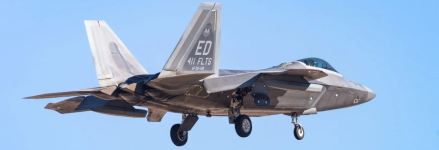
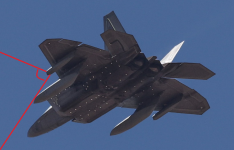
1 of the stealthy sensor pod looks EO & other like EW.
So the fuselage acts as a blindspot, can't look the other side.
Then how will F-22 have spherical coverage? 🤔 :rolleyes:
Will 1 group of few data-linked F-22s do the IRST for other clean config F-22s?

1775492351494.png
1775492361786.png

Below i'm assuming that the IRST sensor can look up/down +/- 45 degrees & 180 degrees in azimuth.
RED zone is blindspot.
YELLOW zone is scanned zone.

1775492383213.png
1775492393593.png
 
If few data-linked F-22s do the IRST for other clean config F-22s, then the flight group would look like this -

View attachment 51029
But wouldnt the issue with the IRST be that it would be significantly easier to track the F22s with the external IRST.
Yea the middle ones dont have IRST pods but when you see 2 F22s on your screen with IRST pods you assume or at least take into account the risk of other F22s being there as well.
 
But wouldnt the issue with the IRST be that it would be significantly easier to track the F22s with the external IRST.
Yea the middle ones dont have IRST pods but when you see 2 F22s on your screen with IRST pods you assume or at least take into account the risk of other F22s being there as well.

Till F-47 arrives they need some work-around which is this 5.5gen MLU.
The pods & EFTS are quoted as stealthy, with RAM & have slant geometry also. They definitey have better RAM than in 1990s & 2000s & they must have done all RCS testing.
The glass aperture of EO pod are also geometric & may have some coating like the cockpit has, provided it doesn't degrade the IRST much.
The stealthy EFT cannot fall into enemy hands, so the jet with it would strategically remain farthest with AIM-260 JATM BVR-AAMs. The AIM-9X CCM has LOAL mode. So those ninja TVC moves may not be required🥷🙅‍♂️ when other clean config F-22s would be around.
 
For those that think that Israel is doing its own software, They are paying LM $281m


Government Description
F-35 lightning II FMS support contract. This contract includes development, integration, and testing of Israel-unique software data loads to support integration of Technology Refresh 3 (TR3) onto F-35 lot 15 Israel production aircraft, reverification of select 3F+ software capabilities, airworthiness-related flight testing, and weapons certification updates for TR-3 aircraft. Additional work encompasses integration of indigenous weapons, customer-unique capability development, continued capability integration, software development, systems engineering, and program management support for the Israel system development and design phase II efforts. The contract also provides for spice adapter assembly, cni follow-on support, and ongoing technical and program support activities.

Amendment Since initial award the Potential End Date has been extended from 02/02/24 to 06/30/28 and the
Potential Award value has increased 396% from $56,856,429 to $281,848,802.
FMS This contract was partially or fully funded by foreign funds as part of the Foreign Military Sales (FMS) assistance program.
Sole Source This Definitive Contract was awarded sole source to Lockheed Martin Corporation because the government believes that only one company can provide the product / service (FAR 6.302-1).

 
  • Like
Reactions: babablacksheep

Finland faces costly F-35 upgrades as Block 4 delays persist

Finland’s new F-35A Lightning II fighters will arrive with fewer capabilities than originally agreed in the country’s procurement deal, and the Finnish Air Force will have to carry out significant upgrades at its own expense, the head of Finland’s F-35 program told Finnish daily Helsingin Sanomat in an article published on April 9, 2026.

The issue stems from persistent delays to the F-35’s Block 4 upgrade, a sweeping modernization of the aircraft’s software, sensors and weapons systems that Lockheed Martin originally claimed would include more than 75 major new capabilities. In September 2025, the US Government Accountability Office (GAO) estimated that Block 4 would not be completed before 2031 at the earliest, representing a five-year slip from the original timeline.

The number of planned capabilities has since been reduced so that the program can in fact be completed.

Retrofits at Finland’s expense

Henrik Elo, the head of Finland’s F-35 program, told Helsingin Sanomat that new features would be added to Finland’s aircraft as upgrade packages become available. Some upgrades will be installed before the fleet reaches full operational capability, which is planned for 2030, but others will follow well after that milestone.

Elo suggested that the final retrofits could extend beyond the middle of the 2030s, with a more precise schedule still to be determined. The upgrades will span software to hardware, he said.

Finland will not receive compensation from Lockheed Martin for its jets requiring post-delivery retrofits due to the Block 4 delays. The same applies to engine modernizations that will also be needed. Helsinki will bear the cost of both.

Elo declined to put a figure on how much the retrofits would come to, but indicated they could be covered in part by the existing F-35 project budget and in part by the fleet’s operating and maintenance funding. Finland’s F-35 deal, finalized in February 2022, covers 64 aircraft and has been valued at approximately 10 billion euros ($9.4 billion), including weapons and support.

Engine modernization adds another layer

The delays do not stop at avionics and software. Block 4’s new capabilities demand more electrical power and cooling capacity than the current Pratt & Whitney F135 engine can provide. An entirely new engine was initially considered, only to be dropped on cost and schedule grounds, in favor of an engine core upgrade (ECU) to the existing powerplant.

That ECU is not yet in production. In its September 2025 report, the GAO declared that it would not enter production before 2031, meaning that some Block 4 capabilities requiring the upgraded engine will be deferred even further, potentially to 2033 or later.

Finland’s Air Force therefore faces two overlapping modernization efforts after its fleet reaches operational capability: completing the Block 4 software and hardware retrofits, plus upgrading all of its engines.

A familiar pattern for F-35 customers

Finland is far from the only customer affected by this issue. The Block 4 delays and the underlying problems with the Technology Refresh 3 (TR-3) hardware package have rippled across the global F-35 fleet.

The GAO reported that all 110 F-35s delivered by Lockheed Martin in 2024 had been late, by an average of 238 days, largely because of TR-3 integration issues. A January 2025 report from the Pentagon’s Director of Operational Test and Evaluation found that no combat-capable TR-3 aircraft had been delivered to the US military through the end of fiscal year 2025.

In Switzerland, rising costs linked to the F-35 program forced the government to cut its planned order from 36 aircraft to approximately 30 in March 2026. This came after Bern concluded that it could not enforce the fixed price it believed had been agreed with Washington.

Block 4 costs have grown from an original estimate of $10.6 billion to $16.5 billion as of 2021, with a further $6 billion in overruns identified since. The Pentagon has narrowed Block 4’s scope to focus on capabilities that can realistically be delivered by 2031 without depending on the engine upgrade.

Finland’s first F-35A, designated JF-501, was rolled out in December 2025 and arrived at Ebbing Air National Guard Base in Arkansas for pilot training earlier this year. All 64 Finnish jets are being built in the TR-3 configuration. The first aircraft are expected to arrive on Finnish soil in 2026, with initial basing planned at Rovaniemi in Lapland.

Finland selected the F-35A in December 2021, choosing Lockheed Martin’s offering over bids from Boeing, Dassault, Saab and the Eurofighter consortium. The aircraft are intended to replace Finland’s legacy fleet of F/A-18C/D Hornets, which are to be phased out between 2025 and 2030.


This article is generally sound, and it highlights a real problem: Finland will receive TR-3-standard F-35s before all the capabilities promised by Block 4 and the engine upgrade are actually available, and it will have to finance a significant portion of the retrofits itself.

The key points are as follows. The GAO clearly stated in September 2025 that the reduced Block 4 would not be completed until 2031 at the earliest—five years behind the initial schedule—and that certain delayed capabilities fall outside the scope of Block 4 itself. The same GAO also indicated that the Engine Core Upgrade (ECU) is not expected to enter production before 2031, which further pushes back certain capabilities dependent on increased power and cooling to 2033 or beyond.

Regarding the TR-3 situation, the overall picture is consistent. Reuters noted that TR-3 deliveries had resumed with combat training capability but not yet full combat capability, which explains the Pentagon’s withholding of payments. And the DOT&E FY2025 report did indeed conclude that no combat-capable F-35 TR-3s had been delivered to U.S. services by the end of fiscal year 2025.

As for Finland itself, the new information appears to come from Henrik Elo via Helsingin Sanomat, and was subsequently picked up by AeroTime. The report is credible in substance: the 64 Finnish F-35s are indeed being built in the TR-3 configuration, the first Finnish aircraft was indeed unveiled in late 2025, the first deliveries to Finland are expected starting in 2026, and full operational capability is targeted for around 2030.

Where the article is particularly interesting is when it states that Finland will not be compensated by Lockheed Martin for these post-delivery retrofits. This is highly plausible and even consistent with the program’s overall logic: the customer receives the aircraft in the contractually agreed configuration and then funds the upgrades, especially when they stem from the program’s overall evolution rather than an isolated defect. The mechanism described is consistent with how the F-35 program operates elsewhere.

The Swiss example further reinforces the overall picture. Reuters did report in March 2026 that Switzerland was reducing its planned purchase from approximately 36 to 30 aircraft due to rising costs. This does not directly prove that Finland will face the same level of cost overruns, but it shows that European customers are beginning to feel the cumulative effect of the program’s cost overruns in concrete terms.

Finland fits squarely into the classic F-35 model, where one purchases today an airframe and architecture intended to evolve over the long term, with a significant portion of the cost passed on to the user through retrofits. What Finland is getting is not exactly “the final aircraft promised in 2021,” but rather an entry point into a modernization trajectory that is still unfinished, with part of the financial burden falling on Helsinki.

Finland is not just purchasing 64 F-35s; it is also purchasing the obligation to finance, for years to come, the maturation of a standard that has not yet been finalized.
 

Finland faces costly F-35 upgrades as Block 4 delays persist

Finland’s new F-35A Lightning II fighters will arrive with fewer capabilities than originally agreed in the country’s procurement deal, and the Finnish Air Force will have to carry out significant upgrades at its own expense, the head of Finland’s F-35 program told Finnish daily Helsingin Sanomat in an article published on April 9, 2026.

The issue stems from persistent delays to the F-35’s Block 4 upgrade, a sweeping modernization of the aircraft’s software, sensors and weapons systems that Lockheed Martin originally claimed would include more than 75 major new capabilities. In September 2025, the US Government Accountability Office (GAO) estimated that Block 4 would not be completed before 2031 at the earliest, representing a five-year slip from the original timeline.

The number of planned capabilities has since been reduced so that the program can in fact be completed.

Retrofits at Finland’s expense

Henrik Elo, the head of Finland’s F-35 program, told Helsingin Sanomat that new features would be added to Finland’s aircraft as upgrade packages become available. Some upgrades will be installed before the fleet reaches full operational capability, which is planned for 2030, but others will follow well after that milestone.

Elo suggested that the final retrofits could extend beyond the middle of the 2030s, with a more precise schedule still to be determined. The upgrades will span software to hardware, he said.

Finland will not receive compensation from Lockheed Martin for its jets requiring post-delivery retrofits due to the Block 4 delays. The same applies to engine modernizations that will also be needed. Helsinki will bear the cost of both.

Elo declined to put a figure on how much the retrofits would come to, but indicated they could be covered in part by the existing F-35 project budget and in part by the fleet’s operating and maintenance funding. Finland’s F-35 deal, finalized in February 2022, covers 64 aircraft and has been valued at approximately 10 billion euros ($9.4 billion), including weapons and support.

Engine modernization adds another layer

The delays do not stop at avionics and software. Block 4’s new capabilities demand more electrical power and cooling capacity than the current Pratt & Whitney F135 engine can provide. An entirely new engine was initially considered, only to be dropped on cost and schedule grounds, in favor of an engine core upgrade (ECU) to the existing powerplant.

That ECU is not yet in production. In its September 2025 report, the GAO declared that it would not enter production before 2031, meaning that some Block 4 capabilities requiring the upgraded engine will be deferred even further, potentially to 2033 or later.

Finland’s Air Force therefore faces two overlapping modernization efforts after its fleet reaches operational capability: completing the Block 4 software and hardware retrofits, plus upgrading all of its engines.

A familiar pattern for F-35 customers

Finland is far from the only customer affected by this issue. The Block 4 delays and the underlying problems with the Technology Refresh 3 (TR-3) hardware package have rippled across the global F-35 fleet.

The GAO reported that all 110 F-35s delivered by Lockheed Martin in 2024 had been late, by an average of 238 days, largely because of TR-3 integration issues. A January 2025 report from the Pentagon’s Director of Operational Test and Evaluation found that no combat-capable TR-3 aircraft had been delivered to the US military through the end of fiscal year 2025.

In Switzerland, rising costs linked to the F-35 program forced the government to cut its planned order from 36 aircraft to approximately 30 in March 2026. This came after Bern concluded that it could not enforce the fixed price it believed had been agreed with Washington.

Block 4 costs have grown from an original estimate of $10.6 billion to $16.5 billion as of 2021, with a further $6 billion in overruns identified since. The Pentagon has narrowed Block 4’s scope to focus on capabilities that can realistically be delivered by 2031 without depending on the engine upgrade.

Finland’s first F-35A, designated JF-501, was rolled out in December 2025 and arrived at Ebbing Air National Guard Base in Arkansas for pilot training earlier this year. All 64 Finnish jets are being built in the TR-3 configuration. The first aircraft are expected to arrive on Finnish soil in 2026, with initial basing planned at Rovaniemi in Lapland.

Finland selected the F-35A in December 2021, choosing Lockheed Martin’s offering over bids from Boeing, Dassault, Saab and the Eurofighter consortium. The aircraft are intended to replace Finland’s legacy fleet of F/A-18C/D Hornets, which are to be phased out between 2025 and 2030.


They should have gone for life extension of their Hornets like the Canadians did.

The Canadians are doing things the right way.