

Indo-Pacific : News & Discussion
- Thread starter dray
- Start date
You are using an out of date browser. It may not display this or other websites correctly.
You should upgrade or use an alternative browser.
You should upgrade or use an alternative browser.


Explore Pacific Forum's Insightful Indo-Pacific Analysis
Dive into Pacific Forum's comprehensive analysis of Indo-Pacific events through its three insightful publications. Stay informed and engaged!
 pacforum.org
France’s Partnerships in the Indo-Pacific (PDF)

Entretien avec l'amiral Pierre Vandier, chef d'état-major de la Marine - Theatrum Belli
« Nous pouvons envoyer un bâtiment de combat ou un aéronef, en moins de 24h, vers n’importe quelle zone de l’océan Indien. » Propos recueillis par Bertrand de Lesquen La […]
 theatrum-belli.com
This year, France is taking over the presidency of the Indian Ocean Naval Symposium, commonly identified by its acronym IONS. What does it mean and what does it represent?
The IONS is a multinational initiative, launched by the Indian Navy in February 2008, which seeks to develop maritime cooperation in the Indian Ocean. Relations between states are based on equal treatment and the search for consensus. Thus, the president leads the work, but has no decision-making function. Presidencies are assigned successively on the basis of equitable geographical distribution. France would like the symposium to have a more operational dimension, through the conduct of more concrete naval actions. In this spirit, the French Navy has placed on the agenda the theme of environmental security, a problem shared by all the States bordering the Indian Ocean which will be taken into account in discussions and working groups from this date. year.
How exactly does the IONS work and what is its use?
The navies around the Indian Ocean need to meet regularly to get to know each other, discuss the issues they share, and pool their points of view and practices. The symposium helped to create this community of exchanges. Three working groups meet during the year on the following topics: HADR [1] (assistance to populations struck by natural disasters), ISI [2] (information sharing and interoperability), maritime safety. This work leads to publications useful for the development of our cooperation. After 13 years of existence, the IONS brings together almost all of the riparian nations [3] of the Indian Ocean, to which are added observer countries [4]. I salute India's remarkable initiative, which is a success. This exceptional forum is particularly valuable in these times when the pace of the world is frantic.
What does the French navy represent in the Indian Ocean today, in terms of bases and manpower?
The Navy is present in the Indian Ocean with sovereign forces, stationed within the FAZSOI [5], located in Réunion, Mayotte, the Scattered Islands and the TAAF [6], within the FFDJ (French forces stationed in Djibouti) and the FFEAU (French Forces in the United Arab Emirates). In addition to these permanent forces, there are occasional forces deployed according to the needs of the missions, such as the carrier strike group, the “Joan of Arc” group or frigates within the missions of Task Force 150. Not to mention these non-permanent reinforcements. , this represents around 600 sailors stationed permanently in the area. The parking of our resources allows us to send a combat vessel or an aircraft, in less than 24 hours, to any area of the Indian Ocean.
What are the main threats weighing on this ocean and what are, therefore, the missions of the French Navy?
The Indian Ocean is rich in multiple fishery and mineral resources. Coveted, they generate tensions that are unlikely to weaken in the decades to come. The Navy's mission is to protect those under French sovereignty by patrolling its EEZ and controlling ships engaged in illegal activities.
The area is also characterized by the intensity of maritime traffic which is concentrated in the straits [7], compulsory passage points. These straits are often places where strong international tensions are expressed and where navies are present to defend the freedom of movement defined in international treaties, as illustrated by its participation in the Agenor mission [8].
Terrorism is also a threat, as the destabilization of the Gulf of Mozambique has reminded us since the end of March. By seizing the port of Palma, the Al-Shabab jihadists caused the Total group to evacuate its Afungi gas site. The Navy takes part on a daily basis in the fight against terrorist groups, whose human and technical resources pass through the sea, as well as the trafficking which contributes to their financing, primarily drug trafficking.
Operation Atalanta [9], which the French Navy supports when present in the area, has made it possible to contain piracy [10]. The last hacking action recorded dates back to April 2019. However, suspicious approaches are still observed and it can be assumed that reducing this deterrent naval presence would be enough to allow it to develop again.
The northern Indian Ocean has also been marked, over the past two years, by offensive, discreet and unclaimed actions carried out on merchant ships. This is one of the visible faces of the gray area operations that characterize our new geopolitical cycle. The French Navy deploys ships, aircraft or submarines to maintain an autonomous situational awareness capability and to be able to analyze and accurately assign these hybrid actions.
Finally, climate change is the source of many threats to the nations bordering the Indian Ocean. Biological, oceanographic, geographic, biochemical or climatic, the avalanche of risks associated with these phenomena is worrying. The French Navy is at the forefront of the battle for environmental security. It has multiple sensors and a wealth of experience in the field of supporting scientific research and monitoring biodiversity [11]. We want to invite the Indian Ocean navies to follow our example.
"France must assume (Editor's note, in the Indo-Pacific zone) the role of a mediating, inclusive and stabilizing power" declared President Emmanuel Macron in Sydney, Australia in 2018. How does this translate concretely for the French navy in the Indian Ocean?
The French Navy is one of the privileged means of action of the French strategy in the Indo-Pacific zone, mainly covered by the seas. IONS embodies this search for mediation, inclusion and stabilization desired by the President of the Republic. In general, we are increasing bilateral and multilateral exercises to increase our interoperability with our privileged partners, and seek to avoid escalation by cooperating, on appropriate subjects, with our competitors.
The French president also underlined the importance of the "trilateral dialogue Australia, India, France". What relations does the French navy have with each of these two navies and for what objectives?
The French Navy is heavily involved in strategic partnerships with Australia and India. We conduct annual exercises with each other's navies [12], which are two major players in maintaining stability in the Indian Ocean. France is helping to strengthen their sovereignty through armaments cooperation.
Do you see a growing naval force in the Indian Ocean, and if so, in what forms?
The rearmament of the seas is expressed strongly in the Indian Ocean. China's thalassocratic turn has resulted in the installation of a military port foothold in Djibouti, a massive increase in its naval resources and its growing presence at sea. It has provoked a cascade rearmament of nations neighbors. Thus, the number of frigates and submarines living in the area continues to increase. In this environment conducive to escalation, the French Navy seeks to control the level of tension, but is also preparing for a possible armed confrontation. France, like Britain now - after long years of absence - sends units several times a year to the Indian Ocean [13] and the Pacific Ocean [14]. In addition, other navies are modernizing or developing, in Iran, Ethiopia and Egypt. The United Nations officially launched the Decade of Ocean Sciences for Sustainable Development (2021-2030) last February.
What part does the French Navy play in the preservation of biodiversity, fishery resources… in waters under French jurisdiction?
The Navy provides logistical support for scientific research operations conducted in the TAAF [15] during several annual deployments. In partnership with the OFB [16], the French Navy has recently conducted scientific missions to the Caribbeans ("An Ba d´Lo") and the Pacific ("Kivi Kuaka"). An identical mission will soon be carried out in the Indian Ocean from Réunion. It also fights against illegal fishing and overfishing, in partnership with other nations. By sharing maritime information within IFCs [17], it contributes to safety at sea and to the prevention of accidents and pollution. Finally, France has permanently deployed units, which constitute as many sensors making it possible to observe the consequences of climate change, to participate in their prevention, and to come to the aid of the populations if necessary.
- Human assistance and disaster relief.
- Information sharing and interoperability.
- South Africa, Saudi Arabia, Australia, Bangladesh, Burma, United Arab Emirates, France, Indonesia, Iran, Kenya, India, Malaysia, Maldives, Mauritius, Mozambique, Oman, Pakistan, United Kingdom, Seychelles, Singapore, Sri Lanka, Tanzania, Thailand, East Timor, and soon Qatar.
- Germany, China, Spain, Italy, Japan, Madagascar, Netherlands, Russia.
- Forces Armées de la Zone Sud de l'Océan Indien: Armed Forces of the Southern Indian Ocean Zone.
- Terres Australes et Antarctiques Françaises: French Southern and Antarctic Lands.
- This is nothing new: the Strait of Malacca, for example, was already the scene of intense trade in the 11th century.
- Launched in February 2020 to provide security in the Strait of Hormuz.
- Operation launched by the European Union in 2008 to fight piracy off the coast of Somalia.
- Between 2011 and 2012, attacks fell by 70%.
- Fruitful partnerships with IFREMER (French Research Institute for the Exploitation of the Sea), OFB (French Office for Biodiversity) or MNHN (National Museum of Natural History).
- In March 2021, the La Pérouse 21 exercise in the Bay of Bengal brought together 8 first-rank vessels.
- Permanent presence of a vessel in the Gulf of Aden area, regular deployments of the carrier strike group (2019-2021) and the Jeanne d'Arc mission (2020-2021) in the Indo-Pacific, participation in operation EMASOH, at the Combined Task Force 150 and Operation ATALANTA, conducting major exercises with our partners to strengthen interoperability (LA PEROUSE mission).
- Such as the SSN Emeraude during the Marianne mission.
- French Southern and Antarctic Lands.
- French Biodiversity Office.
- Information Fusion Cell.

There's no point in talking about France against China when the official policy seems to be to not prod the bear with a stick.
Do you think prodding the bear would be productive?
But the bear is practically attacking your friends and allies.
And what should we do about it? Give a detailed answer, not just a metaphor.
We provide support as we can. Meteor and HAMMER deliveries rushed by taking them from our own stockpile instead of waiting for production to be completed. Rafales being delivered ahead of schedule despite covid lockdown. Did we have to do that? Nope, it wasn't part of the contract terms. But if you want us to nuke Beijing, you're out of your mind.
We provide support as we can. Meteor and HAMMER deliveries rushed by taking them from our own stockpile instead of waiting for production to be completed. Rafales being delivered ahead of schedule despite covid lockdown. Did we have to do that? Nope, it wasn't part of the contract terms. But if you want us to nuke Beijing, you're out of your mind.
And what should we do about it? Give a detailed answer, not just a metaphor.
We provide support as we can. Meteor and HAMMER deliveries rushed by taking them from our own stockpile instead of waiting for production to be completed. Rafales being delivered ahead of schedule despite covid lockdown. Did we have to do that? Nope, it wasn't part of the contract terms. But if you want us to nuke Beijing, you're out of your mind.
Avoid making such statements first.
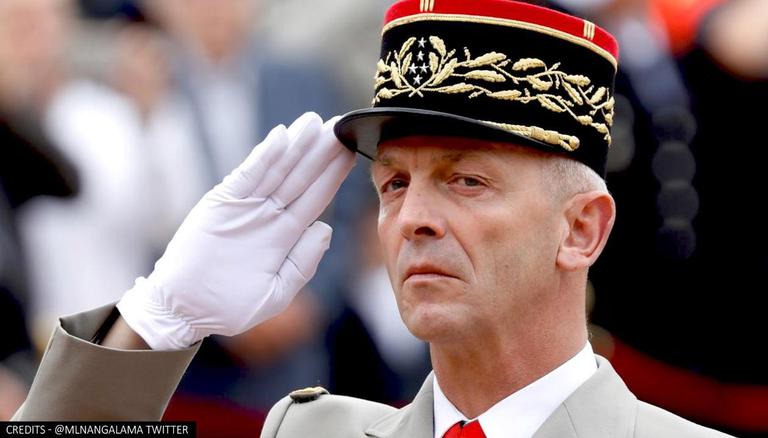
France should avoid being dragged into US-China rivalry: Chief of Defense staff
France should avoid being drawn into the growing China-US rivalry, which will become a central geopolitical confrontation of the future: Chief of Defense staff
 www.republicworld.com

NATO leaders see rising threats from China, but not eye to eye with each other
Tough words about Beijing in summit communiqué but less consensus on among allies about what to do.
 www.politico.eu
It basically tells everyone that are not part of Europe, even the US, that they are on their own against the China threat.
I'm not saying France should back India or Australia or any other non-NATO member, but backing the US through the NATO mechanism should be obvious. The same with all the other powers in Europe.
It basically looks like an attempt to appease China than anything else. Plus control defence spending as much as possible 'cause elections and politics are more important than existential threats.
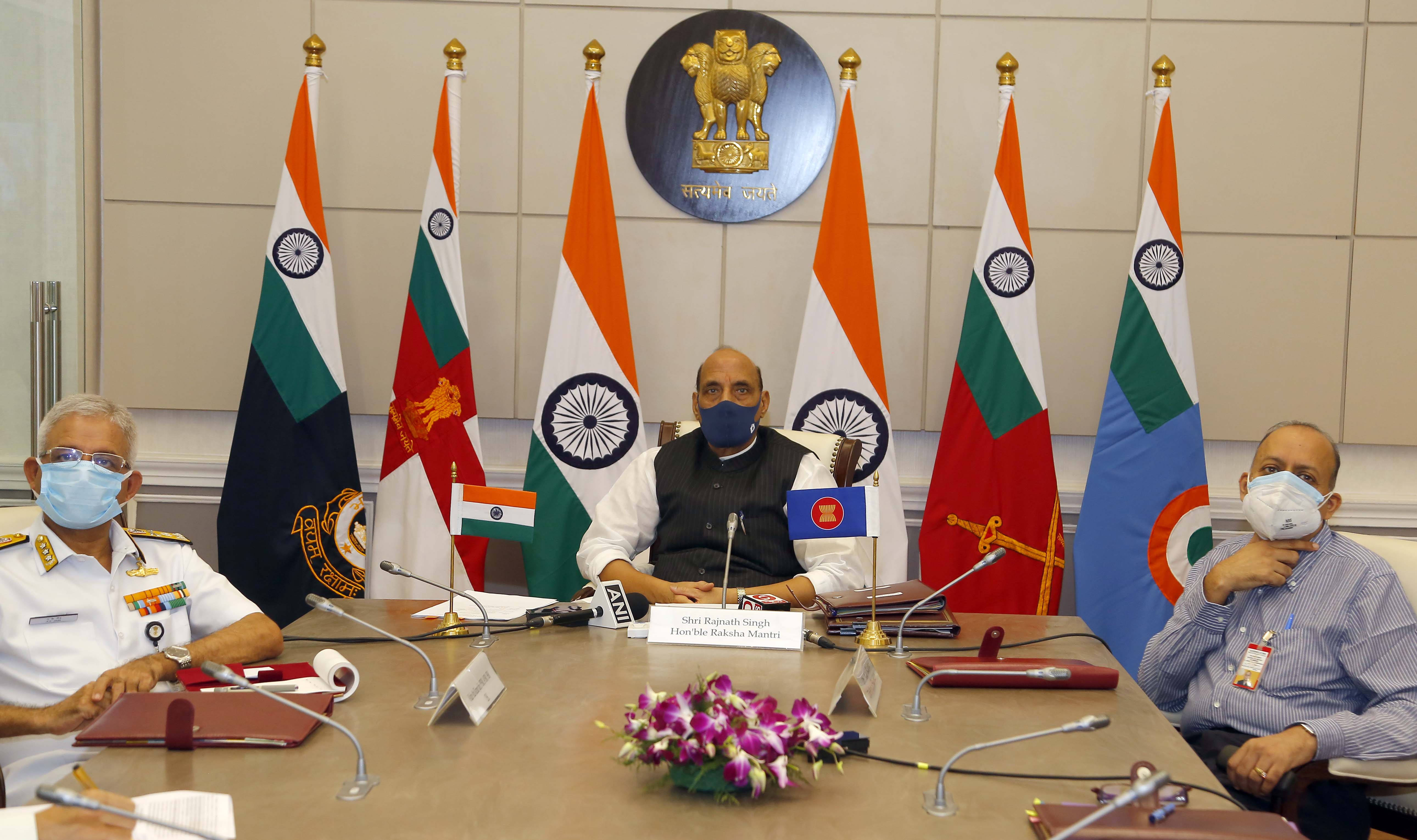
Raksha Mantri calls for open & inclusive order in Indo-Pacific at the 8th ASEAN Defence Ministers Meeting Plus
Raksha Mantri Shri Rajnath Singh called for an open and inclusive order in Indo-Pacific based upon respect for sovereignty and territorial integrity of nations while addressing the 8th ASEAN Defence Ministers Meeting (ADMM) Plus on June 16, 2021. The ADMM Plus is an annual meeting of Defence Ministers of 10 ASEAN (Association of Southeast Asian Nations) countries and eight dialogue partner countries - Australia, China, India, Japan, New Zealand, Republic of Korea, Russia and the United States. Brunei is the Chair of the ADMM Plus forum this year. Shri Rajnath Singh also stressed on “peaceful resolutions of disputes through dialogue and adherence to international rules and laws.”“India has strengthened its cooperative engagements in the Indo-Pacific based on converging visions and values for promotion of peace, stability and prosperity in the region. Premised upon the centrality of ASEAN, India supports utilisation of ASEAN-led mechanisms as important platforms for implementation of our shared vision for the Indo-Pacific,” he added.
During thematic discussions on regional and international security environment, Shri Rajnath Singh put forth India’s views before the Defence Ministers of ASEAN countries and eight dialogue partners. He stressed that the emerging challenges to international peace and security cannot be addressed with outdated systems designed to deal with trials of the past.
The Raksha Mantri reiterated India’s support to freedom of navigation, over-flight and unimpeded commerce for all in international waters in accordance with the UN Convention on the Law of the Sea (UNCLOS). “Maritime security challenges are a concern to India. The Sea lanes of Communication are critical for peace, stability, prosperity and development of the Indo-Pacific region,” he stressed. The Raksha Mantri hoped that the Code of Conduct negotiations will lead to outcomes keeping with international law and do not prejudice the legitimate rights and interests of nations that are not party to these discussions.
On the ‘Act East Policy’, announced by Prime Minister Shri Narender Modi in November 2014, Shri Rajnath Singh stated that the key elements of the policy aim to promote economic cooperation, cultural ties and develop strategic relationships with countries in the Indo-Pacific region through continuous engagement at bilateral, regional and multilateral levels.
Terming terrorism and radicalisation as gravest threats to world peace and security, Shri Rajnath Singh called for collective cooperation to fully disrupt terror organisations and their networks; identify the perpetrators and hold them accountable and ensure that strong measures are taken against those who support and finance terrorism and provide sanctuary to terrorists. As a member of the Financial Action Task Force (FATF), he said India remains committed to combat financing of terrorism.
To deal with cyber threats, the Raksha Mantri called for a multi-stakeholder approach, guided by democratic values, with a governance structure that is open and inclusive and a secure, open and stable internet with due respect to sovereignty of countries, that would drive the future of cyberspace.
On the most recent challenge faced by the world, COVID-19, Shri Rajnath Singh said the effect of the pandemic is still unfolding and the test, therefore, is to make sure that the world economy moves on the path of recovery and no one is left behind. This is only possible if entire humanity is vaccinated, he stated. “Globally available patent free vaccines, unhindered supply chains and greater global medical capacities are some of the lines of effort that India has suggested for a combined effort,” he highlighted.
Referring to the Humanitarian Assistance and Disaster Relief (HADR) operations, the Raksha Mantri stated that India remains one of the first to respond in times of distress in the immediate as well as extended neighbourhood. As a founding member of the Heads of Asian Coast Guard Agencies Meeting (HACGAM), India seeks to enhance capacity building through collaboration in the areas of Maritime Search & Rescue, he added.
Shri Rajnath Singh also underscored the importance India attaches to ASEAN centrality and unity in ensuring peace and stability in the region. He said India shares a deep connect with ASEAN and has continued its active engagement in many areas contributing to regional peace and stability, particularly through ASEAN led mechanisms, such as East Asia Summit, ASEAN Regional Forum and ADMM-Plus. The India-ASEAN strategic partnership has been strengthened by virtue of flourishing cultural and civilisational links and enhanced people-to-people cooperation, he added. The Raksha Mantri thanked Brunei for conducting the ADMM Plus despite the restrictions imposed by COVID-19.
Defence Secretary Dr Ajay Kumar and Chief of Integrated Defence Staff to the Chairman Chiefs of Staff Committee (CISC) Vice Admiral Atul Kumar Jain and other senior officials of Ministry of Defence and Ministry of External Affairs attended the meeting.
***
Raksha Mantri calls for open & inclusive order in Indo-Pacific at the 8th ASEAN Defence Ministers Meeting Plus
Raksha Mantri Shri Rajnath Singh called for an open and inclusive order in Indo-Pacific based upon r
 pib.gov.in
America is back — and wants everyone to focus on China
From Europe’s point of view, Joe Biden’s one-week visit could hardly have gone better. Having spent four years being pilloried by Donald Trump — for low Nato defence spending, trade surpluses, freeriding on US generosity and behaving like a “geopolitical foe” — Europe was craving Biden’s diplomatic balm. The 46th US president did not disappoint. America’s friendship was “rock solid”, Biden said; Europe’s security was America’s “sacred obligation”. In addition to strategic reassurance, Biden also lifted punitive US tariffs on Europe and called off the long-running Boeing-Airbus subsidy dispute. The relief among European officials was visible. Ursula von der Leyen, president of the European Commission, referred to America’s president as “Dear Joe” — an endearment it would be hard to imagine being used for many of Biden’s predecessors, not just Trump.“Biden’s language and tone was everything Europeans wished for,” says Jeremy Shapiro, research director at the European Council on Foreign Relations. America’s internal divisions, as demonstrated during the clashes at the US Capitol on January 6 this year, have been a concern for European leaders America’s internal divisions, as demonstrated during the clashes at the US Capitol on January 6 this year, have been a concern for European leaders © Brent Stirton/Getty Images
Long-running differences remain — not least over Europe’s low defence spending. But the larger purpose behind Biden’s trip, which began with the G7 gathering in an occasionally drizzly Cornwall and wrapped up with the Vladimir Putin summit in Geneva, had more to do with the Indo-Pacific than the Atlantic. Prior to Biden’s first overseas presidential foray, there was speculation about where his strategic priority lay.
Was it the contest between democracy and autocracy, managing the new era of great power competition, reasserting US-led multilateralism or forging coalitions to tackle the pandemic and global warming? The answer is “all of the above”.
But Biden’s trip conveyed what matters most. His overriding preoccupation is China. Biden’s much-hyped Summit of Democracy, which received rote citation from the G7, has been put off until next year. No venue was specified.
By contrast, the China challenge appeared three times in the G7 communiqué and was for the first time cited by Nato — an alliance supposedly about defending the north Atlantic. US President Joe Biden reassured Europe’s leaders that security was America’s ‘sacred obligation’ US President Joe Biden reassured Europe’s leaders that security was America’s ‘sacred obligation’ © Patrick Semansky/AP
“Biden’s basic message to his European friends was: ‘Don’t worry guys, I’ve got your back. Now let me go and do my real business in the Indo-Pacific’,” says Robin Niblett, director of Chatham House, the London-based think-tank. “The language on China was careful. But it threaded through everything.” China also hovered unspoken over the US-Russia summit.
The contrast between Biden’s meeting with Putin in Geneva and Trump’s infamous one-on-one 2018 parley with him in Helsinki was perhaps the most striking feature of Biden’s trip. Unlike Biden’s domestic critics, who accused him of giving Putin the undeserved gift of appearing on the same stage, most Europeans were happy to see them talking. “Negotiating with your adversaries is what diplomacy is supposed to be about — as long as you have aides and note-takers present,” says Fiona Hill, who, as Trump’s Russia adviser, was not allowed into his private meeting with Putin. “Not talking makes no sense. Should Biden refuse to meet Xi Jinping because China has concentration camps?” Russian President Vladimir Putin and President Biden meet at Villa La Grange in Geneva, Switzerland, last week Russian President Vladimir Putin and President Biden meet at Villa La Grange in Geneva, Switzerland, last week © Peter Klaunzer - Pool/Keystone via Getty Images
Pragmatic on Russia One surprising aspect to Biden’s approach was his businesslike treatment of Putin. He refrained from giving sermons about democracy, although he threatened Putin with “devastating” consequences should Alexei Navalny, leader of Russia’s banned opposition, die in jail. He also vowed to retaliate against future Russian cyber attacks following SolarWind’s deep penetration of US government systems last year. The two agreed to establish a nuclear working group and another on cyber security, which some see as today’s equivalent of cold war arms talks. The latter process is likely to be riddled with distrust — Russia, or groups the US believes to be connected to Russia, has visited great disruption on the US at very low cost. But the fact that the group now exists might make Putin think twice. By contrast, Biden made only fleeting references to “values” and “freedom”.
The only one of the two who referred in public to ideals — perhaps trollingly — was Putin, who praised Biden’s “moral values” and his willingness to speak about his family. Again, the contrast with Trump was striking. “Trump was always seen as transactional and Biden as sentimental,” says Stephen Wertheim, co-founder of the Quincy Institute for Responsible Statecraft. “In practice Biden was pragmatic with Putin, while Trump was obsessed with status and prestige.” The explicit goal was to make US-Russia relations less dangerous and unstable. The test of whether Biden has succeeded will be in the dogs that do not bark — the overseas poisonings of Russian dissidents and cyber attacks on the west that do not take place. That will take time to assess. It is hard to prove a negative.
Biden’s implicit goal was to assuage Putin’s paranoia. Chinese Premier Deng Xiaoping listens to US secretary of state Henry Kissinger during their meeting in Beijing in 1974 Chinese Premier Deng Xiaoping listens to US secretary of state Henry Kissinger during their meeting in Beijing in 1974 © AP Biden attracted derision at home for describing Russia as a “great power” and Putin as a “worthy adversary”. He was likewise criticised last month for declining to impose sanctions on the Nord Stream 2 gas pipeline from Russia to Germany. Biden also gave short shrift in Geneva to rumours that Ukraine would be admitted to Nato. The word “appeasement” has begun to creep back into Washington vocabulary. Yet there was a purpose to Biden’s flattery. Some call it a “reverse Henry Kissinger”, after Richard Nixon’s renowned national security adviser, who took cloak-and-dagger trips to Beijing in the early 1970s to capitalise on the Sino-Soviet split. China eventually broke away from the Soviet bloc. Beijing is the senior partner today. The longer-term hope is to drive a wedge between Russia and China. “The more Biden treats Russia with respect as a great power, which is what Putin craves, the easier it will be for him to loosen Russia from China’s embrace,” says Hill.
President Biden is welcomed by European Commission president Ursula von der Leyen ahead of the EU-US summit at the European Council in Brussels, Belgium President Biden is welcomed by European Commission president Ursula von der Leyen ahead of the EU-US summit at the European Council in Brussels, Belgium © Olivier Hoslet/EPA-EFE/Shutterstock Such an approach means downplaying Biden’s “democracy versus autocracy” framing. America would instead play on autocratic Russia’s anxiety about being treated as a little brother by China. Some of America’s partners, including France, Japan and India, are also trying to forge closer relations with Russia with a view to weakening its China ties. “At this point it would be geopolitical malpractice for America not to attempt a “reverse Kissinger”, says Shapiro. “At the very least, America should stop driving Russia into China’s arms. But it will take more than one presidential term to pull off.”
European relief Biden’s game of geopolitical chess is fraught with obstacles. Chief among these is Europe’s reluctance to view China with the same existential concern as America does. The continent does more trade with China than the US. Biden did get references to the China threat into the various summit communiqués. But joint statements are not the same thing as concrete action. Europe does more trade with China than the US, and has shown a reluctance to view it with the same existential concern Europe does more trade with China than the US, and has shown a reluctance to view it with the same existential concern © David Paul Morris/Bloomberg For example, Europe is a long way from following America’s lead to impose a continent-wide ban on sensitive Chinese technology, such as the Huawei 5G network. Biden is also limited by Europe’s scepticism about whether he will be re-elected in 2024 — the once-bitten-twice-shy legacy of Trump. Europeans listened politely to Biden’s focus on democracy versus autocracy. But their greater concern is over the future of US democracy. Will Biden’s “America is back” mantra outlast his term in office? “Europeans are as obsessed with America’s internal divisions as they are with the future of global democracy,” says Brian Katulis, a senior fellow at the Centre for American Progress, a liberal think-tank. “One European official told me he thinks about America in the way an amputee feels that a missing limb is still there. Will it grow back?” The relief with which Biden was greeted in Europe suggests that he has convinced allies that America is at least temporarily back in action. There was also appreciation for the way in which Biden conveyed that message. Instead of talking about the US returning to the head of the table, Biden said America was “back at the table”. Rather than America leading, it was “America leading with allies”. Such modulations sound trivial. But they showed a sensitivity that has recently been lacking. Europeans also noted that Biden had spent hours prepping for each of his summits. “It was almost a shock to see professional diplomats in action again,” says Niblett. “Biden’s team is experienced and understands the game.” Then US President Donald Trump at the G7 Summit in Biarritz, France, in 2019 Then US President Donald Trump at the G7 Summit in Biarritz, France, in 2019 © Jeff J Mitchell/PA A different lens on China Yet there was little disguising the fact that the Atlantic is no longer the world’s most important geopolitical theatre in America’s eyes. That distinction belongs to the Indo-Pacific. Though this was Biden’s first presidential trip, his first summit was a virtual one in March with the leaders of the Quad — the US, Japan, India and Australia. The Quad is not a formal alliance. But it plays a bigger role in Biden’s plans than the future of Nato. “During the Obama years if you mentioned the Quad, people thought of America, Britain, France and Germany,” says Hill. “Now it can only mean the Indo-Pacific.” For the time being, transatlantic relations are moving into a phase of better repair. The coming months will reveal whether Biden’s more flinty approach to Russia will pay off. At Putin’s press conference on Wednesday, he was asked whether there was now trust between him and the US president. “There is no happiness in life,” Putin replied. “There is only a mirage on the horizon.” Minus the Russian gloom, Putin could have been giving a lecture on the limits to end-of-history thinking. Biden’s destination is clear — a stable global order with America as first among equals. That horizon is always likely to be just beyond reach.

America is back — and wants everyone to focus on China
Joe Biden spent the last week reassuring European leaders even as he made clear his ‘real business’ was in the Indo-Pacific
And what should we do about it? Give a detailed answer, not just a metaphor.
We provide support as we can. Meteor and HAMMER deliveries rushed by taking them from our own stockpile instead of waiting for production to be completed. Rafales being delivered ahead of schedule despite covid lockdown. Did we have to do that? Nope, it wasn't part of the contract terms. But if you want us to nuke Beijing, you're out of your mind.

Japan urges Europe to have stronger military presence in Asia to counter China
Japan is taking tougher line on China but might not get its wish of a united front with EU, analyst says.
 www.scmp.com

Indonesia, U.S break ground on joint strategic maritime centre
JAKARTA, June 26 (Reuters) - Indonesia and the United States have broken ground on a new $3.5 million maritime training centre in the strategic area of Batam, in the Riau Islands, Indonesia's maritime security agency said.Attending the ceremony virtually on Friday, the U.S. ambassador to Indonesia, Sung Kim, said the maritime centre would be part of ongoing efforts between the two countries to bolster security in the region.
"As a friend and partner to Indonesia, the United States remains committed to supporting Indonesia's important role in maintaining regional peace and security by fighting domestic and trans-national crimes," he said, according to a statement from Bakamla, Indonesia's maritime security agency.
The training centre, located at the strategic meeting point of the Malacca Strait and the South China Sea, will be run by Bakamla and houses classrooms, barracks and a launch pad, the agency said.
The U.S. collaboration with the world's largest archipelagic nation comes amid rising tensions in the South China Sea, with the Philippines protesting the presence of hundreds of Chinese vessels in the Spratly islands this May.
Earlier this month the foreign ministers of Southeast Asia and China agreed during a meeting to exercise restraint in the South China Sea and avoid actions that could escalate tensions.

Indonesia, U.S break ground on joint strategic maritime centre
Indonesia and the United States have broken ground on a new $3.5 million maritime training centre in the strategic area of Batam, in the Riau Islands, Indonesia's maritime security agency said.
Shaping a trilateral as Rome looks to the Indo-Pacific
In the pushback against China, strategic cooperation between India, Italy and Japan can ensure a free Indo-Pacific
Updated France’s Indo-Pacific Strategy
Launched by the President of the French Republic during his Garden Island speech in Sydney in May 2018, France’s strategy for the Indo-Pacific has become one of its priorities for international action. Three years on, the strategy’s implementation is now producing tangible results and major progress in France’s commitments in the region.
French President Emmanuel Macron : "Many initiatives have been developed over the past three years, and our partnerships with countries in the region have reached unprecedented levels of cooperation. But much remains to be done. Our aim is to help make the Indo‑Pacific a free, safe and open space, which has high ambitions in terms of oceans, the climate and biodiversity, and is integrated with regard to infrastructure and human exchanges. You can count on France’s full commitment. We will continue to play a full role in contributing to the stability of this new strategic space, which is at the core of major global challenges"
Accueil | La France en Australie
Les services de l'ambassade de France en Australie et des consulats généraux de France à Sydney et Melbourne