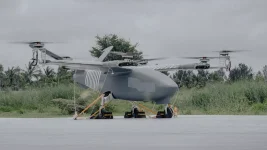
Indian Unmanned Aerial Vehicles Developments

JSW setting up $90 million military drone plant in Hyderabad

V-BAT drone manufacturing at the facility of JSW Defence is expected to commence by last quarter of 2026, said the Group

The $23 billion JSW Group is setting up an unmanned aerial systems manufacturing facility with $90 million (about Rs. 850 crore) investment at Maheshwaram electronics manufacturing cluster, on the outskirts of Hyderabad.

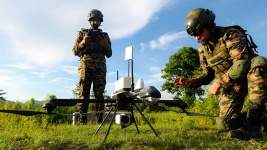
It has entered into a strategic partnership with US-based defence technology firm Shield AI to manufacture the latter’s Group 3 unmanned aerial system (UAS) – under a long-term licensing arrangement for transfer of technology. A fixed-wing, vertical take-off and landing (VTOL), long endurance intelligence, surveillance, reconnaissance (ISR) platform, V-BAT is currently deployed by multiple armed forces globally, including the U.S. Marine Expeditionary Units (MEUs).


The manufacturing, at the facility of JSW Defence, is expected to commence by last quarter of 2026, JSW Group said after the foundation stone laying ceremony in which IT and Industries Minister D. Sridhar Babu, JSW Group’s Parth Jindal and others participated.

The investment will enable JSW to establish a local supply chain and create an advanced facility in India for manufacturing, assembling and testing V-BAT. The effort will enable large-scale production of V-BATs in India to serve the needs of the Indian Armed Forces and also function as a global production hub, the Group said.

Project will create over 300 high-value jobs​

The facility is spread over 16 acres and will have a capacity to manufacture 300 V-BAT drones annually. It will house production, repair, testing, administrative, and support infrastructure. This project will create over 300 high-value jobs, the Minister’s office said.

JSW Group’s Parth Jindal and Sarjan Shah, managing director, Shield AI at the foundation stone laying of JSW defence facility in Hyderabad

JSW Group’s Parth Jindal and Sarjan Shah, managing director, Shield AI at the foundation stone laying of JSW defence facility in Hyderabad | Photo Credit: BY ARRANGEMENT

“From manufacturing the globally renowned V-BAT at scale, the facility will lay the foundation for an integrated, end-to-end UAS ecosystem, from advanced manufacturing to operator training, manufacturing repair and operations (MRO) and sustained innovation. This project stands among the most significant defence technology transfers to India,” Mr. Jindal said.

On the Group’s defence ventures, he said the drone manufacturing project follows the JSW Gecko Motors joint venture, with a Ukrainian company, to make special mobility vehicles in Chandigarh. The facility was commissioned about 18 months ago and supplied nearly 200 vehicles between the Indian Army and the United Nations. In the same facility, JSW has another JV with an American firm to manufacture off-road vehicles.

Total Rs.1,200 cr investment​

The Group will be investing total Rs. 1,200 crore on the defence ventures, which includes Rs. 320 crore towards the technology transfer from Shield. He said India Armed Forces were evaluating the UAS from a localisation perspective. The initial order is for importing eight UAS under the emergency procurement route, something catered directly by Shield AI. The larger orders will be placed once the facility is up, he said.
 
  • Like
Reactions: RationalGuy
In house projects from the 3 different services will rarely have any update in open social media because whoever leaks stuff out will get caught & court martialed / taken care of. So unless they show themselves, we won't know most cases. Army is developing its own ugv uav jugaad in house at different BRD stations, we know squat all about each.
 
Weapons for Navy, Air Force displayed at Jaipur Startup Expo:
Missile capable of striking enemies from 100 km away;
AI-robots transforming agriculture

inner3_1765627855.gif


Whats the operational significance of "kiss and go" a.k.a "Boop" ?
Allows drone operators to be a bit more carefree & aggressive in their handling. The drone won't be immediately lost if it bumps onto something like a tree or a wall etc. This ability is particularly useful for using drones against small, agile targets. Say for counter personnel roles.

From a tech pov this ability is a combination of gyroscopes &/or accelerometers, vision & algorithms.
 
This thing has immense military potential:

India Enters a New Era of Independence as Sarla Aviation Begins Air-Taxi Testing​

1766418074357.png
Bengaluru, December 22, 2025 — In a defining moment for India’s aerospace ambitions, Sarla Aviation today announced the commencement of ground testing for its half-scale electric vertical take-off and landing (eVTOL) demonstrator, SYLLA SYL-X1, at the company’s Bengaluru test facility.

With a 7.5-meter wingspan, SYL-X1 represents the largest and most advanced private eVTOL demonstrator of its kind currently under development in India. Achieved in approximately nine months of development and at a fraction of the capital typically required for comparable global programs, the milestone marks a level of engineering scale, execution speed, and systems maturity not previously demonstrated by a private aerospace company in the country.

With ground testing now underway, Sarla Aviation’s air taxi program enters its core validation phase, moving decisively beyond digital concepts and laboratory-scale experimentation into real aircraft-scale testing. The current demonstrator is a functional sub-scale aircraft, purpose-built to validate structural behavior, propulsion integration, and system-level safety architecture at meaningful scale. Unlike academic prototypes or small RC-scale platforms, SYL-X1 is designed with certification intent from the outset, forming a direct bridge toward Sarla Aviation’s 15-meter wingspan full-scale aircraft.

filters_format(webp).webp
filters_format(webp)_quality(75).webp

Commenting on the milestone, Rakesh Gaonkar, Co-Founder & CTO, Sarla Aviation, said: “This milestone reflects what’s possible when globally experienced Indian engineering teams build with rigor, patience, and world-class standards. Our focus has never been on being first, but on building to last — on creating an aviation giant.

We are building something India can be proud of: a platform that can be certified, produced, and safely operated, designed and owned entirely in India. Our goal is to take this new era of aviation technology across the finish line for India — and bring it home.”


This achievement places India among a small group of nations actively developing next-generation vertical flight systems at industrial scale. The challenge extended far beyond aircraft design alone — encompassing the creation of a certification-aligned flight-test ecosystem, navigation of India’s still-emerging aerospace supply chain, and the scaling of the organization from two founders to a team of nearly 70 engineers within a single development cycle.

During the same period, Sarla Aviation also delivered a full-scale static aircraft for national showcase at Bharat Mobility, while strengthening its long-term execution capability by raising USD 13 million in total funding.

Built entirely in India to global aerospace standards, the SYL-X1 demonstrator reflects Sarla Aviation’s focus on execution, endurance, and scalability. The company’s technology roadmap targets helicopter-class mission endurance, while fundamentally reducing cost, operational complexity, and safety trade-offs through electric propulsion and integrated systems design.

As India’s advanced air mobility ecosystem begins to take shape, long-term success will be determined not by early announcements, but by the ability to execute through certification, production, and sustained operations. In this context, Sarla Aviation brings together one of the most experienced private eVTOL teams in the country, the largest private demonstrator at this stage of development, and a rare synthesis of global aerospace expertise with Indian engineering execution.

Together, these foundations position Sarla Aviation to move decisively beyond demonstration milestones — and toward delivering operational, certified aircraft at scale, built in India, for India, and for the world.

SARLA AVIATION
 
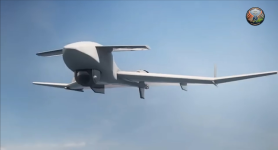
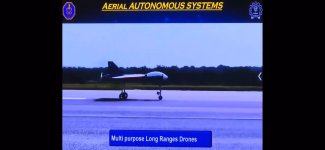
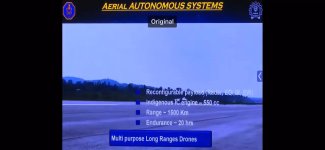

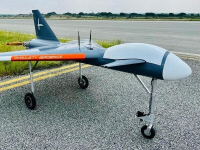
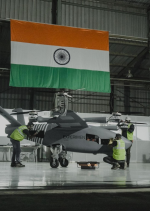
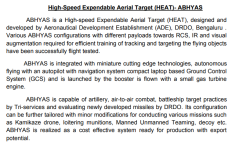
What's the update of this drone? It was being developed with the collaboration with Indian Navy for multi purpose Long range drone,
In the video they explained it was in the final stages of development trials,
View attachment 48345View attachment 48346View attachment 48347
It is just a startup led project being encouraged by the Navy. Has the same limited utility as V-BAT, except the latter can perform VTOL flight.


Looks like an iDEX contract.
 

Attachments

  • 1766461070521.png
    1766461070521.png
    455.8 KB · Views: 9
This thing has immense military potential:

India Enters a New Era of Independence as Sarla Aviation Begins Air-Taxi Testing​

View attachment 48544
Bengaluru, December 22, 2025 — In a defining moment for India’s aerospace ambitions, Sarla Aviation today announced the commencement of ground testing for its half-scale electric vertical take-off and landing (eVTOL) demonstrator, SYLLA SYL-X1, at the company’s Bengaluru test facility.

With a 7.5-meter wingspan, SYL-X1 represents the largest and most advanced private eVTOL demonstrator of its kind currently under development in India. Achieved in approximately nine months of development and at a fraction of the capital typically required for comparable global programs, the milestone marks a level of engineering scale, execution speed, and systems maturity not previously demonstrated by a private aerospace company in the country.

With ground testing now underway, Sarla Aviation’s air taxi program enters its core validation phase, moving decisively beyond digital concepts and laboratory-scale experimentation into real aircraft-scale testing. The current demonstrator is a functional sub-scale aircraft, purpose-built to validate structural behavior, propulsion integration, and system-level safety architecture at meaningful scale. Unlike academic prototypes or small RC-scale platforms, SYL-X1 is designed with certification intent from the outset, forming a direct bridge toward Sarla Aviation’s 15-meter wingspan full-scale aircraft.

View attachment 48545
View attachment 48546

Commenting on the milestone, Rakesh Gaonkar, Co-Founder & CTO, Sarla Aviation, said: “This milestone reflects what’s possible when globally experienced Indian engineering teams build with rigor, patience, and world-class standards. Our focus has never been on being first, but on building to last — on creating an aviation giant.

We are building something India can be proud of: a platform that can be certified, produced, and safely operated, designed and owned entirely in India. Our goal is to take this new era of aviation technology across the finish line for India — and bring it home.”


This achievement places India among a small group of nations actively developing next-generation vertical flight systems at industrial scale. The challenge extended far beyond aircraft design alone — encompassing the creation of a certification-aligned flight-test ecosystem, navigation of India’s still-emerging aerospace supply chain, and the scaling of the organization from two founders to a team of nearly 70 engineers within a single development cycle.

During the same period, Sarla Aviation also delivered a full-scale static aircraft for national showcase at Bharat Mobility, while strengthening its long-term execution capability by raising USD 13 million in total funding.

Built entirely in India to global aerospace standards, the SYL-X1 demonstrator reflects Sarla Aviation’s focus on execution, endurance, and scalability. The company’s technology roadmap targets helicopter-class mission endurance, while fundamentally reducing cost, operational complexity, and safety trade-offs through electric propulsion and integrated systems design.

As India’s advanced air mobility ecosystem begins to take shape, long-term success will be determined not by early announcements, but by the ability to execute through certification, production, and sustained operations. In this context, Sarla Aviation brings together one of the most experienced private eVTOL teams in the country, the largest private demonstrator at this stage of development, and a rare synthesis of global aerospace expertise with Indian engineering execution.

Together, these foundations position Sarla Aviation to move decisively beyond demonstration milestones — and toward delivering operational, certified aircraft at scale, built in India, for India, and for the world.

SARLA AVIATION
Love the aiframe design and V tail. Imagine a tiltrotor version like the Bell 247 Valiant. Would be perfect for ASW, OTHT, cargo/resupply and a range of other missions.

They should explore a turboprop version of this at the very least.
 
This thing has immense potential for military applications,

The Full scale product Will be 6 seater one,
And it can carry 600kg payload
Range -800km

.It can be used for evacuation of injured troops,
. Carrying payload,
. Maritime operation, like fitting Maritime radar from Data patterns
. Recon & ISR purpose, SISIR makes SAR radars for drones,
. Armed variant can strap few helina on it,
Even this sub scale model can be converted to for various military applications,

Hope they venture into defence, Kudos to them for building to fine products
 

Attachments

  • 1766418074357.png
    1766418074357.png
    1.6 MB · Views: 6
This thing has immense potential for military applications,

The Full scale product Will be 6 seater one,
And it can carry 600kg payload
Range -800km

.It can be used for evacuation of injured troops,
. Carrying payload,
. Maritime operation, like fitting Maritime radar from Data patterns
. Recon & ISR purpose, SISIR makes SAR radars for drones,
. Armed variant can strap few helina on it,
Even this sub scale model can be converted to for various military applications,

Hope they venture into defence, Kudos to them for building to fine products

They probably have a foriegn design partner/consultant. Otherwise, this is a
remarkable effort for a first-timer.

The world has moved on to compound helicopters/tiltrotors. HAL is too bogged down to think about innovation. It's up to the pvt entrepreneurs now.

Having said that, these guys will need backing from bigger players like L&T, Tata to survive in the defence market.