Indian Sonar and Torpedo developments

Info that I gathered so far on all Indian torpedoes:
View attachment 47262
Feel free to use this chart for your comparisons. Or if you have some corrections for me, fire away.
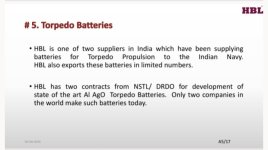
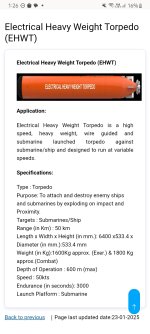
Seems too much underquoting . I got investor presentation from two different battery systems supplier to MoD and defence forces . One is Hbl and other is highenergy . However what caught my attention was the HBL developing an Aluminum silver oxide battery for a torpedo application. If EHWT/WGHWT/Takshak uses such a energy storage system , it would be on par with World's best electric heavyweights ; Blackshark and F21 . Also it would make HBL one of the two companies in the world to make such a state of the art battery . The other one is a french OEM Saft batteries (A total energies company) .

Screenshot_20260227_150305_Chrome.jpg
Screenshot_20260227_145821_Chrome.jpg
 
Seems too much underquoting . I got investor presentation from two different battery systems supplier to MoD and defence forces . One is Hbl and other is highenergy . However what caught my attention was the HBL developing an Aluminum silver oxide battery for a torpedo application. If EHWT/WGHWT/Takshak uses such a energy storage system , it would be on par with World's best electric heavyweights ; Blackshark and F21 . Also it would make HBL one of the two companies in the world to make such a state of the art battery . The other one is a french OEM Saft batteries (A total energies company) .
Aluminum silver oxide batteries offer twice the power and energy of standard zinc/silver-oxide alternatives.
 
  • Like
Reactions: padira
The Electrically Heavy Weight Torpedo (EHWT) is an underwater weapon system that integrates advanced passive acoustic detection and active sonar technology for accurate target identification, tracking, and engagement.

Key Features :
●High-speed processing enabled by FPGAs and controllers for real-time signal processing and quick decision-making.
●Passive acoustic detection uses ultra-low-noise preamplifiers to detect and analyze enemy acoustic emissions, allowing for stealthy identification of targets.
●Active sonar localization transmits high-power acoustic signals that generate echoes to precisely locate and track target movements.
●Autonomous guidance system activates advanced guidance controls once a target is detected for precise target interception.
●Multi-scope data storage records target acoustic signatures and operational data, facilitating further analysis and system optimization.
●Combines sophisticated detection, tracking, and engagement technologies to offer enhanced underwater warfare capabilities

Courtsy - Apollo microsystems
The Advanced Lightweight Torpedo (ALWT) is an underwater weapon system designed for precise detection, tracking, and engagement of enemy targets. It integrates advanced passive detection, high-power sonar transmission, and autonomous target guidance, powered by state-of-the-art electronics and real-time processing capabilities.

Key Features :
Utilizes ultra-low-noise 32-channel preamplifiers for passive detection, ensuring high sensitivity and accuracy in capturing enemy sounds.
High-power sonar transmission through 32 channels and a capacitive nosecone to create echoes, aiding in locating enemy positions.
Activates autonomous target guidance once a target is detected, steering the torpedo directly toward it for precise engagement.
Equipped with high-speed FPGAs and controllers for fast processing and real-time decision-making.
Features smart data storage to retain target sound data and operational information, improving performance over time.
Courtsey - Apollo microsystems
 

Attachments

  • ehwt-homing.png
    ehwt-homing.png
    95.7 KB · Views: 12
  • alwt-homing.png
    alwt-homing.png
    71.3 KB · Views: 13
Electrical Actuation Control System for Rudder Control of Heavy-Weight Torpedo

Digital Controller & Intelligent Power Drive
Four (4) permanent magnet synchronous (PMS) motors
Deflects control surfaces (elevators and rudders) of the Torpedo based on input command from on-board processor (OBP)
EMI/EMC compliant
Electrical Actuation system
Digital controller, based on TMS320F2808 DSP
Intelligent power drives - communicates on CANbus
Command from On Board Processor (OBP) on MIL-STD-1553
Complete Integrated SystemESM-processor-3.pngMS10-Cloud-Lidar-1.png
 
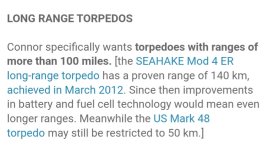
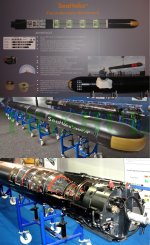
However the biggest bait here is the Range . German torpedo Seahake mod 4 ER aka DM2A4ER is an electric torpedo with range that exceeding 140 kms . It uses a stack of 4 Zn-AgO batteries. If EHWT uses an advance chemistry (Aluminum silver oxide, which is either developed or under development by HBL) with a similar dimensions, we must expect that 50 kms is highly underquoted .Screenshot_20260310_015141_Chrome.jpgDM2A4 Sea Hake HWT-2.jpgDM2A4 Sea Hake HWT-1.jpg
 
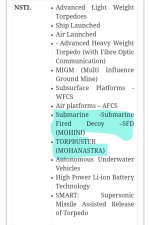
NSTL had already developed state of the art cutting edge systems for torpedo countermeasures .
•MOHINI is a softkill torpedo seducer expandable decoy . It's primarily launched from submarines . IG It's a sub launched variant of mareech
•MOHANASTRA is a torpedo hardkill system . The expandable decoys may employee either a seductive cum destructive mode for wake homing torpedoes or intercept cum destructive mode for a acoustic homing torpedoes.

The entire system is like an active protection system but for ships and sub . Israel's Rafael Advanced defense systems already has a similar product known as SHADE. Screenshot_20260310_135041_Chrome.jpg
 

Attachments

DRDO's Mohanastra Torpedo defence system (TDS) is a preety capable system . It does employee both Hardkill and softkill countermeasures against torpedoes.
I've attached a research paper below from NPOL scientists that was published back in 2021 . For the gist of the system developed or under development , read from chapter 5.1 to 5.4.3 .
 

Attachments

Info that I gathered so far on all Indian torpedoes:
View attachment 47262
Feel free to use this chart for your comparisons. Or if you have some corrections for me, fire away.


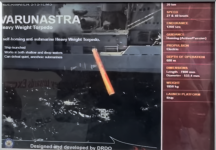
Varunastra endurance is 1200 sec:

1773433447071.png

1773433745111.png

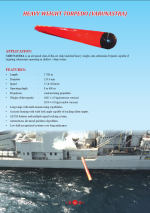
Also, not sure if weight should be corrected to 1600kg for the older contrarotating propeller variant:

1773433671473.png

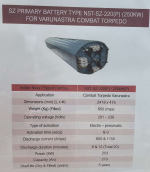
Also FYI, the battery appears to be upgraded from the 200kW SZ-200 to 250kW SZ-220, see above??
 
Last edited:
Amara Raja arm enters defence electronics, builds naval sonar power system

By Md Zakariya Khan
March 18, 2026, 12:12 IST

Nearly 61% of the system’s components are locally sourced, the company eyes expansion into amplifier systems.
1773943633983.png
The company said around 61% of the system’s components are locally sourced, enabling nearly 40% cost savings through advanced power engineering and domestic manufacturing.

Amara Raja Group has forayed into defence electronics, with its R&D arm Amara Raja Design Alpha developing an indigenous Power Conditioning Cabinet (PCC) for naval sonar systems, marking its first mission-critical delivery in the segment.

The company said around 61% of the system’s components are locally sourced, enabling nearly 40% cost savings through advanced power engineering and domestic manufacturing. The PCC is designed to support loads of up to 160 kW, ensuring stable and high-reliability power distribution for sonar systems, which require consistent power quality during prolonged maritime operations.

Focus on naval indigenization

The move aligns with India’s broader push for defence self-reliance, especially in underwater surveillance and anti-submarine warfare capabilities. Sonar systems form a key component of the Indian Navy’s operational architecture, as the country continues to ramp up maritime investments.
The Navy’s budget has more than doubled from ₹49,623 crore in 2020–21 to over ₹1,03,548 crore in 2025–26, underlining the strategic focus on strengthening naval capabilities.

ARDA’s PCC systems will comply with global defence standards such as MIL-STD-901D and MIL-STD-461 for shock resistance and electromagnetic compatibility, ensuring reliability in demanding naval environments.

Expansion plans underway

Going forward, ARDA plans to expand into the design of power amplifiers, signal interfaces, and power amplifier cabinets, aiming to build a more comprehensive domestic ecosystem for sonar technologies.

“We are excited that our expertise in electronics and power system design and manufacturing can contribute directly to our nation's defence systems," said Dr. Suresh Nair, MD, ARDA. "This development reflects our commitment to building deep, long-term capability in strategically important technologies alongside India's defence research institutions.”

The development is also significant given ARDA’s presence in Kochi, home to Naval Physical and Oceanographic Laboratory, a key Defence Research and Development Organization facility that has led India’s sonar technology programme for decades. The emergence of private-sector capabilities within the same ecosystem signals a deepening of indigenous defence innovation.

Amara Raja arm enters defence electronics, builds naval sonar power system
 
I don't know how did we miss this but it's our GaN moment for sonar applications . PMNPT has almost twice piezoelectric coefficient d33 and thrice the em coupling factor q33 than traditional PZT based transducers . This means we can expect a 2 to 2.5 times increase in range (active) and sensitivity (passive) .
I have attached a research paper of a team co headed by NPOL scientists .
 

Attachments