LRAShM missile integration,
Maybe the LSP has started

Maybe the LSP has started

While i agree with the rest of the trajectory in the artwork, I don't think its gonna make vertical dive for antiship role.
While i agree with the rest of the trajectory in the artwork, I don't think its gonna make vertical dive for antiship role.
Also i would still categorize its shallow skip under gliding , not ballistic at all.
@marich01 any insights

suppose say it makes vertical dive as shown, then wouldnt it be an advantage for the enemy bcos rest of the ships in the enemy fleet can fire directly above the ship in the air. If it hits horizontally then rest of the ships have to stop firing at some point to avoid friendly fire.While i agree with the rest of the trajectory in the artwork, I don't think its gonna make vertical dive for antiship role.
Also i would still categorize its shallow skip under gliding , not ballistic at all.
@marich01 any insights

Fyi, in these types of charts the altitude and distance are not to scale, if they were the altitude axis will be lot narrower.

Turning Indian Ocean into the graveyard for PLA-N


 www.twz.com
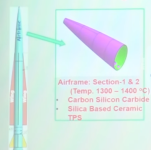
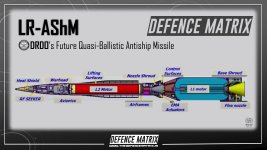
However, based on its appearance, the LR-AShM could be more of a quasi-ballistic missile, propelled to hypersonic speed by a relatively huge booster and then sustained further by its onboard rocket motor. The missile, as shown today and seen in a previous test, lacks the characteristic features of an HGV, including the wedge-shaped lifting body profile typically associated with a weapon of this kind. On the other hand, the large strakes/wings on the missile body do point to an enhanced glide capability.
This kind of missile flies on a quasi-ballistic (rather than a parabolic) trajectory, performing unpredictable, high-speed maneuvers that make it a more challenging target for missile defense systems. Such a “porpoising” or “skip-glide” trajectory involves the weapon abruptly pulling up at least once as it begins the terminal stage of its flight. This kind of maneuver is typically associated with the flight profile of an aero-ballistic missile.
According to the Indian military, the LR-AShM reaches a maximum velocity of Mach 10, while the average speed across the entirety of its flight is around Mach 5, said to be the result of the missile making multiple ‘skips.’ This description would also tally with the LR-AShM being a quasi-ballistic missile.
It could be that this weapon combined elements of both weapons categories, acting as a quasi ballistic missile, but possessing additional glide capabilities and enhance maneuverability, while not truly meeting the definition of the hypersonic boost-glide vehicle.
India announced a flight test of the LR-AShM in November 2024. The missile was launched from Dr. APJ Abdul Kalam Island, Odisha, on India’s eastern coast.
You don't need this to *glide*India’s New Hypersonic Anti-Ship Missile Shown Off During Military Parade
The Long-Range Anti-Ship Missile has an intriguing configuration and is focused on Chinese and Pakistani naval threats. The Long-Range Anti-Ship Missile has been developed to meet the Chinese naval threat and should put India in the elite hypersonic missile club.

@marich01You don't need this to *glide*
Main reason of this blended configuration is to create immense pressure on its flat side to *skip* , more similar to a stone skipping on water surface with gliding on downwards trajectory.
While LR-ashm will be able to make very shallow and fewer skips compared to this this blended configuration.
If its just about gliding than LRASHM's long strakes are more than enough, even a brahmos with small fins is able to maintain level flight with mostly its cylindrical body at mach 2+ speed ( the ramjet does not create lift by sucking in air, it just provides provides propulsion to allow brahmos to reach mach 2+ cruise speed, the lift enough to sustain level flight is generated by cylindrical body of brahmos.)
Now this is that mach 2+, LRASHM in its midcourse remains in speed regime of mach 5-6.
Df-17's HGV is a atmospheric skipper + glider.
From what i get
LR-ASHM is mostly a glider with some shallow skip/phugoid behaviour in its trajectory
 www.twz.com