Indian Economy : News,Discussions & Updates
- Thread starter Butter Chicken
- Start date
-
- Tags
- indian defence forum
You are using an out of date browser. It may not display this or other websites correctly.
You should upgrade or use an alternative browser.
You should upgrade or use an alternative browser.





Hyderabad Biryani Tax Scam: 60TB billing data, 1.77 lakh restaurant IDs: How AI uncovered Rs 70,000 crore tax evasion scam starting with Hyderabad biryani | Hyderabad News - The Times of India
An in-depth investigation into biryani restaurant chains in Hyderabad has blown the lid of a larger tax evasion scam in the food and beverages industry that runs into thousands of crores. By analysing 60 terabytes of transactional data of a pan-India billing software used by more than one lakh...
 timesofindia.indiatimes.com
Inside the playbook: I-T probe into Hyderabad biryani joints blows lid off over Rs 70,000 crore tax evasion scam across India
An in-depth investigation into biryani restaurant chains in Hyderabad has blown the lid of a larger tax evasion scam in the food and beverages industry that runs into thousands of crores.By analysing 60 terabytes of transactional data of a pan-India billing software used by more than one lakh restaurants, the Income Tax department's Hyderabad investigation unit has revealed that these eateries suppressed sales turnover worth at least Rs 70,000 crore since the 2019-20 financial year.
Officials are yet to calculate the tax with penalty on the suppressed income. They added the software they tracked controls about 10% of the total restaurant billing software market.Investigators used big data analysis and AI tools, including Generative AI, to crunch the data spanning 1.77 lakh restaurant IDs.
Across India, the software provider recorded post-billing deletions totalling Rs 13,317 crore out of the Rs 70,000 crore. In Andhra Pradesh and Telangana alone, the suppression of sales reached Rs 5,141 crore.Detailed physical and digital inquiries in a sample of 40 restaurants in Andhra Pradesh and Telangana detected suppression of about Rs 400 crore.
The top five states where evasion was detected were Tamil Nadu, Karnataka, Telangana, Maharashtra and Gujarat. Karnataka logged the highest instances of deletion at roughly Rs 2,000 crore, followed by Telangana (Rs 1,500 crore) and Tamil Nadu (Rs 1,200 crore).
Officials said, some restaurants did not even bother to delete their records even as they under-reported sales in their income tax returns. Based on a sample estimate, officials have concluded that 27% of total sales were suppressed.Working from data accessed at the billing software provider company's centre in Ahmedabad, officials analysed transactions at the department's digital forensic and analytics lab in Ayakar Bhavan, Hyderabad.
Inside the playbook: deletion, edits, and under-reporting
Investigators said restaurants typically enter all sales - card, UPI, and cash - into the software to prevent internal manipulation by servers, cashiers, and managers.Documents accessed by TOI revealed that one pattern flagged was the selective deletion of cash invoices, where restaurants allegedly retained only a portion of cash entries and deleted the rest to reduce income tax and GST exposure.Another pattern was bulk deletion, wiping bills clean for a chosen date range, including up to 30 days of billing, followed by filing returns that reflected only a fraction of the actual sales.Across six financial years from 2019–20 to 2025–26, the dataset covered billing of about Rs 2.43 lakh crore.The probe used high-capacity systems, while AI tools, including Generative AI, were used to quickly map GST numbers to restaurants using open-source information and publicly available online material. Initially, searches were conducted in Hyderabad, Visakhapatnam, and other towns in Telangana and Andhra Pradesh, which revealed that the software was being used for suppressing sales.
The Central Board of Direct Taxes then decided to expand the probe to the rest of India. Officials believe their current findings are only the tip of the iceberg, noting multiple billing platforms operate in the sector and could face similar backend scrutiny.


India's economy grows at faster-than-expected pace of 7.8% in December quarter
The world's fastest-growing major economy expanded by 7.8% in the December quarter.

Its .... not really a good thing.India's economy grows at faster-than-expected pace of 7.8% in December quarter
The world's fastest-growing major economy expanded by 7.8% in the December quarter.www.cnbc.com
Rebase reduces nominal GDP for 2022-23 2023-24 2024-25 2025-26 because MoSPI is now using more accurate sources of data.
So India is expected to be INR 345.5 trillion. Exchange rate average for 1st April 2025 - 26 Feb 2026 is INR 88.02 for 1 dollar. I expect at the end of the FE, it will be 88.3 given current exchange rate of 91.01. That gives you 3.91-92 Trillion dollar economy. This is .... well, less than 4 trillion dollars.
With current exchange rate at 91 or so and assuming it remains at 93.0 avg, a nominal growth (NOT inflation adjusted) of 10% will give India gdp INR 380 Trillion next year or 4.08 trillion dollar. This ... sucks.
It means India will be dragged to .... 6th largest economy for long time. I doubt India will break 5 trillion dollar mark this dacade....
Not to mention, this complicates the government's fiscal math - the current year targets were arrived at upon a GDP assumption of INR 357.13 lakh crore, and even that was achieved by cutting expenditures by almost INR 1 lakh crore (INR 49.64 lakh crore) vs BE (50.65 lakh crore), to counterbalance weaker than expected revenue collection (revenue receipts BE at INR 34.2 lakh crore with RE at INR 33.4 lakh crore).Its .... not really a good thing.
Rebase reduces nominal GDP for 2022-23 2023-24 2024-25 2025-26 because MoSPI is now using more accurate sources of data.
So India is expected to be INR 345.5 trillion. Exchange rate average for 1st April 2025 - 26 Feb 2026 is INR 88.02 for 1 dollar. I expect at the end of the FE, it will be 88.3 given current exchange rate of 91.01. That gives you 3.91-92 Trillion dollar economy. This is .... well, less than 4 trillion dollars.
With current exchange rate at 91 or so and assuming it remains at 93.0 avg, a nominal growth (NOT inflation adjusted) of 10% will give India gdp INR 380 Trillion next year or 4.08 trillion dollar. This ... sucks.
It means India will be dragged to .... 6th largest economy for long time. I doubt India will break 5 trillion dollar mark this dacade....
As far as rankings are concerned, the only way India maintains its positions would be if there's a significant upward revision in the third and fourth quarter numbers in the third estimates that are released around May, the capital outflow from India stops and combined with a RBI intervention, causes the INR to appreciate to 86-87 per $1, or the JPY and GBP somehow depreciate (possible with the JPY due their government's fiscal policies; unclear about GBP).
The UK's 2025 GDP in nominal terms is estimated at GBP 3.03 trillion, or approx. $4.2 trillion in current exchange rates. Assuming the UK continues growing at 3-4% nominal, they remain larger than India until 2027 or 2028 (their 2025 GDP will be higher than India's 2026 GDP in USD unless there's a major upward revision in q3 and q4 numbers).
If India's nominal GDP growth remains at 9-10%, and the INR holds at its current level, the nominal GDP in FY 2030-31 measures at INR 531-556 lakh crore or $5.8-6.1 trillion against earlier estimates $6.5-7.3 trillion. And if the INR continues to depreciate to maybe 100 per $1, well, the GDP measures at around $5.5 trillion - it takes until maybe 2032-34 for the economy to overtake Germany and Japan in rankings.
Last edited:
Its .... not really a good thing.
Rebase reduces nominal GDP for 2022-23 2023-24 2024-25 2025-26 because MoSPI is now using more accurate sources of data.
So India is expected to be INR 345.5 trillion. Exchange rate average for 1st April 2025 - 26 Feb 2026 is INR 88.02 for 1 dollar. I expect at the end of the FE, it will be 88.3 given current exchange rate of 91.01. That gives you 3.91-92 Trillion dollar economy. This is .... well, less than 4 trillion dollars.
With current exchange rate at 91 or so and assuming it remains at 93.0 avg, a nominal growth (NOT inflation adjusted) of 10% will give India gdp INR 380 Trillion next year or 4.08 trillion dollar. This ... sucks.
It means India will be dragged to .... 6th largest economy for long time. I doubt India will break 5 trillion dollar mark this dacade....
 . You do realise that it doesn't change the actual state of things. Better data and calculation allows for better outcomes.
 And what a flawed logic that it "sucks" becoz it's 3.91 not 4? What kind of change you envision due to difference of 90 billion $?
Does productivity changes? What about debt sustainability? Long term economic prospects? Investment won't come becoz 90 billion? We will buy rafale a year later? Which change will happen?
You are using different stats and assumptions to come to unfounded conclusions.
Is 5th 6th 7th economy is growing at faster real growth than India? They are barely hovering over 1-2%.
Whats with this need to manipulate everything in a way to show pessimism all the time & in everything?

They focus too much on international economy.
And what a flawed logic that it "sucks" becoz it's 3.91 not 4? What kind of change you envision due to difference of 90 billion $?
Does productivity changes? What about debt sustainability? Long term economic prospects? Investment won't come becoz 90 billion? We will buy rafale a year later? Which change will happen?
You are using different stats and assumptions to come to unfounded conclusions.
Is 5th 6th 7th economy is growing at faster real growth than India? They are barely hovering over 1-2%.
Whats with this need to manipulate everything in a way to show pessimism all the time & in everything?
Will make imports relatively more expensive but exports cheaper, China OTOH intentionally devalued their currency to make its exports more competitive even if international nominal economy's size is reduced.
Real domestic economy still showing 7+% of REAL growth.
Dollar based exchange rate gives a very skewed idea at best, or outright wrong idea at worst of the actual domestic value generation, our actual domestic value creation is still growing at 7+% excluding domestic inflation.
Last edited:

GDP by ppp is a more accurate measure of the actual real economy of any nation, it is because of the rupee's depreciation that the gdp nominal values haven't shown the growth.They focus too much on international economy.
Will make imports relatively more expensive but exports cheaper, China OTOH intentionally devalued their currency to make its exports more competitive even if international nominal economy's size is reduced.
Real domestic economy still showing 7+% of REAL growth.
Dollar based exchange rate gives a very skewed idea at best, or outright wrong idea at worst of the actual domestic value generation, our actual domestic value creation is still growing at 7+% excluding domestic inflation.
What happened to this ?From last month regarding base year revision in February.

How India’s GDP is set to get a new base and what it means
A GDP base year shift from 2011-12 to 2022-23 will redraw the map of the Indian economy by capturing a decade of digital, renewable and service-sector transformation that old statistics missedwww.indiatoday.in
Today the first advance estimates will be released, most likely GDP would be ~₹360 trillion. This would be final estimates based on old base year. 2nd advance estimates can touch ~₹400 trillion assuming no upward revision in GDP in older base year data that might increase it further apart from the new base year revision. Upcoming financial starting April 2026, we can hopefully touch ₹450 trillion at 10-11% nominal growth meaning $5 trillion GDP at constant USD-INR exchange rates of $1 ≈ ₹90.
Again, this is hopium. Hoping for the best.

It increased in Real GDP terms but decreased in Nominal terms..One of the reasons could be that we overestimated our inflation and tried too hard to bring it down. Still, Nominal GDP only decreased by 2-3% after the rebase. I wouldn't be worried about a 2-3% up/down because of statistical revision. As long as we are growing well rankings should not matter much.What happened ?
Its good enough if we wanna ,compare mostly living standards.GDP by ppp is a more accurate measure of the actual real economy of any nation, it is because of the rupee's depreciation that the gdp nominal values haven't shown the growth.
But
a $19T economy should be a global hegemon. India isn't there yet because 45% of its GDP is still informal and low-productivity.
I.e. its exaggerated as far as stratigic value goes.
Top economists wouldn't just look at total volume ($19.14T PPP); they would distinguish between Strategic GVA (Value Added) and Basic Subsistence.
For comparison.They focus too much on international economy.
Will make imports relatively more expensive but exports cheaper, China OTOH intentionally devalued their currency to make its exports more competitive even if international nominal economy's size is reduced.
Real domestic economy still showing 7+% of REAL growth.
Dollar based exchange rate gives a very skewed idea at best, or outright wrong idea at worst of the actual domestic value generation, our actual domestic value creation is still growing at 7+% excluding domestic inflation.
In 2012, China's nominal GDP growth rate was approximately 10.3%
The real GDP growth rate (inflation-adjusted) was officially 7.7%
In 2013, China's nominal GDP growth rate was approximately 10.1% to 10.2% based on revised figures from the National Bureau of Statistics (NBS).
The real GDP growth rate (inflation-adjusted) was officially 7.7%
In 2014, China's nominal GDP growth rate was approximately 9.6%,
The real GDP growth rate (inflation-adjusted) was officially 7.3%.
In 2015, China's nominal GDP growth rate was approximately 7.0% to 7.1%,, real gdp growth rate 6.9%
In 2016,
Nominal GDP Growth8.0% (approx.)
Real GDP Growth 6.7%
In 2017, China's nominal GDP growth rate was approximately 11.2%,
The real GDP growth rate was revised to 6.8%.
In 2018, China's nominal GDP growth rate was approximately 10.5% based on initial figures, The real GDP growth rate (inflation-adjusted) was officially reported at 6.6%.
In 2019, China's nominal GDP growth rate was approximately 7.8%,
The real GDP growth rate (adjusted for inflation) was initially reported as 6.1%, but was later revised down to 6.0
INDIA. REAL gdp growth.
2023-24 (Actual) 7.2%
2024-25 (Actual) 7.1%
2025-26 (Estimate) 7.6%
We are reaching level of China's growth in early-mid 2010s.
A country as messy as ours is reaching the growth rate of highly centralised controlled china, even in this unstable global climate, for 3 consecutive years.
So have some hopium.
Ehh, what happened was that the real GDP for 2022-23, which had been calculated in the 2011-12 base series at 2011-12 prices, was recalculated at 2022-23 prices. Since prices had increased significantly between 2011-12 and 2022-23, the real GDP number naturally increased as well.It increased in Real GDP terms but decreased in Nominal terms.
Its basically the nominal GDP number for 2022-23 with better and more segmented data in the 2011-12 series. And on that note, the real GDP for 2022-23 (INR 261.17 lakh crore) in the new series is similar but slightly smaller to the nominal GDP for the same year in the 2011-12 series (INR 268.9 lakh crore; 2025-26 PE) owing to revised data.
The price being kept constant (i.e. by calculating the value of all domestic goods and services for 2022-23 in that year's price), the slight downward revision in the 2022-23 GDP (real for new series, nominal for old series) doesn't necessarily mean that output in the old series was underestimated; if anything it was estimated to be slightly higher at the same price in the old series.
Actually ... it does. It reduces room for the government to do things.... like taking debt. Since government tries to maintain a certain debt/gdp ratio, it will have less room to navigate. Basically it invalidates the assumption on this FinMin was running the government. It will also force them reduce imports by using tarrifs or other means. Because they will now have to manage with lower GDP and higher CAD to GDP ratio.
But not by much.Actually ... it does. It reduces room for the government to do things.... like taking debt. Since government tries to maintain a certain debt/gdp ratio, it will have less room to navigate. Basically it invalidates the assumption on this FinMin was running the government. It will also force them reduce imports by using tarrifs or other means. Because they will now have to manage with lower GDP and higher CAD to GDP ratio.
Just before the end of the 2024-25 reporting cycle, the Provisional Estimate placed the figure at ₹330.68 lakh crore.
Following the February 2026 overhaul (which shifted the base year to 2022-23), these "old series" figures were retroactively adjusted to ₹318.07 lakh crore to maintain statistical consistency with the new measurement framework
Over 96% of the central government's debt is internal (borrowed domestically)
How much?! You seem to be assuming the worst because of the effects immediately. Have you ever thought of what effects it will have on investor momentum who now have better set of indicators for 2025 Indian consumer scenario. We haven't just changed the base year, we have also changed the calculation matrix. We have included far more things that were absent in 2011. India of 2025 and 2011 are like heaven and earth apart. Now it's gonna reflect better. We have changed the weightage of sectors.Actually ... it does. It reduces room for the government to do things.... like taking debt. Since government tries to maintain a certain debt/gdp ratio, it will have less room to navigate. Basically it invalidates the assumption on this FinMin was running the government. It will also force them reduce imports by using tarrifs or other means. Because they will now have to manage with lower GDP and higher CAD to GDP ratio.
Have you thought that it also allows GOI and Economic advisors to implement policies in better way? And this is when the informal economy is still hard to capture due to the sheer size and old customs in place. In coming years, UPI data will also be considered for calculation.
You talk about GOI needing to work with different assumptions.. how different is it exactly? Our CAD has been under control for a while now. FRBM is tightening and states are getting better fiscal control except a few outliers like WB. Inflation has been consistently low. And capital expenditure is growing.
RBI has done good job of deciding on Repo Rates. It hasn't cut down the rates earlier, giving the fiscal cushion banking health needs.
You seem to think that reducing imports will have to be done via tarrifs and other restrictive means. Have you thought about the possibility of Domestic manufacturing increasing due to pro-investment policies like tax cuts for data centers? It's not just a building. It's a whole ecosystem.
People have been assuming the worst for India since 2014. Every 6 months some "eminent" economist predicts doom. The reason is that they think that things remain stagnant. No! These are not the days of policy paralysis.
The real impact to economy will be from Oil supply. That too will be softened by various initiatives undergoing since last 5 years. All the work on diversification and investment in exploration along Indian waters will also show their impact.
Oh! And the biggest thing.. ask the states to cut down on freebies. And FYI... Before ladli behena.. there was free bijli, free 5 promises, free this and that, free loans.. ladli yojna got into limelight only becoz Opposition lost at their own game. The solution will happen through Courts and FRBM.
So take a chill pill and stop being all negative all the time.
The January 2025 trade data seems to have dropped under the radar despite multiple major milestones:
* The first ever month of >$80 billion in exports.
* The first ever month of >$40 billion in services exports.
* Highest ever single-month trade volume ($171 billion)
https://www.pib.gov.in/PressReleseDetail.aspx?PRID=2228785®=3&lang=1
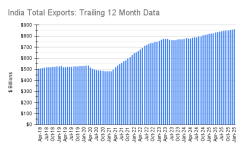
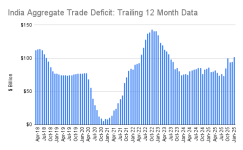
As of January, trailing 12-month exports stand at $865 billion and imports at $966 billion, a deficit of just $101 billion on total trade of $1831 billion. Total exports should exceed $900 billion on a TTM basis by mid 2026. A note of concern is the ride in the deficit in the past few months. It's important to get it down below $80 billion on an annualized basis, but it has crossed into triple digit again recently.
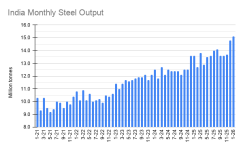
The first month of 2026 saw a new Indian steel production record - the first ever month of >15MT output, with a total of 15.1MT, up 10.5% from the year ago period.
In fact, both Dec 2025 and Jan 2026 have been the two highest months of steel output, by a distance - 14.8MT followed by 15.1MT - nearly equal to Brazil or Iran annual output in just 2 months.
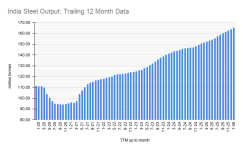
For the trailing 12-month period, Indian steel output is well past 165MT now and looks set to cross 170MT on a TTM basis by the first month of the next fiscal, i.e. April 2026.