

I saw this discussion on X today. Just wanted to ask was this pre-HAL?I am not aware of any such history. Do you have any references?
You are using an out of date browser. It may not display this or other websites correctly.
You should upgrade or use an alternative browser.
You should upgrade or use an alternative browser.


The point I was making is that there is no proven capability within the domestic aviation industry for such a project yet. Had the industry been nurtured like how the shipbuilding industry was/is nurtured maybe this capability would exist by now.Things like RTA 90 haven't been stuck on the IAF side for now. The project has been in the bureaucratic hurdles for years, it hasn't even reached the drawing board.
Was the IAF not involved with the project closely that such statements of dissatisfaction were made in public? IAF has a rather adversarial relationship with HAL. Would owning HAL change anything?In the first place several IAF officers and IAF chiefs have shown their dissatisfaction towards HAL and have asked for HAL to be under IAF afaik. Why is HAL not under IAF or IAF doesn't own a design bureau we don't know, though I am pretty confident it's not because IAF doesn't want it.
IN doesn't own any of the shipyard that supply to them. Their projects suffer many delays frequently. Yet we rarely see IN chiefs publicly admonishing those shipyards.
I am not that optimistic. But I hope you are right.HLFT 42 has seen interest from IAF afaik and they have been involved in the project, the tender for the aircraft's engine was released some time ago. Of course I don't know how well the relationship has been between HAL and IAF for the program but saying there is no interest from IAF is definitely false atleast for now.
How are tugboats a better parallel? Fine, IN currently has 13 classes of tugboats in service. Why can't IAF have one LIFT in service while funding another?Btw the talwar class frigate and HLFT 42 comparison was pretty awful, atleast use an example which would draw the right parallel for example the tugboats.
MoD delays release of funds because the HTFE-25/HTSE-1200 isn't tethered to any other programs. If, say, the IAF had committed to equipping the entire ALH fleet with the HTSE-1200 during its MLU funds would be easier to get. Similarly, if the IAF had committed to purchasing a number of Warrior UCAVs powered by HTFE-25s funds would be easier to get.You are asking why IAF doesn't fund the HTFE 25 engine but the engine's funding should've been from the MoD and the MoD delayed the release of their funds which delayed the project.
IAF's approach seems to be let HAL develop something then we will see what happens. No wonder MoD isn't releasing funds. Again, you don't see this with the IN.
You don't see IN tell MDL or GRSE to make a frigate, we will test it then we will see what happens. IN takes ownership of the process & is more involved through the building phase. Which is why delays don't seem to surprise them. The shipyards are certain that if the ships are built to IN's specs they will be accepted.
Why shouldn't they ask for the funding? Whoever ends up using the facilities, the absence of these facilities affects the IAF the most. It's not like the IAF has a problem with being vocal about other things that affect them.The testing infra wouldn't be developed by the IAF because the IAF doesn't have any use for the infra. HAL and DRDO would be the ones who'll be owning all these testing infra so why would IAF ask for the funding?
You haven't addressed the point I made. I don't care how they ended up with whatever share they have. I am asking what they are doing with it.The 3rd largest budget thing is very misleading. The army has the largest budget not because MoD feels like it but because historically the army has always had the highest number of personnel under them and armies in general require much more money for replenishments across the world.
Is it not IAF's job to advocate for these?
Yet this aberration has existed long enough for other services to copy it. Case in point, the Army has started their own design bureau in 2016. They haven't been very successful yet, but it is a step in the right direction. Why doesn't the IAF do the same?The innovation of the structure by the navy is an aberration, not the norm.
Services set the performance specs for military hardware. Carry out their field trials. Eventually if they are satisfied the hardware gets acquired. They have no leverage over a project ? They can bury a project by just sitting on their hands or by doing an endless series of trials.Services dont run development programs. They are just there to assist. They dont have any leverage over development of a project.
These responsibilities lie with either DRDO or the industry. Only with the recent DPP do we have involvement of services working with the industry as such.
The point was that the Navy is now directly funding engine development:Services cannot directly fund projects under DRDO or DPSU like HAL. I don't know where these assumptions come from.

Why isn't the IAF funding the HTFE/HTSE?
This is not a great argument.No where in the world airforces design and develop platforms like you mentioned. Its out of their reach and mandate.
Does the USN design their own ships? Does the RN? IN does & it seems to work for them. Instead of trying to look for international precedence of what airforces do & don't, how about we adopt a model that seems to work for at least one branch of the Indian military?
We spend an unnecessary amount of time discussing the right method/process, looking for international precedence, instead of working to produce an outcome. At least in our neighborhood, outcomes matter more than procedure.
Instead, we spend peacetime discussing the vagaries of the latest Make1, Make2, DcPP procedures. Then comes a conflict & we are doing emergency purchases from abroad.


IAFs inability to choose a fighter jet for import over decades let alone support domestic programs shows their idiocy. And I feel many in their ranks now and especially before current ACM were people in denial, especially about the canyon wide capability gap between IAF and PLAAF. I remember a former ACM saying IAF is ready for two front war! The same guy iirc said Su 30 tracked J20 even though I am quite sure he knew that J20 was flying with those reflective lenses. The first step in modernization is accepting the current reality!The point I was making is that there is no proven capability within the domestic aviation industry for such a project yet. Had the industry been nurtured like how the shipbuilding industry was/is nurtured maybe this capability would exist by now.
Was the IAF not involved with the project closely that such statements of dissatisfaction were made in public? IAF has a rather adversarial relationship with HAL. Would owning HAL change anything?
IN doesn't own any of the shipyard that supply to them. Their projects suffer many delays frequently. Yet we rarely see IN chiefs publicly admonishing those shipyards.
I am not that optimistic. But I hope you are right.
How are tugboats a better parallel? Fine, IN currently has 13 classes of tugboats in service. Why can't IAF have one LIFT in service while funding another?
MoD delays release of funds because the HTFE-25/HTSE-1200 isn't tethered to any other programs. If, say, the IAF had committed to equipping the entire ALH fleet with the HTSE-1200 during its MLU funds would be easier to get. Similarly, if the IAF had committed to purchasing a number of Warrior UCAVs powered by HTFE-25s funds would be easier to get.
IAF's approach seems to be let HAL develop something then we will see what happens. No wonder MoD isn't releasing funds. Again, you don't see this with the IN.
You don't see IN tell MDL or GRSE to make a frigate, we will test it then we will see what happens. IN takes ownership of the process & is more involved through the building phase. Which is why delays don't seem to surprise them. The shipyards are certain that if the ships are built to IN's specs they will be accepted.
Why shouldn't they ask for the funding? Whoever ends up using the facilities, the absence of these facilities affects the IAF the most. It's not like the IAF has a problem with being vocal about other things that affect them.
You haven't addressed the point I made. I don't care how they ended up with whatever share they have. I am asking what they are doing with it.
Is it not IAF's job to advocate for these?
Yet this aberration has existed long enough for other services to copy it. Case in point, the Army has started their own design bureau in 2016. They haven't been very successful yet, but it is a step in the right direction. Why doesn't the IAF do the same?
Services set the performance specs for military hardware. Carry out their field trials. Eventually if they are satisfied the hardware gets acquired. They have no leverage over a project ? They can bury a project by just sitting on their hands or by doing an endless series of trials.
The point was that the Navy is now directly funding engine development:
View attachment 44797
Why isn't the IAF funding the HTFE/HTSE?
This is not a great argument.
Does the USN design their own ships? Does the RN? IN does & it seems to work for them. Instead of trying to look for international precedence of what airforces do & don't, how about we adopt a model that seems to work for at least one branch of the Indian military?
We spend an unnecessary amount of time discussing the right method/process, looking for international precedence, instead of working to produce an outcome. At least in our neighborhood, outcomes matter more than procedure.
Instead, we spend peacetime discussing the vagaries of the latest Make1, Make2, DcPP procedures. Then comes a conflict & we are doing emergency purchases from abroad.
These guys even allowed a cash strapped country like Pakistan to get ahead in terms of AWACS and EW aircraft and had not done even basic things like SDR before 2019. What prevented IAF from procuring more Phalcon AWACS?
Earlier Ashwin sir said corvettes are easier to build compared to fighter jets, which is true. But when compared to submarines, both are equally technically intensive, infact I would say nuclear submarines are even more difficult to produce than fighter jets. The navy's decision to lease a nuclear sub from USSR/Russia imo was absolutely visionary and helped us a lot for our Arihant programme, a parallel which I personally have not seen in the IAF. The reality is IAF struggles eith even the most basic things required of an airforce of a military power while the Navy with inferior resources consistently delivers world class platforms for strategic and conventional use, the Arihant class and Akula training programme is a classic example of the Navys foresight.

I was giving you historical context on why the institutions were behaving like it. After the DPP-2016 things have started changing in the right direction.
IAF is far ahead compared to army. From 90s they have SDI which undertake all kind of software integration (Similar to Navy's WESEE) and their BRD's has been working with industry for upgrades and spares.
Most of the projects end up in endless trials because the scope is too ambitious and the results are not good enough.
Because there is an explicit limit of Rs 250 cr that airforce can offer under Make-1. You cant build an engine with that kind of money.
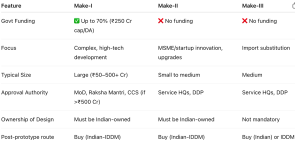
The Royal Navy used to design the entire ship until the 90s. In fact, initial Indian naval architects were trained by the Royal Navy to improve the Leander-class design for the Godavari Class frigate. In Turkey, Turkish Naval Forces Design Project Office (DPO) is the entity responsible for the design and development of new warships.
All over the world, having design competence within the navy is the norm. As industries evolve, they often offload the most labor-intensive work to them. But, retains the tight control and knowledge. You simply can't compare it with airforce. It's absurd to ask the Air Force to design and build fighter aircraft.
The Army Design Bureau and Naval Design Bureau are not the same. It is just a name for the army; they do not design anything, not even an armored vehicle. It is simply a facilitation branch of the service to interact with DRDO, industry, and academia.Yet this aberration has existed long enough for other services to copy it. Case in point, the Army has started their own design bureau in 2016. They haven't been very successful yet, but it is a step in the right direction. Why doesn't the IAF do the same?
IAF is far ahead compared to army. From 90s they have SDI which undertake all kind of software integration (Similar to Navy's WESEE) and their BRD's has been working with industry for upgrades and spares.
They have no control over the "development" of the project, but they do decide on the outcome. Since they are not involved in the development process, issues arise, such as communication problems or lack of understanding due to the technological complexity. Compare it with the US development cycle, where they have officers embedded and milestone-based reviews, and accountability from Senate committees.Services set the performance specs for military hardware. Carry out their field trials. Eventually if they are satisfied the hardware gets acquired. They have no leverage over a project ? They can bury a project by just sitting on their hands or by doing an endless series of trials.
Most of the projects end up in endless trials because the scope is too ambitious and the results are not good enough.
No, they are not directly funding but its coming form MoD budget under "Make-1" of DPP-2016.The point was that the Navy is now directly funding engine development:
Why isn't the IAF funding the HTFE/HTSE?
Because there is an explicit limit of Rs 250 cr that airforce can offer under Make-1. You cant build an engine with that kind of money.
Yes, USN design their own ships. NAVSEA is responsible for basic design then its given to contactors for detailed design. Their industry is advanced that they can handle it. Additionally, USN operates all kinds of testing and evaluation infrastructure in-house. They have full and tight control.This is not a great argument.
Does the USN design their own ships? Does the RN? IN does & it seems to work for them. Instead of trying to look for international precedence of what airforces do & don't, how about we adopt a model that seems to work for at least one branch of the Indian military?
We spend an unnecessary amount of time discussing the right method/process, looking for international precedence, instead of working to produce an outcome. At least in our neighborhood, outcomes matter more than procedure.
The Royal Navy used to design the entire ship until the 90s. In fact, initial Indian naval architects were trained by the Royal Navy to improve the Leander-class design for the Godavari Class frigate. In Turkey, Turkish Naval Forces Design Project Office (DPO) is the entity responsible for the design and development of new warships.
All over the world, having design competence within the navy is the norm. As industries evolve, they often offload the most labor-intensive work to them. But, retains the tight control and knowledge. You simply can't compare it with airforce. It's absurd to ask the Air Force to design and build fighter aircraft.
Total around 1981 cr valued orders are placed . More should be on the way.
MoD concluded 13 contracts under Emergency Procurement mechanism worth 1,981cr against an overall sanctioned outlay of 2,000cr for Army.
- Integrated Drone Detection & Interdiction Systems (IDD&IS)
-Low Level Light-Weight Radars (LLLR /LLWR)
- VSHORADS Launchers & Missiles (VSHORADS is not necessarily DRDO one)
- Remotely Piloted Aerial Vehicles
- Loitering Munitions incl VTOL systems
- Various categories of drones
- Bullet Proof Jackets (BPJs)
- Ballistic Helmets
- Quick Reaction Fighting Vehicles (QRFVs) – Heavy and Medium
- Night Sights for Rifles
MoD concluded 13 contracts under Emergency Procurement mechanism worth 1,981cr against an overall sanctioned outlay of 2,000cr for Army.
- Integrated Drone Detection & Interdiction Systems (IDD&IS)
-Low Level Light-Weight Radars (LLLR /LLWR)
- VSHORADS Launchers & Missiles (VSHORADS is not necessarily DRDO one)
- Remotely Piloted Aerial Vehicles
- Loitering Munitions incl VTOL systems
- Various categories of drones
- Bullet Proof Jackets (BPJs)
- Ballistic Helmets
- Quick Reaction Fighting Vehicles (QRFVs) – Heavy and Medium
- Night Sights for Rifles
It's literally not. At max some IAF official can talk to the MoF officials and try to persuade them, IAF cannot officially enter the MoF office and ask for money for the test facilities. Just imagine if IAF sends a formal proposal for building HTAF for themselves, the first question the MoF will put in front of them would be "What will you use these facilities for? You don't develop jet engines do you?".You haven't addressed the point I made. I don't care how they ended up with whatever share they have. I am asking what they are doing with it.
Is it not IAF's job to advocate for these?
Btw the tweet from Alpha defence is very misleading, many people think that some kind of proposal was rejected but in reality no such news is out there. The HTAF will be made in collaboration with the JV from the looks of it.
The first tweet also tells you that all three services are not able to put front a correct budget for themselves or the allocation process has been very slow.
They literally can't and IAF officials have been vocal about the lack testing infra just recently there was an interview where an IAF official addressed this.Why shouldn't they ask for the funding? Whoever ends up using the facilities, the absence of these facilities affects the IAF the most. It's not like the IAF has a problem with being vocal about other things that affect them.
MoD has delayed several with more strategic importance projects due to delayed funding. You can't pin it on one organization if the whole system has this issue, its systemic issue of the bureaucracy in the country. HTSE program started on 2015, three years after the last Dhruv mk 3 MLU, How will Army/IAF commit if the engine doesn't even exist for the MLU?MoD delays release of funds because the HTFE-25/HTSE-1200 isn't tethered to any other programs. If, say, the IAF had committed to equipping the entire ALH fleet with the HTSE-1200 during its MLU funds would be easier to get. Similarly, if the IAF had committed to purchasing a number of Warrior UCAVs powered by HTFE-25s funds would be easier to get.
Mate do you hear yourself? You are literally comparing shipbuilding and aircraft development as if they are the same. Shipbuilding doesn't have any prototype development anywhere in the world. IN doesn't take any ownership of any project or is somehow more "involved", all three services essentially do the same thing that is giving specs and changing there specs if they feel like it. All of them have changed the specs if their projects in the middle of the development. And for the love of god don't treat shipbuilding and aircraft development as the same.You don't see IN tell MDL or GRSE to make a frigate, we will test it then we will see what happens. IN takes ownership of the process & is more involved through the building phase. Which is why delays don't seem to surprise them. The shipyards are certain that if the ships are built to IN's specs they will be accepted.
Mate have you heard the Air chief's statement? He has blamed the IAF as well as HAL. Any chief calling out any organization is rare, even during the OFB times rarely a high ranking official spoke against them afaik and it's not a good thing.Was the IAF not involved with the project closely that such statements of dissatisfaction were made in public? IAF has a rather adversarial relationship with HAL. Would owning HAL change anything?
IN doesn't own any of the shipyard that supply to them. Their projects suffer many delays frequently. Yet we rarely see IN chiefs publicly admonishing those shipyards.
If you somehow believe that Naval officers don't have issues with the dockyards or the shipyards then, let me tell you it's false.

Total around 1981 cr valued orders are placed . More should be on the way.
MoD concluded 13 contracts under Emergency Procurement mechanism worth 1,981cr against an overall sanctioned outlay of 2,000cr for Army.
- Integrated Drone Detection & Interdiction Systems (IDD&IS)
-Low Level Light-Weight Radars (LLLR /LLWR)
- VSHORADS Launchers & Missiles (VSHORADS is not necessarily DRDO one)
- Remotely Piloted Aerial Vehicles
- Loitering Munitions incl VTOL systems
- Various categories of drones
- Bullet Proof Jackets (BPJs)
- Ballistic Helmets
- Quick Reaction Fighting Vehicles (QRFVs) – Heavy and Medium
- Night Sights for Rifles
VSHORADs might be the locally assembled Igla
Just yesterday we came to know about contracts with IdeaForge for mini UAVs and Solar Industries for loitering munitions.
Also likely LBRM etc from BDLVSHORADs might be the locally assembled Igla
Just yesterday we came to know about contracts with IdeaForge for mini UAVs and Solar Industries for loitering munitions.
By the way, why are we ordering loitering munitions and VSHORADs for counter insurgency?Also likely LBRM etc from BDL
Army contracts, so their priority are those perhaps. Drone thing is getting expedited capacity and capability wise, every corps separately going big on every type of drones including mounting CG84 on drones. VSHORADS makes sense to take out the probing swarm attacks which Pakistanis are deploying.By the way, why are we ordering loitering munitions and VSHORADs for counter insurgency?
In this case they highlighted D4 performance but the dew part of the system was not too effective natually, the non kinetic jamming and spoofing worked much better in comparison. HPM will be handy as well. We used LM to take out some vital assets so these can be tweaked and used more efficiently.
Well some aspects of shipbuilding, specifically the development of nuclear submarines, is indeed more difficult and costly compared to developing a fighter jet.It's literally not. At max some IAF official can talk to the MoF officials and try to persuade them, IAF cannot officially enter the MoF office and ask for money for the test facilities. Just imagine if IAF sends a formal proposal for building HTAF for themselves, the first question the MoF will put in front of them would be "What will you use these facilities for? You don't develop jet engines do you?".
Btw the tweet from Alpha defence is very misleading, many people think that some kind of proposal was rejected but in reality no such news is out there. The HTAF will be made in collaboration with the JV from the looks of it.
The first tweet also tells you that all three services are not able to put front a correct budget for themselves or the allocation process has been very slow.
They literally can't and IAF officials have been vocal about the lack testing infra just recently there was an interview where an IAF official addressed this.
MoD has delayed several with more strategic importance projects due to delayed funding. You can't pin it on one organization if the whole system has this issue, its systemic issue of the bureaucracy in the country. HTSE program started on 2015, three years after the last Dhruv mk 3 MLU, How will Army/IAF commit if the engine doesn't even exist for the MLU?
Mate do you hear yourself? You are literally comparing shipbuilding and aircraft development as if they are the same. Shipbuilding doesn't have any prototype development anywhere in the world. IN doesn't take any ownership of any project or is somehow more "involved", all three services essentially do the same thing that is giving specs and changing there specs if they feel like it. All of them have changed the specs if their projects in the middle of the development. And for the love of god don't treat shipbuilding and aircraft development as the same.
Mate have you heard the Air chief's statement? He has blamed the IAF as well as HAL. Any chief calling out any organization is rare, even during the OFB times rarely a high ranking official spoke against them afaik and it's not a good thing.
If you somehow believe that Naval officers don't have issues with the dockyards or the shipyards then, let me tell you it's false.

Most of the heavy lifting is done by L&T not navy.Well some aspects of shipbuilding, specifically the development of nuclear submarines, is indeed more difficult and costly compared to developing a fighter jet.
But isn't it the Navy which designed it. And final assembly of the entire fabricated hulls is still done by Navy in SBC Vizag, a task which is no mean feat. Of course however, without involvement from TATA SED, L and T and other private companies, Arihant would not be in operation even now lol.Most of the heavy lifting is done by L&T not navy.
DRDO DG ATVP is the nodal agency for this , whole design phase everything, inspection, tests on model sub, hyperscan etc all work is outsourced to L&T and maybe other subcontractor as suitable. What they retain is inspection & any change needed rec etc by QA agencies all are their nominated. They are the boss, sort of while LT does the work as directed. Since strategic asset so navy is heavily involved.But isn't it the Navy which designed it. And final assembly of the entire fabricated hulls is still done by Navy in SBC Vizag, a task which is no mean feat. Of course however, without involvement from TATA SED, L and T and other private companies, Arihant would not be in operation even now lol.
Damn I had no idea about this! Then it's no wonder Arihant is such a roaring success!!! This private public fusion is a must for our aerospace programmes.DRDO DG ATVP is the nodal agency for this , whole design phase everything, inspection, tests on model sub, hyperscan etc all work is outsourced to L&T and maybe other subcontractor as suitable. What they retain is inspection & any change needed rec etc by QA agencies all are their nominated. They are the boss, sort of while LT does the work as directed. Since strategic asset so navy is heavily involved.
Defence ministry inks 13 deals to boost Army's operational readiness | India News - Times of IndiaVSHORADs might be the locally assembled Igla
Just yesterday we came to know about contracts with IdeaForge for mini UAVs and Solar Industries for loitering munitions.
VSHORADs mentioned yesterday was another batch of Igla S assembled by Adani in India.
Defence ministry inks 13 deals to boost Army's operational readiness | India News - Times of India
VSHORADs mentioned yesterday was another batch of Igla S assembled by Adani in India.
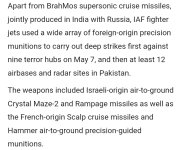
First confirmation that CM-2 was used in Op Sindoor. The IAF must've studied previous Israeli IDF strikes on Iran quite closely to formulate its own strategy.
Indian drone startup Raphe mPhibr raises $100M as military UAV demand soars
Indian drone startup Raphe mPhibr has raised $100 million in an all-equity Series B round led by General Catalyst, as the startup aims to boost its R&D and local production capabilities amid growing demand for drones in battlefields and for border surveillance.
Drones are becoming increasingly ubiquitous in global military operations. In recent and ongoing conflicts, countries have turned to drones for rapid infiltration and high-impact strikes. The recent India-Pakistan war is a prime example, with both militaries deploying drones at scale despite having advanced fighter jets and missile systems. The conflict spurred New Delhi to triple its drone spending to $470 million over the next 12 to 14 months according to the Drone Federation of India, an association representing over 550 companies.
While China remains the dominant force in global drone manufacturing, Raphe mPhibr aims to strengthen India’s indigenous drone capabilities.
Co-founded by siblings Vikash Mishra (chairman) and Vivek Mishra (CEO) in 2017, the Noida-based startup currently offers nine different drones with payloads ranging from 4.4 pounds to 441 pounds, covering an average distance of between 12 to 124 miles. These drones include the mR10 operational drone swarm, the mR20 for high-altitude logistics resupply, the X8 compact platform for maritime patrol and situational awareness at sea, and the Bharat lightweight man-carried drone for quick surveillance in complex terrain.
The startup has more than 10 customers, all of which are Indian government agencies, including the Indian Army, Navy, and Air Force, as well as armed police forces such as the Border Security Force, Central Reserve Police Force, and the Indo-Tibetan Border Police.
The Mishra brothers conceptualized Raphe mPhibr in 2016 while Vikash was studying at the Massachusetts Institute of Technology and Vivek was at the Georgia Institute of Technology. For the initial three to four years, the co-founders focused on understanding the operational needs of the defense forces, along with other requirements, such as environmental and terrain considerations. Then, they began building multicopters to meet the needs of the Indian troops, gradually expanding to fixed-wing and vertical takeoff and landing (VTOL) aircraft.
“In the process, we understood that since the need is new and the area is niche, we focused on both research and manufacturing because we didn’t want to be constrained by what [already existed],” Vivek said in an interview.
The startup began its journey with a 2,000-square-foot research facility in 2017 but expanded to a 100,000-square-foot combined research and manufacturing facility. This has now been expanded to a 650,000-square-foot facility as a result of the fresh capital infusion, which also saw the participation of its existing investor Think Investments.
“From day one, we have been against the transfer of technology,” Vivek told TechCrunch.
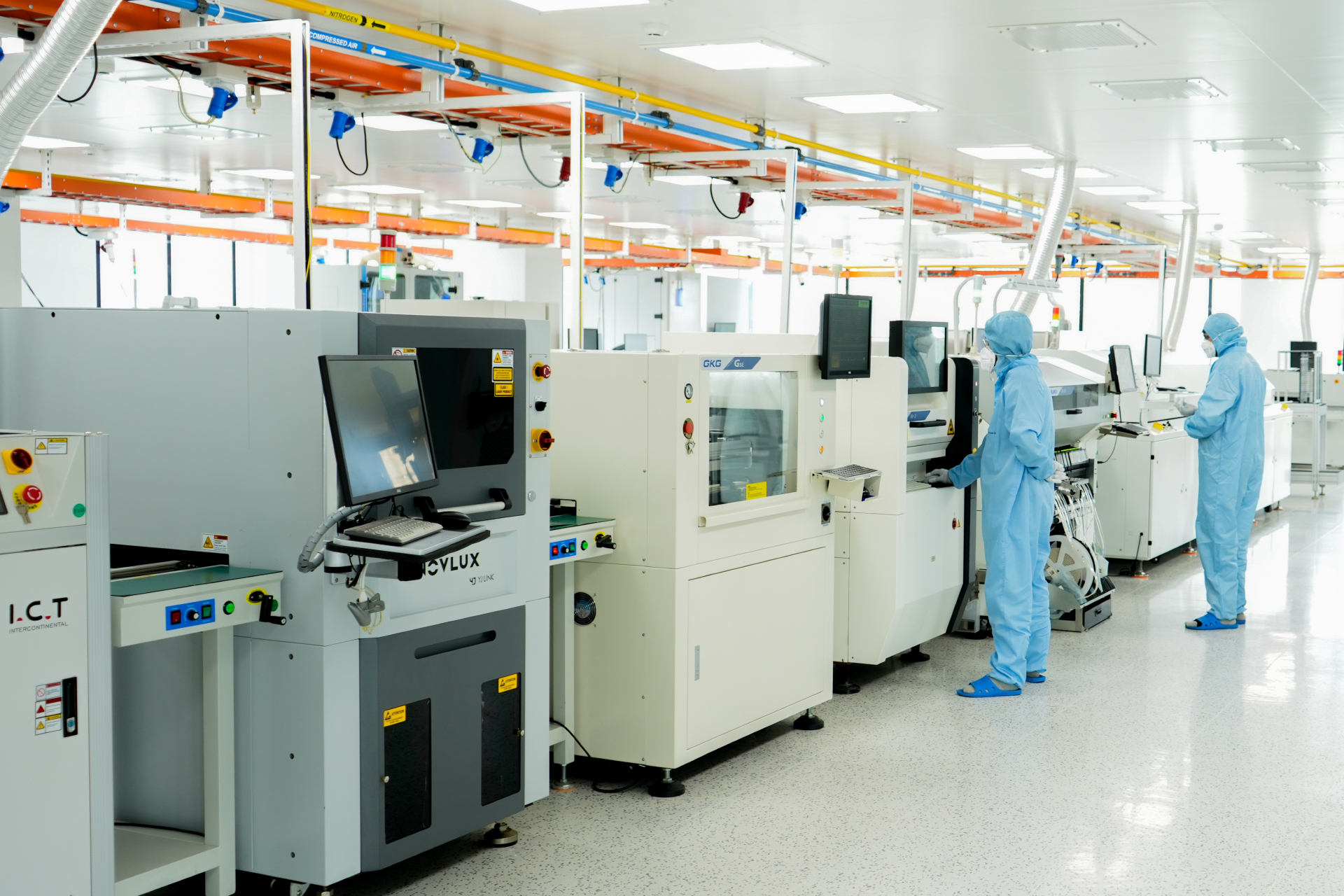
Raphe mPhibr domestically produces its flight controllers, batteries, and all components and materials required to build drone structures, including subtractive metals, thermoplastics, carbon fiber composites, and even wire harnesses. It also develops proprietary autopilots and inertial navigation systems at its facility. However, the startup imports radars and high-end cameras, which it also plans to manufacture in-house within 18 months.
Vivek told TechCrunch that the startup does not rely on China for any of the components it uses, thereby avoiding some supply chain challenges.
“The biggest challenge was setting up the facility and doing research,” he said. “Because doing research in India is slightly more expensive compared to the U.S., just because the infrastructure is quite well set up there… getting the machinery is a challenge, installation, and commissioning is a challenge, and then operating it, again, is a challenge because finding the people who can operate these is hard.”
Raphe mPhibr has addressed some of these hurdles by focusing on training and developing its employees from its early days, he added.
The startup also utilizes AI on its drones for object detection in surveillance scenarios, automatically switching between frequency bands to adapt to electronic warfare, and employing operational UAV swarm intelligence to make decentralized decisions using AI.
In recent months, Raphe mPhibr has partnered with Germany’s Hensoldt and France’s Safran to collaborate on developing new sensors, as well as with France’s Dassault Systèmes for software simulation requirements.
Raphe mPhibr also plans to expand beyond India and enter new markets. To this end, it has already participated in defense air shows, including those in Dubai and Paris.
Vivek told TechCrunch that the startup already has some export licenses and is seeking more but declined to share specifics.
“There are very advanced talks happening with a few government agencies across the world, and very soon, hopefully, this year, we will start delivering there as well,” he said.
In the past 12 months, Raphe mPhibr has sold over 300 drones and has experienced up to 4x revenue growth over the last four years, Vivek said, without disclosing specific numbers. He also stated that the startup has been profitable for each of the last four years and is projected to go public within the next two to five years.
Raphe mPhibr has around 600 employees, with 150 dedicated to research and over 250 to production. To date, the startup has secured a total of $145 million in equity funding.

A windfall is coming for India's surging defence exports
India's defence exports are set for a major boost. NATO's plan to increase defence spending creates a big opportunity. Indian companies like Reliance Defence are already securing deals with European firms. This surge is driven by India's growing manufacturing capabilities and strategic...