Indian Army Artillery Systems : News and Updates

Slightly offtopic but what could be the possible reason that GoI has not tried doing this with HAL? Like selling 49% to private players like TASL &/or L&T, Adani etc.
HAL is already 71% owned by the Government of India. If ownership falls below 50%, it will automatically become a private entity. There is no need to sell it to any major players.
 
  • Like
Reactions: redpanda
In defence, They are mostly producing items that DRDO has developed.

Both of the companies you mentioned are only 51% government-owned. They are run by professional management that is answerable to all shareholders.

It can be run by professionals but u need to engineers to deliver ...my question is how does reservation works on a 51% government owned org ? does the reservation apply or not ?
 

Raising of Dhanush 3rd regiment begins

NEW DELHI: The Indian Army has begun raising the third Regiment of the indigenously manufactured Dhanush artillery guns.

As this newspaper reported in October 2024, going by the tardy delivery of the indigenously produced advanced Bofors gun, Dhanush, for the Indian Army, it will be difficult to meet the March 2026 dateline.

The first gun was inducted in April 2019, and till now, only two regiments have become operational. “Going by the speed of delivery, it is unlikely that all the guns might be delivered in the remaining time,” sources at the top said.

Sources in the defence establishment said, “We have completed the process of raising a second regiment of Dhanush gun systems and also receiving a few systems for the third unit.” The overall project involves inducting 114 guns in six regiments. Some delays are expected before all the guns are inducted.

The Dhanush is the country’s first indigenously built artillery gun, manufactured by Advanced Weapons and Equipment India Limited (AWEIL), previously a part of the Ordnance Factory Board (OFB).

The plan was to induct 114 guns with 80% indigenous content by 2026. Its indigenous content makes its maintenance easier in terms of spare parts’ availability. One Regiment comprises 18 guns. The cost of each gun is about Rs 14 crore. Dhanush can travel through difficult terrains and target enemy targets day or night.

These guns, with upgrades, have been deployed along the Line of Actual Control in Ladakh. The old Bofors gun was a 155 mm 39-calibre piece with a firing range of around 30 km.

Dhanush, which fires up to 36 km, has around 877mm longer barrel. The system also has much more modern equipment and technology onboard, helping in precise targeting with heavier ordnance.

The weapon is the first long-range artillery gun to be produced in India. With eighty-one per cent of its components being indigenously sourced, it is seen to be giving a boost to the development of the indigenous industrial base in the country. The scale would go up to 90 per cent indigenous component in future.

First indigenously built artillery gun

The Dhanush is the country’s first indigenously built artillery gun, manufactured by Advanced Weapons and Equipment India Limited (AWEIL), previously a part of the Ordnance Factory Board (OFB). The plan was to induct 114 guns with 80% indigenous content by 2026. Its indigenous content makes its maintenance easier in terms of spare parts’ availability. One Regiment comprises 18 guns.
 

Raising of Dhanush 3rd regiment begins

NEW DELHI: The Indian Army has begun raising the third Regiment of the indigenously manufactured Dhanush artillery guns.

As this newspaper reported in October 2024, going by the tardy delivery of the indigenously produced advanced Bofors gun, Dhanush, for the Indian Army, it will be difficult to meet the March 2026 dateline.

The first gun was inducted in April 2019, and till now, only two regiments have become operational. “Going by the speed of delivery, it is unlikely that all the guns might be delivered in the remaining time,” sources at the top said.

Sources in the defence establishment said, “We have completed the process of raising a second regiment of Dhanush gun systems and also receiving a few systems for the third unit.” The overall project involves inducting 114 guns in six regiments. Some delays are expected before all the guns are inducted.

The Dhanush is the country’s first indigenously built artillery gun, manufactured by Advanced Weapons and Equipment India Limited (AWEIL), previously a part of the Ordnance Factory Board (OFB).

The plan was to induct 114 guns with 80% indigenous content by 2026. Its indigenous content makes its maintenance easier in terms of spare parts’ availability. One Regiment comprises 18 guns. The cost of each gun is about Rs 14 crore. Dhanush can travel through difficult terrains and target enemy targets day or night.

These guns, with upgrades, have been deployed along the Line of Actual Control in Ladakh. The old Bofors gun was a 155 mm 39-calibre piece with a firing range of around 30 km.

Dhanush, which fires up to 36 km, has around 877mm longer barrel. The system also has much more modern equipment and technology onboard, helping in precise targeting with heavier ordnance.

The weapon is the first long-range artillery gun to be produced in India. With eighty-one per cent of its components being indigenously sourced, it is seen to be giving a boost to the development of the indigenous industrial base in the country. The scale would go up to 90 per cent indigenous component in future.

First indigenously built artillery gun

The Dhanush is the country’s first indigenously built artillery gun, manufactured by Advanced Weapons and Equipment India Limited (AWEIL), previously a part of the Ordnance Factory Board (OFB). The plan was to induct 114 guns with 80% indigenous content by 2026. Its indigenous content makes its maintenance easier in terms of spare parts’ availability. One Regiment comprises 18 guns.
So approx 40 Dhanush and I guess 150 Sharangs delivered till now. Dhanush regiments going along LAC and Sharang along western border.
 
GuBfzAEWYAEmVWH

GuBfy-4XsAAKSNJ

GuBfy-Jb0AAkT6Z

ASSAM RIFLES AND INDIAN ARMY CONDUCTS JOINT TRAINING EXERCISE IN ARUNACHAL PRADESH
 
That looks like the same MGS shown in defexpo ? Must be more dcpp ?

EDIT: video seems from expo so the same. If they drop the shells carriage will it come down to 25ton below ?
 
  • Like
Reactions: redpanda
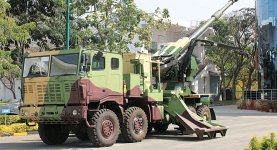
Ahmadnagar, Maharashtra | In visual is the Mounted Gun System (MGS) - a cross-country truck-mounted heavy artillery gun system with exclusively developed mobility and crew protection features in its class.
It has been indigenously developed by involving Indian Industries, DPSU, and Premier Academia, under the leadership of DRDO. MGS has high mobility in terms of gradient, side slope, trench crossing, and cross-country capability, and can operate in both desert and mountainous terrain.


View attachment ssstwitter.com_1751880647142.mp4

 
Other videos

Director, Vehicles Research and Development Establishment (VRDE), G Ramamohana Rao says, "It is a 155-152 calibre gun. These guns have been in place for quite some time. However, these are towed guns, which means that the guns and the primordial can be separated. It is towed and then deployed or retreated. It is essential to have a shoot-and-scoot capability, and hence we have worked on this MGS. In 80 seconds, we can deploy, and in 85 seconds, we can retrieve it from the location. It is an entirely indigenous system with export potential. This is the prototype that the Army can look at..."


  • Like
Reactions: Gautam and redpanda
Now ATAGS stuff from ANI , videos are too big

Pune, Maharashtra: The Advanced Towed Artillery Gun System (ATAGS), an indigenously developed artillery gun for use by the Indian Army, has been developed by DRDO (Defence Research and Development Organisation) in collaboration with private firms like Bharat Forge and Tata Advanced Systems.

Pune, Maharashtra: Director, ARDE, A. Raju says, "The Advanced Towed Artillery Gun System (ATAGS), which is designed and developed by ARDE, Pune. This is one of the best systems in the world, which the DRDO has developed. Its max range is 48 km and has special features like 25 barrel capacity, 52 calibre system and can fire in zone 7... We are also working to develop advanced ammunition systems. The existing ammunition is unguided... We are working on developing the guided ammunition system, which will have better accuracy... Indian Army has ordered 307 ATAGS, for which the contract was signed in March 2025. The order has been split in the ratio of 60:40, between Bharat Forge Ltd and Tata Systems Bengaluru. These guns will supplied in a duration of five years. They are 75% indigenous..."

Pune, Maharashtra: ATAGS Project Director, R.P. Pandey says, "This is a 155 mm /52 calibre artillery gun. It has a firing capability of BMCS Zone 7, which can help it achieve a range of 48 km... We have developed this with the collaboration of DRDO and other private firms..."


The MGS has a very high loading area! - don't see this with other systems - unless a SOP is done well, rate of fire will be less
 

Army’s first regiment of long-range ATAGS artillery guns to be ready by February 2027

The procurement of this system marks a significant milestone in the modernisation of the Army’s artillery regiments and is expected to enhance operational readiness.

PUNE/AHMEDNAGAR: The Indian Army’s plan to induct long-range indigenous artillery systems are in advanced stages, with the Advanced Towed Artillery Gun System (ATAGS) ready for its first product model test, while the Mounted Gun System (MGS) technology demonstrator is awaiting trial.

“The first gun system is ready for the mandatory first of product model test. The first regiment of 18 ATAGS will be inducted within a year thereafter,” said RP Pandey, Project Director (PD) of ATAGS, speaking to The New Indian Express.

The gun has a proven range of over 45 kilometres and can be deployed in 85 seconds, Pandey said at the DRDO’s Armament Research and Development Establishment (ARDE) in Pune. He added that the gun can be deployed in 90 seconds and has been tested up to a range of 48 kilometres. Its wider arc of fire enables more destructive capabilities.

The procurement of this system marks a significant milestone in the modernisation of the Army’s artillery regiments and is expected to enhance operational readiness.

In March, the Ministry of Defence (MoD) signed contracts for the procurement of 307 ATAGS 155mm/52 calibre guns and 327 high-mobility 6x6 gun towing vehicles, at a cost of around ₹6,900 crore. The ATAGS and towing vehicles will be procured from Bharat Forge Limited and Tata Advanced Systems Limited, respectively.

The ATAGS will replace older, smaller calibre guns and enhance the Indian Army’s artillery capabilities.

The ministry said, “ATAGS, renowned for its exceptional lethality, will play a crucial role in bolstering the Army’s firepower by enabling precise and long-range strikes.”

Taking the proven capabilities of ATAGS further, DRDO’s Vehicle Research and Development Establishment (VRDE) in Ahmednagar has developed the first technology demonstrator of the Mounted Gun System.

The MGS is a cross-country truck-mounted heavy artillery system (based on the 155mm/52 calibre ATAGS) with shoot-and-scoot capability. It has been developed indigenously with contributions from Indian industry, defence PSUs, and premier academic institutions, under DRDO’s leadership.

Artillery systems are typically used for indirect fire and are crucial in modern military operations due to their ability to strike targets deep inside enemy territory, operate in all weather conditions, function day and night, and use various types of ammunition.

However, once fired, these guns can reveal their position and become targets for enemy artillery. Mobility is therefore key. By adding mobility, the guns can fire and relocate quickly — a “shoot and scoot” capability — enhancing both survivability and lethality.

Bharat Kushwaha, Design Leader of the MGS project, told The New Indian Express that “high-mobility artillery was a technology gap which needed to be addressed. The Mounted Gun System (MGS) was a viable solution.”

A vehicle carrying the Mounted Gun System technology of the Indian army is seen here.

A vehicle carrying the Mounted Gun System technology of the Indian army is seen here.Photo | Mayank Singh, EPS

To that end, VRDE undertook a technology demonstrator project to design and develop a 155mm/52 calibre MGS based on ATAGS. The gun has been adapted onto an 8x8 cross-country wheeled vehicle with stabilisers and supporting interface structures.

The project has introduced state-of-the-art technologies in carrier vehicles, stabilisers, armoured cabins, ammunition handling cranes, on-board power systems, and integrated compact electronic controllers.

The MGS offers high mobility, including gradient, side-slope, trench-crossing and cross-country capabilities, and can operate in both desert and mountainous terrain.

This system can be rapidly deployed with mechanised forces, destroy enemy targets, and move before facing retaliatory fire.

Both ATAGS and MGS have over 80% indigenous content. “Except for the auto gun alignment and positioning system, muzzle velocity radar, and some types of batteries, everything else is indigenous,” said an official.

The ATAGS can be deployed in 90 seconds to fire its first shell, while the MGS can do so in 80 seconds.

Army requirements are expected to grow. G. Ramamohana Rao, Director of VRDE, said, “Initially, the Army needs 300 such guns, but the total requirement may rise to 700.”

With the modern systems now ready for induction, DRDO has begun working on indigenising remaining components and developing advanced ammunition. This includes shells fitted with ramjets and inertial guidance systems to improve range and precision