Hydrogen generation in India: News & Updates

Gautam

Staff member
Moderator
Feb 16, 2019
16,852
23,214
Tripura, NE, India

RIL plans to use 3 GW solar power to produce green hydrogen at electrolyser facility

The electrolyser factory is one of the four gigafactories announced by RIL’s Chairman Mukesh Ambani earlier this year

By Aarushi Koundal
ET EnergyWorld
October 21, 2021, 17:59 IST
1634921479555.png
New Delhi: Reliance Industries (RIL) is planning to use about 3 gigawatt (GW) of solar energy to generate 400,000 tonnes of hydrogen at its proposed electrolyser gigafactory, according to Madhukar Garg, President - Refining and Petchem R&D, RIL.

“We are still looking at the type of electrolyser to be used at the factory in terms of efficiency...The idea is that we should be using about 3-3.5 GW of solar energy to generate hydrogen to be used at our own refinery,” he added.

Garg was speaking at the Fourth Assembly of the International Solar Alliance on Thursday. The virtual event is being held from 18-21 October 2021

The electrolyser factory is one of the four gigafactories announced by RIL’s Chairman Mukesh Ambani earlier this year to achieve net-zero carbon emissions by 2035. These factories will be set up at a cost of Rs 75,000 crore in the next three to four years.

The first will be a solar photovoltaic gigafactory to manufacture and supply solar cells, modules and is expected to have 100 GW capacity by 2030.

Second gigafactory will be a grid battery facility to stabilise the local power grid and ensure uninterrupted power. Third will be a fuel-cell facility to accelerate electric mobility, and fourth will be an electrolyser facility for green hydrogen production.

“For the solar PV gigafactory, we plan to manufacture silicon, wafers, cells and modules and to initially focus on Indian supply. This will be situated in Jamnagar, Gujarat,” said Garg.

He added that this gigafactory will initially have 20 GW capacity per year, of which one-fourth will be captive and the rest will be exported to the grid. However, he said that this can change depending upon the economics.

For the grid battery gigafactory, he said that RIL is exploring various technologies and the focus is on stationary large-flow batteries.

RIL plans to use 3 GW solar power to produce green hydrogen at electrolyser facility - ET EnergyWorld
 
  • Like
Reactions: BMD and Ashwin

Gautam Adani aims to be one of the largest green hydrogen producers in the world: Gautam Adani

By Rachita Prasad, ET Bureau
Last Updated: Oct 19, 2021, 08:59 PM IST
1634921774863.png
The group's overall organic and inorganic investments across the entire green energy value chain will range between $50 billion and $70 billion, he said

Synopsis
Adani reiterated his plans to invest over $20 billion in renewable energy generation over the next decade.

Billionaire Gautam Adani has said that the Adani Group aims to be one of the largest green hydrogen producers in the world, which could potentially help India emerge as world’s cheapest hydrogen producer.

Adani reiterated his plans to invest over $20 billion in renewable energy generation over the next decade. The group's overall organic and inorganic investments across the entire green energy value chain will range between $50 billion and $70 billion, he said on the sidelines of UK’s Global Investment Summit at the London Science Museum.

“We are putting money where our mouth is and the portfolio companies of Adani are leading the way with investment plans to honour the nation’s commitment," Adani said.

The group plans to invest with potential partners for electrolyzer manufacturing, backward integrations for component manufacturing to secure the supply chain for the solar and wind generation businesses, and artificial intelligence-based utility and industrial cloud platforms.

Adani incubating a data centre company that will power all its data centres by renewable power by 2030. Adani Green Energy, the group's renewable energy company will triple its renewable power generation capacity over the next four years, having achieved its initial target of 25 gigawatts four years ahead of schedule.

Adani said that green policies and climate action not based on equitable growth will struggle in the long run. He said that climate change initiatives need a collaborative approach, where developed nations, which have emitted more greenhouse gases over time, shoulder greater responsibility and propose policies and targets that fairly address the needs of the developing world.

Gautam Adani aims to be one of the largest green hydrogen producers in the world: Gautam Adani
 
GAIL to build India's largest green hydrogen plant in 12-14 months

Speaking at the India Energy Forum by CERAWeek, GAIL Chairman and Managing Director Manoj Jain said the company is looking at building a 10-megawatt (MW) electrolyzer capable of generating 4.5 tonnes of green hydrogen daily

Written By: PTI
Updated: October 21, 2021; 09:15 pm
1634922118154.png
The firm has already floated a global tender to buy the electrolyzer and is hoping to get delivery in 12-14 months. Photo source: Reuters

State-owned GAIL (India) Ltd will build India's largest green hydrogen plant in the next 12-14 months, as it looks to supplement its natural gas business with carbon-free fuel.

Speaking at the India Energy Forum by CERAWeek, GAIL Chairman and Managing Director Manoj Jain said the company is looking at building a 10-megawatt (MW) electrolyzer capable of generating 4.5 tonnes of green hydrogen daily.

The firm has already floated a global tender to buy the electrolyzer and is hoping to get delivery in 12-14 months.

"It will take 12-14 months to put the plant," he said adding that the company has finalised 2-3 sites for the unit including one at Vijaipur in Madhya Pradesh, where the company has a gas processing plant.

Hydrogen is the latest buzz for meeting the world's energy needs. Hydrogen can be produced in three different ways through coal gasification (brown hydrogen), deriving it from methane in natural gas (blue hydrogen) and using renewable energy to produce green hydrogen. Green hydrogen is the cleanest of all with zero carbon emission.

Jain said the plant planned is for 10 MW capacity, the largest announced so far in the country. It will be double the size of the one announced by state electricity producer NTPC. Indian Oil Corp (IOC) has also announced plans to build a green hydrogen plant at its Mathura refinery.

"We have on a pilot basis started mixing hydrogen in natural gas in one of the cities," Jain said adding that the company is testing for idea mix percentage before scaling it up.

The hydrogen GAIL plans to produce can be sold to fertiliser units, which, as per government mandate, are required to use hydrogen as fuel, he said. India's largest gas-transporting and marketing company is also looking at newer avenues to boost business including pushing for use of LNG as fuel in long-haul trucking.

"For India to achieve the target of raising the share of natural gas in the energy basket to 15 per cent gas usage by 2030 from current 6.2 per cent, gas consumption has to rise three-and-a-half times to 600 million standard cubic meters per day. And, for this to happen, all sectors have to jump in," he said.

The government, he said, is pushing for the use of LNG as fuel transport and the mining sector. "We as the industry will set up 20 LNG dispensing stations on Golden Quadrilateral by March 2022 and 500-600 outlets in 3-4 years. The ultimate target is 1,000 LNG stations," he said.

Jain said 70 per cent of India's imported gas is through long-term contracts, which is shielding users such as fertiliser plants and refiners from the current price volatility.

Indian power consumers are affected by gas price volatility, which is also discouraging new users planning to switch to gas, he added.

GAIL to build India's largest green hydrogen plant in 12-14 months
 

India’s first; and one of world’s largest Green Hydrogen Microgrid Projects to be set up at Simhadri

Precursor to large scale Hydrogen energy storage projects​

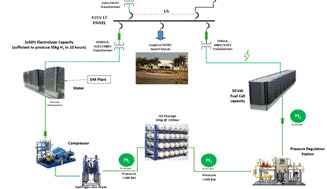
NTPC has awarded a project of “Standalone Fuel-Cell based Micro-grid with hydrogen production using electrolyser in NTPC Guest House at Simhadri (near Visakhapatnam)”. It is India’s first Green Hydrogen based Energy Storage Project. It would be a precursor to large scale hydrogen energy storage projects and would be useful for studying and deploying multiple microgrids in various off grid and strategic locations of the country.


frame_0_delay-0.01sZXAL.jpg


The hydrogen would be produced using the advanced 240 kW Solid Oxide Electrolyser by taking input power from the nearby Floating Solar project. The hydrogen produced during sunshine hours would be stored at high pressure and would be electrified using a 50 kW Solid Oxide Fuel Cell. The system would work in standalone mode from 5PM in the evening to 7AM in the morning.


image0026LFN.jpg


This unique project configuration is designed in-house by NTPC. It is a unique project for India and would open doors for decarbonising the far-off regions of the country like Ladakh, J&K etc., hitherto dependent on diesel generators. The project is in-line with the vision of Hon’ble Prime Minister for becoming carbon neutral by 2070 and making Ladakh a carbon neutral territory.

Hydrogen Fuel for Public Transport​

To promote vehicles operating on hydrogen fuel, this Ministry has issued a notification, vide G.S.R. 889(E), dated 16.09.2016, for use of Hydrogen as an automotive fuel in the country. The specifications for Hydrogen for Internal Combustion Engine have been specified in Annexure IV-W of the said notification. 18% blend of Hydrogen with CNG (HCNG) has been notified by this Ministry vide GSR 585(E) dated 25th September 2020. This Ministry vide GSR 579(E) dated 23rd September 2020 has notified safety norms regarding hydrogen fuel cell vehicles and its components.


Various hydrogen powered vehicles have been developed and demonstrated under projects supported by Government of India. These include 6 Fuel Cell buses (by Tata Motors Ltd.), 50 hydrogen enriched CNG (H-CNG) buses in Delhi (by Indian Oil Corporation Ltd. in collaboration with Govt. of NCT of Delhi), 2 hydrogen fuelled Internal Combustion Engine buses (by IIT Delhi in collaboration with Mahindra & Mahindra), fifteen hydrogen fuelled 3wheelers (by IIT Delhi in collaboration with Mahindra & Mahindra), 2 Hydrogen-Diesel dual fuel cars (by Mahindra & Mahindra) and one fuel cell car (by CSIR-National Chemical Laboratory, CSIR-Central Electrochemical Laboratory and CSIR-National Physical Laboratory). However, commercialization of hydrogen fuelled bus has not been undertaken in India so far.


This information was given by Union Minister for Road Transport and Highways, Shri Nitin Gadkari in a written reply in the Rajya Sabha.
 
Plan on table to halt new coal-fired power plants

By Sarita C Singh & Urmi Goswami
ET Bureau, Last Updated: Dec 22, 2021, 06:17 AM IST
View attachment 22206
NTPC Thermal Power Plant. (Representative Image)
Synopsis
At the UN climate change summit COP26 in Glasgow last month, Prime Minister Narendra Modi announced India's aim to achieve net-zero emissions by 2070 and also pledged to attain 500 GW of installed electricity capacity from non-fossil fuel sources by 2030.


India is considering a proposal to halt new coal-based power units as the country works out a plan to meet commitments made at COP26.

An expert committee tasked by the Union power ministry to update the National Electricity Policy (NEP) has recommended that no new coal-based capacity be considered, said people with knowledge of the matter. Replacement of old coal-based units should only be taken up when it is "convincingly established that it is not viable to meet the projected demand from alternate non-fossil fuel sources", according to its suggestions, said one of the people aware of the details.

At the UN climate change summit COP26 in Glasgow last month, Prime Minister Narendra Modi announced India's aim to achieve net-zero emissions by 2070 and also pledged to attain 500 GW of installed electricity capacity from non-fossil fuel sources by 2030.

Power Ministry's Earlier Stance

The expert committee's recommendation is a marked shift from the power ministry's earlier stance that the country may add more capacity through fossil-fuel sources as they continue to be a cheap source of electricity.

A senior government official said the report submitted by the expert committee in the last week of October is under deliberation. Once the draft policy is prepared, it will be circulated by the ministry among stakeholders for comments, he said.

View attachment 22205

The committee, headed by Gireesh Pradhan, former chairman of the Central Electricity Regulatory Commission, framed its recommendations after consulting all stakeholders, including states. The National Electricity Policy lays down the guidelines for the optimal utilisation of resources such as coal, natural gas, nuclear substances, hydro and renewable sources of energy and was last tweaked in 2005. The Electricity Act provides for its periodic revision.

"With growing penetration of renewable energy, about 60 GW of thermal capacity under construction and average thermal PLF (plant load factor) around 55%, we certainly do not need any more thermal," said Association of Power Producers director general Ashok Khurana. "As power demand increases, our first priority should be to get stranded coal and gas projects on stream."

The committee has suggested replacement of coal-based capacity should only be based on technology that's flexible in ramp-up and ramp-down and has higher efficiency rates, said the people cited above.

De-carbonisation of the electricity system is pitched as one of the priorities of the policy through retirement of inefficient plants and retrofitting existing coal-fired projects to enable flexible ramp-up and ramp-down of generation.

Hydro and gas-based projects are considered to be flexible in generation, while coal-fired plants take several hours to reach the required output and cannot quickly be scaled back if demand drops.

The committee has also recommended that inefficient generating units with a heat rate of over 2700 Kcal per kWh must be retired before March 31, 2023.

Experts said the days of thermal energy in India seem to be numbered given the country's surplus installed base, coupled with the push toward non-fossil energy and emerging energy storage technologies that will make renewable energy available round the clock.

In September, seven UN member countries launched a no-new-coal-energy compact at the UN High-Level Dialogue on Energy in their bid to achieve net-zero emissions by 2050.

Plan on table to halt new coal-fired power plants
Any information about hydrogen based power plants? Is it commercially feasible to run them in GW capacities?
 
Any information about hydrogen based power plants? Is it commercially feasible to run them in GW capacities?
At current prices extraction & transportation of green hydrogen is a far more expensive process than the amount of money that can be made by selling electricity generated by combustion of Hydrogen. So I don't see how thermal plants running on Hydrogen is going to work. Hydrogen has uses in powering many sectors: Industrial, Residential, Commercial, Transportation etc.

But electricity at your home from Hydrogen combustion isn't happening anytime soon.

Right now there are 2 viable processes of producing green Hydrogen:
1. Electrolysers
2. High Temperature Nuclear Reactors

We are working on reactors like the CHTR & the IHTR, but it is a future technology. Electrolysers are available right now but need large scale expansion. That's where companies like Reliance, GAIL, NTPC, TATA, Ohmium etc. come in. All of them are investing in building, acquiring & scaling up electrolysers. But electrolyser technology is not exactly a monolith, there are many types of electrolysers:

1. Alkaline Electrolysers (AE): They were first developed in India by BARC for some nuclear research work. ISRO acquired the tech from them & set up their own Hydrogen production capability. The hydrogen ISRO produced were mostly meant to power their cryogenic hydrolox engines.
2. Polymer Electrolyte Membrane (PEM): Recently developed & tested by CSIR-CERI. This is a spin-off of the R&D work done on the DRDO's PAFC AIP system. CSIR-CERI was involved with the NMRL in the development of the polymer membrane for the AIP. The CSIR is trying to commercialize the technology.
3. Solid Oxide Electrolyser (SOE), Electrochemical-Thermally Activated Chemical (E-TAC) & and Anion Exchange Membrane (AEM): Proprietary technologies developed by foreign companies. Don't know a lot about it.

AE is easily available but requires a lot of electricity. Comparatively PEM is much more energy efficient. The other processes mentioned above are even better then PEM but they use some rare earth minerals, thus scaling them up is a problem. The companies that are trying to get into Hydrogen production in India are largely looking to setup PEM electrolysers. But a lot of the companies want to import the tech rather than using the tech developed by CSIR-CERI. As such the lab is trying to convince these companies to adopt their tech. The govt. might announce a PLI for green hydrogen production too & they might link it to using CSIR-CERI developed PEM. Let's see how this goes.

Production is one thing, transportation is an additional headache. Hydrogen is the lightest element & it is a gas at room temp. Hydrogen gas has a density so low that it permeates out of most pipes. You need pipes made of very high density alloys that are ultra expensive to transport hydrogen gas safely & efficiently. The other way is to transport cryogenically cooled liquid hydrogen, which is no less problematic.

So what do you do? Find a easily transportable chemical that can act as a hydrogen carrier. The carrier chemical will preferable be a fuel itself. Hydrogen in gaseous form will be dissolved as solute into this gaseous or liquid carrier that will be the solvent. The solution will be used directly by end users as fuel.

Much to the great dismay of many environmental activists such a hydrogen carrier chemical is likely going to be a hydrocarbon. So which hydrocarbons are in consideration? 3 hydrocarbons each with its own advantages & disadvantages. Briefly we have the following:

1. Natural Gas(Methane):

Advantages:
i. Being a gas it can dissolve the highest volume of Hydrogen. Therefore it is the most efficient carrier of hydrogen.
ii. Natural gas has high calorific value which would be increased by the presence of Hydrogen.
iii. The technology needed to generate grid scale electricity from natural gas already exists at very competitive prices. The same technology is adaptable for hydrogen spiked natural gas.
iv. There is political will behind natural gas. Modi wants to increase the share of natural gas in our energy grid from the current 6% to 15% by 2030.

Disadvantages:
i. India doesn't have a lot of natural gas. 43% of our current gas consumption comes from domestic sources. If we rely on gas too much in the next few decades this is going to become another drain on our foreign reserves like oil is now.
ii. India's current pipeline infrastructure is inadequate. We have built just ~15,000 km of pipelines in the last 27 years prior to 2014. Since 2014 we have been building an additional 16,000+ km.
iii. We don't have a lot of gas fired power plants. So if we are going to use natural gas as the hydrogen carrier we will also have to set up new gas fired plants.

Future scope:
Our reserves of conventional gas is limited. But we have a lot of Methane hydrates. Extracting methane from hydrates is not something that has been commercially established anywhere yet. Many of our research establishments & companies are working on gas extraction technologies. We have also signed agreements with US, Japan & Canada for co-operation in development of the tech needed. All 3 of these nations have their own gas hydrates reserves, so they have a skin in the game. Some of these countries claim that commercial production of gas from hydrates can be done with in the next 5 years.

Recently we've made some breakthroughs of our own:

How to sequester carbon dioxide and produce natural gas

We have nearly ~2000 trillion cubic feet of natural gas in Methane hydrates. If we can tap even a small share of this it would greatly change the energy & geo-political scenario for us.

2. Ethanol

Advantages:

i. Of the 3 hydrocarbons mentioned here Ethanol is the 2nd most efficient Hydrogen carrier. Liquid fuel are easier to transport.
ii. Can be easily adopted into the transportation sector. Spark ignition engines can readily adopt Ethanol. Burn cleaner than petrol.
iii. Produced from food grains, sugar, agro waste etc. No long term import dependency concern. Can reduce problems of stubble burning.
iv. Can reduce our crude oil import bill. Has acquired govt. support in form of the Ethanol Blending Program (EBP). EBP seeks to achieve 20% ethanol blending from the current 8.5% by 2025.

Disadvantages:
i. Lower calorific value than petrol & natural gas. To produce as much energy as 1 liter of petrol you would need to burn 1.5 liters of Ethanol. Not feasible to use in oil fired electricity plants.
ii. Can have an adverse effect on food security. Requires a meticulously designed incentive scheme to ensure optimal production of Ethanol that doesn't cause an artificial scarcity of food items. We all know how good New Delhi is with incentive schemes.
iii. The EBP will cause short term import dependency on USA & Brazil.

Future scope:
The only way we will achieve 20% Ethanol blending by 2025 is if we import ethanol. Domestic ethanol production plants aren't coming up fast enough. Consumption is shooting through the roof. A program designed to reduce import dependence on crude oil will end up causing a temporary import dependence on ethanol. Brilliant. :ROFLMAO: :ROFLMAO:

3. Methanol

Advantages:

i. Can be produced from our domestic coal. We have a lot of coal & it is pretty cheap. No problems of import dependency or price.
ii. Cleanest liquid hydrocarbon. Easy to transport.
iii. Can be used to make Di-Methyl Ether (DME) that can wholly replace Diesel. Diesel engines need minor tweaks to their compression ratios to use DME. DME can thus be used in road, rail & marine transportation.

Disadvantages:
i. Globally available tech for producing Methanol from Coal doesn't work on Indian coal due to its high ash content. We have to develop our own tech.
ii. It the poorest carrier of hydrogen. Also has the lowest calorific value. You would have to burn 1.9 liters of Methanol to produce energy equivalent to 1 liter of Petrol. Not feasible to be used for producing electricity.

Future scope:
Recently BHEL had a breakthrough with Methanol production. In Sep 2021 BHEL announced that their R&D centre in Hyderabad set up a coal gasification plant that is now producing 0.25 ton per day (TPD) of Methanol from Indian high ash coal using a 1.2 TPD Fluidized bed gasifier. SO they used 1.2 ton Indian coal to produce 0.25 ton Methanol.

India's first Indigenously Designed High Ash Coal Gasification Based Methanol Production Plant at BHEL R&D Centre, Hyderabad

https://dst.gov.in/indias-first-pil...hanol-can-accelerate-countrys-journey-towards

India has 340+ billion metric tons of coal, at our current consumption levels we consume less than 1/350th of our reserves every year. The low conversion ratio of Indian coal to Methanol is not a problem. The fact that we can produce high purity Methanol from Indian coal is a big deal. Still BHEL needs to establish the scalability of their tech.

Some good reads on Methanol in India:

vikaspedia Domains

https://www.thehindubusinessline.co...t-methanol-for-clean-fuel/article34183663.ece

https://www.moneycontrol.com/news/i...ould-be-a-cheaper-fuel-for-india-7540761.html

It is hard to say with certainty where we are headed in the energy scheme in say 30 years from now. But is seems clear that none of these carriers alone can cater to all of our needs. Thus we need to keep developing all of them. The good thing is that the govt. is investing in all 3 potential options.

Anyway I have rambled on for long enough. Let me know if I made any mistakes, I am half asleep right now. I am going to bed. Good night.

 
At current prices extraction & transportation of green hydrogen is a far more expensive process than the amount of money that can be made by selling electricity generated by combustion of Hydrogen. So I don't see how thermal plants running on Hydrogen is going to work. Hydrogen has uses in powering many sectors: Industrial, Residential, Commercial, Transportation etc.

But electricity at your home from Hydrogen combustion isn't happening anytime soon.

Right now there are 2 viable processes of producing green Hydrogen:
1. Electrolysers
2. High Temperature Nuclear Reactors

We are working on reactors like the CHTR & the IHTR, but it is a future technology. Electrolysers are available right now but need large scale expansion. That's where companies like Reliance, GAIL, NTPC, TATA, Ohmium etc. come in. All of them are investing in building, acquiring & scaling up electrolysers. But electrolyser technology is not exactly a monolith, there are many types of electrolysers:

1. Alkaline Electrolysers (AE): They were first developed in India by BARC for some nuclear research work. ISRO acquired the tech from them & set up their own Hydrogen production capability. The hydrogen ISRO produced were mostly meant to power their cryogenic hydrolox engines.
2. Polymer Electrolyte Membrane (PEM): Recently developed & tested by CSIR-CERI. This is a spin-off of the R&D work done on the DRDO's PAFC AIP system. CSIR-CERI was involved with the NMRL in the development of the polymer membrane for the AIP. The CSIR is trying to commercialize the technology.
3. Solid Oxide Electrolyser (SOE), Electrochemical-Thermally Activated Chemical (E-TAC) & and Anion Exchange Membrane (AEM): Proprietary technologies developed by foreign companies. Don't know a lot about it.

AE is easily available but requires a lot of electricity. Comparatively PEM is much more energy efficient. The other processes mentioned above are even better then PEM but they use some rare earth minerals, thus scaling them up is a problem. The companies that are trying to get into Hydrogen production in India are largely looking to setup PEM electrolysers. But a lot of the companies want to import the tech rather than using the tech developed by CSIR-CERI. As such the lab is trying to convince these companies to adopt their tech. The govt. might announce a PLI for green hydrogen production too & they might link it to using CSIR-CERI developed PEM. Let's see how this goes.

Production is one thing, transportation is an additional headache. Hydrogen is the lightest element & it is a gas at room temp. Hydrogen gas has a density so low that it permeates out of most pipes. You need pipes made of very high density alloys that are ultra expensive to transport hydrogen gas safely & efficiently. The other way is to transport cryogenically cooled liquid hydrogen, which is no less problematic.

So what do you do? Find a easily transportable chemical that can act as a hydrogen carrier. The carrier chemical will preferable be a fuel itself. Hydrogen in gaseous form will be dissolved as solute into this gaseous or liquid carrier that will be the solvent. The solution will be used directly by end users as fuel.

Much to the great dismay of many environmental activists such a hydrogen carrier chemical is likely going to be a hydrocarbon. So which hydrocarbons are in consideration? 3 hydrocarbons each with its own advantages & disadvantages. Briefly we have the following:

1. Natural Gas(Methane):

Advantages:
i. Being a gas it can dissolve the highest volume of Hydrogen. Therefore it is the most efficient carrier of hydrogen.
ii. Natural gas has high calorific value which would be increased by the presence of Hydrogen.
iii. The technology needed to generate grid scale electricity from natural gas already exists at very competitive prices. The same technology is adaptable for hydrogen spiked natural gas.
iv. There is political will behind natural gas. Modi wants to increase the share of natural gas in our energy grid from the current 6% to 15% by 2030.

Disadvantages:
i. India doesn't have a lot of natural gas. 43% of our current gas consumption comes from domestic sources. If we rely on gas too much in the next few decades this is going to become another drain on our foreign reserves like oil is now.
ii. India's current pipeline infrastructure is inadequate. We have built just ~15,000 km of pipelines in the last 27 years prior to 2014. Since 2014 we have been building an additional 16,000+ km.
iii. We don't have a lot of gas fired power plants. So if we are going to use natural gas as the hydrogen carrier we will also have to set up new gas fired plants.

Future scope:
Our reserves of conventional gas is limited. But we have a lot of Methane hydrates. Extracting methane from hydrates is not something that has been commercially established anywhere yet. Many of our research establishments & companies are working on gas extraction technologies. We have also signed agreements with US, Japan & Canada for co-operation in development of the tech needed. All 3 of these nations have their own gas hydrates reserves, so they have a skin in the game. Some of these countries claim that commercial production of gas from hydrates can be done with in the next 5 years.

Recently we've made some breakthroughs of our own:

How to sequester carbon dioxide and produce natural gas

We have nearly ~2000 trillion cubic feet of natural gas in Methane hydrates. If we can tap even a small share of this it would greatly change the energy & geo-political scenario for us.

2. Ethanol

Advantages:

i. Of the 3 hydrocarbons mentioned here Ethanol is the 2nd most efficient Hydrogen carrier. Liquid fuel are easier to transport.
ii. Can be easily adopted into the transportation sector. Spark ignition engines can readily adopt Ethanol. Burn cleaner than petrol.
iii. Produced from food grains, sugar, agro waste etc. No long term import dependency concern. Can reduce problems of stubble burning.
iv. Can reduce our crude oil import bill. Has acquired govt. support in form of the Ethanol Blending Program (EBP). EBP seeks to achieve 20% ethanol blending from the current 8.5% by 2025.

Disadvantages:
i. Lower calorific value than petrol & natural gas. To produce as much energy as 1 liter of petrol you would need to burn 1.5 liters of Ethanol. Not feasible to use in oil fired electricity plants.
ii. Can have an adverse effect on food security. Requires a meticulously designed incentive scheme to ensure optimal production of Ethanol that doesn't cause an artificial scarcity of food items. We all know how good New Delhi is with incentive schemes.
iii. The EBP will cause short term import dependency on USA & Brazil.

Future scope:
The only way we will achieve 20% Ethanol blending by 2025 is if we import ethanol. Domestic ethanol production plants aren't coming up fast enough. Consumption is shooting through the roof. A program designed to reduce import dependence on crude oil will end up causing a temporary import dependence on ethanol. Brilliant. :ROFLMAO: :ROFLMAO:

3. Methanol

Advantages:

i. Can be produced from our domestic coal. We have a lot of coal & it is pretty cheap. No problems of import dependency or price.
ii. Cleanest liquid hydrocarbon. Easy to transport.
iii. Can be used to make Di-Methyl Ether (DME) that can wholly replace Diesel. Diesel engines need minor tweaks to their compression ratios to use DME. DME can thus be used in road, rail & marine transportation.

Disadvantages:
i. Globally available tech for producing Methanol from Coal doesn't work on Indian coal due to its high ash content. We have to develop our own tech.
ii. It the poorest carrier of hydrogen. Also has the lowest calorific value. You would have to burn 1.9 liters of Methanol to produce energy equivalent to 1 liter of Petrol. Not feasible to be used for producing electricity.

Future scope:
Recently BHEL had a breakthrough with Methanol production. In Sep 2021 BHEL announced that their R&D centre in Hyderabad set up a coal gasification plant that is now producing 0.25 ton per day (TPD) of Methanol from Indian high ash coal using a 1.2 TPD Fluidized bed gasifier. SO they used 1.2 ton Indian coal to produce 0.25 ton Methanol.

India's first Indigenously Designed High Ash Coal Gasification Based Methanol Production Plant at BHEL R&D Centre, Hyderabad

https://dst.gov.in/indias-first-pil...hanol-can-accelerate-countrys-journey-towards

India has 340+ billion metric tons of coal, at our current consumption levels we consume less than 1/350th of our reserves every year. The low conversion ratio of Indian coal to Methanol is not a problem. The fact that we can produce high purity Methanol from Indian coal is a big deal. Still BHEL needs to establish the scalability of their tech.

Some good reads on Methanol in India:

vikaspedia Domains

Has methanol finally got its due?

Here’s Why Methanol Could Be A Cheaper Fuel For India

It is hard to say with certainty where we are headed in the energy scheme in say 30 years from now. But is seems clear that none of these carriers alone can cater to all of our needs. Thus we need to keep developing all of them. The good thing is that the govt. is investing in all 3 potential options.

Anyway I have rambled on for long enough. Let me know if I made any mistakes, I am half asleep right now. I am going to bed. Good night.
Absolutely wonderful post . A real gem !! You ought to take it to Twitter. I actually asked & expected a small summation . You packed in quite a bit of information. Not that I'm complaining.

Wanted to pen this last night but was caught up in other activities.

One of the few reasons I returned. Else most of the good members here or in any other forum have switched to Twitter .

I guess 2022 will see the rest follow.
 
  • Like
Reactions: Gautam and SammyBoi
Oil India to set up green hydrogen plant in Assam

Speaking on the occasion of the 'bhumi pujan' ceremony of the project, Pankaj Kumar Goswami, Director (Operations) said the hydrogen so generated will be blended with natural gas using the existing infrastructure.

By PTI, DECEMBER 27, 2021 / 02:21 PM IST
1640698369363.png

Oil India Ltd, the nation’s second-largest state-owned oil explorer, is setting up a plant to manufacture green hydrogen at its Jorhat oilfield in Assam, the company said in a statement.

"To strengthen its bouquet of clean energy offerings”, the company has initiated action for setting up a 100 kW green hydrogen plant at its Pump station-3 in Jorhat, it said.

The pilot plant will generate green hydrogen using AEM technology, it said without giving details. "This is a first of its kind project in the country.”

Speaking on the occasion of the 'bhumi pujan' ceremony of the project, Pankaj Kumar Goswami, Director (Operations) said the hydrogen so generated will be blended with natural gas using the existing infrastructure.

Hydrogen being the cleanest form of energy is the latest focus area across the globe to satiate the rising energy needs.

Green hydrogen is derived from water electrolysis using renewable energy like solar or wind. Biomass-based hydrogen production technologies also qualify under the green category.

The government proposed the National Hydrogen Mission in the Union Budget 2021-22, initiating a hydrogen roadmap for the country. The mission was announced in August this year by Prime Minister Narendra Modi.

Under the Paris agreement (COP 21), by the year 2030, India is committed to reducing its greenhouse emissions by 33-35 per cent from the 2005 levels.

This has necessitated finding alternative sources of cleaner energy.

Oil India To Set Up Green Hydrogen Plant In Assam
 

Since you evinced an interest in non carbon energy resources ( a bit of a misnomer here tbh ) , I thought there's no better introduction to this subject in India & possibly the world than to see India's richest man & the most powerful group's foray into this terrain.

Points to note : you may want to ignore the teleprompter style pre scripted interview at least early on & if 35 min seems a stretch apart from the accent , pls make use of subtitles & 1.5x speed features on YT.

@Ginvincible
 
  • Like
Reactions: Ginvincible

Since you evinced an interest in non carbon energy resources ( a bit of a misnomer here tbh ) , I thought there's no better introduction to this subject in India & possibly the world than to see India's richest man & the most powerful group's foray into this terrain.

Points to note : you may want to ignore the teleprompter style pre scripted interview at least early on & if 35 min seems a stretch apart from the accent , pls make use of subtitles & 1.5x speed features on YT.

@Ginvincible
Yes, I have been keeping on eye on what Ambani and Adani are doing with renewables, especially with solar and hydrogen. They both want to be the leading renewable power companies in the world. I fully expect competition between the both of them will usher in another new age of super low price solar cells and will likely make India one of the leading producers of clean hydrogen. Watch the price of polysilicates and electrolyzers come crashing down by the end of the decade if they actually pull through.
 
  • Like
Reactions: _Anonymous_
Yes, I have been keeping on eye on what Ambani and Adani are doing with renewables, especially with solar and hydrogen. They both want to be the leading renewable power companies in the world. I fully expect competition between the both of them will usher in another new age of super low price solar cells and will likely make India one of the leading producers of clean hydrogen. Watch the price of polysilicates and electrolyzers come crashing down by the end of the decade if they actually pull through.
What's your take on Reliance backing Na Ion battery instead of traditional Li Ion battery for the transportation sector. Lots of people are of the opinion he's betting against physics & chemistry yet he's gone and bought out a British based unicorn pioneer in this field & Ambani's rarely known for making a false move .
 
What's your take on Reliance backing Na Ion battery instead of traditional Li Ion battery for the transportation sector. Lots of people are of the opinion he's betting against physics & chemistry yet he's gone and bought out a British based unicorn pioneer in this field & Ambani's rarely known for making a false move .
I think for larger vehicles or vehicles that will have more range, lithium is the way to go. Sodium ion could be feasible for smaller, cheaper vehicles with more limited range. I could see it open up the low budget EV market, but then again a better lithium recycling/extraction process could negate any cost advantage sodium has. The issue is just that sodium doesn't have the energy density, I think sodium is fine for stationary grids or like home power storage. All of this is moot if solid state technology makes an entry, I know Toyota has a big focus on making hybrids and solid state EVs.
 
  • Like
Reactions: _Anonymous_
I think for larger vehicles or vehicles that will have more range, lithium is the way to go. Sodium ion could be feasible for smaller, cheaper vehicles with more limited range. I could see it open up the low budget EV market, but then again a better lithium recycling/extraction process could negate any cost advantage sodium has. The issue is just that sodium doesn't have the energy density, I think sodium is fine for stationary grids or like home power storage. All of this is moot if solid state technology makes an entry, I know Toyota has a big focus on making hybrids and solid state EVs.
If Na Batteries are built to last say 5 hours or 30-40 kms or whichever is lesser , they could subscribe to an energy solutions provider who can provide them with charged batteries from a refilling station much like a gas station for a monthly plan like a subscriber does a phone plan with a service provider.

Ofc this involves setting up of a massive infrastructure of battery mfg , charging stations / refilling stations across the land . Reliance has the wherewithal to do it except he must commercialize the product ASAP & sign up 4 wheel & 2 wheel manufacturers before they standardize their battery on Li ion .

As a sop he can offer the OEMs a royalty for a fixed period of time . As it is with the advent of EVs service stations as we know it will see vastly reduced revenues & consequently so would OEMs as far as sales of spares go except batteries & the occasional accident cases.
 
  • Like
Reactions: Ginvincible