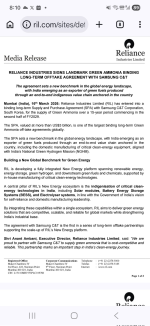
At current prices extraction & transportation of green hydrogen is a far more expensive process than the amount of money that can be made by selling electricity generated by combustion of Hydrogen. So I don't see how thermal plants running on Hydrogen is going to work. Hydrogen has uses in powering many sectors: Industrial, Residential, Commercial, Transportation etc.
But electricity at your home from Hydrogen combustion isn't happening anytime soon.
Right now there are 2 viable processes of producing green Hydrogen:
1. Electrolysers
2. High Temperature Nuclear Reactors
We are working on reactors like the CHTR & the IHTR, but it is a future technology. Electrolysers are available right now but need large scale expansion. That's where companies like Reliance, GAIL, NTPC, TATA, Ohmium etc. come in. All of them are investing in building, acquiring & scaling up electrolysers. But electrolyser technology is not exactly a monolith, there are many types of electrolysers:
1. Alkaline Electrolysers (AE): They were first developed in India by BARC for some nuclear research work. ISRO acquired the tech from them & set up their own Hydrogen production capability. The hydrogen ISRO produced were mostly meant to power their cryogenic hydrolox engines.
2. Polymer Electrolyte Membrane (PEM): Recently developed & tested by CSIR-CERI. This is a spin-off of the R&D work done on the DRDO's PAFC AIP system. CSIR-CERI was involved with the NMRL in the development of the polymer membrane for the AIP. The CSIR is trying to commercialize the technology.
3. Solid Oxide Electrolyser (SOE), Electrochemical-Thermally Activated Chemical (E-TAC) & and Anion Exchange Membrane (AEM): Proprietary technologies developed by foreign companies. Don't know a lot about it.
AE is easily available but requires a lot of electricity. Comparatively PEM is much more energy efficient. The other processes mentioned above are even better then PEM but they use some rare earth minerals, thus scaling them up is a problem. The companies that are trying to get into Hydrogen production in India are largely looking to setup PEM electrolysers. But a lot of the companies want to import the tech rather than using the tech developed by CSIR-CERI. As such the lab is trying to convince these companies to adopt their tech. The govt. might announce a PLI for green hydrogen production too & they might link it to using CSIR-CERI developed PEM. Let's see how this goes.
Production is one thing, transportation is an additional headache. Hydrogen is the lightest element & it is a gas at room temp. Hydrogen gas has a density so low that it permeates out of most pipes. You need pipes made of very high density alloys that are ultra expensive to transport hydrogen gas safely & efficiently. The other way is to transport cryogenically cooled liquid hydrogen, which is no less problematic.
So what do you do? Find a easily transportable chemical that can act as a hydrogen carrier. The carrier chemical will preferable be a fuel itself. Hydrogen in gaseous form will be dissolved as solute into this gaseous or liquid carrier that will be the solvent. The solution will be used directly by end users as fuel.
Much to the great dismay of many environmental activists such a hydrogen carrier chemical is likely going to be a hydrocarbon. So which hydrocarbons are in consideration? 3 hydrocarbons each with its own advantages & disadvantages. Briefly we have the following:
1. Natural Gas(Methane):
Advantages:
i. Being a gas it can dissolve the highest volume of Hydrogen. Therefore it is the most efficient carrier of hydrogen.
ii. Natural gas has high calorific value which would be increased by the presence of Hydrogen.
iii. The technology needed to generate grid scale electricity from natural gas already exists at very competitive prices. The same technology is adaptable for hydrogen spiked natural gas.
iv. There is political will behind natural gas. Modi wants to increase the share of natural gas in our energy grid from the current 6% to 15% by 2030.
Disadvantages:
i. India doesn't have a lot of natural gas. 43% of our current gas consumption comes from domestic sources. If we rely on gas too much in the next few decades this is going to become another drain on our foreign reserves like oil is now.
ii. India's current pipeline infrastructure is inadequate. We have built just ~15,000 km of pipelines in the last 27 years prior to 2014. Since 2014 we have been building an additional 16,000+ km.
iii. We don't have a lot of gas fired power plants. So if we are going to use natural gas as the hydrogen carrier we will also have to set up new gas fired plants.
Future scope:
Our reserves of conventional gas is limited. But we have a lot of Methane hydrates. Extracting methane from hydrates is not something that has been commercially established anywhere yet. Many of our research establishments & companies are working on gas extraction technologies. We have also signed agreements with US, Japan & Canada for co-operation in development of the tech needed. All 3 of these nations have their own gas hydrates reserves, so they have a skin in the game. Some of these countries claim that commercial production of gas from hydrates can be done with in the next 5 years.
Recently we've made some breakthroughs of our own:
How to sequester carbon dioxide and produce natural gas
We have nearly ~2000 trillion cubic feet of natural gas in Methane hydrates. If we can tap even a small share of this it would greatly change the energy & geo-political scenario for us.
2. Ethanol
Advantages:
i. Of the 3 hydrocarbons mentioned here Ethanol is the 2nd most efficient Hydrogen carrier. Liquid fuel are easier to transport.
ii. Can be easily adopted into the transportation sector. Spark ignition engines can readily adopt Ethanol. Burn cleaner than petrol.
iii. Produced from food grains, sugar, agro waste etc. No long term import dependency concern. Can reduce problems of stubble burning.
iv. Can reduce our crude oil import bill. Has acquired govt. support in form of the Ethanol Blending Program (EBP). EBP seeks to achieve 20% ethanol blending from the current 8.5% by 2025.
Disadvantages:
i. Lower calorific value than petrol & natural gas. To produce as much energy as 1 liter of petrol you would need to burn 1.5 liters of Ethanol. Not feasible to use in oil fired electricity plants.
ii. Can have an adverse effect on food security. Requires a meticulously designed incentive scheme to ensure optimal production of Ethanol that doesn't cause an artificial scarcity of food items. We all know how good New Delhi is with incentive schemes.
iii. The EBP will cause short term import dependency on USA & Brazil.
Future scope:
The only way we will achieve 20% Ethanol blending by 2025 is if we import ethanol. Domestic ethanol production plants aren't coming up fast enough. Consumption is shooting through the roof. A program designed to reduce import dependence on crude oil will end up causing a temporary import dependence on ethanol. Brilliant.
 3. Methanol
Advantages:
i. Can be produced from our domestic coal. We have a lot of coal & it is pretty cheap. No problems of import dependency or price.
ii. Cleanest liquid hydrocarbon. Easy to transport.
iii. Can be used to make Di-Methyl Ether (DME) that can wholly replace Diesel. Diesel engines need minor tweaks to their compression ratios to use DME. DME can thus be used in road, rail & marine transportation.
Disadvantages:
i. Globally available tech for producing Methanol from Coal doesn't work on Indian coal due to its high ash content. We have to develop our own tech.
ii. It the poorest carrier of hydrogen. Also has the lowest calorific value. You would have to burn 1.9 liters of Methanol to produce energy equivalent to 1 liter of Petrol. Not feasible to be used for producing electricity.
Future scope:
Recently BHEL had a breakthrough with Methanol production. In Sep 2021 BHEL announced that their R&D centre in Hyderabad set up a coal gasification plant that is now producing 0.25 ton per day (TPD) of Methanol from Indian high ash coal using a 1.2 TPD Fluidized bed gasifier. SO they used 1.2 ton Indian coal to produce 0.25 ton Methanol.
India's first Indigenously Designed High Ash Coal Gasification Based Methanol Production Plant at BHEL R&D Centre, Hyderabad
Indias first pilot plant to convert high ash coal to methanol can accelerate the countrys journey towards clean technology | Department Of Science & Technology | Department Of Science & Technology (DST)
India has 340+ billion metric tons of coal, at our current consumption levels we consume less than 1/350th of our reserves every year. The low conversion ratio of Indian coal to Methanol is not a problem. The fact that we can produce high purity Methanol from Indian coal is a big deal. Still BHEL needs to establish the scalability of their tech.
Some good reads on Methanol in India:
vikaspedia Domains
Government takes a hard look at methanol for clean fuel
https://www.moneycontrol.com/news/i...ould-be-a-cheaper-fuel-for-india-7540761.html
It is hard to say with certainty where we are headed in the energy scheme in say 30 years from now. But is seems clear that none of these carriers alone can cater to all of our needs. Thus we need to keep developing all of them. The good thing is that the govt. is investing in all 3 potential options.
Anyway I have rambled on for long enough. Let me know if I made any mistakes, I am half asleep right now. I am going to bed. Good night.