

France: Updates and Discussion
- Thread starter BMD
- Start date
You are using an out of date browser. It may not display this or other websites correctly.
You should upgrade or use an alternative browser.
You should upgrade or use an alternative browser.


Sure he will be, why wouldn't he?Vladimir Putin to Macron
I sincerely wish you success in your public action and good health

I hope Modi will be as warm

My French is poor, so does that mean that 51% of overseas French voted Le Pen?yep!
and/but noticeable that LePen “won” in France’s overseas:
Not so. From what I heard, Macron has implemented nothing but right wing policies since taking office, so this was an election between right and far-right, and it was split fairly evenly. UKIP, under Farage, actually refused to form an alliance with Le Pen's party at EU level because they were too right wing. And they maxed out at about 4-5% of the UK vote.For us Marine Lepen is in the same category as Boris Johnson.

The margin is actually very, very small considering.Any ideas why she lost by such margin? I am guessing in your country the intensity of right wing supporters are less compared to ours. No disrespect to your people
That's hardly a badge of honour these days.Vladimir Putin to Macron
I sincerely wish you success in your public action and good health
I hope Modi will be as warm

Your English is no better, you fool. The abstentions were 51% . LePen won ~58% of the vote vs Macron's ~42% .My French is poor, so does that mean that 51% of overseas French voted Le Pen?
I used to think the quality of French education in UK was of a very high order indeed till I encountered a few samples & then you. Your English leaves much to be desired & you're commenting on your knowledge of French!?!
Plus you're Irish. Which means had you known your own native language French wouldn't be half as difficult to master even for a numskull like you.

High abstention, sanction vote, breakthrough of the extreme right... The five lessons of the presidential election in overseas FranceMy French is poor, so does that mean that 51% of overseas French voted Le Pen?
(…)
Re-elected with 58.5% of the vote as head of state, Emmanuel Macron only received 41.7% of the vote in the overseas territories. The results show a deep rejection of the government's policies outside France. Marine Le Pen made a historic breakthrough, particularly in the West Indies.
"This vote obliges me", admitted Emmanuel Macron during his speech after winning the presidential election on Sunday evening, 24 April. It obliges him, because it was not a wave of support that returned him to power for "five more years", as his supporters chanted on the Champ-de-Mars in Paris. Never before has the far right been so strong in France. Never before has the Rassemblement National (and before it the Front National) obtained such high scores. Never before had the Le Pen family come first in overseas territories.
At the end of this election, the President of the Republic will have to draw conclusions from the overseas vote. In the West Indies, Mayotte and Reunion, as in the Pacific, the French were reluctant to go to the polling booths. And those who did, while they had voted for Jean-Luc Mélenchon [err.. “left-left wing”, Le Parti des Insoumis] in the first round, decided this time to put the name of Marine Le Pen in the ballot box. Overseas La 1ère looks at the five lessons of this historic election.
1- General demobilisation of voters
Since the announcement of the abstention rate at the national level during this second round (28%), questions have been raised about the vitality of democratic life in France. However, in the overseas territories, this rate is soaring. This weekend, 51.3% of the overseas population did not vote. Admittedly, this rate is lower than in the first round (56% of voters had shunned the ballot box). But compared to the 2017 presidential election, which had already seen Emmanuel Macron and Marine Le Pen face off, the demobilisation is accentuated: in 2022, participation has fallen by almost five points.
Despite a slight increase in turnout between the first and second rounds, the abstention rate exceeded 50% in all the territories, with the exception of Wallis and Futuna (38.6%), Réunion (40.6%) and Saint-Pierre and Miquelon (42.9%). However, turnout remains lower there than in France.
Demobilisation was more marked in the Pacific. In New Caledonia, where the independents called for abstention, 100,000 voters went to the polls in the second round of the 2017 presidential election. This year, only 76,000 people voted. In Wallis and Futuna, an archipelago in the Pacific that traditionally votes more than the other overseas territories, the abstention rate is ten points higher than five years ago, at 38%. In Martinique and Guadeloupe, less than one in two voters turned out this weekend. In French Guiana, the abstention rate even exceeded 60%.
2- A historic breakthrough for Marine Le Pen
The 2022 election is marked by the historic victory of Marine Le Pen in the French Overseas Territories, a feat for the far-right candidate, whose father, Jean-Marie Le Pen, had never managed to convince the overseas voters. Between the second round of 2017 and that of 2022, the National Rally gained 190,000 additional votes, reaching the symbolic threshold of 500,000 voters. An unprecedented score.
A victory to be put into perspective, Marine Le Pen having failed to collect more votes than in 2017 during the first round. She who presented herself as the people's candidate against the technocratic president took advantage of the proximity she created with the overseas departments during the campaign, while Emmanuel Macron, caught up in the war in Ukraine, remained at a distance in metropolitan France. She managed to reap the fruits of the anger of the Ultramarines, who were less won over by her nationalist and identity-based project than by her proposals to improve purchasing power.
The result: she came out on top in Antilles-Guyana, Saint-Martin, Saint-Barthélemy, Saint-Pierre and Miquelon, as well as in Mayotte and Reunion Island. While Emmanuel Macron received 58.5% of the French vote, Marine Le Pen received 58.3% of the overseas vote. A vote that runs counter to the national choice. A glass ceiling that has been shattered.
Clearly rejected by the West Indians in 2017 - Emmanuel Macron had been voted for by more than 75% -, Marine Le Pen was, this time, chosen by the Guadeloupeans and Martiniqueans, with respectively 69.6% and 60.9% of the votes. In Reunion Island, she managed to convince 130,000 more people between the first and second rounds to vote for her: she gained twenty points more than in the 2017 election (59.6% against 39.7% five years ago). Only the Pacific is a bulwark against the far right. Emmanuel Macron came out on top there. However, Polynesia also came close to seeing the far right come out on top: the candidate received 48.2% of the vote.
3- The barrage against the far-right did not work in overseas territories
"We must not give a vote to Madame Le Pen! The slogan was given by most French political leaders, including Jean-Luc Mélenchon, the far-left candidate who was defeated in the first round of the election, but whose 22% of voters represented a reserve of votes coveted by the two finalists. Overseas, it was Marine Le Pen who managed to capture the left-wing vote.
In the first round, the leader of France Insoumise came out on top in the overseas territories, with 40% of the vote. But what were his voters going to do in the second round? Vote Macron, Le Pen? Put in an empty envelope? Abstain? "[The French] are capable of knowing what to do, they are capable of deciding what is good for the country," the Marseille MP had hammered on the evening of his defeat, without giving a clear voting instruction.
This call for a barrage against the far right was not heard overseas. Jean-Luc Mélenchon had attracted 330,000 voters in the first round, coming first in the territories where, on Sunday evening, Marine Le Pen came first. It is difficult to know how many Mélenchon voters voted, or what they voted. But the purely numerical demonstration suggests that a large proportion of them resigned themselves to voting for Marine Le Pen: between the two rounds, Emmanuel Macron won only 190,000 additional votes, while the RN candidate won 327,000.
During the election evening on France 2 [french tv channel], the insoumise deputy Mathilde Panot also put a word on this Melenchonist vote that became Lepenist in the second round. According to her, anti-Macronism, especially in the West Indies, was stronger than the fear of the far right.
An analysis shared by Martial Foucault, holder of the Overseas Chair at Sciences Po, interviewed by Serge Massau: "Marine Le Pen's voters in the Overseas Departments and Territories are not necessarily anti-Europe, for national preference, nor against the threat of identity that would weigh on the country. It would be wrong to think that they adhere to the whole of her programme. Instead, they have picked up on themes that she alone has taken up in this inter-trial period, such as the high cost of living, inflation and social inequalities.”
4- Anti-macronism: the big winner of the election
The results in the overseas territories are a stinging disavowal for the government. Coming third in the overseas vote in the first round, behind Jean-Luc Mélenchon and Marine Le Pen, the president of the Republic Emmanuel Macron lost all the votes he had won in 2017 - he had won 64.4% of the votes in the second round, a score equivalent to the national result.
After five years marked by social and health crises, mistrust has won. For the Overseas Chair of Sciences Po Paris, Marine Le Pen's breakthrough in this election does not represent a vote of support for the ideas of the National Rally, but rather a sanction vote against Emmanuel Macron and his government.
In Martinique, the outgoing president lost 60,000 votes between 2017 and 2022. In Guadeloupe, he lost 57,000 votes. In the Indian Ocean, he lost 65,000 votes in Réunion. The decline is general in all the overseas territories. Emmanuel Macron is weakened in the overseas territories. "His score in the Overseas Territories will force the next government to urgently address the situation in the Overseas Territories and issues such as inflation on which there has been no improvement in five years," said Martial Foucault.
5- Last basin to vote for Emmanuel Macron: the Pacific
The only consolation for Emmanuel Macron was that he came out on top in the three Pacific territories of French Polynesia (51.8% of the vote), New Caledonia (61%) and Wallis and Futuna (67.4%).
How do you explain this result, which stands out from the rest of the overseas territories? The Pacific traditionally supports the Republican right, which Les Républicains embodied for years - in 2017, François Fillon came first in Polynesia and New Caledonia. But with the collapse of the parties, Emmanuel Macron has captured the centre-right electorate. And therefore the French Pacific territories.
In New Caledonia, the independents abstained heavily, as they did in the referendum on self-determination on 12 December 2021. As a result, the majority of loyalists, satisfied with the government's attitude following the vote in favour of keeping the island in the fold of the Republic, went to the polls on Sunday. The same goes for Wallis and Futuna, where the vote in favour of Emmanuel Macron is a vote of reason, more than of support.
In Polynesia, on the other hand, the tide began to turn in favour of the far right. The president came out on top. But only by a hair. Between the two rounds, Gaston Flosse, former president of Fenua and still very influential local political figure, decided to support Marine Le Pen. A symbolic break for the former Secretary of State in Jacques Chirac's government between 1986 and 1988. In 2002, the Polynesian had supported the outgoing president against the candidate who had made it to the second round by surprise: Jean-Marie Le Pen.
(deepL)

Forte abstention, vote sanction, percée de l'extrême-droite... Les cinq enseignements du scrutin présidentiel en Outre-mer - Outre-mer La 1ère
Réélu avec 58,5 % des voix à la tête de l'État, Emmanuel Macron n'a recueilli que 41,7 % des votes dans l'ensemble des Outre-mer. Les résultats témoignent d'un profond rejet de la politique du gouvernement hors des frontières de l'Hexagone. Marine Le Pen y a fait une percée historique, notamment...
 la1ere.francetvinfo.fr
Last edited:
Modi is coming to give Macron a little kiss next week.Sure he will be, why wouldn't he?
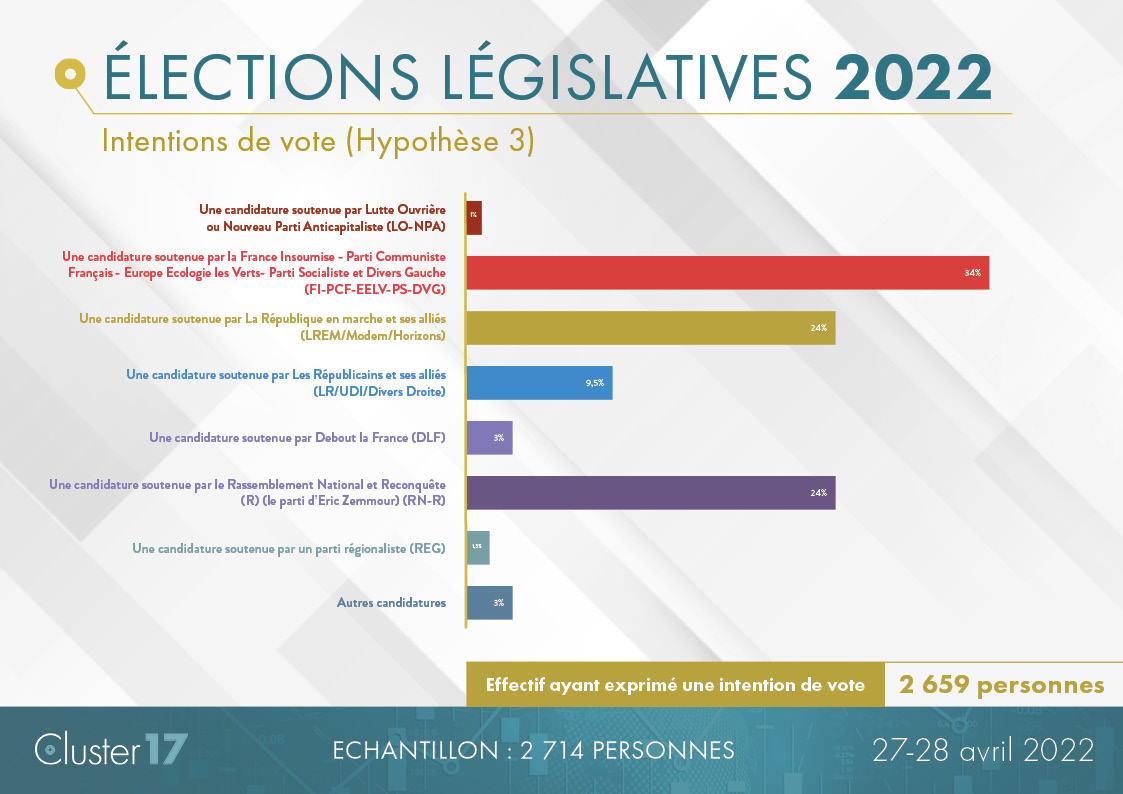
A potential great surprise is about to come with the last part of the general elections in France : Almost all left organizations signed an agreement : The "NUPES" is born (Nouvelle Union Populaire Écologiste et Sociale )
This is a very particular agreement, not only an electoral one, but also an agreement about the government policy.
Many here in France think about 1936 : "Le Front Populaire" with great social achievements (first 2 weeks Holidays ! )
I'is plausible to have a 1st Minister from the left party next june 19
An historic agreement between LFI and the Ecologists
The last agreement signed with the PS (Parti socialiste)
An article in english from the guardian
This is a very particular agreement, not only an electoral one, but also an agreement about the government policy.
Many here in France think about 1936 : "Le Front Populaire" with great social achievements (first 2 weeks Holidays ! )
I'is plausible to have a 1st Minister from the left party next june 19
An historic agreement between LFI and the Ecologists
The last agreement signed with the PS (Parti socialiste)
An article in english from the guardian
Last edited:

France reshaped: Election emboldens Le Pen, undercuts Macron
France faced an ecstatic Marine Le Pen on Monday after her party’s far-right candidates sent shockwaves through the political establishment and helped deny President Emmanuel Macron’s centrist allianc...


Australian and French soldiers undertake Townsville training
Royal Australian Regiment 1st and 3rd battalion personnel have trained alongside around 120 soldiers from a French Army contingent. The training was part of French Mistral-class landing helicopter do
 www.defenceconnect.com.au
A police blunder in Nanterre: a 17-year-old boy was killed and his arrest was not in accordance with the law...
I would say that it was the police officer's shooting that did not comply with the rules of self-defence (and proportionality of the response to the threat).A police blunder in Nanterre: a 17-year-old boy was killed and his arrest was not in accordance with the law...

A police blunder in Nanterre: a 17-year-old boy was killed and his arrest was not in accordance with the law...
The investigation is not made, so You can't say that.
For policeman as for every one in France, he is supposed to be innocent until a court decide he is not.
Last edited:
A badly known 17 old young was fired by a policeman, because he refused to halt after committing several mistakes and refusing to comply.
Note that he hadn't a driving licence, and that it was at least the 5th time he was arrested in such situation.
I could argue that if he was fleeing in car with no driving license that represents an immediate threat to the public. Especially if he drove it directly at the officer who shot him. We'll have to see what comes out in the wash.I would say that it was the police officer's shooting that did not comply with the rules of self-defence (and proportionality of the response to the threat).
The vehicle was stationary and the 2 policemen were on its side, i.e not on its trajectory. One policeman fired just as the driver started off again.I could argue that if he was fleeing in car with no driving license that represents an immediate threat to the public. Especially if he drove it directly at the officer who shot him. We'll have to see what comes out in the wash.
"The Nanterre public prosecutor has announced that the police officer who shot Nahel has been remanded in custody. A judicial investigation into voluntary manslaughter has also been opened. The conditions for using his weapon on Tuesday were "not met", explained the public prosecutor.
The police officer who shot Nahel said he had fired to "prevent the vehicle from fleeing again", even though the driver's behaviour on the road was "dangerous", explained the Nanterre public prosecutor. The two police officers said they "felt threatened when they saw the driver drive off".
ps: (anecdotally) the tweet you posted, I know the area in the video well. I recognise the school I went to when I was a kid.
A simple advice for all men : when a policeman ask you to stop, you stop.
This young didn't deserve to be shot, but if he drive a car with a licence, respect the rules, follow the policemen orders, he would still be alive.
It's as simple as that. Also.
This young didn't deserve to be shot, but if he drive a car with a licence, respect the rules, follow the policemen orders, he would still be alive.
It's as simple as that. Also.

One shot? In Murrrca that cop would have unloaded his whole magazine.A simple advice for all men : when a policeman ask you to stop, you stop.
This young didn't deserve to be shot, but if he drive a car with a licence, respect the rules, follow the policemen orders, he would still be alive.
It's as simple as that. Also.