Defence Research and Development Organisation (DRDO) : News and Updates

What a BS comment, nowhere in the article it is said that DRDO's AIP system has failed, Mountain rats is as always jumping to conclusions without understanding the context.
It's on the Navy's insistence of not procuring the Scorpenes with the noisy MESMA AIP why DRDO's Fuel Cell AIP even exists in the first place.
Also, how exactly do you get a proven AIP system if you are not going to lend a submarine for integration, testing & validation of the AIP system in real life conditions.
Regarding foreign collaboration, Naval Group will be involved when the INS Khanderi undergoes MLU in 2026 and the AIP system gets installed on the boat.
As far as P75I is concerned, DRDO's Fuel cell AIP is not even in the picture.
 
Did you even read the article? Nowhere it said that the DRDO's AIP failed. On the other hand, it welcomes successful development of DRDO's fuel cell AIP but raises questions about who will integrate it and where will the submarine for live testing come from. He argues that a foreign collaborator should be used for integration, which we are anyway doing with Naval Group.
 
This is true. For the flak DRDO get, they are hamstrung and blame shifted by the political leadership driven mechanism in place. We know that for a long time but typically forget. Govt side, for all its power, want assured return on every outgoing. That does not work in scientific development process. It also explains why license mfg is the preferred route for the sly customer with Govt blessing. No risk approach where everyone get own share via corrupt practice.
Issue lies with the way setup is created. Each incumbent Govt want the huge psu/Govt funded agency votebank factored in for the next election irrespective of which party or coalition is in power. Military agencies do not deal with that, so they are unhappy money spent on such cause would have been better given to them and they would buy from outside. DRDO like org for their part would promise to develop stuff else there is no validity in their existence. This infighting for resource allocation is where the political leadership thrives, because it makes their role relevant. They get to decide who gets what and not an ounce of blame is directed at them.
As long as this approach stays, license mfg will stay via other names like IDDM.

Delhi | Addressing the Delhi Defence Dialogue 2025 at Manohar Parrikar Institute for Defence Studies and Analyses (MP-IDSA), DRDO Chief Sameer V Kamat says, "One of the challenges of funding cutting-edge R&D in industry was who would be accountable for the failure. Unlike DARPA in the US, which has a mandate from its Senate and Congress, where if failures occur, they don't have to answer to the Senate why it has caused loss to the taxpayer. Only 10 to 15% of DARPA projects succeed because they really look at moonshots when it comes to technology. We don't have such a mechanism in India. If our projects fail, we have to answer to CAG and the Parliament why a loss has been caused to the government. But R&D has to be looked at as an investment, not an expenditure. Because even if a project fails, the lessons that you learn from that R&D can be used in several other places. We are now looking at a separate chapter for R&D in our GFR. Secretary DSP has been tasked to come up with such a chapter. This will then help us in funding cutting-edge R&D in startups, MSMEs even large industries, which will then speed up our innovation..."

 
Key areas of cooperation outlines in this TA include Aeronautical platforms, Unmanned vehicles, Advanced Materials for defence applications, Cyber Security, Artificial Intelligence, Space, Navigation, Advanced Propulsion, Advanced Sensors, Quantum Technologies, Underwater Technologies and other areas of mutual interest.

The agreement provides a formal framework for joint research and training programs, testing activities, exchange of information, organization of workshops, seminars, etc., to enhance the skill and knowledge in Defence R&D
 

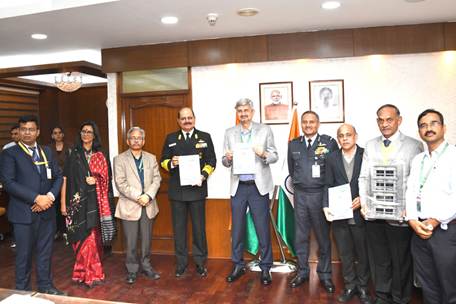
DRDO hands over seven technologies developed under Technology Development Fund scheme to the Armed Forces


image0015O7Y.jpg


Posted On: 05 DEC 2025 7:35PM by PIB Delhi

Defence Research and Development Organisation (DRDO) has handed over seven technologies developed under the Technology Development Fund (TDF) scheme to the three Services. The technologies are: an Indigenous High-Voltage Power Supply for Airborne Self-Protection Jammers; A Tide-Efficient Gangway for Naval Jetties; Advanced Very Low Frequency-High Frequency Switching Matrix Systems; VLF loop Aerials for Underwater Platforms; Indigenous Waterjet Propulsion System for Fast Interceptor Craft; A Novel Process for Recovery of Lithium Precursors from used Lithium-ion Batteries and A Long-life Seawater Battery System for Sustained Underwater Sensing and Surveillance Applications.
 

Detailed article

India tests morphing fighter jet wing technology as DRDO reveals new breakthrough​

Soon, Indian fighter jets may no longer depend on fixed wings.

Instead, they could fly with morphing wings that adapt instantly to mission demands, a capability long explored by Airbus, NASA and DARPA but now making major strides inside India’s own aeronautics ecosystem.

India is moving decisively in this direction through a Defence Research and Development Organisation (DRDO)-supported programme that has successfully demonstrated morphing wing behaviour on a flight-capable platform.

A senior DRDO scientist directly involved in the research spoke to AGN, sharing insight into the hardware, the actuation system, the control logic and the future roadmap for scaling the design to next-generation combat aircraft.

A senior DRDO scientist directly involved in the research spoke to AGN, sharing insight into the hardware, the actuation system, the control logic and the future roadmap for scaling the design to next-generation combat aircraft.

This breakthrough goes beyond new materials. It represents a fundamental shift in how Indian aircraft may achieve stealth, manoeuvrability and endurance, using wings that reshape themselves continuously throughout a mission.

“An aircraft wing is always a compromise,” the DRDO scientist told AGN. “Morphing allows us to reconfigure it to suit different phases of flight with greater aerodynamic efficiency.”

After years of modelling and theory, India now has validated, dynamic morphing hardware capable of real-time geometric change in flight. The implications for both unmanned systems and future fighters like AMCA are substantial.

How DRDO’s shape-memory alloy morphing wing reshapes in flight for agility, stealth and efficiency​

At the heart of the system is a shift away from hydraulic or electromechanical actuators toward Shape Memory Alloys (SMAs), lightweight smart metals that contract when heated and elongate as they cool.

The morphing wing segment, developed by CSIR–National Aerospace Laboratories (NAL) under DRDO funding, uses a 45-degree diagonally cut leading edge.

This enables the forward portion of the wing to droop smoothly when the SMA actuators contract, reshaping the camber into a more lift-efficient or manoeuvre-optimised configuration. As the SMA cools, the surface returns to its low-drag cruise shape.

High-speed morphing wing demonstrated​

Where global morphing research often struggles is in actuation speed under load. India’s approach stands out.

Tests on a 300 mm-span micro air vehicle show the morphing segment can shift shape at 35 degrees per second, even with full propeller wash simulating real flight conditions.

Adaptive power distribution: The underappreciated breakthrough enabling practical morphing wings​

One of the most important innovations is not visible at all: the power allocation logic that manages SMA actuation.

SMAs require electrical heating, meaning multiple wing segments can quickly become a power burden. For small UAVs, endurance is everything. For fighters, weight and energy management are equally critical.

To solve this, the DRDO-supported team engineered an adaptive control allocation algorithm that intelligently distributes electrical power across the morphing segments.

Why this matters: India positions itself for sixth-generation fighter architectures​

Although the demonstrator is small, the engineering principles are not. They align directly with trends in Europe and the US toward morphing structures, mission-adaptive control surfaces and blended stealth geometries.

A future where Indian fighters adapt like living organisms in flight​

With this demonstration, India has joined a small group of nations exploring dynamic, real-time morphing structures. But unlike many early Western experiments that remained conceptual, DRDO and CSIR–NAL have produced a flight-ready, controllable and energy-efficient implementation.