Yes true, missiles as a complex multi domain integrated systems are prone to failures, in today's digital checkout era plenty of in stock products fail during the 5 phase checkout. So imagine what was the case back during 1970s 80s when entire system were mechanical hydraulic based and each section had to be entirely disintegrated for checkout purpose then reintegrated again. I think many can remember even during the Karachi Port raid, out of 8-10 or 11 missiles fired in total, 1 failed and did not meet mission requirement. So this happens very often. In today info age, we are in no position to verify the claim just by hearsay or simply looking at a video. This is why such extensive panel is formed and based on test reports the cause is established.
Any claim that some weapon system is more or less reliable based on probable (imaginary) shortfalls related to subsystem units need to be substantiated with verified proof, otherwise its frankly bogus. A high speed supersonic system needs a suitable sensor package proven to work in speed regime upto 2.5-3 times of working environment ie it has to be proven for speed > = 2000m/sec before being cleared as part of bill of material. It will not use any off the shelf tv camera based guidance or IR seeker that is not suitable for the purpose. This is how ruggedization is achieved, a very specific mil-grade solution for a specific purpose because mil grade items need to have very high tolerance limit for its role.
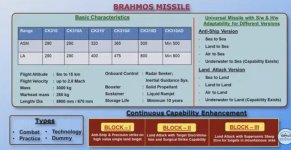
A degree of stealth is always built into a smart system like Brahmos & speed is its one unique feature among many. There are at least 3-4 level of redundancy built into it that gives it such unique capability.
So this is basically how the armed forces wanted the missiles to be, right from the k15 prithvi days and gradually implemented in other systems. A tactical purpose missile should be fire and forget, user can control upto launch moment but after that the missile has to be smart, it should not depend on any external guidance/datalink/satcom or need any external source update to perform its mission.
This is because as user we can not control the target zone environment, it is assumed the missile will be subject to heavy EW environment which degrades its ability to operate if it is dependent on outside comm source (like gps, position & bearing update). So the missile is made very smart with own obc and a dead reckoning navigation scheme is used , which means it is resistant to every kind of jamming or ew attack the enemy has implemented.
This is what ECM/ECCM means and why Brahmos , K15 or every other indigenous missile system we use. No amount of enemy interference will have any effect on its ability because Brahmos Pralay etc are all self contained systems. You only initiate the ins , this initiation is vital because here the accuracy is needed, but this initiation is at the launch point, and you control from where you will launch your missile. Once you initiate its guidance package, the missile obc takes over fully automated from that point to target hit with top notch accuracy. No other support is needed.
If we had used a mid course guidance update scheme, what would have happened? Suppose if the missile is flying thru a heavy EW environment during its midcourse and no link was possible between its obc and your satcom or other datalink, total comm blackout. Therefore no update was possible and your missile obc switched to INS again but in here the accuracy can be affected by 10s of meters due to that phase and target can be missed. Therefore both the mission time which is very short for Brahmos (300km within 5 mins vs 18-24 min for a subsonic cm) and no outside datalink/guidance dependency create the ultimate stealth effect. Your enemy will not be able to move or take precaution in enough time to avoid getting hit. That is why this missile is so deadly, if it had to depend on an external source for guidance, enemy could have detected that comm signature and still had enough time to take evasive action (because subsonic missile so longer flight time) and dodge the hit ie move their vital asset in time. But the complete silence and very quick action of Brahmos means enemy just do not get to react in time at all.
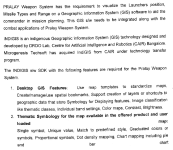
DRDO have a GIS linked with Pralay and other upcoming missile systems for good mission planning, which will help setting the location position (as opposed to pre surveyed) for better accurate INS initiation. The mission planning software also has a live map of every identified enemy ad and ew zones that is updated in real time , and the last update is stored in the missile obc memory. This helps in a way that the missile itself decides which areas to avoid and where to fly thru, all by itself. Pretty amazing.
View attachment 48181



 www.pravda.com.ua